

DeBounce Review 2026: Pricing, Accuracy & Alternatives

By Kushal Magar · June 12, 2026 · 11 min read · Last updated: September 30, 2026
Key Takeaway
DeBounce is a pay-as-you-go email verification platform with a 97.5%-or-better deliverability guarantee, non-expiring credits, and 20+ ESP integrations. With rates as low as $0.00045/email at high volume, it is built for cost-conscious teams cleaning large lists. The main gaps for B2B outbound: no catch-all confidence scoring, limited spam trap detection, a 7-day data retention window, and no contact discovery or outreach layer, so it only cleans the lists you already have.
DeBounce is a pay-as-you-go email verification platform serving 15,000+ businesses across 180+ countries. With rates as low as $0.00045/email — one of the lowest per-email rates in the category — it offers a 97.5%-or-better deliverability guarantee, non-expiring credits, and 20+ native ESP integrations. Our rating: 4.0/5.
The case for DeBounce is simple for high-volume email marketers: it is cheap, fast, and integrates directly with Mailchimp, HubSpot, ActiveCampaign, and Apollo without API work. At scale, that per-email economics beats most competitors by a wide margin.
The limitation for B2B outbound teams is equally clear: DeBounce verifies email addresses you already have. It does not find new prospects, does not enrich records with phone numbers or firmographics, and does not tell you which companies are in an active buying cycle. If you are building pipeline from scratch, DeBounce covers one step in a multi-tool stack — not the whole workflow.
This review covers DeBounce's credit pricing at each volume tier, its accuracy on standard and catch-all addresses, the integration library, data retention limits, and a direct comparison with NeverBounce and ZeroBounce for teams evaluating their verification options in 2026.
According to G2, DeBounce holds a 4.5/5 rating. On Capterra, it scores 4.6/5. The most cited strength is price. The most cited weakness is catch-all handling and limited data retention.
What Is DeBounce?
DeBounce is an email validation service built around a single problem: email lists decay at roughly 30% per year as people change jobs, abandon addresses, and companies shut down. Sending to unverified lists produces hard bounces, spam complaints, and damaged sender reputation — problems that compound over time.
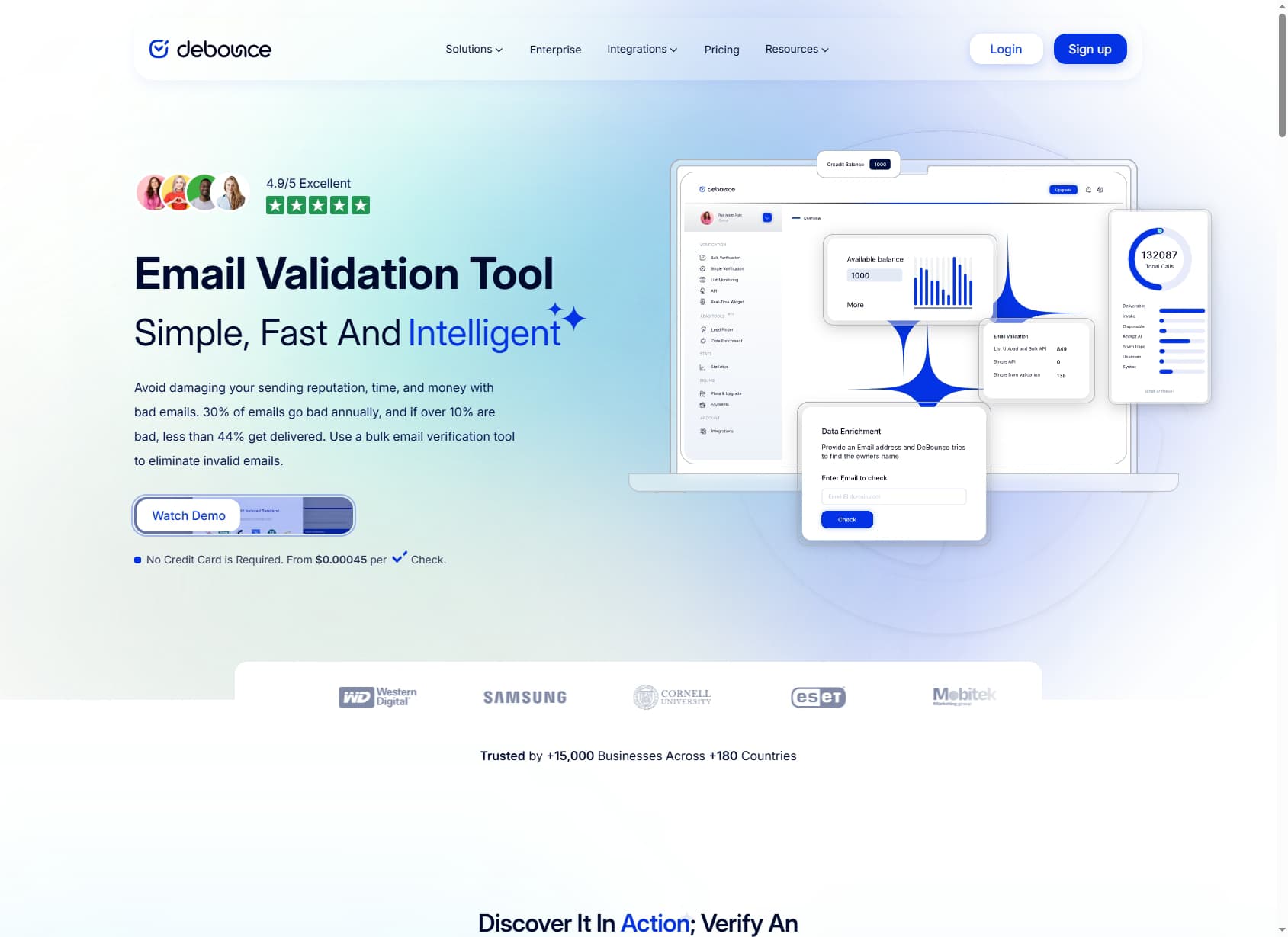
DeBounce — email verification platform serving 15,000+ businesses across 180+ countries with a 4.9/5 Trustpilot rating
DeBounce was founded to compete on price. While NeverBounce charges $0.008/email at entry volumes, DeBounce's smallest pack works out to $0.003/email as of September 2026, falling to about $0.00045 at its highest volumes. Enterprise clients include Western Digital, Samsung, Cornell University, ESET, and Siemens.
DeBounce validates each address through a multi-stage pipeline: syntax check → domain and MX record lookup → SMTP handshake testing → disposable email detection → catch-all identification → role-based email filtering. Each verified address receives a status classification:
- Valid — safe to send; mailbox confirmed
- Invalid — does not exist; remove from list
- Disposable — temporary inbox; typically excluded from sends
- Catch-all — domain accepts all mail regardless of whether the specific address exists; deliverability unconfirmed
- Unknown — server timed out or did not respond; cannot be confirmed
- Role-based — addresses like info@, support@, admin@ that go to teams rather than individuals
DeBounce processes bulk uploads (CSV), supports real-time API validation for form integrations, and offers an automated list monitoring feature that re-verifies lists on a rolling basis.
DeBounce is not a prospecting tool. It has no contact database for generating lists from scratch: its Email Finder needs a first name, last name, and company domain to work from, and there is no enrichment API for phone numbers or firmographics. Teams that need to build lists from target account data should see our DeBounce alternatives guide or the waterfall enrichment explainer.
DeBounce Pricing: Credits and What You Actually Pay
DeBounce runs on pay-as-you-go credits with no monthly subscription required, though an optional monthly plan takes 8% off as of September 2026. Credits never expire — a structural advantage over ZeroBounce, which imposes a 12-month expiry window. There are no contracts, no setup fees, and no overages.
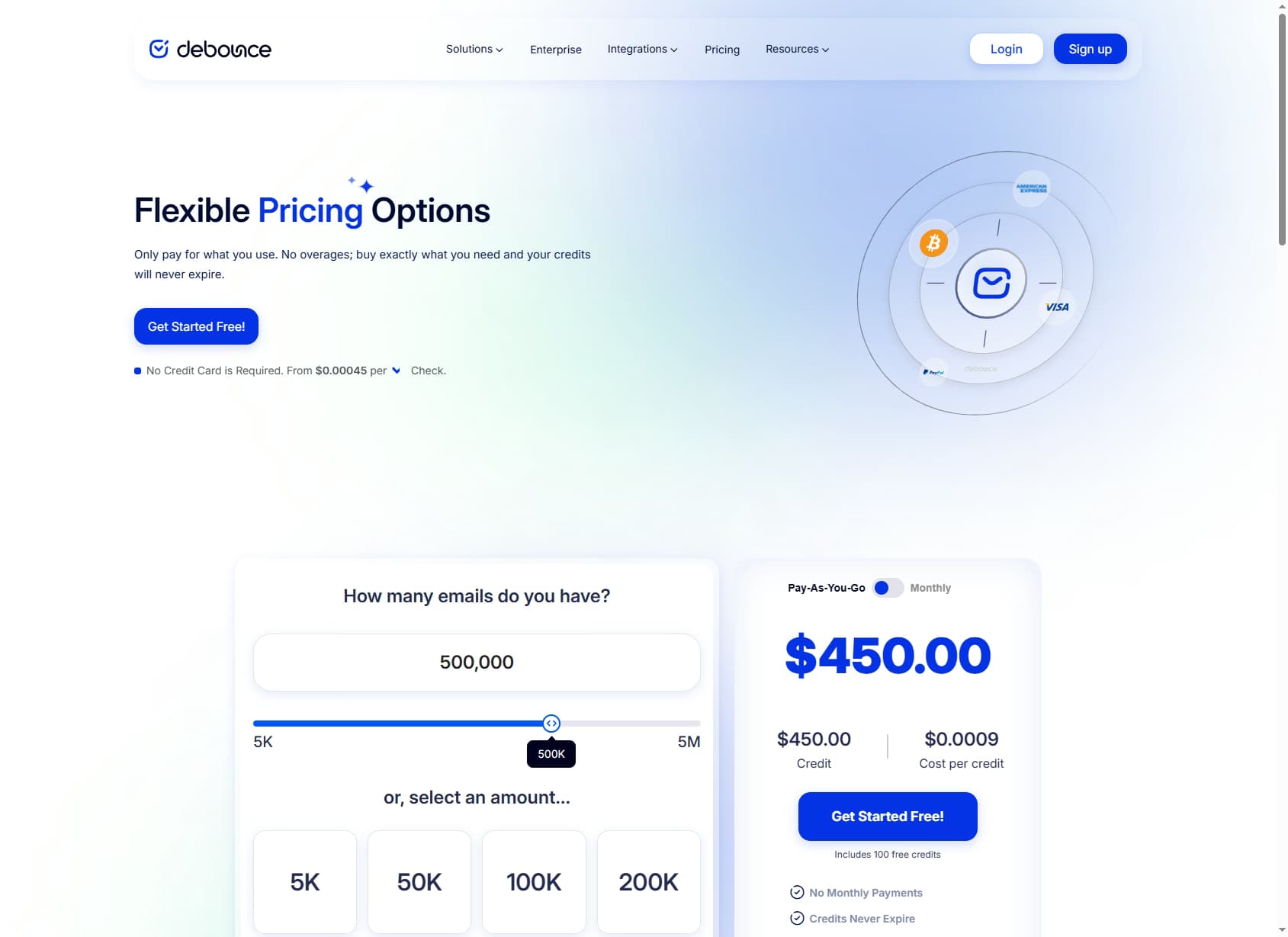
DeBounce pay-as-you-go pricing — credits never expire, no subscription required
Email Validation Credit Packages
| Credit Package | Price (PAYG) | Per Email |
|---|---|---|
| 5,000 | $15 | $0.003 |
| 50,000 | $75 | $0.0015 |
| 100,000 | $135 | $0.00135 |
| 500,000 | $450 | $0.0009 |
| 1,000,000 | $750 | $0.00075 |
| 5,000,000 | $2,200 | $0.00044 |
Pay-as-you-go prices from DeBounce's pricing calculator as of September 2026. The minimum purchase is 5,000 validations, and volumes above 5 million go through support.
Additional Credit Costs
Not all DeBounce features consume credits at the standard 1:1 rate. Data enrichment (returning name, photo, and additional contact details) costs 20 credits per successful detection. Catch-all validation costs 10 credits per email. List monitoring renews at 2x the list size per month — a recurring credit draw teams should budget for.
Free Trial
New accounts receive 100 free verifications with no credit card required. This is the same free tier size as ZeroBounce. NeverBounce offers a more generous 1,000-email free trial for comparison.
Pricing vs. Competitors at 100K Volume
At 100,000 verifications: DeBounce costs $135 as of September 2026, NeverBounce costs $500, ZeroBounce costs approximately $640. DeBounce costs less than a third of NeverBounce's price at this volume tier. For pure list cleaning at high volume, the economics are difficult to match.
DeBounce Key Features
Bulk Email List Validation
DeBounce's core feature is bulk verification via CSV upload. Independent tests on 1,000-email lists return results in under 30 minutes. At 100,000 emails, processing runs under 2 hours according to user reports. Verified results are available for download in multiple formats and filtered by status.
Real-Time API
The DeBounce API validates a single email address in real time, making it suitable for form validation at the point of submission. API access is included at no additional charge — there are no separate API credit tiers. This is cleaner than some competitors that charge differently for API vs. bulk.
Catch-All Domain Detection
DeBounce flags catch-all domains — servers configured to accept mail to any address pattern regardless of whether the specific address exists. This is a meaningful identification step. The gap is scoring: DeBounce does not provide a confidence score to help decide whether to send to flagged addresses. ZeroBounce's AI scoring system attempts to classify catch-alls as safe or unsafe — a meaningful distinction for enterprise-heavy B2B lists.
Automated List Monitoring
DeBounce can monitor a stored list on a recurring basis, flagging new invalid addresses as they appear. This is useful for CRM hygiene teams managing large contact databases where decay accumulates over time. List monitoring consumes 2x the list size in credits each month — plan credit spend accordingly.
ESP and Tool Integrations
DeBounce integrates with 20+ platforms including HubSpot, Mailchimp, ActiveCampaign, MailerLite, Klaviyo, SendGrid, Mailjet, Brevo, Apollo, Zapier, WordPress, and WooCommerce. The integration library is thinner than NeverBounce's 80+ but covers the most common ESP and CRM use cases without requiring API work.
Data Enrichment (Light)
DeBounce offers a data enrichment layer that can return names, photos, and limited contact details alongside verified email addresses. This is not a substitute for full B2B enrichment — it does not return direct dials, job titles, firmographic data, or technographic signals. Each enrichment detection costs 20 credits vs. 1 credit for a standard verification.
DeBounce Pros: What It Does Well
- ✓Low per-email price at volume. At $0.00135 per email for 100K credits as of September 2026, falling to about $0.00045 at 5M, DeBounce undercuts NeverBounce ($0.005 at 100K) by more than 3x. For high-volume list cleaning on a tight budget, the economics are hard to beat.
- ✓Non-expiring credits. Credits never expire — unlike ZeroBounce (12-month expiry) and Kickbox (12-month expiry). Teams can buy in bulk when pricing is favorable and use credits across multiple campaigns without time pressure.
- ✓Fast bulk processing. Independent tests report 100,000 emails verified in under 2 hours. For teams running large campaign lists, processing speed directly affects campaign launch timelines.
- ✓Strong Trustpilot reputation. DeBounce holds a 4.9/5 rating across 1,396 Trustpilot reviews — the highest in this comparison set. Price is the most cited positive in user reviews, followed by ease of use and integration breadth.
- ✓No credit card required to start. The 100-email free trial requires no payment details. Low friction entry for teams evaluating the tool before committing.
- ✓API included at no extra cost. Real-time API access for form validation is bundled into all accounts without separate credit tiers or billing. This matters for development teams integrating verification into their product stack.
- ✓Enterprise client base. Samsung, Western Digital, Siemens, and Cornell University use DeBounce — signals that the platform handles enterprise-scale volumes reliably.
DeBounce Cons: Where It Falls Short
- ✗No catch-all confidence scoring. DeBounce identifies catch-all domains but provides no scoring to classify whether a specific catch-all address is safe to send to. On enterprise B2B lists, catch-all domains can represent 10–30% of addresses. ZeroBounce's AI scoring system recovers a meaningful portion of these — DeBounce leaves them all in limbo.
- ✗Limited spam trap detection. Independent reviews flag gaps in DeBounce's spam trap coverage. For teams working with older purchased lists or third-party data, this increases inbox placement risk. ZeroBounce uses AI-based spam trap scoring — a meaningful differentiator for deliverability- sensitive sends.
- ✗7-day data retention window. Verified results are deleted from DeBounce's servers after 7 days. Teams must download results promptly after each batch run. This creates operational friction for teams running large lists close to campaign deadlines.
- ✗No B2B contact discovery. DeBounce verifies emails you provide — it does not find new prospects, enrich contact records with phone numbers, or return firmographic data. B2B teams still need a separate tool for everything upstream of verification.
- ✗No buying signals or intent data. DeBounce tells you if an address is deliverable — not whether the company is in an active buying cycle. Signal-based outbound requires a separate tool entirely. See our guide to waterfall contact providers if you need contact data upstream of verification.
- ✗No native outreach layer. DeBounce exports a cleaned CSV. It has no sequencing, no CRM sync beyond ESP integrations, and no reply tracking. Every verified contact still needs a separate tool to reach at scale.
- ✗Thinner integration library than category leaders. 20+ integrations cover the main ESPs but fall short of NeverBounce's 80+. Teams relying on less common platforms may need API work rather than a native connector.
DeBounce vs Alternatives: Comparison Table
DeBounce is a verification-only tool, so the fair comparison is with other list cleaners. It competes directly with NeverBounce, Kickbox, and ZeroBounce on price and accuracy. Where DeBounce wins is cost. Where it loses is catch-all scoring and feature depth.
| Feature | DeBounce | NeverBounce | ZeroBounce |
|---|---|---|---|
| Starting Price | $15 per 5,000 credits (PAYG) | $0.008/email | $15/mo (2,000 credits) |
| Pricing Model | Pay-as-you-go or monthly credits | Pay-as-you-go or monthly | Credits or monthly |
| Claimed Accuracy | 97.5%+ deliverability guarantee | 97–99% | 96–98% |
| Catch-All Handling | Flagged — no confidence scoring | Flagged as catch-all, no scoring | AI catch-all scoring |
| Spam Trap Detection | Limited — gaps in coverage | No | Yes — AI spam trap scoring |
| B2B Contact Enrichment | Light — names, photos only | None | Email append (US B2C only) |
| Native Integrations | 20+ ESPs (Mailchimp, HubSpot, Apollo) | 80+ (Mailchimp, HubSpot, Salesforce) | 35+ |
| Data Retention | 7 days | No stated limit | No stated limit |
| Credit Expiry | No expiry | No expiry | 12 months |
| Free Trial | 100 free credits (no card) | 1,000 free verifications | 100 free credits |
For more verifiers in the same category, see our EmailListVerify review and MailerCheck review for side-by-side alternatives in the same category.
Who Should Use DeBounce?
DeBounce is the right tool for a specific profile. It is wrong for another. The distinction matters before committing credits.
DeBounce Is the Right Fit If You:
- Have an existing large email list that needs cleaning before a campaign send — and price per verification is the primary constraint
- Run email marketing campaigns to consumer or mixed lists where catch-all domain handling is not a major factor
- Need a non-expiring credit bank you can draw from across multiple campaigns throughout the year
- Use mainstream ESP platforms (Mailchimp, ActiveCampaign, HubSpot) and want native integration without API work
- Are evaluating quickly and want a no-credit-card free tier to test with real data
Consider an Alternative If You:
- Are targeting enterprise accounts where catch-all domains are common — you will need catch-all scoring, not just detection
- Are building B2B outbound from scratch — you need contact discovery and enrichment, not just list cleaning
- Have older purchased lists with potential spam trap exposure — ZeroBounce's AI spam trap scoring provides better coverage
- Need results stored beyond 7 days without downloading immediately after each run
- Want buying signals, hiring triggers, or funding alerts alongside your contact data — DeBounce has none of these
For the second profile — teams building B2B outbound from a target account list rather than cleaning an existing database — start with an email finder or waterfall enrichment tool, then keep a low-cost verifier like DeBounce as the final check before sending.
If DeBounce's lack of contact discovery is a dealbreaker, SyncGTM is one alternative worth a look: it finds verified emails, phone numbers, and firmographics through waterfall enrichment across 50+ data providers.