

Emailsearch.io Review 2026: B2B Data Coverage, Pricing & SyncGTM Comparison

By Kushal Magar · June 15, 2026 · 14 min read
TL;DR: Emailsearch.io Review 2026 Verdict
Emailsearch.io is a B2B email finder with a claimed 600M contact database and a LinkedIn Sales Navigator Chrome extension. Plans start at $29/mo. On paper, the $0.0064 per-email rate at scale looks competitive. In practice, independent review data is nearly absent — and what exists is damaging. Our rating: 3.2/5.
The case for Emailsearch.io is price. The Basic plan at $29/mo is one of the cheaper entry points in the email-finder category. The Chrome extension for LinkedIn Sales Navigator enables bulk export without visiting individual profiles — a genuine workflow accelerator for LinkedIn-heavy prospecting teams. ISO 27001 and GDPR/CCPA claims add a compliance surface.
The case against is harder to dismiss. One Capterra reviewer gave it 1.0/5 and reported the tool failed to return a single email or phone number from 30,000 entries, with zero support response. Scamadviser rates the domain with a low trust score. There are no independent accuracy benchmarks validating the 92% claim. The Chrome extension carries documented LinkedIn ToS risk. There is no waterfall enrichment, no buying signals, and no continuous CRM enrichment.
This review covers real pricing math, what the 600M contact claim actually means, how the LinkedIn extension works and where it risks your account, support quality concerns, and a direct comparison with SyncGTM, Hunter.io, and Apollo for teams evaluating their B2B data stack in 2026.
What Is Emailsearch.io?
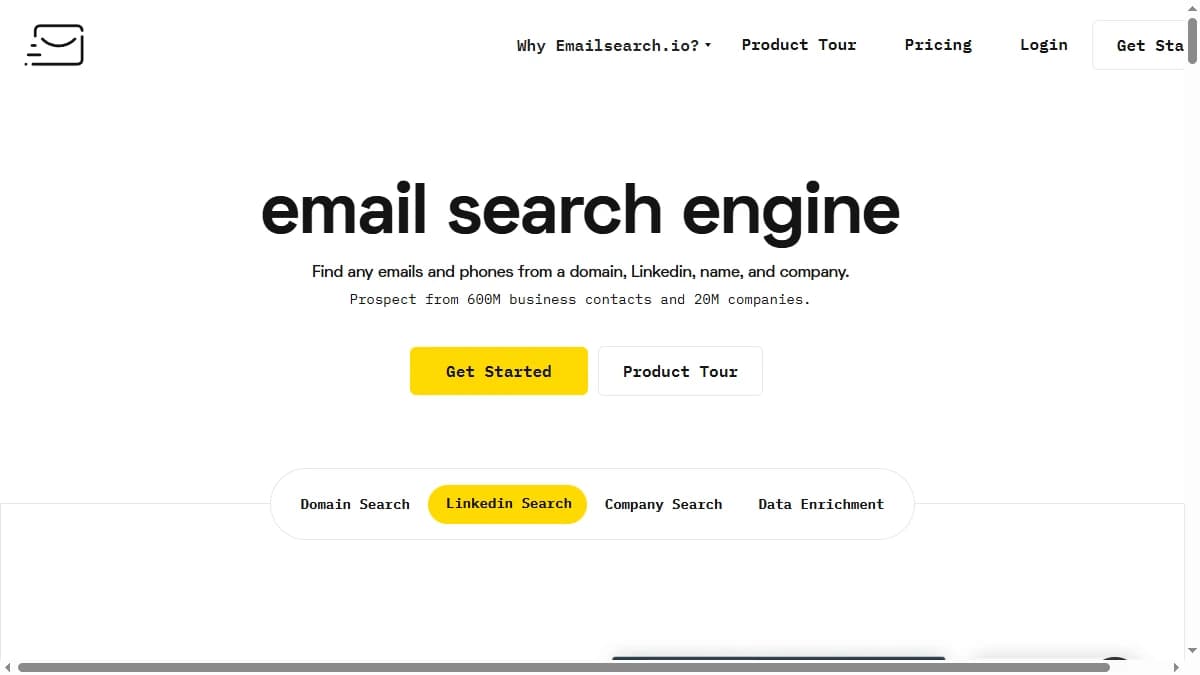
Emailsearch.io is a B2B email search engine and data enrichment tool that claims a database of 600 million business contacts across 20 million companies. The platform describes itself as an "end-to-end personalization" tool that helps sales teams build prospect lists, enrich contacts with email and phone data, and push results to CRM or drip campaign tools.
The defining feature is a Chrome extension for LinkedIn Sales Navigator that enables bulk extraction of emails and phone numbers without visiting individual profiles. This is the tool's main differentiation versus simpler lookup-by-name tools, and it is the feature most prominently marketed to LinkedIn-heavy prospecting teams.
Emailsearch.io also provides a web application for individual lookups, a domain search tool, a company search covering 20M+ B2B companies, bulk CSV upload, and an API. The platform claims ISO 27001 certification and GDPR/CCPA alignment. The product is used by a claimed 50,000 professionals worldwide.
| Capability | What Emailsearch.io Provides | Notable Gaps |
|---|---|---|
| Database | 600M contacts, 20M companies, 200B+ websites crawled. | No waterfall — single source, dead end on misses. |
| Email Finder | Lookup by name + domain, bulk CSV, API, domain search. | Hit rates unverified externally; one enterprise user reported 0% match on 30K entries. |
| LinkedIn Extension | Bulk export from Sales Navigator without profile visits. | Violates LinkedIn ToS — account suspension risk. |
| Phone Numbers | Claimed via Chrome extension extraction. | No dedicated phone data layer or direct dial database. |
| Buying Signals | Not available. | No hiring, funding, tech-change, intent monitoring. |
| CRM Integrations | HubSpot, Salesforce, Pipedrive, Outreach, Zoho, Zapier. | No continuous CRM enrichment — manual re-runs required. |
| Compliance | ISO 27001, GDPR/CCPA aligned, crawls public data only. | LinkedIn ToS compliance is a separate, unresolved risk. |
Emailsearch.io Pricing: Four Plans Decoded
Emailsearch.io runs a credit-based subscription model across four paid tiers plus a permanent free plan. The free tier provides 50 credits per month with no card required — useful for testing result quality against a small real-world list before committing. Paid plans step up through Basic, Pro, Expert, and Agency, with an advertised per-email rate of $0.0064 at volume scale.
| Plan | Price | Best For | Key Features |
|---|---|---|---|
| Free | $0/mo | Testing data quality | 50 credits/month, no card required |
| Basic | $29/mo | Individual SDRs / low-volume teams | Email finder, Chrome extension, bulk CSV |
| Pro | $49/mo | Growing sales teams | All Basic + higher credit allocation, CRM sync |
| Expert | $99/mo | High-volume prospecting teams | All Pro + API access, advanced reporting |
| Agency | $279/mo | Agencies and enterprise | All Expert + multi-account, priority support |
Pricing reflects publicly advertised USD list rates. Exact credit allocations per plan are not prominently published on the pricing page — request a breakdown before committing to a paid tier.
The real cost math
The advertised $0.0064 per-email rate is only achievable at high volume on the Agency or custom enterprise tier. At the Basic tier ($29/mo), the effective cost per verified email depends entirely on your hit rate — and with no public benchmark of what percentage of inputs actually return results, this is difficult to evaluate in advance.
If the tool returns zero emails for a significant portion of your list (as documented in the Capterra review), the effective cost per usable contact is infinite regardless of the per-email rate advertised. The 50-credit free tier is genuinely useful here: test the tool against 50 real contacts from your target ICP before upgrading.
Compared to SyncGTM at $99/mo: cascading 50+ providers delivers verified hit rates 15–25% higher on identical lists, with documented 3–6% bounce rates, mobile direct dials, buying signals, and integrated outreach. The cost-per-usable-contact comparison almost always favors the waterfall approach once you move beyond the lowest volume tier.
Emailsearch.io Data Coverage: 600M Contacts — What That Really Means
Emailsearch.io claims a database of 600 million business contacts, 400 million verified email addresses, and 200 billion websites crawled — with data refreshed weekly. On paper, this is a large dataset. In practice, database size numbers are among the least meaningful metrics in the email-finder category, and they tell you little about your actual hit rate on a target ICP.
Raw contact counts include duplicates, historical records, and contacts outside any given team's ICP. The question that actually matters — what percentage of your specific input list returns a verified, deliverable email address — is not answered by the 600M figure. Independent benchmarks that test email finders against the same input lists consistently show that database-size claims are poor predictors of real-world hit rates.
The more important architectural fact: Emailsearch.io is a single-source database. When a contact is not found, you get nothing — there is no cascade to a second or third provider to recover the record. This is the key structural difference vs waterfall enrichment platforms that query 15–50+ providers sequentially, recovering contacts that any single source misses.
| Region / Segment | Coverage Quality | Notes |
|---|---|---|
| US Mid-Market | Claimed strong | Not independently benchmarked; test on your ICP. |
| UK & Western Europe | Claimed good | GDPR compliance claimed; actual hit rates unverified. |
| APAC | Unknown | No independent reviewer data; typical single-source tools perform poorly outside US/EU. |
| LATAM / MENA | Unknown | No reviewer data; high-risk segment for single-source tools. |
| SMB (<50 emp) | Likely variable | SMB domains with limited public footprint hit hardest by single-source limits. |
The one publicly documented real-world data point is damaging. A verified Capterra reviewer reported purchasing multiple packages and processing 30,000 entries without the tool returning a single email or phone number. That is a single data point, and it could reflect a specific ICP mismatch — but the absence of counterbalancing positive reviews makes it difficult to dismiss.
Emailsearch.io Accuracy: The 92% Claim Under the Microscope
Emailsearch.io claims "92% accurate emails" and "industry-leading accuracy rates." This number is not supported by publicly available independent benchmarks as of June 2026. The claim is not explained in terms of methodology — it is unclear whether the 92% refers to deliverability of emails returned, hit rate across all inputs, or something else.
For context, industry-standard accuracy claims from leading email finders in 2026 range from 90–97%+ — all measured on the delivered subset, not the full input list. The meaningful number is your verified hit rate: what percentage of your specific ICP input list returns a usable, deliverable email address. That number varies significantly by region, company size, and the freshness of the underlying database.
- Emailsearch.io claims: 92% accuracy, 400M+ verified emails, weekly data refresh. Not independently verified.
- Capterra reality check: One user reported 0% match rate on 30,000 entries. This is the only detailed public test result available.
- No G2 benchmark data: G2 lists the product but shows minimal validated reviews — making peer comparison impossible.
- Comparison baseline: Independent benchmarks of leading single-source email finders (Hunter, Findymail, Snov.io) on US/EU mid-market data return verified hit rates of 55–75%. Waterfall tools like SyncGTM return 15–25% more on the same lists.
The honest recommendation: use the 50-credit free tier to test against 50 real contacts from your actual ICP before upgrading. Self-reported accuracy claims from any email finder are insufficient proof of real-world performance on your specific prospect universe.
LinkedIn Chrome Extension: The Core Feature and Its Risks
The Chrome extension for LinkedIn Sales Navigator is Emailsearch.io's most differentiated feature. It enables bulk export of emails and phone numbers from Sales Navigator search results without visiting individual profiles — a meaningful workflow accelerator for LinkedIn-heavy prospecting teams. The extension integrates with existing Sales Navigator licenses and pushes results directly to CRM or CSV.
The risk is real and needs to be stated clearly. LinkedIn's Terms of Service explicitly prohibit automated scraping of user data, including bulk extraction via third-party tools. LinkedIn actively detects and bans accounts using unauthorized scraping extensions. Consequences include:
- Permanent suspension of your LinkedIn account.
- Loss of your paid Sales Navigator license (typically $800–$1,600+ per seat per year).
- Potential legal action — LinkedIn has pursued litigation against scraping tool providers, with the HiQ Labs case and subsequent rulings establishing precedent.
Emailsearch.io claims GDPR and CCPA compliance and states it "crawls public data only." LinkedIn ToS compliance is a separate question, and the platform does not appear to address it prominently. Tools that use a Chrome extension to extract Sales Navigator data are operating in a ToS grey zone that LinkedIn actively polices.
Teams with high-value LinkedIn accounts should evaluate this risk carefully. The alternative — platforms like SyncGTM that enrich from their own multi-provider data infrastructure without requiring a LinkedIn extension — avoids this risk entirely.
Key Features: What You Actually Get
Email Finder (Web App)
The web application allows individual name + domain lookups, domain search to find all indexed emails at a company, and company search across the claimed 20M+ B2B company database. Bulk CSV upload handles batch enrichment jobs against the credit allocation.
LinkedIn Sales Navigator Chrome Extension
The headline feature. The extension overlays Sales Navigator search results and exports emails and phone numbers in bulk without requiring individual profile visits. This is the primary workflow differentiation vs. lookup-only tools. The LinkedIn ToS risk (detailed in the section above) applies here.
API Access
API access is available on Expert and Agency plans. Technical documentation is not prominently published; API capabilities appear to cover the core email lookup and bulk enrichment endpoints. Developers evaluating the API should request documentation and rate limit details before committing to a tier.
CRM Integrations
Native integrations with HubSpot, Salesforce, Pipedrive, Outreach, and Zoho are listed, plus Zapier for broader workflow automation. These are push integrations — you export enriched data from Emailsearch.io into your CRM. There is no continuous, real-time CRM enrichment that keeps records fresh automatically.
Free Trial
50 credits per month on the free tier, no card required. This is genuinely useful for testing. Run your actual ICP against those 50 credits before upgrading to any paid plan.
What's Missing
No waterfall enrichment. No buying signals (hiring, funding, tech stack, job changes). No continuous CRM enrichment. No phone number database beyond Chrome extension extraction. No native outreach sequencing. No AI lead scoring. No real-time contact monitoring. Emailsearch.io is intentionally narrow as a contact finder — and the missing pieces define who it fits and who it does not.
Emailsearch.io Pros: What It Does Well
- ✓Low entry price. The $29/mo Basic plan is one of the cheaper entry points in the category. For individual SDRs testing email-finder tooling on a limited budget, the upfront cost is not a blocker.
- ✓Free tier with no card required. 50 free monthly credits with no credit card requirement is genuinely useful for testing data quality on your specific ICP before any spend commitment.
- ✓LinkedIn Sales Navigator bulk export. The Chrome extension enabling bulk export from Sales Navigator without visiting individual profiles is a meaningful workflow accelerator for LinkedIn-first prospecting. No other standard lookup tool delivers this natively.
- ✓Large claimed database. 600M contacts and 20M+ companies, updated weekly, is a substantial claimed dataset. Whether that translates to good real-world hit rates on your ICP requires testing, but the volume indicates meaningful crawl breadth.
- ✓Compliance certifications. ISO 27001 certification and GDPR/CCPA alignment are documented. For enterprise buyers with compliance requirements on data vendor procurement, these credentials check a real box.
- ✓Broad CRM integration roster. HubSpot, Salesforce, Pipedrive, Outreach, Zoho, and Zapier cover the majority of CRM stacks used by B2B sales teams. Push integrations are functional even without continuous enrichment.
Emailsearch.io Cons: Where It Falls Short
- Extremely thin public review record. One Capterra reviewer rated Emailsearch.io 1.0/5 after the tool failed to return a single email or phone number from a 30,000-entry input list. G2 shows minimal validated reviews. Scamadviser assigns a low trust score. The absence of a verifiable independent benchmark makes it impossible to validate the 92% accuracy claim before committing budget.
- Reported support unresponsiveness. The Capterra reviewer explicitly noted that after purchasing multiple packages and receiving zero results, support failed to respond at all — via email. For a tool where core functionality is in question, unresponsive support is a critical risk.
- LinkedIn Chrome extension carries ToS risk. Bulk extraction of Sales Navigator data via a third-party Chrome extension violates LinkedIn's Terms of Service. Account suspension — including your paid Sales Navigator license — is a documented consequence. Tools in this category rarely disclose this risk prominently.
- Single-source database caps coverage. No waterfall enrichment means a Not Found from Emailsearch.io is a dead end. Multi-provider waterfall platforms that cascade across 15–50+ providers consistently return 15–25% more verified contacts on identical input lists, particularly outside US and Western Europe.
- No buying signals or intent data. There is no hiring signal monitoring, funding alert tracking, tech stack change detection, or job change alerts. Modern outbound strategies that sequence contacts based on trigger events cannot run on Emailsearch.io alone.
- No continuous CRM enrichment. The platform does not natively keep HubSpot, Salesforce, or Pipedrive records fresh in real time. Every data refresh requires a manual re-run or API call — adding operational overhead for RevOps teams running live databases.
- Agency plan pricing jumps steeply. The gap from Expert ($99/mo) to Agency ($279/mo) is large without clearly published differentiation on the public site, making it difficult to evaluate whether the Agency tier delivers proportional value.
Emailsearch.io vs SyncGTM vs Hunter.io vs Apollo
The B2B email-finder market in 2026 spans single-source finders (Emailsearch.io, Hunter.io), all-in-one sales intelligence platforms (Apollo), and waterfall enrichment platforms (SyncGTM, Clay, FullEnrich). Here is how Emailsearch.io stacks against the most common alternatives teams evaluate.
| Feature | Emailsearch.io | SyncGTM | Hunter.io | Apollo |
|---|---|---|---|---|
| Pricing Model | Tiered credit subscription | Subscription from $99/mo | Tiered subscription | Tiered subscription |
| Entry Price | $29/mo (Basic) | $99/mo (unlimited search) | $34/mo (Starter) | $49/mo (Basic) |
| Free Trial | 50 credits/month free | Free plan available | 25 searches/month free | Free plan available |
| Database Size | 600M contacts claimed | 50+ providers cascaded | Domain-crawled database | 210M+ contacts |
| Accuracy Claim | 92% — unverified externally | 3–6% bounce rate (verified) | Verified deliverability | Varies by tier |
| Waterfall Enrichment | No — single source | Yes — 50+ providers | No — single source | No — single source |
| LinkedIn Chrome Extension | Yes — Sales Navigator bulk | Native workflow (no extension risk) | Yes — basic | Yes — advanced |
| Mobile Direct Dial | Claims phone extraction | Across multiple providers | Not available | Yes (higher tiers) |
| Buying Signals | None | Hiring, funding, tech, job changes | None | Basic intent signals |
| CRM Integrations | HubSpot, Salesforce, Pipedrive, Zoho | HubSpot, Salesforce, Pipedrive, Attio | HubSpot, Salesforce, Pipedrive | HubSpot, Salesforce, and more |
| Native Outreach | CRM + drip campaigns | Built-in sequencing | Campaigns (basic) | Full sequences |
| Support Quality | Reported unresponsive (Capterra: 1.0/5) | Dedicated GTM expert (Pro+) | Chat + email | Chat + email |
| Best For | SMBs wanting LinkedIn extraction | RevOps and modern outbound teams | Domain-based prospecting | All-in-one sales intelligence |
The honest take on each option
Emailsearch.io is best evaluated on a free trial before any commitment. The price is low, the Chrome extension for LinkedIn is genuinely useful if you use Sales Navigator heavily, and the compliance certifications are real. The public review record is too thin to rely on vendor claims alone. Test your specific ICP on the free tier before spending. For a broader view of alternatives, see the Emailsearch.io alternatives roundup.
SyncGTM cascades across 50+ enrichment providers instead of relying on a single database. That architectural difference lifts verified hit rates 15–25% on the same input lists, with documented 3–6% bounce rates. SyncGTM also bundles mobile direct-dial lookups, buying signals (hiring surges, funding rounds, tech stack changes, job changes), native CRM enrichment, and outreach sequencing — all under $99/mo. No Chrome extension means no LinkedIn ToS risk. For any team running modern outbound at scale, the platform advantage over a single-source finder is structural. Compare the 6 best waterfall email finders to see the full landscape.
Hunter.io is the domain-first specialist with the widest independent review base in the category. Starting at $34/mo, Hunter is the safest default for teams that have target company domains in hand and want reliable, benchmarked email pattern finding. Chrome extension for LinkedIn without the same ToS controversy, mature deliverability tooling, lightweight outreach campaigns built in. See the Hunter.io review for a detailed breakdown.
Apollois the most feature-complete all-in-one in the category — 210M+ contacts, intent signals, sequences, and a free plan that is more generous than most. For teams that want to consolidate data, sequencing, and signals into one platform and are willing to accept Apollo's database as their primary source, it covers the widest surface area. Apollo's data quality is independently benchmarked and generally regarded as strong on US enterprise, with better coverage than most single-source alternatives. See the Apollo.io review for a full breakdown.
Who Should Use Emailsearch.io?
Emailsearch.io is worth testing in a narrow set of scenarios — primarily when LinkedIn Sales Navigator bulk export is the primary workflow requirement, budget is constrained, and you are willing to validate data quality on the free tier before committing.
Consider Emailsearch.io if:
- Your primary prospecting workflow is LinkedIn Sales Navigator, and bulk export without visiting profiles would meaningfully accelerate list building.
- You are testing email-finder tooling at very low volume and budget ($29/mo Basic) and want to compare result quality across tools before standardising.
- Your ICP is US or Western European mid-market and you can validate hit rates on your specific contacts with the 50 free credits before committing.
- Compliance certifications (ISO 27001, GDPR, CCPA) are a procurement requirement and the vendor's claims are sufficient for your security review.
Do not use Emailsearch.io if:
- You need reliable, independently benchmarked data quality before committing budget — the public review record is too thin and too negative to rely on vendor claims.
- Your LinkedIn account or Sales Navigator license is high-value — the Chrome extension carries documented ToS risk and potential for permanent account suspension.
- You are running sustained outbound at 1,000+ contacts/month and need verified hit rates with known bounce rates. Use SyncGTM for waterfall enrichment across 50+ providers.
- You need phone numbers from a dedicated direct-dial database — the phone extraction is extension-dependent and not backed by a proper phone data layer.
- You need buying signals (hiring, funding, tech changes, job changes) to time outreach. Emailsearch.io has none.
- You need continuous CRM enrichment that keeps records fresh without manual re-runs — Emailsearch.io is a push tool, not a real-time enrichment layer.
Emailsearch.io Review: Frequently Asked Questions
What is Emailsearch.io and how does it work?
Emailsearch.io is a B2B email finder and data enrichment platform that claims a database of 600 million business contacts and 20 million companies. The platform's headline feature is a Chrome extension that integrates with LinkedIn Sales Navigator, enabling bulk export of emails and phone numbers without visiting individual profiles. Under the hood, Emailsearch.io combines its own crawled database (indexing 200 billion websites, updated weekly) with email pattern generation to return contact data. The platform offers a web application for individual lookups, bulk CSV upload, LinkedIn Sales Navigator integration, and an API. It claims ISO 27001 certification and GDPR/CCPA alignment. Key limitations include very limited independent review data (one Capterra reviewer rated it 1.0/5 after failing to extract a single email from 30,000 entries), low trust scores on Scamadviser, no waterfall enrichment, and reliance on a Chrome extension that carries LinkedIn ToS risk.
How much does Emailsearch.io cost per month?
Emailsearch.io offers four subscription plans in 2026. The Basic plan starts at $29/month, the Pro plan at $49/month, the Expert plan at $99/month, and the Agency plan at $279/month. A free tier provides 50 credits per month with no card required. The platform also advertises a per-email rate of $0.0064 at scale, making it one of the cheapest per-contact options on paper. However, the actual cost depends heavily on your hit rate — if the tool fails to return emails for a significant portion of your input list (as at least one enterprise user reported), the effective cost per usable contact is much higher. No information on credit rollover is publicly documented. Annual billing discounts are not prominently advertised.
How accurate is Emailsearch.io?
Emailsearch.io claims 92% email accuracy and an industry-leading accuracy rate. However, this claim is not backed by independent third-party benchmarks as of mid-2026. The platform has extremely limited public review data: one Capterra reviewer gave it a 1.0/5 rating after reporting that the tool failed to find a single email or phone number from a 30,000-entry input list. G2 listings show minimal reviews. Scamadviser rates the domain with a lower trust score. The 92% figure likely refers to deliverability of emails that are actually returned, not the overall hit rate across all lookups. For comparison, independent benchmarks of leading email finders show verified hit rates of 55–75% on US/EU mid-market data for single-source tools, and waterfall enrichment platforms like SyncGTM that cascade across 50+ providers achieve 15–25% higher coverage on the same lists with documented 3–6% bounce rates.
Is Emailsearch.io's LinkedIn Chrome extension safe to use?
Emailsearch.io's Chrome extension for LinkedIn Sales Navigator enables bulk email and phone extraction without visiting individual profiles. While this is the product's most differentiated feature, it carries meaningful risk. LinkedIn's Terms of Service prohibit automated scraping of user data, and LinkedIn actively identifies and bans accounts using unauthorized scraping extensions. Using a Chrome extension that bulk-exports Sales Navigator data risks permanent LinkedIn account suspension — including your paid Sales Navigator license. LinkedIn has pursued legal action against scraping tool providers in the past. The compliance risk is real and unevenly disclosed by tools in this category. Emailsearch.io claims GDPR and CCPA alignment, but LinkedIn ToS compliance is a separate and significant concern. Teams with high-value LinkedIn accounts or Sales Navigator licenses should evaluate this risk carefully before deploying the extension at scale.
What are the biggest Emailsearch.io limitations?
Five limitations stand out. First, extremely thin public review record — one Capterra reviewer rated it 1.0/5 after the tool failed entirely, and G2 shows minimal validated reviews, making it hard to assess real-world performance before committing. Second, reported support unresponsiveness — the Capterra reviewer noted complete failure to get support responses even after purchasing multiple packages. Third, LinkedIn Chrome extension risk — bulk Sales Navigator scraping violates LinkedIn ToS and carries real account suspension risk. Fourth, single-source database — no waterfall enrichment means if Emailsearch.io does not have a contact, you get nothing; multi-provider tools typically return 15–25% more verified contacts on the same input lists. Fifth, no buying signals or intent data — no hiring signals, funding alerts, tech stack changes, or job change monitoring, limiting use for signal-based outbound strategies.
How does Emailsearch.io compare to SyncGTM?
Emailsearch.io and SyncGTM address different parts of the B2B data problem. Emailsearch.io is a standalone email finder with a LinkedIn Chrome extension, a claimed 600M contact database, and plans starting at $29/mo. SyncGTM is a waterfall enrichment platform that cascades across 50+ data providers (vs Emailsearch.io's single source), delivers verified hit rates 15–25% higher on the same lists, includes mobile direct-dial lookups, surfaces buying signals (hiring surges, funding rounds, tech stack changes, job changes), runs continuous real-time CRM enrichment, and bundles sequencing — all from $99/mo. SyncGTM also avoids the LinkedIn ToS risk inherent to Chrome extension-based extraction. For any team needing reliable, scalable B2B data with signals and CRM automation, SyncGTM is structurally the stronger fit. Emailsearch.io may appeal to very small teams wanting a low-cost entry point, but the public review record raises significant concerns about delivery reliability and support.
Conclusion: Is Emailsearch.io Worth It in 2026?
Emailsearch.io has an attractive price point, a large claimed database, and a genuinely useful LinkedIn Sales Navigator Chrome extension. ISO 27001 and GDPR/CCPA certifications check compliance boxes. The 50-credit free tier with no card required is a genuinely low-risk entry point.
The structural problem is the review record. The only detailed independent user report on Capterra rates it 1.0/5 and documents complete failure to return any results from 30,000 entries with zero support response. Scamadviser assigns a low trust score. The 92% accuracy claim has no independent validation. For a data tool where the core value proposition is delivering verified contact information, this is a critical gap.
The LinkedIn Chrome extension is useful — and it carries a meaningful ToS risk that is not prominently disclosed. Teams with high-value LinkedIn accounts need to evaluate that trade-off carefully before deploying at scale.
Our recommendation: Start with the 50-credit free trial and test against your actual ICP before spending. If results match your needs and the LinkedIn extension workflow is important, the $29/mo Basic is low-risk. If you need reliable, scalable B2B data with verified hit rates, buying signals, and integrated outreach, look at SyncGTM or compare the full alternatives landscape in our Emailsearch.io alternatives roundup. For the broader email-finder category, the best B2B email finder tools guide covers the full 2026 landscape. External reviews worth checking before deciding: G2 reviews and Capterra.