


Explorium Review 2026: B2B Data API Pricing, Coverage and Fit

By Kushal Magar · October 22, 2026 · 14 min read
Key Takeaway
Explorium is a B2B data API and hosted MCP server built for AI agents. It claims 146M+ companies, 767M+ professional profiles, and 4,000+ signals, sold as one-time credit packs: Lite $29.99 (500 credits), Starter $149.99 (5K), Growth $749.99 (30K), Scale $7,499.99 (500K). Fetching a record costs 1 credit, an email 2, and a phone 5, so 1,000 contacts with email and mobile run about $150 to $180. Match and statistics calls are free. Credits expire after 12 months, events cover roughly the last quarter, and there is no native CRM sync below Enterprise. Our rating: 3.8/5. Best for developers and AI SDR builders; weaker for reps who want a finished prospecting app.
Explorium is a B2B data API and MCP server for teams building AI agents and GTM automation. In this Explorium review we rate it 3.8/5: cheap to start, well designed for agents, and broad on company signals, but thin on independent accuracy evidence and mostly single-source on contacts.
The Explorium reviews that rank today are short and mostly written by vendors pitching their own tool. They also quote three different price lists, none of which match the current pricing page.
This review fixes that. We cover the AgentSource API, the MCP server, per-call credit math, the event catalog, rate limits, and who should and should not buy.
We did not run a paid Explorium account for this post. Findings come from Explorium's homepage, pricing page, and developer docs (checked October 2026), plus reviews on G2, Capterra, and Trustpilot. Vendor claims are labeled as claims.
What Is Explorium?
Explorium is a B2B data provider that sells company, contact, and business event data through an API and a hosted MCP server. Its homepage headline reads “B2B data and infrastructure for AI SDR.”
The company was founded in Tel Aviv in 2017 and started life as an external-data platform for data science teams. Public funding reports put total funding around $125M, including a an early $19M raise covered by Globes and a $75M Series C led by Insight Partners.
Today the pitch is narrower. Explorium positions itself as the data layer behind AI SDRs and GTM agents, and its developer product is branded AgentSource.
Explorium claims 146M+ business entities, 767M+ professional profiles, 90M+ geospatial data points, and 4,000+ data signals. Logos on the homepage include Taboola, PepsiCo, Bombora, Artisan, Common Room, and monday.com.

How Explorium Works
Explorium works in three steps: match or fetch an entity to get an Explorium ID, enrich that ID with the data you need, then subscribe to events that change it.
- Match or fetch. Match turns a company name, domain, or person into an Explorium ID and is free. Fetch searches by filters (industry, size, location, title, seniority) and costs 1 credit per returned record.
- Enrich. Pass IDs to business or prospect enrichments, either synchronously or as an async job. Each call accepts one ID or a list.
- Monitor. Enroll entities in events (funding, hiring, role changes) and receive them by webhook.
Every step is available in three places: the REST API at api.explorium.ai, the hosted MCP server for AI clients, and Explorium's chat product, Vibe Prospecting, which runs the same data inside Claude or ChatGPT.
There is no list-building web app in the classic sense. If your team expects to log in, filter a table, and push leads to a CRM, Explorium will feel unfinished.
Explorium Key Features and Signals
Explorium's core value is breadth on the company side: 16 business enrichments and a long list of business events, sold through the same credit balance as contact data.
Business enrichments
The v2 API lists 16 business enrichments. They cover the standard firmographic layer plus several research-style datasets most contact vendors skip.
- Firmographics, technographics, and webstack
- Funding and acquisitions, financial indicators
- Workforce trends, employee ratings, company hierarchies
- Website keywords, website changes, LinkedIn posts
- Business challenges, competitive landscape, and strategy pulled from 10-K filings
- Lookalikes and Bombora intent
Prospect enrichments
On the people side there are 3 prospect enrichments: profiles, LinkedIn posts, and contact information. Contact information returns a work email with a validity status (valid, catch-all, or invalid), a mobile number, and other associated phones.
Business and prospect events
Events are where Explorium earns the “signals” label. The event catalog in the docs includes:
- New funding rounds, investments, and IPO announcements
- New products, new offices, office closures, and awards
- Partnerships and mergers and acquisitions
- Hiring by department (engineering, sales, marketing, finance, and more) plus headcount increases and decreases
- Executive hires and cost cutting
- Lawsuits, outages, and security breaches
- Prospect job changes, role changes, and work anniversaries
The catch is the window. The docs say events cover roughly the last quarter, with no historical records, so you cannot backfill a year of hiring signals for scoring.
Research (GenAI)
AgentSource v2 adds a Research endpoint. You define an output schema, and Explorium runs an AI research task over a list of businesses or prospects and returns structured fields.
Explorium MCP and AI Agent Use Cases
Explorium's hosted MCP server lets Claude, Cursor, n8n, and other MCP clients search and enrich companies and contacts with the same API key and credits as the REST API.
Per the AgentSource MCP docs, the v2 server runs at mcp-v2.explorium.ai over streamable HTTP, with an SSE endpoint for older clients. The v1 server at mcp.explorium.ai is scheduled for deprecation.
The server exposes 11 tools:
- Businesses: match-business, fetch-businesses, fetch-businesses-statistics, fetch-businesses-events, enrich-business
- Prospects: match-prospects, fetch-prospects, fetch-prospects-statistics, fetch-prospects-events, enrich-prospects
- Shared: autocomplete for filter values
Statistics tools are free, which matters for agents. An agent can size a market (“how many US fintechs with 50 to 200 employees are hiring engineers?”) before it spends a credit.
Typical agent use cases look like this:
- AI SDR research: pull firmographics, recent funding, and 10-K strategy notes into a personalized first line.
- Trigger-based outbound: enroll target accounts in hiring or funding events and start a sequence by webhook.
- Account scoring: combine technographics, workforce trends, and Bombora intent into a score inside your own model.
- Ad hoc analyst work: ask Claude for a list of accounts and contacts without writing code.
The docs also list rules agents must follow: use one category type per request, never mix country filters, and call autocomplete before dependent filters. Expect a few failed calls while you tune prompts. For a wider comparison, see our ranking of enrichment MCPs for Claude Code.
Explorium Pricing: Plans, Credits, What You Actually Pay
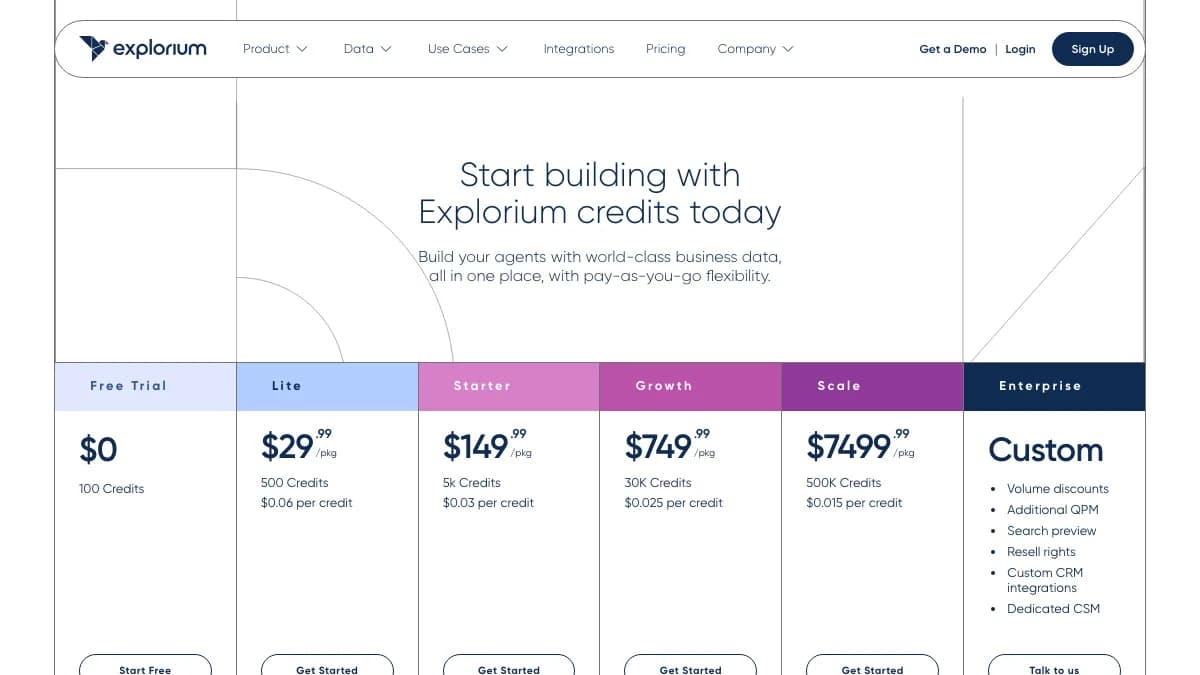
Explorium pricing is pay-as-you-go: one-time credit packages from $29.99 for 500 credits to $7,499.99 for 500,000 credits, with a free trial of 100 credits valid for 90 days.
Other Explorium reviews quote a $99.99 Starter pack or a $200 pack for 5,000 credits. The Explorium pricing page showed the following in October 2026.
| Package | Price | Credits | Per credit |
|---|---|---|---|
| Free Trial | $0 | 100 | n/a |
| Lite | $29.99 | 500 | $0.06 |
| Starter | $149.99 | 5,000 | $0.03 |
| Growth | $749.99 | 30,000 | $0.025 |
| Scale | $7,499.99 | 500,000 | $0.015 |
| Enterprise | Custom | Custom | Volume discounts |
All paid packages include every account and prospect enrichment and event. Enterprise adds volume discounts, higher queries per minute, search preview, resell rights, custom CRM integrations, and a dedicated CSM.
What a credit buys
The pricing page says generate actions cost 1 credit, enrichments 1 to 5, and events 1. The developer docs are more specific:
- Match and statistics calls: free
- Fetch businesses or prospects: 1 credit per returned record, 2 with the premium intent filter
- Contact information, email only: 2 credits
- Contact information, phone or email plus phone: 5 credits
Pricing math for common workflows
Here is what typical jobs cost on the Starter and Growth packs, assuming every record returns data.
| Workflow | Credits | Starter ($0.03) | Growth ($0.025) |
|---|---|---|---|
| Find 1,000 matching prospects (fetch only) | 1,000 | $30 | $25 |
| Find 1,000 prospects + work email | 3,000 | $90 | $75 |
| Find 1,000 prospects + email and mobile | 6,000 | $180 | $150 |
| Fetch 1,000 companies with premium intent filter | 2,000 | $60 | $50 |
Roughly $0.15 to $0.18 per fully enriched contact is competitive for API data. The real cost depends on hit rate, and the docs do not say whether misses are charged, so send the credit-usage: true header on test calls to see exactly what each call consumed.
Pricing gotchas
- Paid credits expire after 12 months and do not roll over.
- Packages are non-refundable and do not auto-renew.
- Credits are shared across API, MCP, and enrichments, so a chatty agent can drain a pack fast.
Explorium Data Coverage and Accuracy
Explorium's company coverage is broad and well documented, but there is no independent benchmark of its contact accuracy, so treat its email and phone claims as unverified until you test them.
On coverage, the company side is the strength. 146M+ business entities and 4,000+ signals put Explorium in the same league as the larger firmographic providers, and the 10-K and website-change enrichments go beyond what contact-first vendors sell.
On contacts, the picture is less clear. Explorium claims 767M+ professional profiles, and its Vibe Prospecting materials cite a 97.8% company match accuracy figure and under 2% bounce, but the data page does not explain how those numbers are measured.
The architecture matters here. The synchronous contact endpoint returns Explorium's own data only, and waterfall is limited to the async job, which retries misses against one verified external provider. Read our explainer on waterfall enrichment for why provider count drives find rates.
Our advice: run 200 records from your real ICP through fetch and contact enrichment, then verify the emails independently. Compare find rate and bounce rate against your current provider before you buy a Growth or Scale pack.
Explorium API Developer Experience
Explorium's API is clean and agent-friendly, with consistent v2 endpoints, sync and async variants, signed webhooks, and an llms.txt index, but the docs still leave gaps on credit costs.
What works
- Consistent v2 surface. Every endpoint lives under /v2, and one endpoint takes a single ID or a list, so separate bulk routes are gone.
- Async jobs. Every enrichment has a sync route and a job route you can poll, which suits large batches.
- Signed webhooks. Event deliveries carry an HMAC signature over timestamp and payload, and enrollments can be paused or re-pointed without re-enrolling entities.
- AI-readable docs. The llms.txt index and a migration skill for coding agents make it easy to point Claude Code or Cursor at the docs.
What to watch
- Rate limit. The default limit is 200 queries per minute per API key, and bulk payloads count each entity as a query. Higher limits need an upgrade.
- v1 to v2 migration. v1 still runs in parallel, but some fields were removed in v2. Check the migration guide before upgrading production code.
- Credit costs per enrichment. The per-call credit page tells you to read the usage header rather than listing a rate card for every enrichment.
- Small doc inconsistencies. The contact endpoint prose says prospect_id while the spec names the field prospect_ids. Minor, but it costs a debugging round.
If you are comparing raw developer experience, our review of People Data Labs covers the closest developer-first rival.
What Explorium Users Say
Explorium's user ratings are high but based on very few reviews, and many predate its pivot to an agent-focused data API.
- G2: roughly 4.6 to 4.8 out of 5, from fewer than 30 reviews depending on when you check.
- Capterra: near 5.0 out of 5, from about a dozen reviews.
- Trustpilot: around 2 out of 5, driven mostly by people complaining about privacy notification emails rather than by paying customers.
The positive themes are consistent. Reviewers praise data breadth, the API and integration options, and lower costs than previous providers, with one G2 reviewer saying it cut their data spend in half.
The negatives are about fit and freshness. Reviewers mention occasional outdated records, point-in-time gaps, slower customer service, and a technical setup that assumes engineering time.
The Trustpilot pattern is worth noting for compliance teams. Explorium sends notices to people in its database, which is a privacy-law requirement in some regions, and some recipients respond with one-star reviews.
Explorium Pros and Cons
Pros
- Built for agents: REST API plus hosted MCP server
- Low entry cost: $29.99 pack, 100 free trial credits
- Free match and statistics calls for market sizing
- 16 business enrichments, including 10-K research
- Broad event catalog with signed webhooks
- Bombora intent available inside the same credits
Cons
- No independent benchmark for contact accuracy
- Waterfall only on async jobs, with one fallback provider
- Credits expire after 12 months, no rollover or refunds
- Events cover about 3 months, with no history
- No native CRM sync below Enterprise
- Few recent reviews; many predate the API pivot
Who Should Use Explorium (and Who Shouldn't)
Explorium fits builders: teams that write code or run agents and want company signals and contacts behind one key.
Good fit
- Startups building an AI SDR or research agent
- RevOps and GTM engineers who run Claude, Cursor, or n8n workflows
- Data teams that want firmographics, technographics, and events without a seat license
- Platforms that need resell rights (Enterprise)
Poor fit
- SDRs who want a prospecting UI, Chrome extension, and sequencer
- Teams that need the highest possible email and mobile find rates from many providers
- Buyers who need long event history for scoring or attribution
- Teams that want HubSpot or Salesforce sync out of the box
Explorium Alternatives
The closest Explorium alternatives are other API-first B2B data providers, plus intent and all-in-one platforms if you need a UI.
| Tool | Best for | Key difference vs Explorium |
|---|---|---|
| People Data Labs | Developers who want a raw person and company dataset by API or bulk file | Larger raw person graph and bulk licensing; fewer packaged event signals |
| Coresignal | Data teams that need historical employee and company records | Deep history and raw datasets; you build the signal logic yourself |
| Bombora | Account-level intent data on its own | Intent specialist; Explorium resells Bombora intent as an enrichment |
| ZoomInfo | Enterprise sales teams that want a full seat-based platform | UI, workflows, and CRM tooling included; annual contracts and seat pricing |
| Apollo.io API | Teams that want data plus a sequencer in one place | Built-in outreach; API access tied to paid seat plans |
For a ranked list, see our guide to the best enrichment APIs for B2B sales teams and our roundup of Coresignal alternatives.
Explorium Review: Final Verdict
Our rating: 3.8/5. Explorium is one of the most agent-ready B2B data APIs on the market, held back by unproven contact accuracy, a short event window, and credits that expire.
The strengths are real. Free match and statistics calls, a hosted MCP server, 16 business enrichments, and packs from $29.99 make it easy to prototype an AI SDR in an afternoon.
The weaknesses show up at scale. Contact data is mostly single source, event history stops at about a quarter, and you will build your own CRM sync.
If you are building agents, start with the free 100 credits and a Lite pack. Measure find rate and bounce rate on your own ICP before committing to Growth or Scale.
If mostly single-source contact data is a dealbreaker, SyncGTM is one alternative worth a look: it runs waterfall enrichment across 50+ data providers for verified emails and phone numbers.