

Hunter.io vs Anymail Finder: Verified Email Finders Ranked 2026

By Kushal Magar · October 5, 2026 · 12 min read
Key Takeaway
Anymail Finder finds more emails (86.4% vs 57.6%) and only charges for verified results. Hunter.io adds domain search and built-in campaigns but burns credits faster. Pick Anymail for bulk list enrichment; pick Hunter for manual account-based prospecting with email sequences.
In Hunter.io vs Anymail Finder, both tools find verified business emails. But they charge differently, find different percentages, and suit completely different workflows.
Anymail Finder only bills you when it verifies an email. Hunter charges per email found — whether or not it survives your next send. In a benchmark of 5,000 contacts, Anymail Finder found verified emails for 86.4% of targets; Hunter found 57.6%.
Hunter adds domain search, built-in cold email campaigns, and a deeper Chrome extension. Anymail Finder is leaner — API-first, built for bulk automation, and priced on outcomes rather than searches.
This comparison covers find rate, accuracy, pricing model, domain search, catch-all handling, and the exact situations where each tool is the right call.
TL;DR
| Dimension | Hunter.io | Anymail Finder | Winner |
|---|---|---|---|
| Find rate (5k benchmark) | 57.6% | 86.4% | Anymail Finder |
| Email accuracy | 86.1% | 98.9% | Anymail Finder |
| Billing model | Per email found | Per verified email only | Anymail Finder |
| Starter price | $49/mo ($34 annual) | $29/mo (400 credits) | Anymail Finder |
| Free tier | 50 credits/mo recurring | 100 credits one-time | Hunter.io |
| Domain search | Yes — core feature | No | Hunter.io |
| Built-in email campaigns | Yes | No | Hunter.io |
| Catch-all domain handling | Low-confidence flags | Attempts verification | Anymail Finder |
| Bulk upload limit | 50,000 rows/file | 100,000 rows/file | Anymail Finder |
| API access | Yes (paid plans) | Yes (all plans) | Anymail Finder |
| CRM integrations | Salesforce, HubSpot, Pipedrive | Via API / Zapier | Hunter.io |
| Chrome extension | Yes | No | Hunter.io |
What Are Hunter.io and Anymail Finder?
Hunter.io is a domain-first email finder. Enter a company domain and Hunter returns every business email it has indexed from public sources — websites, LinkedIn, newsletters, and press releases. A built-in verifier attaches a confidence score to each address. Hunter also runs cold email sequences and offers a Chrome extension for LinkedIn prospecting.
Founded in 2015, Hunter has indexed 100M+ verified business email addresses. Its free tier (50 credits/month, no credit card required) makes it one of the most accessible email finders on the market.
Anymail Finder is a person-first, verified-only email finder. You provide a name and company (or upload a bulk CSV). Anymail Finder attempts to find and verify the email — and only charges you if it succeeds. Credits roll over while subscribed, and unverified lookups cost nothing.
Anymail Finder is built for automation. Its API connects directly to outreach stacks and CRM workflows. It does not have a Chrome extension or built-in campaigns — the assumption is that you already have a sequencer.
The key divergence is the billing model and the starting point. Hunter charges per search; Anymail charges per outcome. Hunter starts from a company domain; Anymail starts from a specific person.
Hunter.io Deep Dive

Hunter.io domain search — returns all indexed emails at a company domain with confidence scores
Hunter.io is best described as a domain-to-contacts machine. You give it a company domain and it returns every email address it has crawled from the public web — press releases, team pages, LinkedIn, Twitter, and conference speaker bios. Each address gets a confidence score; 90%+ means the format is verified and the address is deliverable.
The domain search workflow is fast for account-based outreach. A SDR targeting Acme Corp can see the full contact list for that domain in seconds, sorted by confidence. No scraping required.
Hunter also runs cold email campaigns natively. Starter plans include 3 connected email accounts and 500 recipients per sequence. Growth adds 10 accounts and 5,000 recipients. For teams that want to prospect and sequence from a single tool, Hunter covers both.
The weakness is find rate. Hunter found emails for 57.6% of contacts in the Anymail Finder benchmark — meaning 4 in 10 contacts come back empty. On small companies, startups, and catch-all domains, the find rate drops further. Hunter flags catch-all results as low-confidence rather than attempting deeper verification.
Pros
- ✓ Domain search finds all contacts at a company in one query
- ✓ Recurring free tier: 50 credits/month, no card required
- ✓ Built-in cold email campaigns included on all paid plans
- ✓ Chrome extension for LinkedIn and Gmail
- ✓ Month-to-month billing available (no annual lock-in)
- ✓ Native CRM integrations: Salesforce, HubSpot, Pipedrive
Cons
- ✗ 57.6% find rate — leaves 4 in 10 contacts empty
- ✗ 86.1% accuracy — 1 in 7 found emails will bounce
- ✗ Credits charged per email found, not per verified email
- ✗ Catch-all domains return low-confidence or no result
- ✗ Bulk upload capped at 50,000 rows per file
- ✗ Verifications consume a separate 0.5 credits each
Best for: SDRs who prospect account-by-account, want domain search, and need a built-in sequencer in a single tool.
Pricing
| Plan | Monthly price | Annual price | Credits/mo |
|---|---|---|---|
| Free | $0 | $0 | 50 |
| Starter | $49/mo | $34/mo | 2,000 |
| Growth | $149/mo | $104/mo | 10,000 |
| Scale | $299/mo | $209/mo | 25,000 |
Email verifications cost 0.5 credits each. Bulk domain search costs 1 credit for up to 10 emails. Annual billing saves ~30%.
Evaluating other options? 9 Hunter.io alternatives ranked for B2B enrichment in 2026.
Anymail Finder Deep Dive
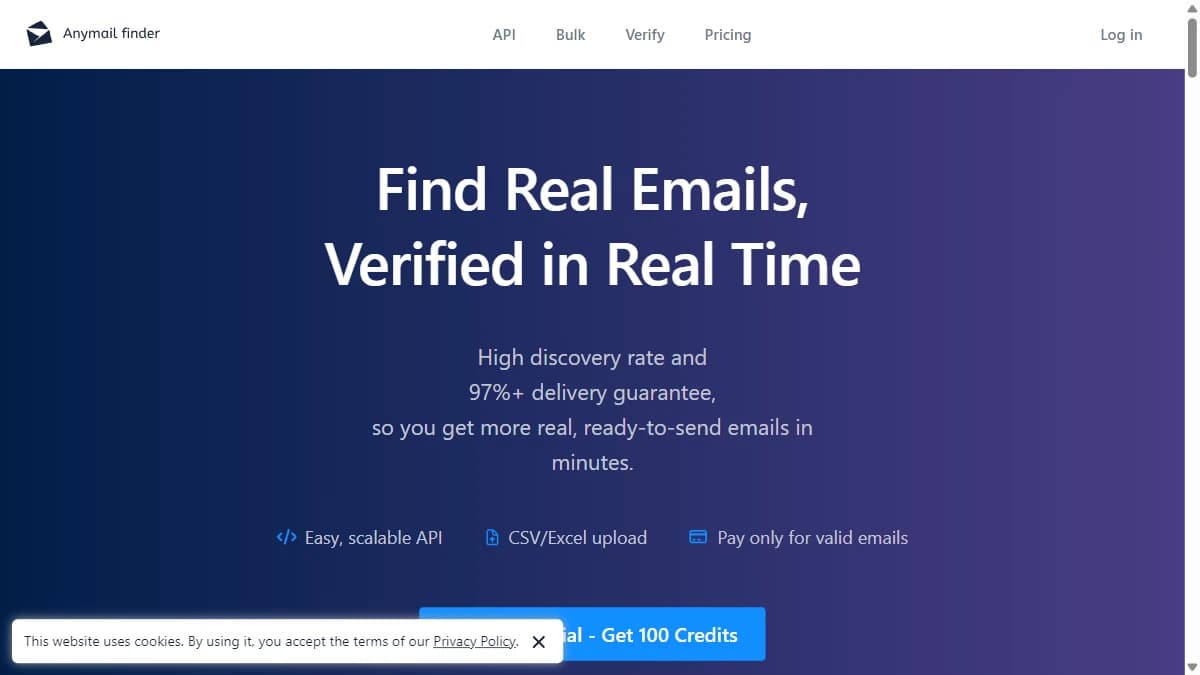
Anymail Finder — verified-only email lookup, you only pay when an email is confirmed deliverable
Anymail Finder is a verified-email-first platform. You give it a person’s name and company (or upload a CSV with thousands of rows). It searches, verifies, and only charges you if it returns a confirmed deliverable address. Unverified lookups — where it cannot confirm the address — are free.
The find rate reflects this approach. In a head-to-head benchmark of 5,000 B2B contacts, Anymail Finder found verified emails for 86.4% of targets. Email accuracy was 98.9% — only 46 invalid emails were returned from 5,000 lookups. Hunter found 57.6% with 467 invalid emails in the same test.
Anymail Finder handles catch-all domains more aggressively than Hunter. Rather than flagging catch-all results as low-confidence, it attempts a deeper verification pass. This is one reason its find rate on SMB and startup lists outperforms Hunter significantly.
The bulk upload limit is 100,000 rows per file — double Hunter’s 50,000. The API is available on all plans, not gated behind higher tiers. For RevOps teams enriching CRM data at scale or triggering lookups from automation tools, Anymail Finder is designed for that workflow.
The trade-off is feature breadth. Anymail Finder has no Chrome extension, no built-in sequencer, and no domain search. You need a separate tool to prospect and send. It is a data enrichment engine, not an all-in-one prospecting platform.
For a deeper review, see our full Anymail Finder review covering pricing, hit rates, and API integration.
Pros
- ✓ 86.4% find rate — 50% higher than Hunter in head-to-head tests
- ✓ 98.9% accuracy — only charges for verified deliverable emails
- ✓ Pay-per-verified-email model: zero waste on unverified lookups
- ✓ Handles catch-all domains better than Hunter
- ✓ 100,000 row bulk upload (double Hunter’s limit)
- ✓ API available on all plans, credits roll over while subscribed
Cons
- ✗ No Chrome extension — no LinkedIn one-click lookup
- ✗ No domain search — cannot surface all contacts at a company
- ✗ No built-in email sequencer
- ✗ Free tier is one-time only (100 credits on signup, not recurring)
- ✗ CRM integrations require API setup or Zapier
- ✗ Smaller community and fewer third-party integrations than Hunter
Best for: RevOps and automation teams enriching large contact lists, teams that already have a sequencer, and anyone who values paying for outcomes over searches.
Pricing
| Plan | Monthly price | Verified credits | Per credit |
|---|---|---|---|
| Starter | $29/mo | 400 | $0.073 |
| Growth | $49/mo | 1,000 | $0.049 |
| Pro | $89/mo | 2,000 | $0.045 |
| Scale | $149/mo | 5,000 | $0.030 |
| Business | $199/mo | 10,000 | $0.020 |
| Enterprise | $299/mo | 25,000 | $0.012 |
Annual billing saves 33%. Credits roll over while subscribed. Unverified lookups are free — you only pay when an email is confirmed. Decision-maker searches cost 2 credits; company searches cost 1 credit for up to 20 emails.
Hunter.io vs Anymail Finder: Head-to-Head Comparison
| Feature | Hunter.io | Anymail Finder |
|---|---|---|
| Search model | Domain-first | Person-first |
| Find rate (5k benchmark) | 57.6% | 86.4% |
| Email accuracy | 86.1% (467 invalid/5k) | 98.9% (46 invalid/5k) |
| Billing model | Per email found | Per verified email only |
| Free tier | 50 credits/month (recurring) | 100 credits (one-time) |
| Starter plan | $49/mo · $34/mo annual | $29/mo (400 verified credits) |
| Billing flexibility | Monthly or annual | Monthly or annual |
| Domain search | Yes — core feature | No |
| Catch-all domain handling | Low-confidence flags only | Deep verification attempt |
| Bulk upload limit | 50,000 rows/file | 100,000 rows/file |
| Built-in email sequencer | Yes (campaigns) | No |
| Chrome extension | Yes (LinkedIn + Gmail) | No |
| API access | Yes (paid plans) | Yes (all plans) |
| CRM integrations | Salesforce, HubSpot, Pipedrive | Via API / Zapier |
| Credit rollover | No | Yes (while subscribed) |
| Decision-maker search | Via name + domain | Yes (2 credits) |
| Company email search | Via domain search | Yes (1 credit, up to 20) |
| GDPR posture | Public-web sourced | Public-web + verification |
5 Key Differences That Actually Matter
1. Find rate: the 30-point gap
Anymail Finder found verified emails for 86.4% of 5,000 contacts. Hunter found 57.6%. That’s a 50% relative improvement in coverage from the same input list.
The gap matters most on SMB lists and startup-heavy ICP segments. Smaller companies use catch-all domains and have less indexed public presence — exactly where Hunter’s crawl-and-index model struggles.
2. The billing model difference
Hunter charges 1 credit per email found. If the email bounces on send, you already paid for it. Verifications cost an additional 0.5 credits — so a verified email find costs 1.5 credits total.
Anymail Finder charges only when it returns a verified, deliverable email. Failed lookups are free. Credits roll over while you’re subscribed. For teams enriching large lists, this model eliminates waste on unverifiable contacts.
3. Domain search: Hunter’s killer feature
Hunter’s domain search has no equivalent in Anymail Finder. You enter acmecorp.com and Hunter returns every email address it has ever indexed at that domain — names, roles, confidence scores — in one query.
This is invaluable for account-based outreach where you need to identify all contacts at a target company before deciding who to approach. Anymail Finder cannot do this.
4. Catch-all domain handling
Catch-all domains accept all email — even invalid addresses. This makes verification difficult. Hunter flags these as low-confidence and often returns no result. You get a blank where Anymail Finder would have given you an email.
Anymail Finder attempts deeper verification on catch-all domains. It can still fail — not every catch-all email is verifiable — but the attempt rate is higher. For lists where 20–30% of companies use catch-all email (common in SMB and European markets), this difference compounds.
5. All-in-one vs. enrichment-only
Hunter is an all-in-one prospecting tool: find emails, verify them, run cold email campaigns, track opens and replies. The Starter plan connects 3 email accounts and sends to 500 recipients per sequence. You can run an entire email outbound motion inside Hunter.
Anymail Finder is an enrichment engine only. No campaigns, no tracking, no Chrome extension. If you already have a sequencer (Instantly, Smartlead, Outreach), Anymail Finder plugs in via API and does one job extremely well. If you need everything bundled, Hunter wins on convenience.
Which One Should You Pick?
Choose Hunter.io if you:
- Prospect account-based and need to see all contacts at a domain
- Want a built-in email sequencer — one tool, not two
- Need a recurring free tier with no credit card required
- Use a Chrome extension for LinkedIn and Gmail prospecting
- Need native CRM push to Salesforce or HubSpot without API setup
- Want month-to-month billing to test before committing
Choose Anymail Finder if you:
- Already have a sequencer and need verified emails only
- Enrich large CRM lists (10k+ contacts) where find rate matters
- Want to pay per outcome — only when an email is confirmed
- Work with SMB or startup lists where catch-all domains are common
- Need API-first integration into your automation stack
- Want credits that roll over and never expire while subscribed
Both tools have genuine gaps. Hunter misses 42% of contacts in head-to-head tests. Anymail Finder has no domain search — you cannot explore a company’s full contact list without already knowing who you’re looking for.
For teams comparing email finders more broadly, the Hunter.io vs RocketReach comparison covers how Hunter stacks up against another major finder — with phone coverage factored in.
For broader list enrichment options, see the best B2B data providers for sales teams in 2026 — covers 12+ tools ranked by data type, coverage, and price.
If budget is the primary constraint, 7 best free email address finders in 2026 ranks no-cost options including Hunter’s free tier and others.
For teams hitting coverage ceilings with a single provider, a waterfall approach — where your CRM tries multiple finders in sequence until one returns a verified result — consistently outperforms any single tool. See how the best waterfall email finders compare.
Final Verdict
For bulk list enrichment, Anymail Finder is the stronger tool. An 86.4% find rate with 98.9% accuracy — and a billing model that charges only for verified results — means more contacts enriched and less budget wasted on undeliverable addresses. Teams enriching CRM exports, inbound leads, or event attendee lists will see meaningfully better coverage from Anymail Finder than from Hunter.
For manual, account-based prospecting where reps research companies one-by-one, Hunter.io wins on workflow. Domain search, a Chrome extension, built-in email campaigns, and a recurring free tier make it a complete prospecting tool for individual SDRs. You can move from “target this company” to “email sent” without leaving the platform.
Pricing tells the same story. Hunter’s $49/mo Starter plan gives 2,000 credits — but at 57.6% find rate and 86.1% accuracy, you get roughly 991 deliverable emails from those credits at a cost of ~$0.049 each. Anymail Finder’s $49/mo Growth plan gives 1,000 verified credits — exactly 1,000 confirmed deliverable emails — at the same $0.049 per email. The difference is predictability: with Anymail Finder, you know exactly how many deliverable contacts you’re buying. With Hunter, you find out after the sends.
Neither tool has the coverage breadth to enrich a large B2B list on its own. Hunter misses 42% of contacts. Anymail Finder misses 14%. For teams chasing every possible contact, chaining multiple providers in a waterfall consistently outperforms either tool alone. The Hunter.io alternatives guide covers the full field of email finders worth adding to that waterfall.
Whichever you choose, SyncGTM can strengthen the enrichment behind it — chaining Hunter, Anymail Finder, and 48+ other providers in a waterfall to lift your CRM coverage well beyond what either tool finds alone.