The Best B2B Data Providers for Sales Teams in 2026

By Kushal Magar · August 4, 2026 · 13 min read
Key Takeaway
Sales teams should pick a data provider on rep workflow, not database size. Cognism wins if your reps dial. Apollo wins on seat economics for SDR pods. ZoomInfo wins for enterprise AEs with RevOps support. SyncGTM wins when no single vendor covers your ICP — it cascades 50+ providers and includes outreach in one subscription, so reps go from list to first touch without a second tool.
If you are asking what are the best B2B data providers for sales teams, the honest answer is that database size is the wrong tiebreaker. What decides rep output is email deliverability, whether a mobile number actually rings a human, how cleanly records land in your CRM, and what a seat costs once the whole team is on it.
A rep who spends the first ninety minutes of the day cleaning a list is not selling. B2B contact data decays at roughly 2% per month, so a list that was 95% accurate a year ago is closer to 71% accurate today.
We ranked eight providers from the perspective of the people who actually use them — SDRs building lists, AEs researching accounts, and RevOps leads signing the contract. Each section covers accuracy, dial coverage, CRM depth, and real cost at team scale.
If you want the same category judged purely on raw database size and coverage breadth, read our companion guide to the best B2B database providers.
TL;DR — Every Provider in One Line
- SyncGTM — Best when no single vendor covers your ICP. 50+ provider waterfall, 76+ data points per lead, outreach included. From $99/mo.
- Cognism — Best for teams that dial. Human-verified mobiles, DNC screened, strongest EMEA coverage. ~$25K/yr.
- ZoomInfo — Best for enterprise AEs with RevOps behind them. Intent data, org charts, deepest Salesforce sync. From ~$15K/yr.
- Apollo.io — Best seat economics for SDR pods. Data plus sequencer in one seat. From $49/mo per seat.
- LeadIQ — Best CRM sync workflow. One-click capture from LinkedIn to Salesforce or Outreach. From $36/user/mo.
- Amplemarket— Best all-in-one for mid-market outbound. Data, AI copy, and multichannel in one platform. ~$1,500–$3,000/mo.
- Breeze Intelligence — Best for HubSpot-only teams. Enrichment inside the CRM, no integration layer. From $45/mo.
- Seamless.ai — Best real-time search for niche ICPs. Finds contacts static databases miss. From $147/mo.
Why Data Quality Decides Your Sales Team's Output
Every downstream sales metric inherits its ceiling from data quality. A sequence cannot outperform the list it runs on, and a dialler cannot connect a number that was never valid.
The damage compounds in three places most teams do not measure. Bounce rate above 3% starts degrading domain reputation, which quietly suppresses deliverability on the good addresses too.
Wrong mobile numbers waste the most expensive minutes on the team. An SDR making 60 dials against a list with 40% bad numbers is really making 36 dials and burning the rest.
Then there is time-to-first-touch. When a rep has to export a CSV, run it through a verifier, re-import it, and map fields by hand, a list built on Monday reaches inboxes on Wednesday.
That is why this ranking weights workflow as heavily as raw coverage. For a deeper look at how enrichment actually works under the hood, see our guide to B2B lead enrichment.
How We Ranked the Best B2B Data Providers for Sales Teams
We scored each provider on five criteria that map to what a sales team feels day to day. Database size was deliberately excluded as a standalone metric.
- Contact accuracy and deliverability — verified email rate and observed bounce rate on real lists, not vendor samples.
- Mobile and direct-dial coverage — fill rate on mobile numbers and whether those numbers are human-verified or scraped.
- CRM sync depth — native two-way sync, field-level enrichment rules, and automatic record refresh versus manual CSV round-trips.
- Seat and credit pricing at team scale — what ten reps actually cost after credit overages, not the headline price for one.
- Time from list to first touch — how many tools and steps sit between building a list and sending the first message.
1. SyncGTM — Best Data-First Stack for Coverage Plus Outreach
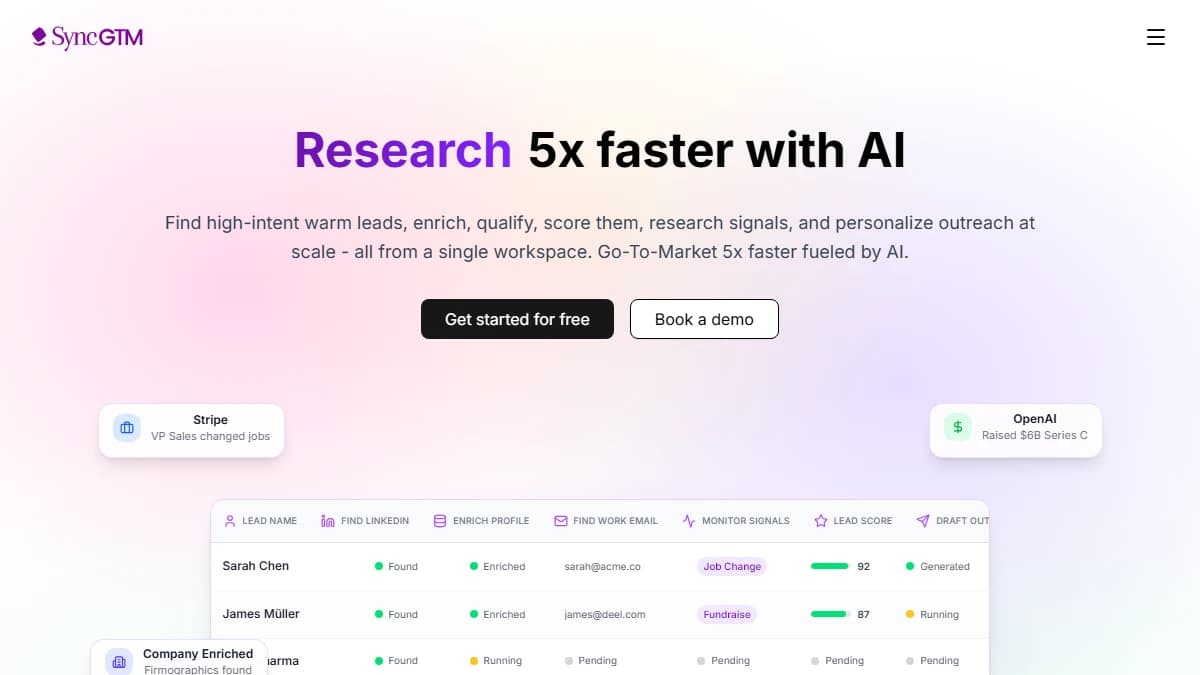
SyncGTM — cascade 50+ B2B data providers, append buying signals, and run outreach from the same subscription
SyncGTM is a data-first platform built for sales teams whose ICP no single vendor covers well. Instead of maintaining one proprietary database, it cascades 50+ underlying providers and returns the first verified email, mobile, and firmographic hit across the whole pool.
The practical effect on a rep's day is fewer dead rows. Teams that layer SyncGTM over a primary database typically move contact coverage from 50–60% to 80–95% on the same target list.
It also removes the handoff that usually costs a day. Enrichment, buying signals, and outreach live in one subscription, so a list built in the morning can be sequenced the same afternoon without a CSV export.
What sales teams get per lead
- 76+ data points — email, mobile, firmographics, technographics, and signals in one enrichment pass
- 50+ provider waterfall — cascaded in an optimised sequence, so you stop paying for a miss
- Buying signals — job changes, funding rounds, hiring spikes, and product launches appended automatically
- Integrated outreach — sequences run from the same platform, cutting the list-to-first-touch gap
- Pay-per-valid-result — credits are consumed only when enrichment succeeds
Pros
- Highest coverage ceiling on this list — 80–95% fill rate because misses fall through to the next provider
- Outreach included, so reps do not need a separate sequencer seat on top of the data spend
- No per-seat data tax — pricing is credit-based, so adding an SDR does not double the bill
- Buying signals turn a flat contact list into a prioritised call queue
- Works alongside Apollo or ZoomInfo rather than forcing a rip-and-replace
Cons
- Search filters are less mature than ZoomInfo's for pure account discovery
- Initial waterfall configuration takes some setup to prioritise providers for your ICP
- No native intent-data product — signals are event-based rather than topic-based
Best for: Sales teams with a multi-region or niche ICP that a single database leaves half-covered, and teams that want data plus outreach on one bill. See how the cascade model compares in our roundup of best waterfall contact providers.
Pricing: From $99/mo on a pay-per-valid-result credit model. Full tiers on the SyncGTM pricing page.
2. Cognism — Best Mobile and Direct-Dial Coverage
Cognism — human-verified mobile numbers screened against DNC lists across the US, UK, and EU
Cognism is the strongest B2B data provider for sales teams whose primary motion is the phone. Its Diamond Data tier is human-verified rather than algorithmically inferred, which is why connect rates hold up where scraped numbers fall apart.
The compliance layer matters more than most teams expect. Cognism screens against DNC registries in the US, UK, and EU and was built GDPR-first, which removes a real blocker for teams calling into Europe.
The trade-off is commercial rigidity. Pricing is annual, team-wide, and quoted — there is no month-to-month path for a two-rep pilot.
Pros
- Diamond Data mobiles are phone-verified by humans — the highest connect rate in the category
- DNC screening across US, UK, and EU registries reduces compliance exposure for outbound calling
- Strongest EMEA and DACH coverage of any major provider
- Unrestricted-view licence on most plans means reps are not rationed on credits mid-quarter
Cons
- Annual contracts with no self-serve tier — expect a sales cycle before a single rep touches it
- Roughly $25K/yr entry point prices out most teams under ten reps
- US mid-market coverage trails ZoomInfo and Apollo
- No native sequencer — you still pay for a separate outreach tool
Best for: SDR and AE teams running phone-led outbound into EMEA, where verified mobiles and DNC compliance are non-negotiable. Our full Cognism review breaks down the tiers.
Pricing: Quote-only. Team contracts typically start near $25,000/yr, or roughly $1,000+ per user per year.
3. ZoomInfo — Best for Enterprise AE Teams with RevOps Support
ZoomInfo — intent data, org charts, and the deepest native Salesforce enrichment of any provider here
ZoomInfo is the strongest option for enterprise AE teams that research accounts before they touch them. Org charts, reporting lines, and topic-level intent give an AE a map of the buying committee rather than a list of names.
Its Salesforce integration is the deepest in the category. Field-level enrichment rules and scheduled record refresh mean the CRM stays current without a rep doing anything.
None of that lands without RevOps. The platform rewards teams with someone who owns configuration and punishes teams that buy seats and hope.
Pros
- Org charts and reporting lines make multi-threading an enterprise deal genuinely faster
- Topic-level intent data surfaces accounts already researching your category
- Deepest native Salesforce sync — automated enrichment rules and record refresh at the field level
- Largest US contact and company coverage of the providers on this list
Cons
- From roughly $15,000/yr with multi-year terms — the most expensive entry point here
- Phone data mixes verified direct dials with switchboard numbers, so connect rates lag Cognism
- Credit and seat structure is complex enough that overage surprises are common
- Needs a RevOps owner — small teams underuse most of what they pay for
Best for: Enterprise AE teams selling into large buying committees, with RevOps resource to run configuration. See the detail in our ZoomInfo review.
Pricing: Quote-only, typically from $15,000/yr. Intent and org-chart modules are priced separately.
4. Apollo.io — Best Seat Economics for SDR Pods
Apollo.io — contact data and a sequencer in the same seat, the cheapest way to stand up an SDR pod
Apollo.io gives sales teams the lowest cost per productive SDR seat of any provider here. One $49/mo seat covers search, contact data, and sequencing, which collapses two line items into one.
For a five-person SDR pod that difference is material. The same coverage split across a data tool and a separate sequencer usually runs two to three times the price.
Accuracy is the trade. Apollo's emails hold up reasonably well, but mobile numbers are noticeably weaker outside the US and bounce rates climb on smaller companies.
Pros
- $49/mo per seat including sequencing — the best price-to-capability ratio for SDR teams
- Free tier lets a rep validate the workflow before anyone signs anything
- Two-way Salesforce and HubSpot sync included on paid plans
- Fastest list-to-first-touch of the traditional databases, since sequences live in the same tool
Cons
- Mobile coverage is thin outside the US — a problem for phone-led teams selling into EMEA or APAC
- Bounce rates rise on sub-200-employee companies, so verification is still a separate step
- Export limits on lower tiers frustrate teams building large lists
- Deliverability suffers when whole teams sequence from the same shared data pool
Best for: SMB and mid-market SDR pods that need data and sequencing on one budget line. Full breakdown in our Apollo.io review.
Pricing: Free tier available. Paid from $49/mo per seat, with credit limits by tier.
5. LeadIQ — Best CRM Sync for Sales Navigator Prospecting
LeadIQ — capture a prospect from LinkedIn into Salesforce, HubSpot, or Outreach in one click
LeadIQ is built for the SDR who prospects inside LinkedIn Sales Navigator all day. Its Chrome extension captures a contact and pushes it to Salesforce, HubSpot, or Outreach in a single click, with fields already mapped.
That removes the CSV round-trip entirely. For a rep working 40 profiles a day, it is the difference between an hour of admin and five minutes.
It is an email-first tool, though. Phone coverage is the most consistent complaint in user reviews, and phone lookups burn credits far faster than email lookups.
Pros
- Fastest LinkedIn-to-CRM workflow of any tool here — one click, fields pre-mapped
- Native pushes to Salesforce, HubSpot, Outreach, and Salesloft rather than generic CSV export
- Free plan with 50 verified emails per month is a genuine trial, not a demo gate
- Job-change tracking flags when a champion moves to a new account
Cons
- Phone number accuracy is the weakest of the eight — not a fit for dial-heavy teams
- Phone lookups consume roughly 10x the credits of an email lookup
- Needs a Sales Navigator licence to be useful, adding ~$99/mo per rep on top
- Pro tier at $100–$130/user/mo erodes the price advantage at team scale
Best for: Email-led SDR teams that live in Sales Navigator and want zero friction between finding a prospect and sequencing them. See our full LeadIQ review.
Pricing:Free plan with 50 emails/mo. Essential from $36/user/mo, Pro $100–$130/user/mo, Enterprise custom.
6. Amplemarket — Best All-in-One for Mid-Market Outbound
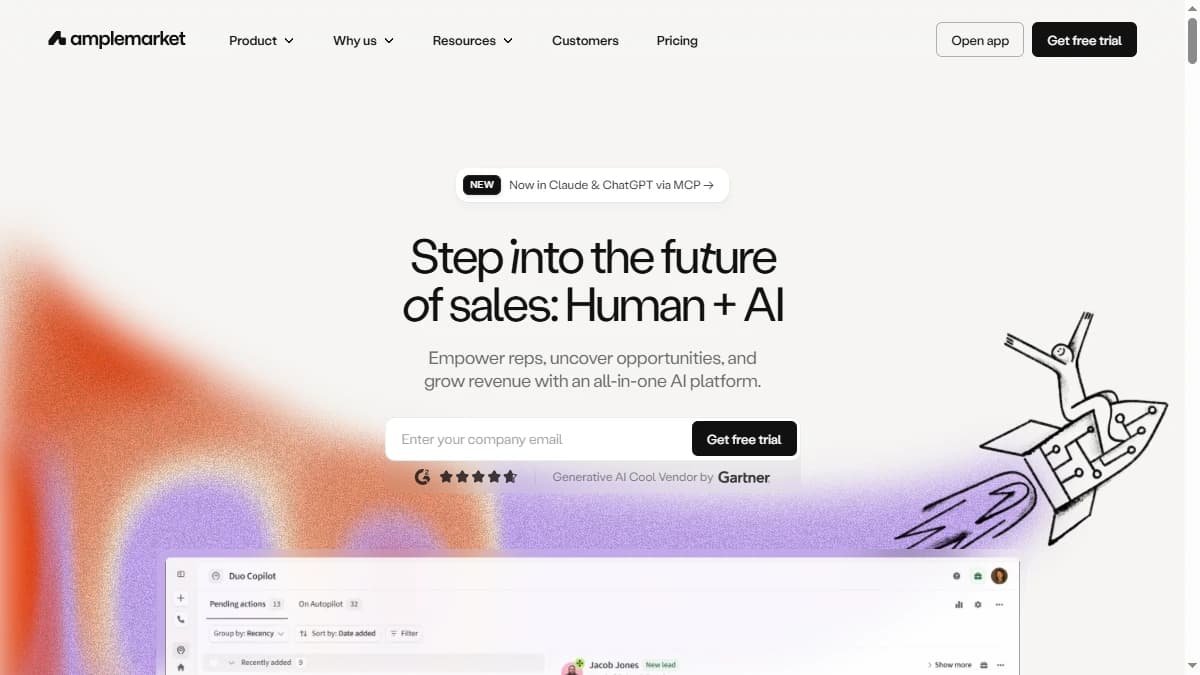
Amplemarket — data, AI copywriting, and multichannel sequencing consolidated into a single platform
Amplemarket consolidates the whole outbound stack for mid-market teams that would rather manage one vendor than five. Data, signal detection, AI copy, email, and LinkedIn sequencing all sit in one platform.
Its signal layer is genuinely strong for a data provider. Job changes, funding events, and hiring spikes are surfaced natively rather than bolted on through a third-party integration.
The catch is transparency and lock-in. There is no public pricing page, contracts are annual, and consolidating everything into one vendor makes leaving expensive.
Pros
- One platform replaces a data tool, a sequencer, and a signal tool — fewer integrations to maintain
- Native job-change, funding, and hiring signals drive genuinely timely outreach
- Built-in deliverability tooling including mailbox warm-up and inbox rotation
- AI copy generation is grounded in the enriched record, not generic prompts
Cons
- No public pricing — RevOps cannot benchmark cost without a sales call
- Roughly $1,500–$3,000/mo puts it out of reach for teams under ten reps
- Annual contracts standard, with meaningful switching cost once sequences live inside it
- Contact coverage is good but not best in class — it wins on consolidation, not raw data
Best for: Mid-market outbound teams of 10–50 reps that want one vendor for data, signals, and sequencing. Read our full Amplemarket review.
Pricing:Custom quote only. User reports place real spend at roughly $1,500–$3,000+/mo depending on seats.
7. Breeze Intelligence — Best CRM-Native Enrichment for HubSpot Teams
Breeze Intelligence — the former Clearbit dataset, now enriching records natively inside HubSpot
Breeze Intelligence is the Clearbit dataset rebuilt as a native HubSpot feature. For a sales team already standardised on HubSpot, it is the shortest path from an anonymous form fill to an enriched, routable record.
There is no integration layer to maintain and no sync to debug. Enrichment happens on the record itself, so reps see firmographics without leaving the deal view.
The cost of that convenience is total lock-in. Since the Clearbit standalone product was retired, the data is unavailable to anyone not paying for HubSpot.
Pros
- Zero integration work — enrichment is a native HubSpot property, not a synced object
- Form shortening lifts conversion by auto-filling fields the dataset already knows
- Buyer-intent visitor identification reveals which companies browsed without converting
- Clean firmographic and technographic quality inherited from Clearbit
Cons
- HubSpot-only — worthless to a Salesforce team, and unusable standalone
- Credits are consumed even when enrichment returns nothing usable
- Weak on contact-level emails and mobiles — it is a company enrichment tool, not a prospecting database
- Real all-in cost reaches $1,340–$5,000+/mo once the required HubSpot tier is included
Best for: HubSpot-native sales teams that need inbound records enriched and routed automatically, with prospecting data sourced elsewhere. Background in our Clearbit review.
Pricing: From $45/mo for 100 credits on annual billing, on top of a paid HubSpot subscription.
8. Seamless.ai — Best Real-Time Search for Hard-to-Find ICPs
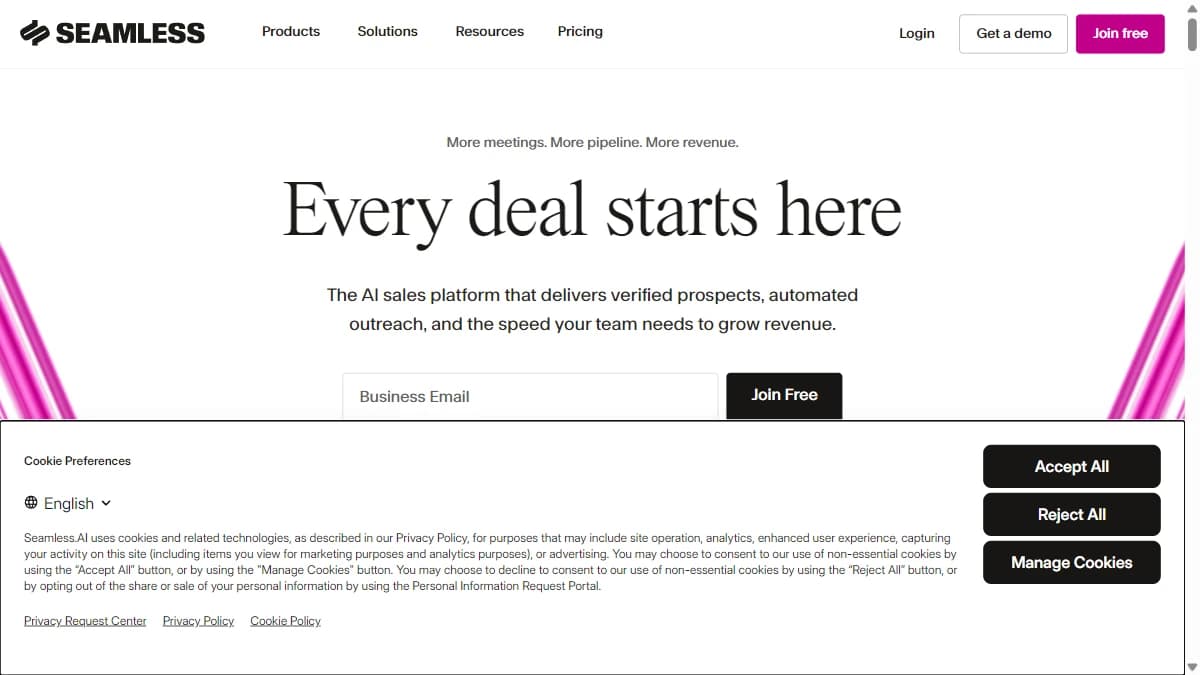
Seamless.ai — searches the live web for contacts rather than serving a pre-indexed database
Seamless.ai takes a different approach from every other provider on this list. Rather than querying a static index, it searches the live web at request time, which surfaces contacts at small or obscure companies that pre-built databases never captured.
That is a real advantage for teams selling into long-tail markets. Local services, regional manufacturers, and newly formed companies show up here when they are missing from ZoomInfo.
Accuracy is the recurring complaint. Results need verification before a rep sends anything, and credits are consumed whether or not the record turns out to be valid.
Pros
- Real-time search finds contacts at long-tail companies that static databases miss entirely
- Chrome extension pulls contacts directly from LinkedIn and company websites
- Salesforce and HubSpot integrations included on paid tiers
- Unlimited-style search on higher tiers suits high-volume list building
Cons
- Accuracy is inconsistent — always verify before sending, which adds a step and a cost
- Credits are charged even when the email bounces or the phone number is wrong
- Pro tier is quote-only with a 5-user minimum and a 12-month commitment
- Frequent user complaints about aggressive renewal and cancellation terms
Best for: Teams prospecting into fragmented or long-tail markets where standard databases return empty. Details in our Seamless.ai review.
Pricing: From $147/mo on annual billing. Pro is quote-only with a 5-seat minimum.
B2B Data Provider Comparison for Sales Teams
Judged on what a rep feels daily — dial coverage, CRM depth, and what a seat really costs.
| Provider | Core Strength | Mobile / Dial Coverage | CRM Sync | Starting Price |
|---|---|---|---|---|
| SyncGTM | 50+ provider waterfall + outreach | High — cascaded mobile sources | Salesforce, HubSpot, webhooks | From $99/mo |
| Cognism | Phone-verified Diamond Data | Best in class (DNC screened) | Salesforce, HubSpot, Outreach | ~$25K/yr team contract |
| ZoomInfo | Intent data + org charts | High volume, mixed quality | Deepest native Salesforce | From ~$15K/yr |
| Apollo.io | Data + sequencer in one seat | Moderate — US skewed | Salesforce, HubSpot (2-way) | From $49/mo per seat |
| LeadIQ | One-click capture to CRM | Low — email-first tool | Salesforce, HubSpot, Outreach | From $36/user/mo |
| Amplemarket | Data + AI multichannel in one | Moderate | Salesforce, HubSpot | ~$1,500–$3,000/mo |
| Breeze Intelligence | HubSpot-native enrichment | Limited | HubSpot only | From $45/mo (100 credits) |
| Seamless.ai | Real-time contact search | Moderate — verify before dialling | Salesforce, HubSpot | From $147/mo |
How to Choose the Right Provider for Your Sales Team
Start with the motion your reps actually run, then work backwards to the data requirement. The wrong order is how teams end up paying enterprise prices for coverage they never touch.
- If your reps dial, buy for mobile fill rate. Cognism first, SyncGTM if your ICP spans regions Cognism covers thinly. Email-first tools like LeadIQ will quietly halve your connect rate.
- If you are scaling an SDR pod, buy for seat economics. Apollo at $49/mo per seat with sequencing included beats stacking a data tool and a sequencer at two to three times the cost.
- If AEs work large accounts, buy for research depth.ZoomInfo's org charts and intent data earn their price only when there is RevOps resource to configure them.
- If your CRM is the system of record, buy for sync depth. Breeze Intelligence for HubSpot-only shops, ZoomInfo for Salesforce, LeadIQ when the priority is one-click capture speed.
- If a single database keeps missing your ICP, buy coverage, not another seat.A waterfall layer like SyncGTM recovers the 30–50% that single-source providers leave unreachable.
- If budget is the hard constraint, a credit-based tool such as UpLead from $99/mo gives a small team verified data without an annual commitment.
Whatever you shortlist, test on your own list. Vendor sample data is curated; G2 sales intelligence reviews are useful for spotting billing and support patterns the demo will not show you.
For a broader shortlist of prospecting software beyond pure data vendors, see our guide to B2B sales prospecting tools.
Final Verdict
There is no single winner, because sales teams do not run a single motion. The best B2B data provider for your team is the one that matches how your reps actually generate meetings.
Choose Cognism if the phone is your primary channel and you sell into EMEA. Nothing else here matches human-verified, DNC-screened mobile coverage.
Choose Apollo.io if you are standing up or scaling an SDR pod on a real budget. Data plus sequencing in one $49 seat is still the best value in the category.
Choose ZoomInfo if AEs work six-figure deals through large buying committees and you have RevOps to run it. Org charts and intent data pay for themselves in enterprise cycles only.
Choose SyncGTM when your ICP is the problem — multi-region, niche, or long-tail — and one database keeps leaving half the list unreachable. The 50+ provider waterfall returns 76+ data points per lead and includes outreach, so reps go from list to first touch without a second subscription.
Before you sign anything, run the same 200 accounts through every shortlisted provider. Fill rate, bounce rate, and cost per valid record on your own data will settle the decision faster than any comparison table, including this one.
This post was reviewed in August 2026. Pricing and features change — verify current plans on each provider's website before purchasing.