


JobsPikr Review 2026: Job Data Feeds, Search API and Pricing

By Kushal Magar · November 29, 2026 · 12 min read
Key Takeaway
JobsPikr is a job-posting data feed built for analysts: 70,000+ claimed sources, history back to 2019, and delivery by feed, file, S3/FTP, API or dashboard. Plans start at $79 a month for 1,000 jobs, but the API and the richer fields start on the $400-a-month (annual) Growth plan. It fits labor-market research and job boards well; for sales prospecting you still need a way to reach the people behind each hiring signal.
Short version of this JobsPikr review: it’s a job-posting data feed built for analysts and data teams, not a ready-made lead-gen tool. We rate it 3.7/5.
TL;DR
- What it is: a job data platform from the PromptCloud team that claims 70,000+ sources and history back to 2019, per its Job Data API page.
- Pricing: Kick-off $79/mo for 1,000 jobs, Starter $240 for 5,000, Growth $480 for 25,000, or $72, $200 and $400 a month billed annually, per the pricing page. Enterprise is custom.
- The catch: API access, S3/FTP export and fields like seniority, industry and agency-versus-employer start on Growth.
- Best for: labor-market research, compensation benchmarking, job boards and HR tech data pipelines.
- Weak for: sales prospecting on its own. It returns hiring companies, not the decision-makers to contact.
JobsPikr sells three things: raw job data feeds, a Job Search API, and a dashboard product called JobsPikr Insights. This review covers each one, prices out what a credit actually buys, and checks whether it fits sales prospecting or labor-market research.
We also compare it with job data tools we’ve reviewed before, including Mantiks, TheirStack and PredictLeads.
What Is JobsPikr?
JobsPikr is a job-posting data platform that collects job ads from job boards and company career sites, cleans and enriches them, and delivers them as feeds, API responses or dashboards. It’s a subsidiary of the data-as-a-service company PromptCloud and launched as a product in 2017, according to its about page.
The homepage pitch is “Turn Job Data into Market Signals.” Most of its use-case pages target workforce planners, compensation teams, investors and job boards, with sales intelligence as one use case among many.
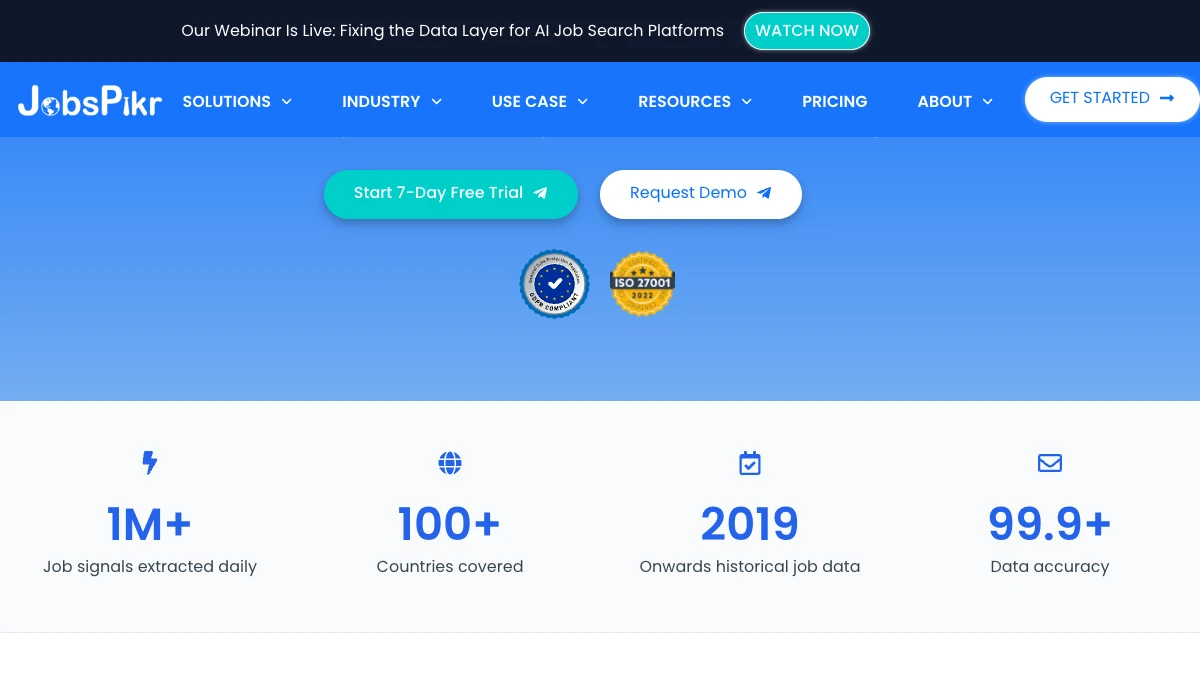
JobsPikr’s homepage claims 1M+ job signals a day, 100+ countries and history from 2019 (captured November 2026).
That framing matters. JobsPikr is strongest when the job post itself is the data you want to analyze, and weaker when the job post is only a trigger to find someone to email.
How JobsPikr Works
JobsPikr runs a daily pipeline: collect, cleanse, enrich and deduplicate job ads. Its data overview page describes bots scanning job sources every day and machine learning filling in fields the posting doesn’t state outright.
- Collection. Job boards and company websites, which JobsPikr puts at 70,000+ sources on its Job Data API page.
- Standardization. Job titles map to the O*NET SOC occupation taxonomy, and each posting gets the hiring company’s industry, size and business type.
- Enrichment. Inferred salary, education and experience, plus a skills model the data overview says identifies around 50k distinct skills.
- Deduplication. Removes the same company’s ad when it appears on multiple platforms in a short time frame.
- Delivery. XML feeds, CSV/JSON/XML downloads, S3/FTP exports, the API, or JobsPikr Insights dashboards.
You query by job title, company, location, category, post date and keywords in the job description, then download the matches. Every downloaded job counts against your monthly credit limit.
JobsPikr Key Features: Feeds, API and Dashboards
Job Data Feeds
The feed is the core product: structured postings with title, company, location, salary and “20 more fields,” in JobsPikr’s words. Delivery options are live XML feeds updated daily, manual CSV/JSON/XML downloads, and scheduled exports to S3 or FTP.
The plan comparison table on the pricing page gives Starter XML feeds and manual downloads, then adds S3/FTP export and the API on Growth. Kick-off isn’t listed in that data-access table, so confirm how you’d pull data during the trial.
Job Search API
The API page lists three endpoints: a Job Search API for filtered queries, an Expired Jobs API that returns jobs that expired within a date range, and an Aggregation API that returns counts, such as jobs by category or location. Responses come back as JSON or XML.
Two caveats. API access is marked for Growth and Enterprise only, and the API reference lives in a support portal that redirects to a login, so you can’t read the docs before you sign up.
The Expired Jobs endpoint is the underrated piece. Knowing when a role closed says more about time-to-fill and real demand than the open listing alone.
Historical Job Posting Data
JobsPikr says it has collected postings continuously since 2019, according to its historical data page. You scope a request by date range, geography and role, and JobsPikr follows up with available coverage and next steps.
This is where JobsPikr earns its keep for research teams. You can start scraping today’s jobs yourself, but you can’t go back and collect what employers advertised in 2020.
Pre-Built Datasets and One-Off Downloads
For one-time needs, JobsPikr sells ready-made datasets and a “Single Use Data Download” priced on request. The datasets page lists JSON, CSV and XLSX as delivery formats.
JobsPikr Insights Dashboards
JobsPikr Insights is the dashboard layer built on the same job feed. The Insights page lists custom dashboards by location, skill or role, emerging-skills tracking, downloadable reports, and salary benchmarking across up to five companies.
It’s aimed at HR, workforce planning and compensation teams who want answers without building a pipeline. Sales teams get less from it, because the dashboards summarize markets rather than list accounts to call.
Enrichment Fields by Plan
The richer fields are gated. Seniority, inferred salary, skills, industry, standardized company name and company type (agency or direct employer) start on Growth, while education and experience requirements are Enterprise only.
Company type is the field sales teams should care about most. Without it, recruitment-agency postings mix in with direct employers, and you end up prospecting the agency instead of the company that’s actually hiring.
JobsPikr Pricing: Plans, Credits, What You Actually Pay
JobsPikr has four subscription plans plus one-off data purchases. Prices below come from the JobsPikr pricing page in November 2026, where they display as images rather than text.
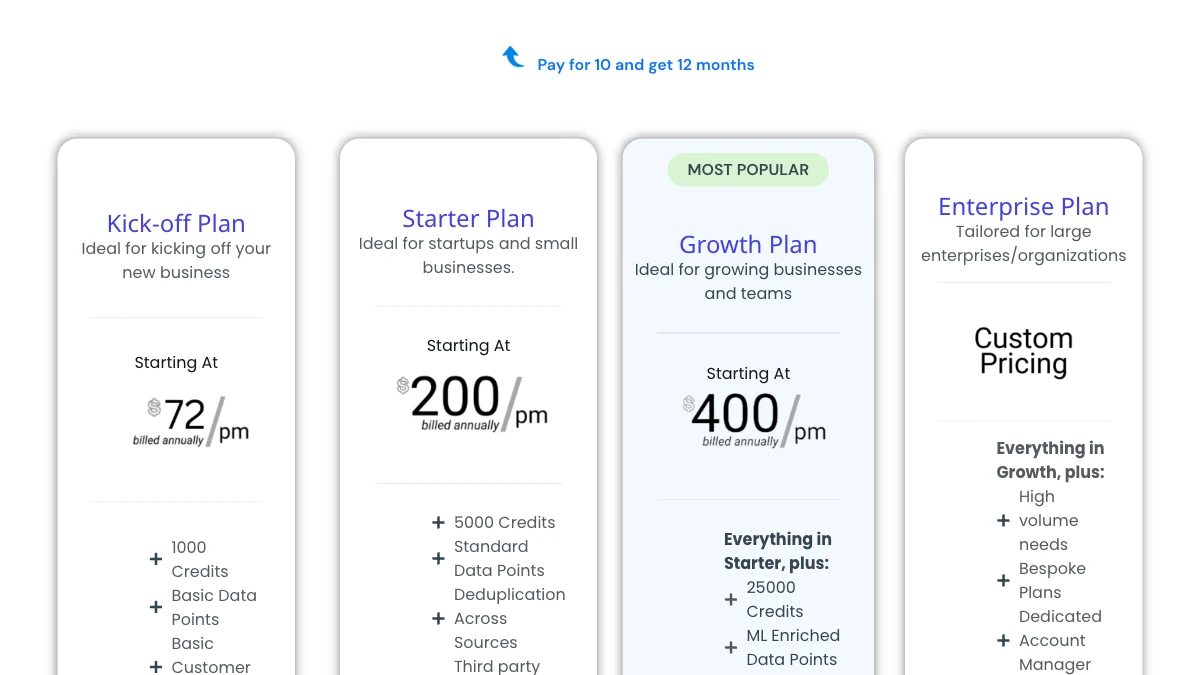
JobsPikr pricing, annual view: Kick-off $72, Starter $200 and Growth $400 a month billed annually (captured November 2026).
| Plan | Billed monthly | Billed annually | Job credits / month | Key inclusions |
|---|---|---|---|---|
| Kick-off | $79/mo | $72/mo | 1,000 | Basic data points, basic support, no deduplication |
| Starter | $240/mo | $200/mo | 5,000 | Deduplication across sources, remote-jobs filter, hiring department, XML feeds and manual downloads |
| Growth | $480/mo | $400/mo | 25,000 | ML-enriched fields (seniority, skills, inferred salary, industry, company type), API, S3/FTP export, onboarding specialist |
| Enterprise | Custom | Custom | High volume | Education and experience fields, account manager, enhanced SLAs, custom job source additions |
A credit is one job downloaded in a month, and add-on credits are available on every plan. Kick-off, Starter and Growth each list a 7-day free trial, and the homepage says no credit card is needed.
Cost per 1,000 Jobs
The per-job price falls sharply as you move up. Using the listed plan prices, monthly billing works out to $79 per 1,000 jobs on Kick-off, $48 on Starter and $19.20 on Growth, and annual billing brings those to $72, $40 and $16.
The catch is that the cheapest per-job tier is also the first with API access. If you need programmatic access, the realistic entry point is Growth at $400 a month billed annually on the pricing page, or $4,800 a year.
The Annual Discount
The yearly toggle advertises “Pay for 10 and get 12 months.” That math holds for Starter and Growth, but Kick-off’s annual rate is a smaller cut: $72 a month versus $79 on the pricing page.
Coverage, Freshness and Deduplication
Sources and Countries
JobsPikr claims 70,000+ sources, more than 1 billion historical records and 1M+ records touched daily on its Job Data API page, and 100+ countries on its homepage. The data overview page says “over 75,000 websites daily,” so treat the exact source count as approximate.
There’s no public source list. The dataset request form names boards like Indeed, Glassdoor, LinkedIn, Monster, Seek, Reed and Naukri Gulf, which shows the mix but not coverage depth by country.
Freshness
Feeds refresh daily, and JobsPikr markets them as real time. For sales triggers, daily is fine; for job boards competing on freshness, ask how fast a new posting shows up, because the site doesn’t publish a latency figure.
Deduplication
Deduplication isn’t on the Kick-off plan. JobsPikr defines a duplicate as one company’s ad posted on multiple platforms in a short time frame, and removes them from Starter up.
On Kick-off, expect the same role to appear more than once when it runs on several boards. That inflates hiring counts, which matters if you treat job volume as a buying signal.
Accuracy and Compliance Claims
The homepage claims “99.9+” data accuracy and shows GDPR and ISO 27001:2022 badges. We couldn’t find a published method behind the accuracy figure, so read it as a vendor claim.
Job Posts Are Not Hires
JobsPikr’s own historical data page makes a fair point: job postings show advertised demand, not completed hires or headcount. Keep that in mind before reading a spike in postings as proof a company is growing.
What Users Say About JobsPikr
Third-party review volume is thin. Capterra shows an average of about 4.5 out of 5 from roughly a dozen reviews, and G2 has a single review, so neither score says much on its own.
Across those reviews, praise centers on ease of use, data freshness and responsive support. Complaints are scattered: one reviewer flagged poor customer service, another found some imported jobs had already expired, and one wanted candidate data, which JobsPikr doesn’t sell.
The testimonials JobsPikr features on its own pages come mostly from data engineering and talent intelligence roles. That’s a fair read on who the product is built for.
Sales Prospecting or Labor-Market Research: Who Should Use JobsPikr
Strong fit: labor-market and workforce research
- Workforce planning and talent intelligence teams tracking skills demand and how roles change across markets.
- Compensation analysts benchmarking salaries against competitors, either in Insights or from the raw feed.
- Investors and alt-data analysts using hiring as a leading indicator. JobsPikr runs a separate investor offering with stock ticker mapping.
- Job boards and HR tech platforms that need a steady feed of structured postings to display or analyze.
- Academic and economic researchers who need a multi-year archive rather than a current snapshot.
Mixed fit: sales prospecting
JobsPikr does have a sales intelligence page: role-based trigger feeds, skill signals like Python, React or Salesforce in job ads, and layering hiring data into HubSpot or Salesforce for lead scoring.
The gap is the last mile. JobsPikr returns the job post and the hiring company, and its contact-details field only shows up when the posting itself names a recruiter or hiring manager.
So for outbound, plan a second step to find the decision-maker and their email. Our guide to using hiring signals to time sales outreach walks through that workflow, and our hiring signal tools comparison covers tools that bundle contacts.
Poor fit
- Small sales teams that want a list of accounts and contacts, not a data pipeline.
- Teams that need API access on a tight budget, since the API starts on Growth.
- Buyers who need to read API docs and a full source list before they commit.
JobsPikr Alternatives
If JobsPikr’s pricing or focus doesn’t fit, these are the tools worth comparing. Our ranking of the best job postings APIs goes deeper on the API-first options.
Hirebase
Hirebase includes its job APIs on every plan, from a free tier of 500 jobs a month to Starter at $99 a month for 25,000 jobs, per its pricing page. That’s the same monthly volume as JobsPikr Growth for far less, though JobsPikr’s 2019 archive and research enrichment are its edge.
TheirStack
TheirStack charges 1 credit per job and starts at $19 a month for 1,500 credits with no commitment, per its pricing page. It’s built for sales teams, with tech-stack detection from job descriptions plus API, webhooks and MCP access; see our TheirStack review.
PredictLeads
PredictLeads sells company-level signals rather than a raw feed: 1 credit returns up to the latest 1,000 job openings for one company, and credits start at $0.04, per its pricing page. New accounts get $20 in free credits; our PredictLeads review covers its coverage.
Mantiks
Mantiks turns job posts into leads and finds the contacts to approach, which closes JobsPikr’s biggest gap for sales. Starter is €99 a month excluding tax for 500 credits on its pricing page; our Mantiks review covers the trade-offs, and our Mantiks alternatives roundup ranks five other hiring-signal tools.
Lightcast
Lightcast is the enterprise benchmark for labor-market intelligence and skills data, aimed at workforce, education and economic development teams. JobsPikr runs a head-to-head comparison page against it, so it’s the natural shortlist partner if research is your use case.
| Tool | Entry price | What a unit buys | API | Best for |
|---|---|---|---|---|
| JobsPikr | $79/mo ($72 billed annually) | 1 credit = 1 job downloaded | Growth and Enterprise | Labor-market research, job boards, historical analysis |
| Hirebase | Free (500 jobs/mo); Starter $99/mo | 25,000 jobs/mo on Starter | All plans | Developers who want cheap API volume |
| TheirStack | $19/mo for 1,500 credits | 1 credit = 1 job | Yes, plus webhooks | Sales teams, tech-stack targeting |
| PredictLeads | $20 free credits; from $0.04/credit | Up to 1,000 latest openings for one company | Yes | Company-level signal enrichment |
| Mantiks | €99/mo excl. tax, 500 credits | Hiring companies plus contacts | Growth plan and up | Sales and staffing teams |
JobsPikr Pros and Cons
Pros
- Deep history. JobsPikr says it has collected job postings continuously since 2019, and you can scope historical pulls by date range, geography and role instead of buying the whole archive.
- Several ways to get the data: live XML feeds, CSV/JSON/XML downloads, scheduled S3 or FTP exports, and an API with search, expired-jobs and aggregation endpoints.
- Research-friendly enrichment. Titles map to the O*NET SOC taxonomy, and higher plans add inferred salary, seniority, skills, industry and an agency-versus-employer flag.
- Self-serve plans and a 7-day free trial with no credit card, so you can test coverage before talking to sales.
- JobsPikr Insights gives HR and compensation teams dashboards, salary benchmarking and reports without building a data pipeline.
- Prices drop steeply with volume: from $79 per 1,000 jobs on Kick-off to $16 per 1,000 on annual Growth.
Cons
- API access starts on Growth, which costs $400 a month billed annually or $480 a month billed monthly. Starter buyers get feeds and downloads only.
- Key fields are gated. Seniority, industry, skills, inferred salary and the agency-versus-employer flag need Growth, and Kick-off has no deduplication at all.
- No decision-maker contacts. The contact field only shows a recruiter or hiring manager when the job post itself lists one, so sales teams need a separate enrichment step.
- The API reference sits behind a support-portal login, and there is no public list of job sources by country.
- Thin third-party proof: a single G2 review and roughly a dozen on Capterra.
- Its own pages quote slightly different source counts (70,000+ in most places, 75,000 on the data overview page), and plan prices appear only as images.
JobsPikr Review Verdict: Is It Worth It in 2026?
JobsPikr earns a 3.7/5. For labor-market research, compensation benchmarking and job-board data, it’s a solid buy: a multi-year archive, daily feeds, research-friendly enrichment, and self-serve plans you can trial for a week.
For sales prospecting, it’s raw material, not a finished product. You pay $400 a month or more (billed annually, per the pricing page) to get the API and the agency filter, then still need a separate step to find who to contact.
Our advice: if you’re evaluating the API, run the 7-day trial on Growth. Pull a sample for your exact countries and roles before you commit to a year.
If the missing decision-maker contacts are a dealbreaker, SyncGTM is one alternative worth a look: it pairs hiring signals with work email and phone enrichment, then pushes leads to Instantly, Smartlead, HeyReach or your CRM.