

Mantiks Review 2026: Hiring Signals From Job Offers, Pricing

By Kushal Magar · November 27, 2026 · 11 min read
Key Takeaway
Mantiks turns job postings into qualified B2B leads by identifying companies that are actively hiring and surfacing the right decision-maker contact. Its agency-post decoding is unique in the category. The main trade-offs: annual-only pricing, undisclosed job board coverage, and modest credit limits on the entry tier. It earns its price for staffing firms and IT services teams; it's oversized for teams that need multiple buying signals.
Short version of this Mantiks review: it’s a focused hiring-signal tool that converts job postings into leads with bundled contact data. Starter plan is €99/month on an annual commitment for 500 credits. Its agency-post decoding — identifying the real client behind recruitment-agency job ads — is a capability no other tool in this category matches. Our rating: 3.8/5.
Most buying-signal tools pull from LinkedIn activity, review sites, or intent cookies. Mantiks takes a narrower bet: it assumes that when a company posts a job, it is growing, spending, and open to vendor conversations.
That bet is well-founded for specific audiences — staffing firms, IT services companies, training providers, and B2B sales teams whose ICP correlates with headcount growth. For everyone else, hiring data is one signal among several, and a single-signal tool has clear ceiling.
This review covers exactly what Mantiks delivers: its job board coverage, how credits work, what the contact data looks like, which integrations are real, and where it falls short compared with TheirStack and LoneScale.
What Is Mantiks?
Mantiks is a French B2B prospecting platform that monitors job postings across major job boards, identifies companies that are actively hiring, and surfaces decision-maker contact data — LinkedIn profiles, business emails, and direct phone numbers — for the right persona at each company.
The core insight driving the product: a company posting jobs is a company with open budget, an active pain point, and a decision-maker who needs to solve it. That signal arrives earlier than a funding announcement and is more reliable than anonymous intent data.
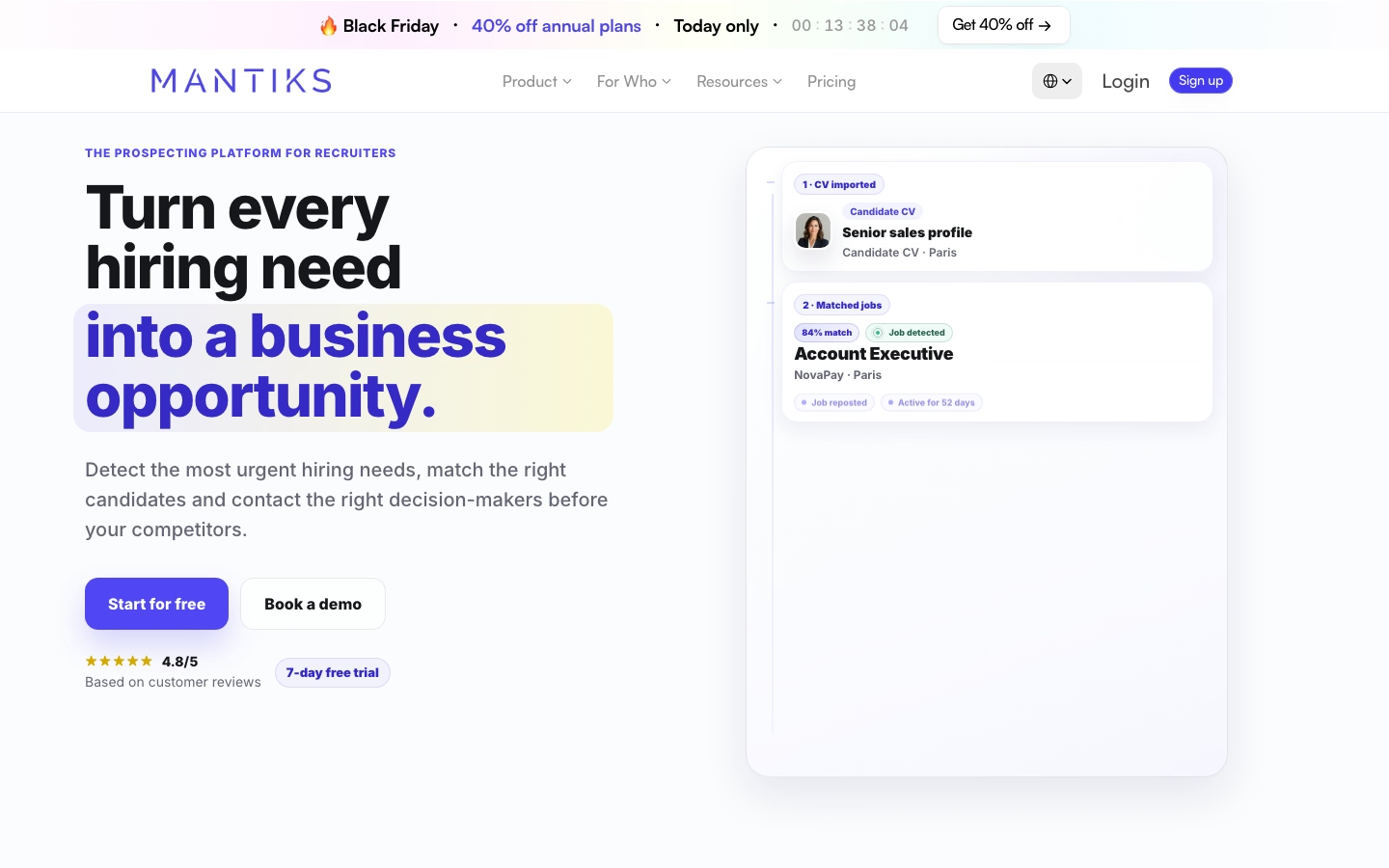
Mantiks positions itself as hiring-signal intelligence for sales and recruiting teams (verified November 2026).
Mantiks targets three primary audiences: recruitment agencies, consulting and IT services firms, and sales teams whose ICP is defined by headcount growth.
How Mantiks Works
Mantiks continuously crawls job postings from major job boards and describes its job detection as continuous monitoring. Most intent data vendors operate on weekly or monthly batch cycles, and stale hiring signals are significantly less actionable.
When you set up a monitoring filter — job title, keyword, industry, location, or company size — Mantiks alerts you when matching postings appear. For each match, it recommends the most relevant decision-maker persona. If a company posts for a software engineer, Mantiks surfaces the CTO or Head of Engineering. If it posts for an account executive, it surfaces the VP of Sales.
The step that differentiates Mantiks from every other tool in this category is its agency post analysis. Many job boards are flooded with postings published by recruitment agencies on behalf of their clients — the actual hiring company is hidden. Mantiks decodes those postings and identifies the end client. That alone surfaces a meaningful portion of the market that direct-employer-only scrapers miss entirely.
For staffing and recruiting use cases, there is a CV-matching workflow: upload a candidate profile and Mantiks finds companies currently hiring for similar roles, scored by fit. No general B2B sales intelligence tool offers this.
Mantiks Key Features
Job Monitoring and Hiring Alerts
Set filters by job title, keyword, industry, company size, or location. Mantiks sends automated alerts when matching postings appear. Urgency scoring prioritizes companies that have reposted roles multiple times or increased hiring volume — signals of active, unfilled pressure rather than passive job postings.
Decision-Maker Contact Data
For every company flagged by a hiring alert, Mantiks identifies the most relevant decision-maker and provides a LinkedIn profile, business email, and direct phone number. Emails, phones and LinkedIn profiles are all included from the Starter plan.
Agency Post Decoding
Mantiks analyzes job postings published by recruitment agencies and identifies the real client company behind them. This is the platform’s clearest technical differentiator — it surfaces a segment of the market that direct-scraping tools structurally cannot reach.
CV-to-Opportunity Matching
Upload a candidate CV and Mantiks maps it to companies currently hiring for similar roles, ranked by opportunity score. This feature is designed for HR tech vendors and staffing firms, not for standard B2B outbound.
Bulk Exports and Recurring Reports
Bulk data exports and scheduled recurring reports are available on the Growth plan and above. The Starter plan offers standard (non-bulk) exports. For teams running structured outbound sequences, Growth-tier exports integrate more cleanly with CRM workflows.
Outreach Campaigns (Ultimate Only)
The Ultimate plan adds a built-in outreach layer: up to 5 active campaigns with 1,000 contacts per audience. This is a lightweight sequencing tool, not a replacement for a dedicated platform like Instantly or Lemlist — but it removes one integration step for teams with modest volume.
API, Webhooks, and CRM/ATS Workflows
API access and webhooks start on the Growth plan, alongside CRM/ATS workflows. Mantiks also mentions native integrations but doesn't list them on its homepage or pricing page. The Job API covers four operations: searching hiring activity, monitoring companies, enriching contacts, and automating delivery to downstream tools.
Mantiks Pricing: Plans, Credits, What You Actually Pay
Mantiks has four tiers as of November 2026. All prices verified from the Mantiks pricing page. All prices are EUR-denominated and exclude VAT. Paid plans require an annual commitment, and annual billing is 20% cheaper than the 3-month Discovery term.
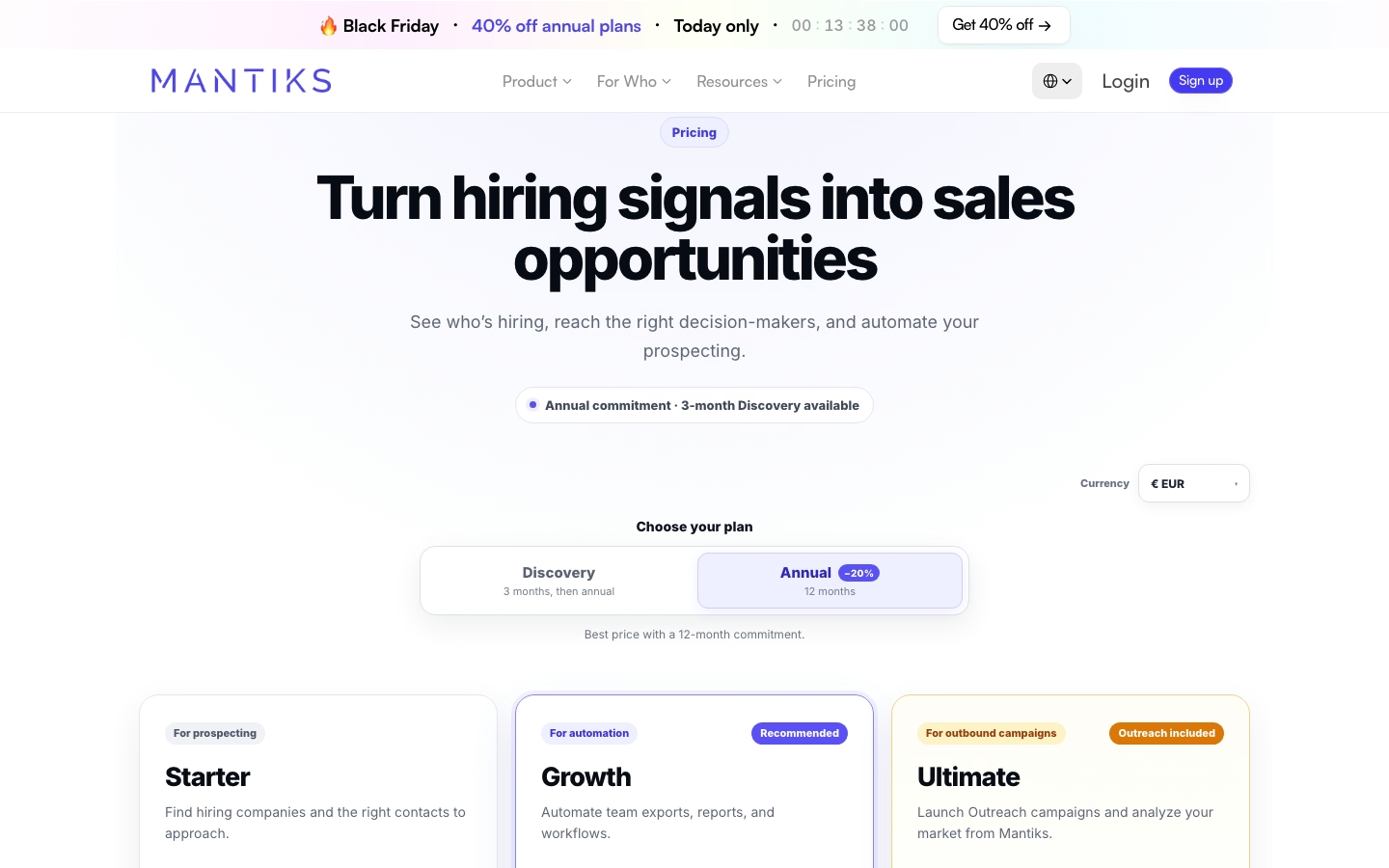
Mantiks pricing page (November 2026). All paid plans are annual-only.
| Plan | Price/month | Credits/month | Seats | Key additions |
|---|---|---|---|---|
| Starter | €99 (annual) | 500 | 1 (+€34/seat) | Emails, phones and LinkedIn profiles, standard exports, CV-to-opportunity matching |
| Growth | €190 (annual) | 1,000 | 1 (+€68/Growth, +€34/Starter) | Bulk exports, recurring reports, CRM/ATS workflows, API and webhooks |
| Ultimate | €350 (annual) | 1,500 | 1 (+€90/Ultimate) | Outreach campaigns (5 active, 1,000 contacts/audience), Market Analysis |
| Outsourced | Custom | Unlimited | Custom | Done-for-you prospecting: targeting, enrichment, qualification, CRM integration |
Credit math at Starter: 500 credits per month at €99 works out to roughly €0.20 per contact reveal including phone numbers. The constraint is volume: 500 credits supports a focused outbound motion, not a high-velocity SDR team.
Discovery option: Mantiks offers a 3-month Discovery term that converts to annual billing. This reduces the upfront commitment for teams uncertain about coverage fit.
Outsourced prospecting: For agencies and teams that want results without operating the tool themselves, Mantiks will run targeting, enrichment, qualification, and CRM integration end-to-end. Pricing is on request and scoped per engagement.
Data Coverage, Integrations, and What Users Say
Job Board Coverage
Mantiks does not publicly disclose which job boards it indexes. A customer testimonial on its homepage says it helps them “cover the main job boards,” and the product's own examples lean French (Paris roles, FR country codes). For teams targeting North America, Asia-Pacific, or niche job boards (sector-specific boards, local boards), coverage should be verified before purchase.
One vendor testimonial cites saving “about two hours daily” previously spent manually scanning job boards — which implies the coverage is sufficient to replace manual sourcing for the stated use cases. These are vendor claims and not independently verified.
Contact Data Quality
Mantiks provides business email, LinkedIn profile, and direct phone number for the recommended decision-maker persona at each hiring company. The specific update frequency for job detection is not documented in vendor-facing materials; contact data freshness is also not separately disclosed.
No G2 or Capterra profile exists for Mantiks as of November 2026. Third-party review data is limited to a small number of independent blog reviews — insufficient to generate reliable aggregate quality scores.
Integrations
Mantiks offers an API and webhooks for connecting to any CRM, ATS, or internal tool, and says native integrations exist without listing them publicly. The Job API covers four endpoints: job search, company monitoring, contact enrichment, and automated delivery. API access starts on the Growth plan.
Ask which CRMs connect natively before you buy; anything else goes through the API, which takes some technical setup.
See our broader analysis of best B2B data providers for sales teams for context on where hiring-signal tools sit in a full enrichment stack.
Who Should Use Mantiks — and Who Shouldn’t
Best fit
- Recruitment agencies and staffing firms — the core use case. Mantiks was built for teams that sell into hiring companies and need a systematic, automated way to identify and contact them.
- IT services and consulting companies — when a company posts for a developer, cloud architect, or data engineer, it often signals an infrastructure or integration project where an IT services firm can compete.
- Training and HR tech vendors — companies posting volume roles are often open to onboarding tools, LMS platforms, and HR software. Mantiks’ CV-matching workflow is particularly useful here.
- B2B sales teams targeting growth-stage companies — hiring volume is a reliable proxy for budget availability, especially for teams selling to companies with 10–200 employees.
Poor fit
- Teams that need multiple buying signals — funding rounds, technology usage, intent data, or social signals — in a single workflow. Mantiks covers one signal only.
- High-volume outbound teams. 500–1,500 credits per month is not enough for teams running 500+ weekly touches.
- Teams targeting companies outside Western Europe where Mantiks coverage has not been independently verified.
- Applicant tracking and bulk recruiting management. The platform explicitly says it does not cover these workflows.
For teams that need to combine hiring signals with technographic data, our best hiring signal tools comparison covers all the major options side by side.
Mantiks Alternatives
Mantiks operates in a category with a small number of direct competitors. Here are the ones worth evaluating:
TheirStack
TheirStack infers the technology stack a company is using or evaluating by analyzing job description language — not just job titles, but the tools, frameworks, and platforms named in postings. A free plan is available; no annual commitment is required on paid tiers. It is more developer-friendly than Mantiks and better suited to teams that want to filter prospects by tech stack rather than hiring volume alone. See our TheirStack alternatives breakdown.
LoneScale
LoneScale tracks two signals simultaneously: job change alerts (when a known contact moves to a new company) and hiring activity. For teams with an existing contact database who want to combine re-engagement triggers with new account prospecting, LoneScale covers more ground than Mantiks. Pricing is on request. See LoneScale alternatives for more options in this segment.
Dataset providers (TheirStack, SignalBase)
For teams that want raw job posting data via API — to build their own enrichment or trigger workflows — TheirStack and SignalBase offer cleaner API-first access than Mantiks. Mantiks is a workflow tool; TheirStack and SignalBase are data infrastructure. Our ranking of the best job postings APIs compares that category on sourcing, freshness and price.
Mantiks Pros and Cons
Pros
- Agency post decoding is a genuinely unique capability. Mantiks analyzes job postings published by recruitment agencies and identifies the end client behind them. No other tool in the hiring-signal category does this consistently, and it surfaces a substantial slice of the market invisible to direct-employer-only scrapers.
- Contact data is bundled — no second tool needed. Every lead Mantiks surfaces comes with a LinkedIn profile, business email, and direct phone number. For teams that would otherwise need a separate enrichment step, that all-in-one flow removes friction and cost.
- Continuous monitoring with daily signals. Mantiks describes its job detection as continuous monitoring — not a weekly or monthly batch job. Stale intent data is a persistent problem across the category; real-time or near-real-time detection is a meaningful differentiator.
- CV-to-opportunity matching is a standout for staffing and HR tech use cases. Upload a candidate profile and Mantiks finds companies actively hiring for similar roles — a workflow no general-purpose sales intelligence tool offers.
- A 7-day free trial and a 3-month Discovery term let you test job board coverage against your ICP before signing a 12-month contract.
- Outreach campaigns are built in on the Ultimate plan. Teams running smaller-volume targeted sequences don't need a separate sequencing tool if they upgrade.
Cons
- Annual commitment required on all paid plans. There is no month-to-month option on the Starter or Growth tiers — you lock in for 12 months before you know whether the data hits at scale. The 7-day free trial and 3-month Discovery term reduce this risk somewhat but don't eliminate it.
- Job board coverage is not disclosed. A customer quote on the Mantiks homepage credits it with covering 'the main job boards', but Mantiks does not publish the full list. That opacity makes it impossible to verify coverage gaps before buying, particularly for markets outside France and Western Europe.
- Credit volumes are modest relative to price. 500 credits per month on the Starter plan at €99 works out to €0.20 per credit. Teams running high-volume outbound will hit the ceiling quickly and need to either upgrade or supplement.
- No G2 or Capterra profile with verified reviews. As of late 2026, Mantiks has not accumulated enough third-party reviews to generate a reliable aggregate score. Vendor claims on the product page are unverified by external users.
- Pricing is EUR-denominated and annual-only on standard tiers. For teams outside the eurozone, currency risk applies. The absence of monthly billing adds cash-flow friction for smaller teams.
- The Ultimate plan's outreach feature is capped at 5 active campaigns and 1,000 contacts per audience — small enough that it won't replace a dedicated sequencing tool for teams doing serious volume.
Final Verdict: Is Mantiks Worth It in 2026?
Mantiks earns a 3.8/5 for the audiences it was built for. Recruitment agencies, staffing firms, IT services companies, and training vendors will get clear value from a tool that systematically turns job postings into qualified prospects — with contact data bundled and agency posts decoded.
The annual commitment is the main friction point. At €99/month, the Starter plan costs €1,188 per year for 6,000 total credits — roughly €0.20 per contact reveal. That is a fair price. But you are committing to it before fully validating job board coverage for your specific ICP and geography. The 7-day free trial and 3-month Discovery option mitigate that risk; the absence of monthly billing does not eliminate it.
For teams that need multiple buying signals — hiring activity combined with tech stack, funding rounds, or intent data — Mantiks is not the right choice as a standalone tool. It is a single-signal platform, and it makes no apology for that. Pair it with a multi-source enrichment layer if your prospecting strategy requires broader signal coverage.
If Mantiks’ single-signal approach and annual-only commitment are dealbreakers, SyncGTM is one alternative worth a look: it layers hiring signals alongside email and phone enrichment from 50+ providers, so contact coverage doesn’t depend on a single data source.