

6 Best Job Postings APIs for B2B Lead Generation in 2026

By Kushal Magar · November 27, 2026 · 13 min read
Key Takeaway
Job postings APIs surface companies in a buying window before they reach out to vendors. SyncGTM is the best pick for GTM teams — it connects job signal search to contact enrichment and CRM sync in one workflow from $49/mo. Hirebase leads on freshness at 1–2 hours. Fantastic.jobs wins on volume at 12M+ jobs/month. Techmap is the go-to for tech-stack signals derived from job descriptions. JobsPikr suits labor market analytics and compliance-sensitive use cases. People Data Labs is a solid developer choice for teams already using PDL for person and company enrichment.
A company posting ten SDR roles is in a buying window for sales tools. A startup that hired a VP of Revenue is about to pick a CRM and sequencer. The right job postings API surfaces that signal — before a company ever fills out a demo form.
The right job postings API turns that signal into a list of in-market accounts with contact data attached. The wrong one gives you a CSV you have to clean, deduplicate, and manually enrich before it is worth anything.
This guide compares six job postings APIs — SyncGTM, Hirebase, Fantastic.jobs, Techmap, JobsPikr, and People Data Labs — on the dimensions that matter for B2B sales teams: source (ATS vs job board), freshness, filters, webhooks, and cost per 1,000 postings.
TL;DR
- SyncGTM — best end-to-end GTM workflow: job signal search + contact enrichment + CRM sync, from $49/mo
- Hirebase — best freshness: 1–2 hours from career page to API, ATS-first crawling, Starter $99/mo (25K jobs/month)
- Fantastic.jobs — best volume: 12M+ jobs/month from 60 ATS platforms plus job boards like LinkedIn, from $45/mo
- Techmap — best for tech-stack signals: extracts software intent from job descriptions, AWS S3 delivery, contact sales
- JobsPikr — best for labor market analytics: 70K+ sources, ISO-27001, 5-year archive, pricing by inquiry
- People Data Labs — best for developer pipelines: 28.8M postings in beta, Snowflake/Databricks native, contact sales
Why Job Postings Signal Buying Intent
Hiring is a lagging indicator of budget allocation. By the time a company posts a job, budget has already been approved. A VP of Sales posting signals a CRM evaluation. A data engineering cluster signals a data warehouse or enrichment platform decision.
Most of a B2B buying process happens before a vendor conversation. By the time a prospect books a demo, budget is allocated and shortlisting has started. Job postings let you identify companies in that research phase before they reach out.
The key signals to watch for:
- Hiring a function head (VP of Revenue, Head of Marketing) → tool evaluation underway
- Posting 5+ roles in one department → budget approved and scaling
- Hiring roles that name a competitor in the job description → displacement opportunity
- Job description mentions your category explicitly → active evaluation signal
For more on using signals in B2B prospecting, see our guide to TheirStack alternatives for hiring-signal enrichment and the job posting data providers comparison.
1. SyncGTM
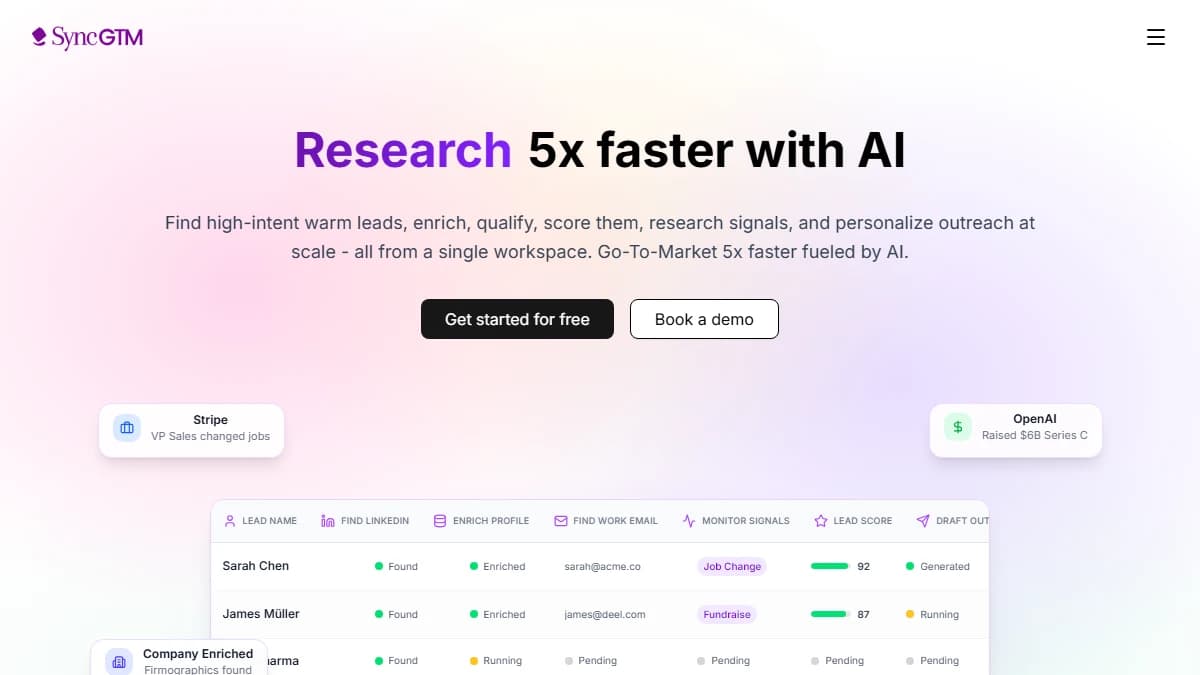
SyncGTM — job signals, contact enrichment, and CRM sync in one GTM workflow
SyncGTM is a GTM data platform that connects job posting signals directly to contact enrichment and outbound sequencing.
Where most job posting APIs stop at delivering raw job data, SyncGTM closes the loop. Its Job Openings signal finds companies actively hiring for target roles, and the search can re-run on a schedule (daily at the most frequent). Its LinkedIn Job Search action lets you pull job listings by title, seniority, location, and date posted directly from LinkedIn's job index. Both actions feed into SyncGTM's waterfall enrichment engine — covering 20+ providers — so the moment you identify a company hiring a VP of Sales, you can enrich the CEO's email and mobile number and push the contact to your CRM without leaving the platform.
Access is available across the app, the CLI (npm install -g @syncgtm/cli) and MCP (Claude, Cursor, and other AI clients), so sales teams and technical users building enrichment pipelines can run the same job signal workflow.
Pros
- Job signals feed directly into contact enrichment — no CSV export or separate tool
- LinkedIn job search + job openings signal in one platform
- MCP access lets AI agents build lead lists from hiring signals autonomously
- Waterfall enrichment from 20+ providers on the same credit balance
- Native HubSpot, Salesforce, Pipedrive, and Attio sync
Cons
- Job postings search is a signal feature, not a raw data delivery API — not suitable for building a job board or HR product
- Job data comes back as table rows for enrichment, not as a bulk historical archive
Best for: GTM teams who want hiring signals + contact enrichment + CRM sync without assembling a data stack from scratch.
Pricing: From $49/mo (Solo, 1,000 credits) — see SyncGTM pricing. Pro plan at $249/mo includes unlimited lead finder and 10,000 credits.
2. Hirebase

Hirebase — direct career-page and ATS crawling with 1–2 hour job freshness
Hirebase is a direct-source job posting API built on ATS and career page crawling rather than job board aggregation.
It crawls 1,180,000+ career pages and 80+ ATS platforms including Greenhouse, Lever, Workday, Ashby, and iCIMS. New postings appear in the API within 1–2 hours of going live. Expired listings are detected and removed hourly, keeping the active dataset clean.
Active coverage sits at 6.6M+ jobs — smaller than aggregator-based APIs but fresher with automated deduplication. Hirebase also offers a Hiring Manager API that returns the manager behind a posting at $0.30 per run, bridging the gap between job signal and decision-maker contact.
Pros
- 1–2 hour freshness — fastest among job posting APIs for ATS-sourced data
- Expired listings removed hourly — active dataset stays clean
- Semantic search across job descriptions for tech stack and keyword matching
- Hiring Manager API bridges job signals to decision-maker contact
- Free plan available for evaluation
Cons
- ATS-only sourcing — companies that only post to LinkedIn or Indeed are not covered
- Pull-only API (no webhooks) — requires polling on a schedule
- Some documented filters marked as not yet applied in the API
- Smaller active set (6.6M jobs) vs aggregator-based APIs that cover job boards too
Best for: Sales teams running intent-based outreach where reaching a company within 24 hours of a key hire announcement drives competitive advantage.
Pricing (hirebase.org/pricing): Free (500 jobs/50 companies/month); Starter $99/mo (25K jobs); Growth $249/mo (250K jobs); Scale $999/mo (2M jobs). Annual billing saves 20%.
3. Fantastic.jobs
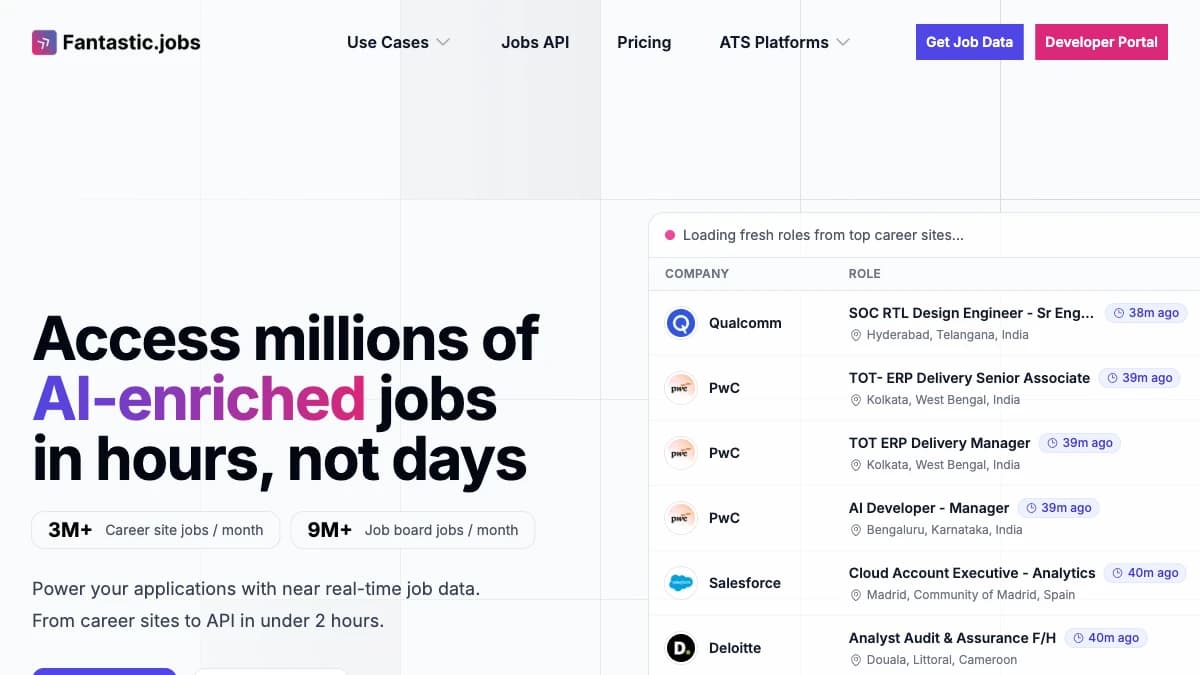
Fantastic.jobs — 12M+ jobs/month from career sites and job boards with AI enrichment
Fantastic.jobs is a high-volume job data API that combines direct career-site crawling with job board aggregation, covering 12M+ job postings per month.
Its source mix is unusually broad: 3M+ jobs per month from 275,000+ career sites (60 ATS platforms including Workday, Greenhouse, Lever, and iCIMS) plus 9M+ from job boards (including LinkedIn, Wellfound, and YCombinator). Data is refreshed hourly, with a 6-month backfill available on signup and 100+ country coverage.
The API adds AI-enriched fields to raw job data — normalized job titles, company size inferences, and technology classifications extracted from job descriptions. For high-volume consumers, enterprise delivery goes direct to S3, Azure, or Google Cloud. It is the clearest choice for teams building downstream products (job boards, HR tools, AI job platforms) that need raw volume at a low per-unit cost.
Pros
- Highest volume at 12M+ jobs/month — largest coverage across both ATS and job boards
- AI-enriched fields normalize raw job descriptions for downstream filtering
- Hourly refresh with 6-month backfill available out of the box
- High-volume delivery to S3, Azure, or Google Cloud
- Lowest entry price at $45/mo for Self Serve
Cons
- No webhooks — pull-based API
- High-volume tier ($1,000/mo+) requires a sales conversation for custom delivery
- Specific endpoint details and filter options require checking the external developer docs
Best for: Teams building job-board products, AI job platforms, or high-volume lead generation lists that need broad ATS + job board coverage at scale.
Pricing (fantastic.jobs): Self Serve from $45/mo (under 1M jobs/month); High Volume from $1,000/mo (1M+ jobs/month, reselling).
4. Techmap
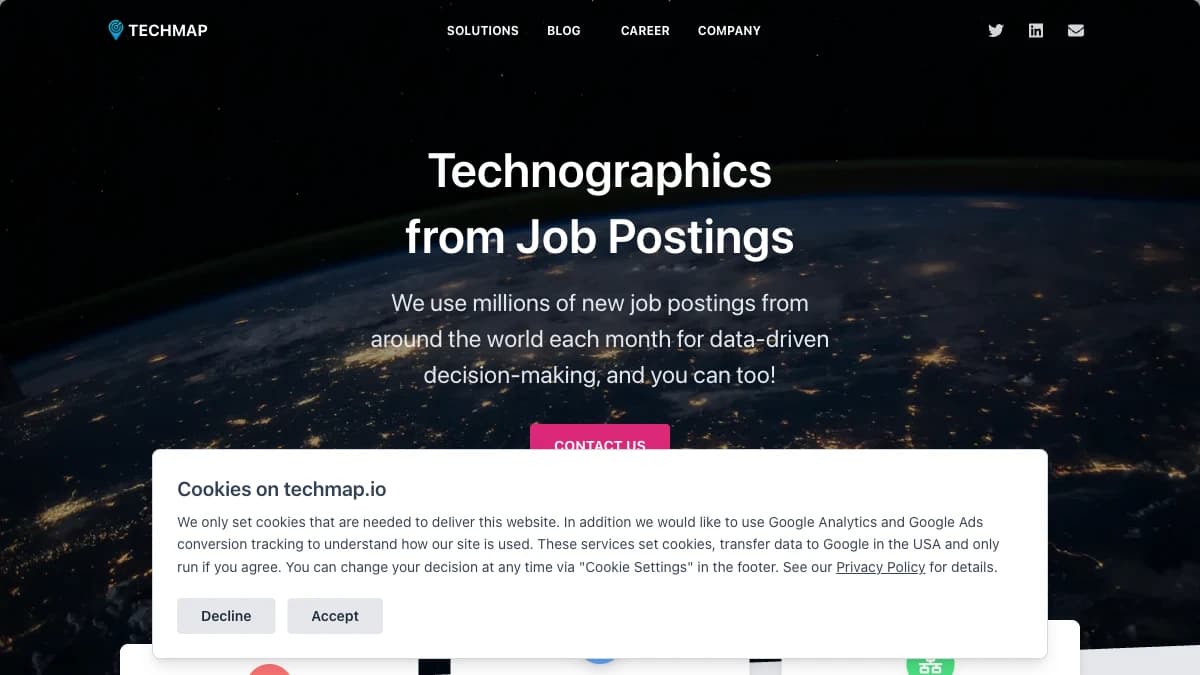
Techmap — technology signals extracted from job postings for B2B sales leads
Techmap takes a different angle on job posting data: rather than delivering raw job listings, it extracts technology signals from job descriptions to help sales teams identify which companies use — or are actively adopting — specific software tools.
Its job posting API feeds millions of new worldwide postings each month into a technology-mapped database. When a company posts a Salesforce admin role or a Snowflake data engineer, Techmap captures that as a technology signal and surfaces it in its search interface. Sales teams can filter companies by the technologies mentioned in their job posts to build targeted ICP lists — before those companies appear in any web-crawl technographic tool.
Data is delivered as JSON files from AWS S3 with daily updates. Techmap is also available on AWS Data Exchange, making it a natural fit for AWS-native data stacks. It is well-suited to teams who want to identify companies in an active implementation or migration, rather than just companies that already use a tool.
Pros
- Tech stack signal extraction from job descriptions — catches backend tools invisible to web-crawl technographics
- Surfaces companies in active adoption or migration (a stronger intent signal)
- AWS S3 delivery and AWS Data Exchange native — fits existing AWS data infrastructure
- Daily updates with worldwide coverage
Cons
- No public pricing — requires a sales conversation to evaluate cost
- No real-time delivery or webhooks — daily batch updates only
- No documented REST API endpoints or filter parameters on the public site
- Not suitable for contact enrichment or enrichment pipeline — delivers company signals only
Best for: Sales and marketing teams building ICP filters based on technology adoption signals, particularly those with existing AWS data infrastructure.
Pricing: Contact Techmap for pricing. Free data feed subscription available for evaluation.
5. JobsPikr
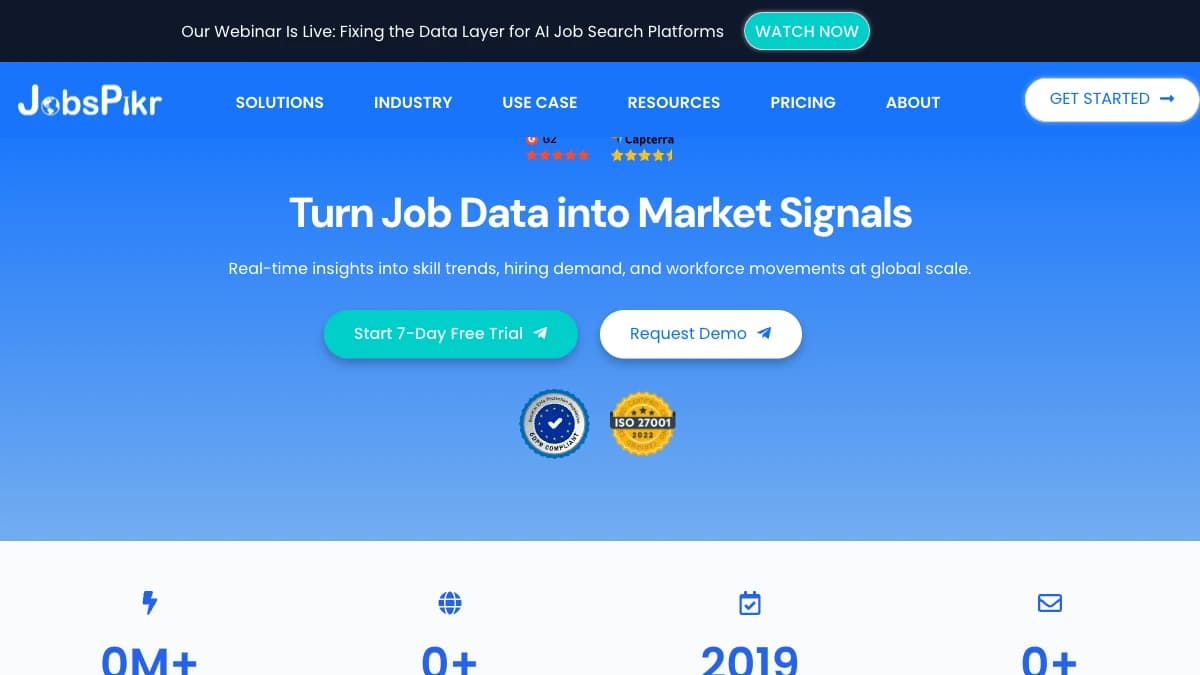
JobsPikr — 70K+ sources, ISO-27001 certified, 5-year historical job archive
JobsPikr is a labor market intelligence platform built on job board aggregation across 70,000+ sources and 100+ countries, with particular strength in historical depth and compliance certifications.
Its job data feed API collects from major job boards including Indeed, Glassdoor, LinkedIn, Monster, Seek, and Naukri, refreshed daily. Historical data goes back to 2019 — a 5-year archive useful for market research, compensation benchmarking, and longitudinal hiring trend analysis. JobsPikr is ISO-27001-2022 certified and GDPR-compliant, two certifications that matter for enterprise buyers in regulated industries.
For B2B lead generation, JobsPikr works best as a data source for teams building their own signal processing logic. It ranks 4.9/5 on G2 and 4.8/5 on Capterra, with users describing it as "the single source of truth for labor market data" and "absurdly cost-effective compared with in-house scraping."
Pros
- 70K+ sources — one of the broadest source counts among job data APIs
- 5-year historical archive dating to 2019 for trend analysis and competitive research
- ISO-27001-2022 and GDPR-compliant — suitable for enterprise and regulated industries
- G2 4.9 and Capterra 4.8 — strong user satisfaction
- 7-day free trial without a credit card
Cons
- Job board only — no direct ATS crawling, so freshness lags behind Hirebase
- No webhooks — daily batch delivery only
- Pricing not publicly listed — requires inquiry form submission
- Some counter elements on the homepage appear unrendered (placeholder values)
Best for: HR tech companies, workforce analytics platforms, and enterprise sales teams with compliance requirements who need broad historical coverage.
Pricing: Pricing by inquiry (Starter, Growth, Enterprise tiers). 7-day free trial available without a credit card.
6. People Data Labs
People Data Labs — developer-first job posting dataset with Snowflake and Databricks native delivery
People Data Labs (PDL) is a developer-first data platform best known for person and company enrichment, with a job posting dataset currently in public beta.
PDL's job postings product covers 28.8M postings scraped directly from company career pages, refreshed daily. Its value proposition rests on cross-join capability: because PDL also covers 70M+ companies and hundreds of millions of person profiles, job signals can be joined to contact data within the same data platform. For teams already using PDL's person or company APIs, adding job postings is a natural extension rather than a separate integration.
Delivery options include API, licensed data feeds, Snowflake, and Databricks — making PDL the strongest choice among these six for data engineering teams building enrichment pipelines in a modern data stack. See our People Data Labs alternatives guide for other options in the developer data space.
Pros
- Snowflake and Databricks native — fits modern data stack infrastructure without ETL
- Cross-join with PDL person and company datasets for immediate contact enrichment
- 28.8M postings from career pages with daily refresh
- Developer-friendly API with strong documentation
Cons
- Job posting product is still in beta — less production-hardened than Hirebase or Fantastic.jobs
- 24-hour refresh is the slowest among ATS-crawled options
- Pricing for job postings is not public — requires a sales conversation
- No real-time delivery or webhooks at this stage
Best for: Data engineering teams already using PDL's person and company APIs who want to add job signal enrichment without leaving the platform.
Pricing: Job postings pricing by inquiry (beta). Person Data Pro starts at $98/mo — see PDL pricing.
Side-by-Side Comparison
| Tool | Source | Volume | Freshness | Webhooks | Entry Price | Enrichment |
|---|---|---|---|---|---|---|
| SyncGTM | Multi-source signals | Job openings + LinkedIn jobs | Scheduled re-runs (daily+) | No (scheduled refresh) | $49/mo | Native (20+ providers) |
| Hirebase | ATS + career pages (80+) | 6.6M active | 1–2 hours | No | $99/mo API | Hiring Manager API ($0.30) |
| Fantastic.jobs | ATS (60 platforms) + job boards | 12M+/month | Hourly | No | $45/mo | AI field enrichment |
| Techmap | Job postings (undisclosed) | Millions/month | Daily | No | Contact sales | Tech stack signals only |
| JobsPikr | Job boards (70K+ sources) | 70K+ sources | Daily | No | Inquiry | None |
| People Data Labs | Career pages (beta) | 28.8M postings | Daily | No | Contact sales | Person + company cross-join |
Cost per 1,000 postings
Only Hirebase publishes prices tied to a job volume, so it is the one tool here where cost per 1,000 postings can be worked out from the public price list. At list price on hirebase.org/pricing, Starter ($99 for 25,000 jobs a month) works out to about $3.96 per 1,000, Growth ($249 for 250,000) to about $1.00, and Scale ($999 for 2M) to about $0.50, before the 20% annual discount. Fantastic.jobs prices Self Serve from $45 a month for applications under 1 million jobs a month without tying that price to a fixed volume, and Techmap, JobsPikr and People Data Labs quote job data on request. SyncGTM charges credits per search and enrichment rather than per posting, so compare it on cost per enriched contact instead.
How to Choose the Right Job Postings API
- If you want hiring signals that go straight into outreach: Use SyncGTM. The job signal feeds directly into contact enrichment and CRM sync — no pipeline to build. See our guide to the best B2B data providers for sales teams for the full enrichment landscape.
- If you want hiring alerts with decision-maker contacts rather than an API: look at a workflow tool instead. Our Mantiks review covers one built around job offers.
- If freshness drives your competitive advantage: Use Hirebase. Its 1–2 hour freshness and hourly expired-listing removal are unmatched among ATS crawlers. First-mover outreach on a new executive hire closes at a meaningfully higher rate.
- If you're building a downstream product: Use Fantastic.jobs. Its $45/mo entry price, 12M+ jobs/month, and cloud storage delivery make it the best raw data source for job boards, HR tools, and AI job applications.
- If tech stack signals are your ICP filter: Use Techmap. It extracts technology adoption signals from job descriptions that web-crawl technographic tools cannot see — particularly valuable for selling infrastructure, data, or developer tools.
- If compliance and historical depth matter: Use JobsPikr. Its ISO-27001 certification, GDPR compliance, and 5-year archive make it the right choice for enterprise HR tech and regulated industries.
- If you're already in the PDL ecosystem: Use People Data Labs. The ability to cross-join job signals with person and company profiles inside Snowflake or Databricks removes an integration step entirely.
Final Verdict
For B2B sales teams, the question is not which job postings API has the most data — it is which one gets you from "company is hiring a CFO" to "email sent to CFO" in the fewest steps.
SyncGTM wins that race because it eliminates the steps between signal and outreach. Job openings and LinkedIn job search feed directly into waterfall enrichment, CRM sync, and sequencer integration. The MCP access layer means technical users can automate the entire workflow through an AI client without any custom code.
Hirebase is the right choice if you value freshness above all else. At 1–2 hours from career page to API, it is the fastest signal in this comparison. Pair it with a separate enrichment provider and you have a strong intent-based outreach stack.
Fantastic.jobs at $45/mo is the strongest value pick for high-volume list building or for teams building a downstream product that needs raw job data at scale.
For the full picture on signal-based lead generation, see our LoneScale alternatives guide and the best SDR tools for prospecting in 2026.