

Oxygen Agent Review 2026: AI GTM Platform Pricing and Fit

By Kushal Magar · October 28, 2026 · 14 min read
Key Takeaway
Oxygen (oxygen-agent.com) is an agentic GTM platform that bundles search, waterfall enrichment, email, LinkedIn and WhatsApp sequences, a CRM, workflows, and content scheduling in one credit-based workspace. Agents optimize sequences, research ICP segments, and draft replies; Claude Code or Codex can drive it by CLI or MCP. Free tier: 250 credits. Paid: $49 to $1,999/mo at $1 per 100 credits, with inboxes ($4) and LinkedIn seats ($34) billed on top. Catches: agent chats default to Auto-approve, Salesforce sync is stated inconsistently, and there are no independent reviews yet. Our rating: 3.7/5.
Oxygen promises to replace a nine-tool GTM stack with one workspace where AI agents find accounts, write sequences, and update your CRM. This Oxygen Agent review checks what the product actually does, what it costs once you add inboxes and LinkedIn seats, and who it fits.
We read Oxygen's homepage, pricing page, docs, and integrations page on October 28, 2026. We did not run paid campaigns, so data quality and reply-rate claims below are labeled as vendor claims.
A naming note: this is OXYGEN at oxygen-agent.com, an agentic GTM platform. It is not Oxygen Builder, the WordPress page builder, or any other product called Oxygen.
TL;DR: Oxygen Agent Review 2026
- What it is: An all-in-one agentic GTM workspace: search, enrichment, sequences, CRM, workflows, and content scheduling.
- How it works: You describe a campaign in chat. Agents build tables, enrich them, launch email and LinkedIn sequences, and log every action and cost.
- Pricing: Free with 250 credits. Paid tiers run $49 to $1,999 a month at $1 per 100 credits. Inboxes, LinkedIn seats, and domains cost extra credits.
- Biggest strengths: Published per-action prices, free sending, credit caps on every paid run, and CLI/MCP access for coding agents.
- Biggest catches: Agent chats start on Auto-approve, Salesforce sync is described inconsistently, and independent reviews are missing.
- Best for: Small sales-led B2B teams and agencies that want one tool instead of a stitched stack.
- Rating: 3.7/5.
What Is Oxygen Agent?
Oxygen is an agentic marketing and sales platform for B2B GTM teams, sold by OXYGEN GTM Inc. Its hero line is "Agentic Revenue Platform where Growth becomes natural," and the subhead calls it a GTM operating system for CRM, outbound, and content workflows.
The product is built on four primitives: Tables, Sequences, Workflows, and CRM. A fifth layer, Context, stores your ICP, positioning, campaigns, and learnings in a knowledge graph Oxygen calls your "second brain."
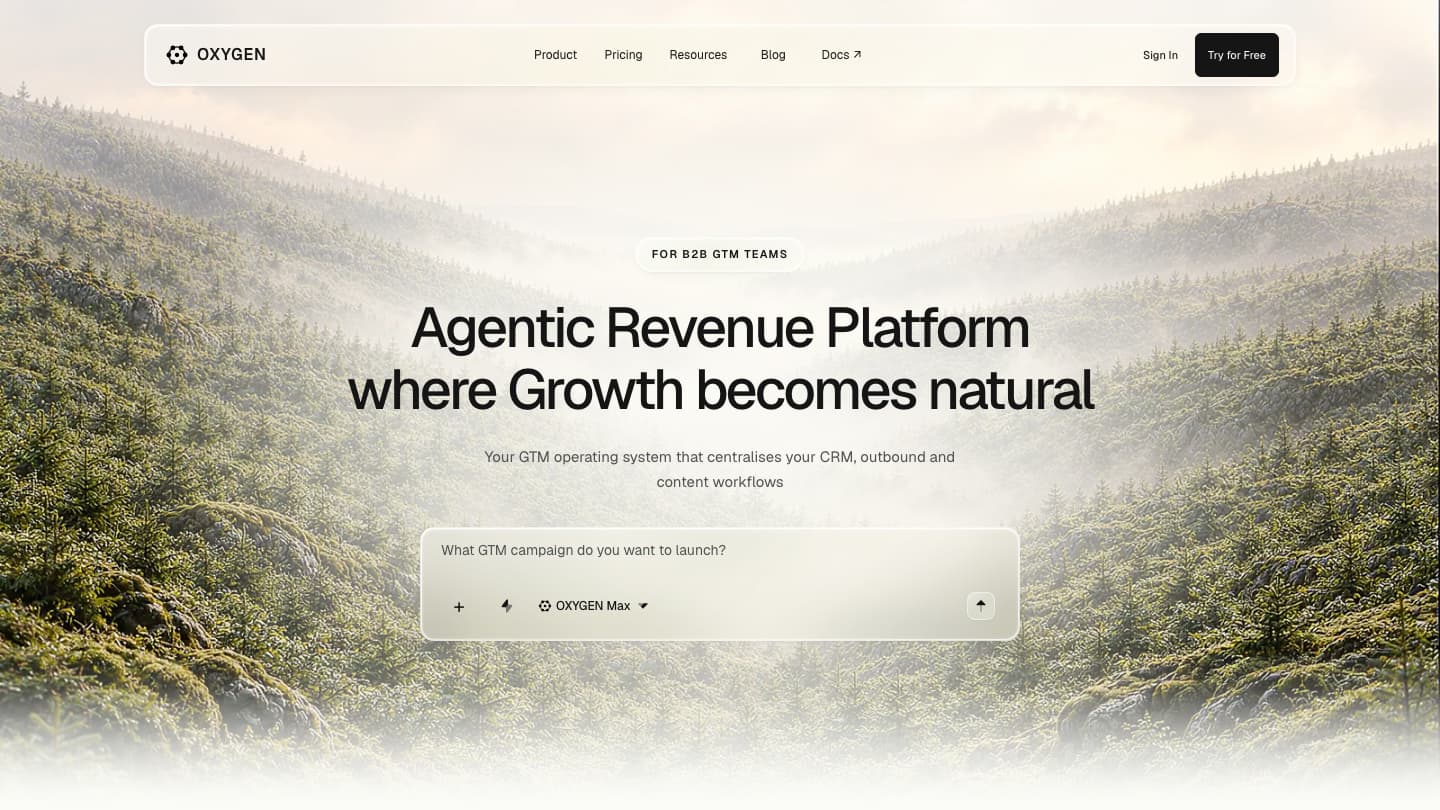
Oxygen's homepage on October 28, 2026. The prompt box is where you describe a campaign and pick a model tier.
Oxygen lists six use cases: TAM sourcing, inbound enrichment, content scheduling, multi-channel outbound, CRM workflows, and building the second brain. Its pitch is cost consolidation: the homepage prices a typical stack of data, CRM, sequencer, inbox, LinkedIn, scheduling, and automation tools at about $726 a month, against Oxygen "from $49."
Treat that comparison as marketing. The $49 tier buys 4,900 credits, and inboxes and LinkedIn seats draw from that same pool, as the pricing section below shows.
Setup: From Signup to First Campaign
Oxygen setup takes three steps: sign up free, let it build your second brain, then connect senders and launch. The homepage claims you can be set up in under 10 minutes; we did not time it.
- Sign up. No card is needed. The free workspace gets a one-time grant of 250 credits and has no time limit.
- Build context. Oxygen analyzes your offer, ICP, and competitors and pulls context from tools like LinkedIn, email, Slack, and Notion into the knowledge graph.
- Connect senders. Attach Google or Microsoft mailboxes, buy managed inboxes, or connect LinkedIn, WhatsApp, or X. This needs a paid plan.
- Source and launch. Ask the agent for a market, enrich the table, and approve a sequence.
The Oxygen docs follow the same order: first session, source leads, enrich leads, email setup, first sequence, newsletters, replies, and CRM records. The web app, the oxygen CLI, and any MCP client share one API, one approval system, and one credit balance.
How Oxygen Agents and Approvals Work
Oxygen runs two kinds of agents: a chat agent you direct, and standing agents that run on a schedule or trigger with a credit budget. Approvals decide how much they can do without you.
The chat agent
The in-app agent, called Oxygent (or the Workspace Agent), takes a plain-language brief like "find B2B software companies that match our ICP." In the homepage demo, the OXYGEN Agent then searches Apollo, BlitzAPI, Sales Navigator, and Ocean.io and dedupes the results into one table.
The chat box offers three model tiers: OXYGEN Max, Balanced, and Fast. The pricing page names AI column tiers slightly differently, as Fast, Balanced, and Frontier.
Standing agents
The homepage shows four example agents:
- Campaign Optimizer: daily, rewrites the sequence steps with the lowest reply rate.
- ICP Researcher: weekly, finds segments that reply and sources lookalike accounts.
- Sales Agent: drafts a reply to every new inbound conversation.
- Knowledge Agent: files each campaign's learnings into the second brain.
Approvals: read this before you launch
Oxygen's approvals docs define an approval as explicit human confirmation before live work spends credits or writes to an external system. Enrichment runs, sequence launches, publishing, LinkedIn engagement, CRM sync, and pushes to outside campaigns all fall under it.
The defaults matter. Copilot defaults to Ask for approval, but Oxygent chats start on Auto-approve, which the homepage FAQ says lets "sends, sequence starts and paid steps run without an approval card."
Paid steps under 100 credits also run without asking on every plan. Every approved run carries a credit cap, and work past the cap is skipped, not charged. Auto-approved actions are still logged in the chat's event log.
Our advice: switch the chat to Ask for approval before your first live sequence. An agent that can message prospects unprompted is a brand risk until you trust its copy.
Data Sources and Waterfall Enrichment
Oxygen does not own a contact database. It routes searches and lookups to outside providers, either on Oxygen's managed keys or your own.
The integrations page lists sourcing and enrichment providers including Apollo, ZoomInfo, People Data Labs, Wiza, Dropcontact, Ocean.io, PredictLeads, Crustdata, Findymail, Forager, Lusha, Hunter, and ZeroBounce. Web search runs through Firecrawl, Serper, Exa, and others.
How the waterfall bills
Per the waterfalls docs, a waterfall tries providers in order and stops at the first usable result. Managed email and phone finders charge only when they return a value.
- Before any finder runs, Oxygen may test up to eight guessed addresses through its verifier at 0.225 credits each.
- If a found email then fails verification, you pay for both the find and the check, and the waterfall moves on. One row can charge more than once.
- Own-key calls cost a 0.05-credit platform fee per successful call, even when nothing is found. Your provider bills you separately.
Oxygen publishes no hit-rate or accuracy figures we could check. Its FAQ suggests testing the waterfall on a sample of your own accounts with free credits, which is the right call. For context on how waterfalls compare, see our waterfall enrichment explainer.
Email and LinkedIn Execution
Oxygen sends outreach itself, from your mailboxes and LinkedIn account, so it competes directly with standalone sequencers. Sends cost 0 credits; the accounts behind them do not.
Sequences
The first sequence guide lists these step types: email, LinkedIn invites, messages and InMail, profile visits, follows, likes and comments, WhatsApp messages, call tasks, and CRM tasks. Steps can wait, wait for a signal, or branch on data.
- A reply ends the lead's enrollment on every channel.
- An optional company-level pause stops outreach to colleagues at the same company.
- Launches need approval plus a
--max-live-sendscap for email, WhatsApp, and CRM-task steps in the CLI. - A dry-run mode simulates the sequence without sending.
Inboxes and deliverability
You can connect Google or Microsoft mailboxes by OAuth, import mailboxes from Zapmail, or have Oxygen buy domains and managed inboxes. Warm-up is included, and optional placement testing costs $1 per inbox a month.
Managed inboxes do not remove the sending rules. Google's email sender guidelines still require authentication, low spam rates, and easy unsubscribe for bulk senders.
LinkedIn accounts connect through a hosted sign-in and cost $34 a month each. New accounts warm up for about two weeks by default, and an account's 20 daily invites go out 30 to 45 minutes apart.
Daily caps run at half volume on weekends unless you override it. Those defaults are conservative, which is good for account safety.
Oxygen CRM and Integrations
Oxygen includes a free CRM with companies, people, deals, and custom objects, plus funnel dashboards and a Unibox for email, LinkedIn, and WhatsApp threads. Workflows can move a record's stage when a positive reply arrives.
Syncing with an existing CRM is where the documentation gets messy. The homepage FAQ says "HubSpot syncs both ways, Attio receives updates and Pipedrive can be imported; there is no Salesforce sync."
The integrations page, checked the same day, lists Salesforce with "Sync CRM accounts, contacts, and deals." It also lists Close, Breakcold, Folk, monday.com, and Gong. Salesforce teams should get the sync direction in writing before signing.
If you want to keep your sequencer, Oxygen can push leads into Instantly, Smartlead, lemlist, or HeyReach campaigns. Salesforge, Reply.io, Woodpecker, and La Growth Machine are also listed.
For coding-agent users, the homepage lists Claude Code, Codex, Cursor, Grok, and OpenClaw as clients through the CLI or MCP. The CLI can install Oxygen skills into Codex, Claude Code, and Cursor.
Oxygen Pricing: Plans, Credits, What You Pay
Oxygen pricing is one plan sold at six credit levels, from $49 to $1,999 a month, plus a free tier and custom Enterprise. Every dollar buys 100 credits, and credits pay for data, AI, and sending accounts. Prices below were checked on oxygen-agent.com/pricing on October 28, 2026.
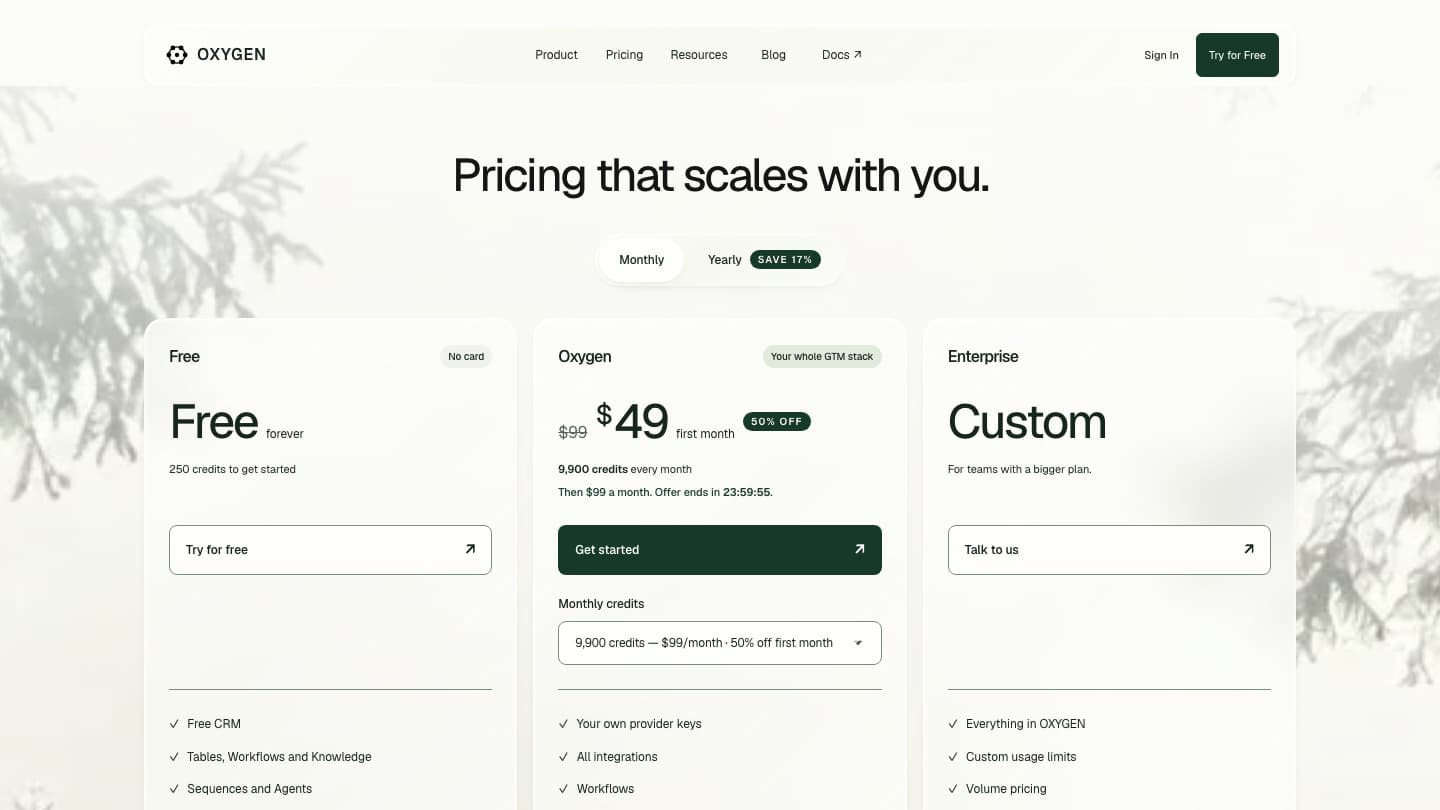
The pricing page showed a 24-hour "50% off first month" offer on the $99 tier when we checked. That is a promo; the list price is $99 a month.
| Plan | Monthly | Yearly (upfront) | Credits | Per 100 credits |
|---|---|---|---|---|
| Free | $0 | n/a | 250 one-time grant | n/a |
| Oxygen $49 | $49 | $490 | 4,900 / mo | $1.00 |
| Oxygen $99 | $99 | $990 | 9,900 / mo | $1.00 |
| Oxygen $199 | $199 | $1,990 | 19,900 / mo | $1.00 |
| Oxygen $499 | $499 | $4,990 | 52,395 / mo (+5%) | ~$0.95 |
| Oxygen $999 | $999 | $9,990 | 109,890 / mo (+10%) | ~$0.91 |
| Oxygen $1,999 | $1,999 | $19,990 | 229,885 / mo (+15%) | ~$0.87 |
| Enterprise | Custom | Custom | Custom | Volume pricing |
The free tier includes the CRM, Tables, Workflows, Knowledge, Sequences, and Agents, but you cannot connect sending accounts on it. The billing docs add that connecting new own-provider keys needs the $99 plan or higher.
What each action costs
| Action | Credits | USD | Note |
|---|---|---|---|
| Work email found (average) | 8.5 | $0.085 | Only charged when found |
| Mobile phone found (average) | 99 | $0.99 | Only charged when found |
| Email verification | 0.225 | $0.00225 | Per check |
| AI column, Fast tier | 1.5 | $0.015 | Per row run |
| AI column, Balanced tier | 4 | $0.04 | Per row run |
| AI column, Frontier tier | 25 | $0.25 | Per row run |
| Web Research Agent (Quick / Standard / Deep) | 2.1 / 5.5 / 10 | $0.021 to $0.10 | Per row |
| Workflow tool step | 0.05 | $0.0005 | Plus the tool's own price |
| Own-key (BYOK) provider call | 0.05 | $0.0005 | Platform fee; provider bills you |
| Email or WhatsApp send | 0 | $0 | Sending is free |
Sending accounts and add-ons
| Item | Price (in credits) | Note |
|---|---|---|
| Your own mailbox | $1 / mailbox / mo | Warm-up included |
| Managed Google Workspace or Microsoft 365 inbox | $4 / inbox / mo | Up to 5 per domain |
| Sending domain (.com) | $12.50 / yr | Registrar price |
| LinkedIn account | $34 / account / mo | Connections, messages, InMail |
| WhatsApp number | $34 / number / mo | Messages included |
| Phone number | $10 / mo | Plus $0.05 per connected minute |
| X account | $10 / mo | Posting and engagement |
| Dedicated IP | $25 / mo | Optional |
| Credit top-up | $1.30 / 100 credits | Never expires |
A realistic monthly bill
Here is the math for one founder running a modest outbound motion. The assumptions are ours; the unit prices are Oxygen's.
- 3 managed Google inboxes: 1,200 credits ($12)
- 1 LinkedIn account: 3,400 credits ($34)
- 1,000 work emails found: about 8,500 credits ($85)
- 1,000 Balanced AI column runs for ICP scoring: 4,000 credits ($40)
- Domain: 1,250 credits ($12.50) once a year
That is about 17,100 credits in a typical month. It outgrows the $99 tier (9,900 credits) and fits the $199 tier (19,900).
Phone numbers change the math fast. At an average of $0.99 per mobile found, 200 phones add about 19,800 credits.
What Users Say: Verified vs Claimed
Oxygen has almost no independent review footprint yet. We found no Product Hunt listing, G2 blocks automated checks, and search turned up no Reddit threads about the product as of October 28, 2026.
The social proof on the homepage is a curated wall of LinkedIn posts. A fractional GTM engineer calls it "probably the most efficient stack for smaller leaner teams," and an automation engineer calls it "early stage, but if you're serious about agentic GTM, this is one to test now."
| Claim | Source | Status |
|---|---|---|
| Get set up in less than 10 minutes | oxygen-agent.com homepage | Vendor claim; not tested |
| Grew from 0 to over 450 users in less than 45 days | LinkedIn post quoted on the Oxygen homepage | Third-party quote curated by the vendor; not independently verifiable |
| Finished fastest at 44 seconds in a tool benchmark | LinkedIn post quoted on the Oxygen homepage | Informal test; the author called it directional |
| Enrichment and AI billed at a flat 5x provider cost | oxygen-agent.com/pricing | Vendor claim; provider costs are not published |
| Salesforce sync | Homepage FAQ vs /integrations page | Conflicting: FAQ says no Salesforce sync, integrations page lists it |
| Independent G2, Capterra, or Product Hunt rating | Searched October 28, 2026 | None found |
Customer logos on the site include Sympower, SignalFisher, Flino, FIOR, Grasp, Growth Alliance, and Atticus. We found no published case studies with reply or pipeline numbers.
Oxygen Pros and Cons
Pros
- One workspace for search, enrichment, sequences, inboxes, LinkedIn, CRM, and content scheduling.
- Every action has a published credit price, and email and WhatsApp sends cost nothing.
- Pay-on-find enrichment for managed email and phone lanes.
- Credit caps on every paid run, with work past the cap skipped rather than charged.
- Full web app for non-technical users, plus CLI and MCP access for Claude Code, Codex, and Cursor.
- Free tier with no time limit, and top-up credits never expire.
Cons
- Oxygent chats start on Auto-approve, so sends can go out without an approval card unless you change it.
- Salesforce sync is described as absent on the homepage and present on the integrations page.
- Sending accounts eat plan credits: one LinkedIn seat uses most of the $49 tier's 4,900 credits.
- Top-ups cost $1.30 per 100 credits, 30% more than plan credits.
- No published hit rates and no independent reviews yet.
- Young product with naming drift between pages (Max vs Frontier model tiers).
Who Should Use Oxygen (and Who Shouldn't)
Oxygen fits small, sales-led B2B teams that want one bill and one workspace instead of a data tool, a sequencer, an inbox vendor, and a CRM.
Good fit
- Founders and 1 to 5 seller teams starting outbound from scratch.
- Agencies running campaigns for several clients on credits.
- GTM engineers who want Claude Code or Codex to run campaigns through MCP.
- HubSpot or Attio users who are happy to sync from Oxygen.
Poor fit
- Salesforce shops that need confirmed two-way sync today.
- Teams with a tuned sequencer and inbox setup they do not want to move.
- Buyers who need third-party reviews or audited data accuracy before purchase.
- Phone-heavy teams, since mobile finds average $0.99 each.
If you are still deciding between platforms and AI SDRs, our best AI SDR tools roundup and guide to B2B sales agents cover the wider category.
Oxygen Alternatives
The right Oxygen alternative depends on whether you want an all-in-one workspace or an autonomous AI SDR.
- Apollo.io: a large contact database with sequences and a CRM layer, priced per seat.
- Amplemarket: AI-assisted multichannel outbound with built-in data. See our Amplemarket review.
- Unify: signal-driven outbound plays. See our Unify review.
- 11x and Artisan: autonomous AI SDRs sold on annual contracts. Compare them in our 11x review and Artisan review.
For the full list, read our Oxygen Agent alternatives breakdown or the best AI agents for outbound.
Oxygen Agent Review: Final Verdict
Our rating: 3.7/5. Oxygen is one of the most complete all-in-one agentic GTM workspaces for small B2B teams, with unusually transparent unit pricing.
It earns points for free sending, pay-on-find enrichment, per-run credit caps, and letting both humans and coding agents work in the same workspace. The breadth is real: few tools combine inboxes, LinkedIn, a CRM, and content scheduling at this price.
It loses points for an Auto-approve default in agent chats, contradictory Salesforce statements, add-on costs that quickly push you past the entry tier, and no independent reviews. Start free, switch chats to Ask for approval, and test enrichment on 50 known accounts before you connect a mailbox.
If moving your sending into a new all-in-one platform is a dealbreaker, SyncGTM is one alternative worth a look: it finds and verifies contacts and tracks buying signals, then pushes leads into Instantly, Smartlead, or HeyReach.