


5 Best QuickEmailVerification Alternatives for B2B Enrichment in 2026

By Kushal Magar · June 14, 2026 · 13 min read
Key Takeaway
QuickEmailVerification is an email verification platform — it validates emails you already have via a credit-based model (free tier: 3,000 credits/month) but does not find new contacts, enrich B2B data, or support outreach. The 5 best QuickEmailVerification alternatives for B2B enrichment in 2026 are: SyncGTM (waterfall enrichment across 50+ providers with verified emails, 76+ data points, and CRM sync from $99/mo), ZeroBounce (AI catch-all scoring and spam-trap detection from $18/mo), NeverBounce (developer-friendly bulk verification from $0.003/email), Bouncer (B2B-focused catch-all toxicity scoring from $25/mo), and Hunter.io (domain-based email finder with verification and campaigns from $34/mo).
The best QuickEmailVerification alternatives solve a problem that QuickEmailVerification does not: they find and enrich B2B contacts before verifying them, rather than only cleaning a list you already own.
QuickEmailVerification built its reputation on reliable deliverability checks, 99% claimed accuracy, and compliance coverage — GDPR, CCPA, HIPAA, and ISO 27001. Serving 300,000+ businesses, it is a credible tool for what it does.
The problem is scope. QuickEmailVerification has no contact database, no email finder, no B2B enrichment layer, and no outreach functionality. For B2B teams doing prospecting — building lists from ICP accounts, enriching with firmographic data, and sequencing outreach — that is three additional tools you still have to stitch together.
The catch-all gap compounds this. On enterprise B2B lists where catch-all configurations are common, standalone verifiers flag addresses as unknown without resolution. A waterfall enrichment approach cross-references multiple providers to recover a meaningful portion of those valid contacts.
According to Gartner's B2B data quality research, contact data decays at roughly 30% per year. A tool that only verifies what you already have cannot keep pace with that decay. This guide compares five alternatives — the top three make QuickEmailVerification's standalone cleaning step unnecessary entirely.
Quick Summary
The best QuickEmailVerification alternatives in 2026 are SyncGTM, ZeroBounce, NeverBounce, Bouncer, and Hunter.io. SyncGTM is the top pick for most B2B teams — waterfall enrichment across 50+ providers, 76+ data points per verified person, buying signals, and native CRM sync from $99/mo.
TL;DR: Best QuickEmailVerification Alternatives in 2026
- SyncGTM — Best overall for B2B prospecting. Waterfall enrichment across 50+ providers, verified emails + phones, 76+ data points, buying signals, and CRM sync from $99/mo with a free tier.
- ZeroBounce — Best like-for-like upgrade. AI catch-all scoring, spam-trap detection across 30+ networks, email finder, and activity data from $18/mo.
- NeverBounce — Best for developers. Real-time API, batch processing, and pay-as-you-go from $0.003/email — competitive with QuickEmailVerification's volume tiers.
- Bouncer — Best for B2B list quality. Toxicity scoring on catch-all and risky addresses, bulk processing, and real-time API from $25/mo.
- Hunter.io — Best for domain prospecting. Domain search, email finder, 7-step verification, and built-in cold email campaigns from $34/mo.
Why Teams Look for QuickEmailVerification Alternatives
QuickEmailVerification is a list hygiene tool, not a prospecting platform. It answers "is this email deliverable?" — not "who should I email, what is their direct dial, and are they in-market right now?" That scope gap drives four recurring pain points for B2B teams.
Verification-only, no contact finding. QuickEmailVerification cleans the list you bring it. It has no contact database, no email finder, and no way to generate a list from target accounts. Every B2B team using it still needs a separate tool to build the list first.
Catch-all domains return "unknown" with no resolution. A significant share of enterprise B2B email addresses sit on catch-all domains. QuickEmailVerification, like most standalone verifiers, marks these as risky or unknown — suppressing valid addresses with no waterfall retry. Platforms that cross-reference multiple providers recover meaningful coverage on these addresses.
No B2B firmographic enrichment. QuickEmailVerification returns a verified or invalid flag per address. It returns no job title, company, LinkedIn profile, phone number, or technographic data. Every enriched field needed for personalised outreach requires a separate tool.
No outreach layer. QuickEmailVerification exports a cleaned list. It has no sequences, no CRM sync, and no analytics. Every verified contact still needs a separate tool to reach.
According to G2's email verification category data, teams that switch from standalone verification to integrated enrichment platforms report 35–50% higher deliverability and spend 60% less time on manual list hygiene. The five alternatives below each address one or more of these gaps.
1. SyncGTM
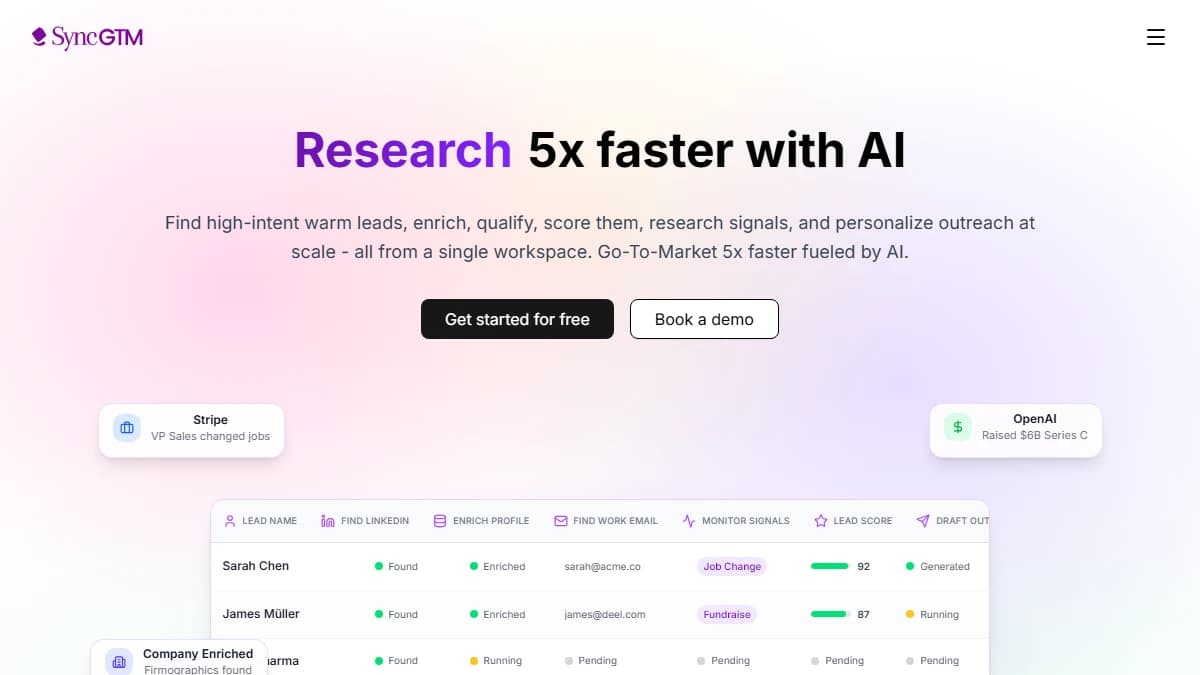
SyncGTM — waterfall enrichment across 50+ providers with verified emails, phones, and integrated outreach
SyncGTM is a B2B prospecting platform built around waterfall enrichment — querying 50+ data providers in sequence until verified contact data is found. Where QuickEmailVerification cleans a list you already have, SyncGTM builds and verifies that list from scratch: verified work email, direct dial, LinkedIn profile, and 76+ firmographic and technographic data points in one pass from a target account or company name.
The key distinction for B2B teams is that verification is embedded in the enrichment output. Every email SyncGTM returns has been cross-referenced across multiple providers before delivery — making a separate QuickEmailVerification cleaning step redundant. You do not pay per email to verify a list after the fact; verified deliverability is the baseline output.
SyncGTM also covers the entire workflow QuickEmailVerification leaves open. Buying signal detection surfaces in-market accounts before competitors reach them — hiring spikes, funding rounds, tech stack changes, and job change alerts. Native CRM sync to HubSpot, Salesforce, Pipedrive, Attio, and Zoho routes enriched leads without Zapier. Built-in outreach sequencing closes the loop without a third tool.
On catch-all domains — where QuickEmailVerification marks addresses as risky or unknown — SyncGTM cross-references across providers to recover a meaningful portion of those addresses as confirmed deliverable. SyncGTM's waterfall enrichment across 50+ providers delivers 20–40% higher contact coverage than any single data source on hard-to-find contacts. See our waterfall enrichment guide for a detailed explanation of how the approach works.
Pros
- • Waterfall enrichment across 50+ providers — verification built into the output, not a separate step
- • 76+ data points per verified person: email, direct dial, LinkedIn, firmographics, technographics, buying signals
- • Outreach included — no additional sequencing tool needed
- • Native CRM sync to HubSpot, Salesforce, Pipedrive, Attio, Zoho
- • Buying signals: hiring, funding rounds, job changes, tech stack updates
- • Free tier with 200 credits/month, no credit card required
Cons
- • Not designed for bulk cleaning of pre-built lists at a per-email rate
- • Starter plan at $99/mo is a higher floor than QuickEmailVerification's credit-based entry
- • No binary valid/invalid quality score equivalent to standalone verifiers
Best for: B2B teams doing outbound prospecting — building lists from ICP accounts, enriching with 76+ data points, and routing verified buyers to CRM or outreach sequences.
Pricing: Free tier (200 credits/mo). Starter $99/mo. Pro $249/mo. Business $649/mo.
2. ZeroBounce

ZeroBounce — bulk email verification with AI scoring, spam-trap detection, and email finder
ZeroBounce is the most direct QuickEmailVerification replacement for teams that specifically need better bulk list verification. It validates emails against 30+ data points, uses AI scoring to classify addresses that standalone verifiers flag as unknown, and claims 99%+ accuracy — matching QuickEmailVerification's headline number with stronger catch-all handling underneath.
The critical differentiator over QuickEmailVerification is what happens with catch-all domains. ZeroBounce's AI scoring system attempts to classify catch-all addresses as safe or unsafe using engagement history and behavioral signals — rather than simply returning a risky flag. On enterprise B2B lists where catch-all domains represent 10–30% of addresses, that distinction recovers a meaningful share of valid contacts.
ZeroBounce also includes spam-trap detection across 30+ networks — a capability QuickEmailVerification does not explicitly offer — and an email finder for domain-based prospecting. Its activity data layer appends engagement signals to validated addresses. Pricing starts at $18/mo for 2,000 monthly verifications, with pay-as-you-go from $0.008/email. For teams whose primary use case is still bulk verification rather than full enrichment, ZeroBounce is the clear upgrade path.
Pros
- • 99%+ claimed accuracy with AI scoring for catch-all and unknown addresses
- • Spam-trap detection: 30+ trap networks checked per address
- • Email finder included — builds lists QuickEmailVerification cannot
- • Activity data layer appends engagement signals to validated addresses
- • 100 free verifications per month; pay-as-you-go from $0.008/email
- • 35+ integrations including Mailchimp, HubSpot, Salesforce, ActiveCampaign
Cons
- • Still a verification-first tool — no waterfall enrichment, no firmographic data
- • Email finder is domain-based — not a full B2B contact database
- • No outreach layer — verified contacts still need a separate sending tool
- • Activity data layer is an add-on, not included in base pricing
Best for: Teams whose primary need is accurate bulk list cleaning — the like-for-like QuickEmailVerification upgrade with higher catch-all resolution, spam-trap detection, and an email finder.
Pricing: Free (100 verifications/mo). Monthly plans from $18/mo (2,000 verifications). Pay-as-you-go from $0.008/email.
3. NeverBounce
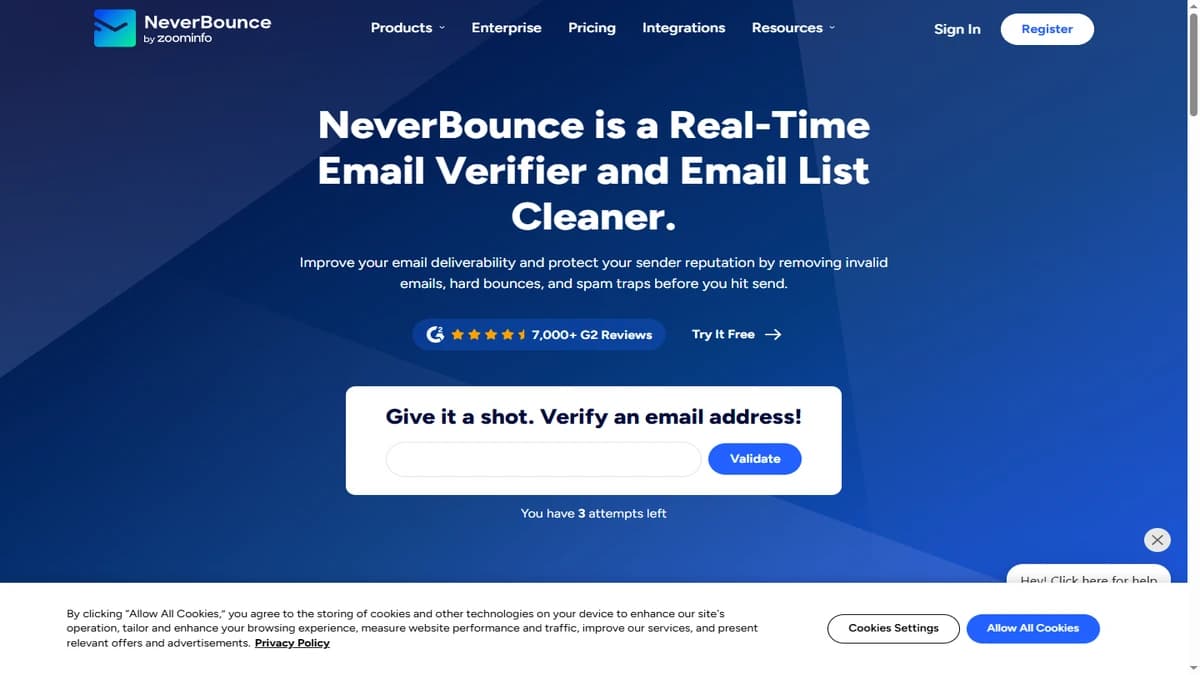
NeverBounce — developer-friendly bulk email verification with real-time API and Sync re-verification
NeverBounce is a developer-first email verification platform that competes directly with QuickEmailVerification on accuracy while offering a stronger real-time API and integration ecosystem. Pay-as-you-go starts at $0.003/email — competitive with QuickEmailVerification's volume tiers on large jobs.
NeverBounce's real-time API is its clearest technical advantage. It validates addresses at the point of form entry or CRM import — not as a batch after the fact. The Sync feature automatically re-verifies your lists on a schedule, keeping them clean without manual uploads. QuickEmailVerification requires you to initiate each verification pass manually.
Where QuickEmailVerification focuses on compliance (GDPR, CCPA, HIPAA, ISO 27001), NeverBounce is stronger on API flexibility and integration depth — connecting natively to Mailchimp, HubSpot, Salesforce, Marketo, and 40+ other platforms. For engineering teams building verification into a product or workflow, NeverBounce's webhook support and documentation are significantly stronger. See our full NeverBounce review 2026 for a detailed breakdown of accuracy, pricing, and API capabilities.
Pros
- • Pay-as-you-go from $0.003/email — competitive with QuickEmailVerification at volume
- • Real-time API with point-of-entry validation — catches bad emails before CRM entry
- • Sync feature for automatic scheduled list re-verification
- • 40+ native integrations: Mailchimp, HubSpot, Salesforce, Marketo
- • 98%+ accuracy on standard deliverability checks
- • Strong developer docs, webhooks, and SDKs for product integration
Cons
- • No spam-trap detection (ZeroBounce advantage)
- • No contact finding or enrichment — verification-only like QuickEmailVerification
- • No native outreach layer
- • Catch-all handling flags unknowns but does not resolve them
- • Fewer compliance certifications than QuickEmailVerification's HIPAA + ISO 27001 coverage
Best for: Engineering teams embedding verification into a product or workflow — and B2B teams running high-volume bulk cleaning where real-time API integration is a priority.
Pricing: Pay-as-you-go from $0.003/email. Monthly plans from $10/mo (1,000 verifications).
4. Bouncer
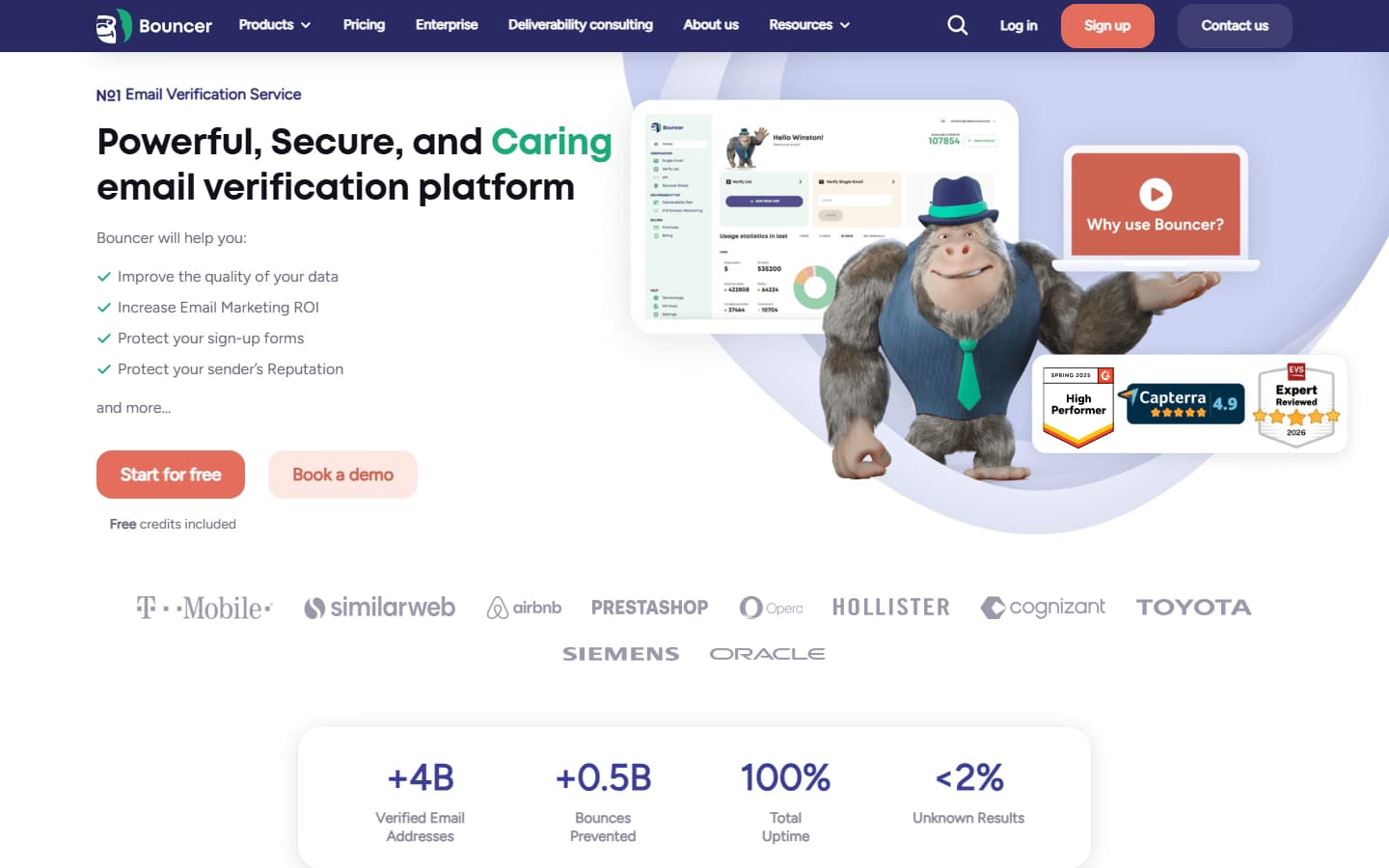
Bouncer — B2B-focused email verification with toxicity scoring on catch-all and risky addresses
Bouncer is an email verification platform built specifically for B2B list quality, with a toxicity scoring layer that addresses QuickEmailVerification's weakest dimension: catch-all and risky address handling.
Where QuickEmailVerification returns a binary valid/invalid/risky result, Bouncer adds a Deliverability Score (0–100) and Toxicity Score per email address. The Toxicity Score rates how likely an address is to be a spam trap, bot, or high-bounce risk — a distinction QuickEmailVerification does not surface at the individual address level. On B2B lists targeting enterprise accounts with high catch-all domain exposure, this granularity protects sender reputation without over-suppressing valid contacts.
Bouncer processes bulk lists at high throughput and offers a real-time API with support for CRM platforms. Pricing starts at $25/mo for 2,500 verifications. For a broader comparison of verification tools in this tier, see our Bouncer review 2026 and the Kickbox alternatives guide.
Pros
- • Deliverability Score + Toxicity Score per address — more granular than QuickEmailVerification's output
- • Purpose-built for B2B list quality — not just generic email hygiene
- • Catch-all handling with risk classification (not blanket suppression)
- • Real-time API and bulk processing with fast throughput
- • GDPR-compliant data processing with EU-based servers
- • Pay-as-you-go option for one-off verification jobs
Cons
- • No contact finding or enrichment — verification-only like QuickEmailVerification
- • No outreach layer — verified contacts need a separate sending tool
- • Smaller integration ecosystem than ZeroBounce or NeverBounce
- • No spam-trap network database at ZeroBounce's scale (30+ networks)
Best for:B2B teams targeting enterprise accounts with high catch-all domain exposure — where Toxicity Scoring adds list quality precision QuickEmailVerification's binary output does not provide.
Pricing: Free tier (100 verifications). Starter $25/mo (2,500 verifications). Pay-as-you-go available.
5. Hunter.io

Hunter.io — domain-based email finder and verifier with built-in cold email outreach campaigns
Hunter.io is an email finder and verifier that closes QuickEmailVerification's biggest gap: it finds email addresses from company domains and job titles, then verifies them — combining two steps QuickEmailVerification forces you to split across separate tools.
Hunter's Domain Search returns all email addresses associated with a company domain, including a confidence score and the sources where each address was found publicly. The Email Verifier runs a 7-step process — format check, domain validity, MX records, SMTP handshake, and Hunter database match — returning a Deliverability Score similar to QuickEmailVerification's accuracy output in purpose but with more transparency on the check methodology.
Hunter also includes a Campaigns feature for cold email outreach, turning it into a lightweight prospecting-to-send stack without a third tool. The free plan includes 25 searches and 50 verifications per month. Paid plans start at $34/mo for 500 searches. For domain-based B2B prospecting where QuickEmailVerification's verification-only workflow creates friction, Hunter is the most streamlined upgrade. See the B2B sales prospecting tools comparison for context on how Hunter fits the broader outbound stack.
Pros
- • Domain Search finds emails from company websites — closes QuickEmailVerification's contact-finding gap
- • 7-step verification with Deliverability Score and source transparency
- • Built-in Campaigns for cold email — finding, verifying, and sending in one tool
- • Chrome extension for LinkedIn and website prospecting
- • Free plan: 25 searches + 50 verifications/mo (no credit card)
- • Native integrations: HubSpot, Salesforce, Pipedrive, Zapier
Cons
- • Domain-based search only — cannot find emails from a name without a domain
- • No direct dial or phone number data
- • No firmographic enrichment or B2B data points beyond email
- • Catch-all domains reduce coverage (flags low confidence, does not resolve)
- • Campaigns feature is basic — not suitable for high-volume cold outreach at scale
Best for: SMB and mid-market teams doing domain-based B2B prospecting — finding, verifying, and running lightweight outreach in one tool at a lower total cost than QuickEmailVerification plus a separate finder.
Pricing: Free (25 searches + 50 verifications/mo). Starter $34/mo. Growth $104/mo. Business $349/mo.
Side-by-Side Comparison
| Feature | SyncGTM | ZeroBounce | NeverBounce | Bouncer | Hunter.io |
|---|---|---|---|---|---|
| Starting Price | $99/mo (free tier) | $18/mo | $0.003/email | $25/mo | $34/mo |
| Contact Finding | Yes — 50+ providers | Domain-based finder | No | No | Domain search |
| Email Verification | Built into enrichment | Yes — 99%+ accuracy | Yes — 98%+ accuracy | Yes — 98%+ accuracy | Yes — 7-step check |
| Catch-All Handling | Waterfall retries | AI scoring | Flagged, no resolution | Toxicity scored | Low confidence flag |
| Spam Trap Detection | Via providers | Yes — 30+ networks | No | Yes | No |
| B2B Enrichment | Yes — 76+ data points | Email + activity data | No | No | Email + domain data |
| Buying Signals | Hiring, funding, tech, job changes | None | None | None | None |
| Native Outreach | Yes — built-in | None | None | None | Yes — Campaigns |
| CRM Sync | HubSpot, SF, Pipedrive, Attio, Zoho | 35+ integrations | 40+ integrations | Limited | HubSpot, SF, Pipedrive |
| Free Tier | 200 credits/mo | 100 verifications/mo | Pay-as-you-go only | 100 verifications | 25 searches + 50 verifications |
How to Choose the Right QuickEmailVerification Alternative
Your choice depends on where QuickEmailVerification is failing you and what you need next.
- You need better bulk verification with AI catch-all scoring and spam-trap detection. Choose ZeroBounce. It is the closest like-for-like QuickEmailVerification upgrade — AI catch-all resolution, spam-trap detection across 30+ networks, and an email finder from $18/mo.
- You want a developer-friendly real-time API and lower per-email cost. Choose NeverBounce. At $0.003/email with point-of-entry validation, automatic scheduled re-verification, and 40+ native integrations, it is the strongest API-first alternative.
- Your ICP skews enterprise with high catch-all domain exposure and you need granular risk scoring. Choose Bouncer. Its Deliverability Score plus Toxicity Score per address gives more precision than QuickEmailVerification's binary output on risky addresses.
- You need to find contacts by domain and run lightweight cold email outreach. Choose Hunter.io. Domain Search closes QuickEmailVerification's contact-finding gap, and the built-in Campaigns feature covers outreach without a third tool from $34/mo.
- You want the full outbound workflow — enrichment, signals, CRM, outreach — from one platform. Choose SyncGTM. Waterfall enrichment across 50+ providers, 76+ data points per verified lead, buying signals to prioritise in-market accounts, and built-in outreach from $99/mo. See our EmailListVerify alternatives guide and the best SDR tools for prospecting comparison for additional context on how these tools fit the B2B stack.
Final Verdict
QuickEmailVerification is a credible list-cleaning tool. Its 99% accuracy claim, strong compliance coverage (GDPR, CCPA, HIPAA, ISO 27001), and no-expiry credits make it a reliable option for teams that have a pre-built list and need to clean it before sending.
For B2B prospecting in 2026, the workflow has moved well past CSV cleaning. Teams that win outbound are finding contacts, enriching with firmographic and technographic context, adding buying signals, and sequencing — in one integrated pass. QuickEmailVerification sits three steps behind that workflow by design.
SyncGTM is the best QuickEmailVerification alternative for most B2B teams. Waterfall enrichment across 50+ providers, 76+ data points per verified lead, buying signals to identify in-market accounts, and built-in outreach sequencing — from $99/mo with a free tier. Verification is not a separate step; it is built into every enrichment result.
If you only need a better bulk verifier without changing your stack, ZeroBounce is the right move — AI catch-all scoring, spam-trap detection across 30+ networks, and an email finder from $18/mo. For B2B teams targeting enterprise accounts with catch-all-heavy lists, Bouncer's Toxicity Score adds precision that QuickEmailVerification's binary output cannot match.
For teams ready to replace QuickEmailVerification and their prospecting tool in one step, explore our MailerCheck alternatives guide and the DeBounce alternatives comparison to see how the full verification tool landscape fits together.