

QuickEmailVerification Review 2026: B2B Data Coverage, Pricing & SyncGTM Comparison

By Kushal Magar · June 14, 2026 · 12 min read
Key Takeaway
QuickEmailVerification is a solid email verification tool trusted by 300,000+ businesses — including Fortune 50 clients — with PAYG pricing from $4/500 credits, never-expiring credits, a free daily tier, and 25+ native integrations. It handles standard list cleaning well. The gaps: no catch-all confidence scoring, weaker spam trap detection, slower bulk processing on large lists, and zero B2B contact enrichment. Best for teams cleaning existing lists; not a substitute for full B2B enrichment or contact discovery.
QuickEmailVerification is an email validation platform trusted by 300,000+ businesses — including Fortune 50 clients like PWC, Accenture, IBM, Cisco, Adobe, Amazon, and Salesforce. It claims 99% email deliverability over five years of processing, holds a 4.4/5 G2 rating, and offers PAYG credits from $4 per 500 verifications with credits that never expire. Our rating: 3.8/5.
The case for QuickEmailVerification is breadth and accessibility. A freemium tier of 100 free verifications per day requires no credit card. PAYG pricing scales up cleanly. Twenty-five-plus native integrations cover HubSpot, Mailchimp, and Salesforce without custom API work. ISO 27001, GDPR, CCPA, and HIPAA compliance gives it a strong regulatory posture across major markets.
The limits are equally clear. QuickEmailVerification verifies contact data you already have — it does not find new contacts, enrich records with firmographics, or signal when accounts are in a buying cycle. Catch-all domains are flagged with no confidence scoring. Spam trap detection lags behind ZeroBounce. Bulk processing on larger lists can be slow.
This review covers QuickEmailVerification's pricing in detail, what the 99% accuracy claim actually means in practice, catch-all handling, integration depth, and a direct comparison with SyncGTM, NeverBounce, and ZeroBounce for teams evaluating email verification options in 2026.
What Is QuickEmailVerification?
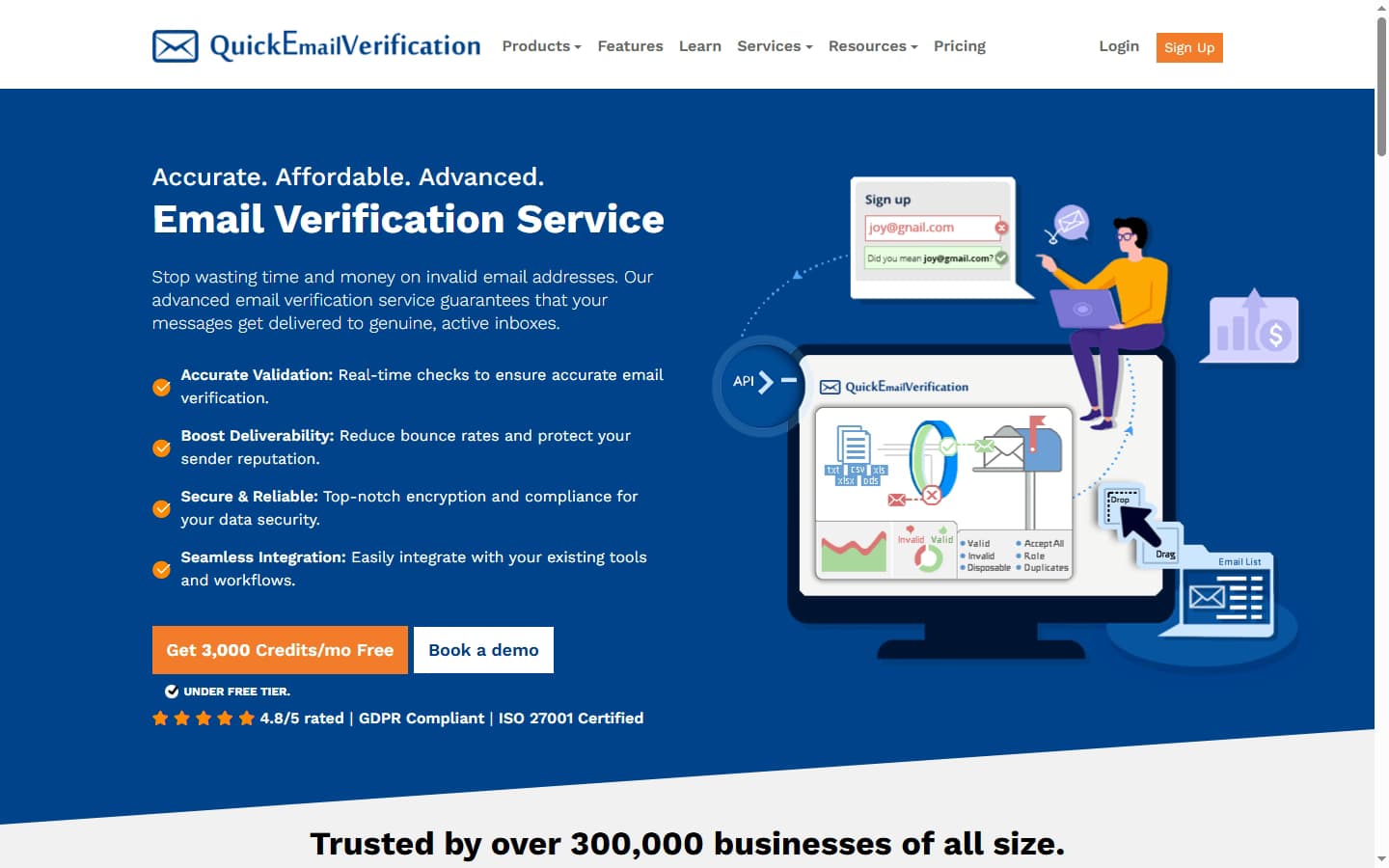
QuickEmailVerification — email validation platform trusted by 300,000+ businesses with a 99% accuracy guarantee.
QuickEmailVerification is an email validation service that checks whether email addresses are valid, deliverable, and safe to send to before campaign dispatch. It processes addresses in real time via API, in bulk via CSV upload, and through a free daily tier of 100 verifications. The platform claims to process "thousands of email addresses every minute" and has built a customer base that includes some of the largest organizations in the world.
The verification logic runs in layers: syntax check (correctly formatted?), domain MX record lookup (does the domain accept email?), and SMTP-level handshake (does the mail server accept this specific address?). Each address returns one of several classifications: valid, invalid, unknown, catch-all (accept-all), free (Gmail/Yahoo/etc.), disposable (temporary email service), or role-based (info@, sales@, etc.).
The compliance posture covers ISO 27001, GDPR, CCPA, and HIPAA — a broader certification stack than many competitors and meaningful for teams operating in regulated industries or across multiple jurisdictions.
| Capability | What QEV Provides | Notable Gaps |
|---|---|---|
| Email Verification | Syntax, MX, SMTP handshake. Multi-status classification: valid, invalid, catch-all, disposable, role-based, unknown. | No catch-all confidence scoring. Weaker spam trap detection. |
| Real-Time API | Single-email API for inline validation at form submission, CRM entry, or point of capture. | API docs are functional but lack language-specific SDKs in the depth NeverBounce offers. |
| Bulk Processing | CSV upload via drag-and-drop dashboard. Encrypted transfer. Download results with status appended. | Slower processing on large lists per G2 reviews. Not ideal for time-sensitive same-day campaigns. |
| Freemium Tier | 100 free verifications per day. No credit card required. Full API access on free tier. | 100/day is limited for teams with ongoing high-volume needs. |
| Integrations | 25+ native connectors: HubSpot, Mailchimp, Salesforce, ActiveCampaign, and more. | Fewer connectors than NeverBounce (80+) or ZeroBounce (35+). |
| Contact Enrichment | Not available. | No email finder, no firmographics, no B2B prospecting. |
QuickEmailVerification Pricing: Plans, Credits, What You Actually Pay

QuickEmailVerification pricing — tiered PAYG and monthly subscription options with volume discounts and non-expiring credits.
QuickEmailVerification uses a three-tier structure: a free daily tier, pay-as-you-go credits, and monthly subscriptions. All credits never expire — a meaningful advantage for teams with irregular verification needs who want to buy in advance and use credits over time without pressure.
There is no setup fee on any plan. Volume discounts kick in as credit bundles increase, with the per-unit cost decreasing at higher tiers. Enterprise and custom pricing is available for organizations with ongoing high-volume needs.
| Plan | Price | Credits / Limit | Credit Expiry |
|---|---|---|---|
| Free | $0 | 100/day | Daily reset |
| PAYG Starter | $4 | 500 credits | Never expire |
| Monthly Subscription | From $25/mo | 500 daily credits | Monthly reset |
| Enterprise | Custom | Custom volume | Negotiated |
The real cost math
At $4 per 500 credits PAYG, QuickEmailVerification costs $0.008/email at entry-level volume — the same per-unit rate as NeverBounce. ZeroBounce's entry-level price works out to $0.0075/email ($15/mo for 2,000 credits). For small-volume occasional cleanups without a monthly commitment, the PAYG model with non-expiring credits gives QuickEmailVerification good flexibility.
The freemium option is genuinely useful for developers embedding real-time verification in forms or CRM intake flows — 100 free verifications per day covers many low-throughput use cases without any payment setup. No competitor in the category offers an equivalent free-forever API tier at this limit.
QuickEmailVerification Key Features
Email verification
The core verification pipeline checks syntax, then domain MX records, then performs an SMTP handshake with the mail server. QuickEmailVerification classifies each address into one of several buckets: valid, invalid, catch-all (accept-all), disposable, role-based, or unknown. The "catch-all" classification covers servers configured to accept any incoming message — a common configuration in enterprise organizations where IT routes all mail to a catch-all inbox.
On B2B lists targeting larger organizations, catch-alls can represent 10–30% of addresses. QuickEmailVerification flags them but provides no confidence score to help teams decide whether to include or suppress those records. This is the tool's most significant accuracy gap versus ZeroBounce, which provides AI-powered confidence scoring on catch-all addresses.
Real-time API
The real-time API validates single email addresses and returns results in milliseconds — suitable for inline validation at form submission, CRM entry, or point of capture. The free tier includes full API access (100 requests/day), making it practical for developers evaluating integration fit before purchasing credits. Paid API access scales with credit balance. Documentation is functional but lacks the language-specific SDK libraries and interactive playground that NeverBounce offers.
Bulk CSV processing
Bulk verification via drag-and-drop CSV upload is straightforward: upload your list, wait for processing, download the enriched CSV with verification status appended. Transfers are encrypted. The known limitation is processing speed on large lists — multiple G2 reviewers flag delays on high-volume batches compared to NeverBounce and Emailable, which are typically faster on bulk jobs.
Integrations
Twenty-five-plus native integrations cover the major marketing and CRM platforms: HubSpot, Mailchimp, Salesforce, ActiveCampaign, GetResponse, and others. This is a meaningful advantage over verification-only tools that require custom API development for every integration. Teams with standard marketing stacks can connect QuickEmailVerification directly without engineering effort.
The integration count (25+) sits between Captain Verify (API-only, no native connectors) and NeverBounce (80+). For most mid-market marketing stacks, 25+ connectors covers the key tools without needing the full NeverBounce ecosystem.
Compliance
ISO 27001, GDPR, CCPA, and HIPAA compliance gives QuickEmailVerification a strong regulatory profile — broader than most verification tools in the category. For teams operating in healthcare (HIPAA), California (CCPA), or across the EU (GDPR), this multi-framework coverage reduces compliance overhead. The combination of ISO 27001 certification and HIPAA compliance is particularly unusual at this price point.
QuickEmailVerification Pros: What It Does Well
- ✓Free daily tier with full API access. 100 free verifications per day with no credit card required and no feature restrictions on the API. No competitor offers an equivalent free API tier at this limit — ZeroBounce and NeverBounce both require paid credits for API calls.
- ✓Credits never expire. PAYG credits have no expiry date — buy a bundle, use it over months or years without pressure. ZeroBounce and NeverBounce credits also do not expire, so this is parity rather than a differentiator, but it is a meaningful advantage over older tools that imposed 12-month expiry windows.
- ✓Trusted by Fortune 50 clients. PWC, Accenture, IBM, Cisco, Adobe, Amazon, and Salesforce appear on the customer list. For procurement teams requiring vendor credibility or enterprise security review, a 300,000+ customer base including major brands reduces evaluation friction.
- ✓25+ native integrations out of the box. HubSpot, Mailchimp, Salesforce, ActiveCampaign, and more connect without custom API development. For marketing teams without engineering support, plug-and-play integration matters. This puts QuickEmailVerification well ahead of Captain Verify (API-only) on practical usability.
- ✓Broad compliance coverage. ISO 27001, GDPR, CCPA, and HIPAA certifications in a single platform. Rare at this price point. Meaningful for teams in healthcare, financial services, or multi-jurisdiction campaigns who cannot use non-certified verification tools.
- ✓Responsive customer support. G2 and Capterra reviewers consistently cite fast, helpful support responses. For a tool used in time-sensitive campaign workflows, support quality is a practical operational consideration.
QuickEmailVerification Cons: Where It Falls Short
- No B2B contact discovery. QuickEmailVerification verifies emails you provide — it does not find new prospects, enrich contact records, or return firmographic data. You need a separate tool for everything upstream of verification.
- No catch-all confidence scoring. The platform flags catch-all (accept-all) domains with no scoring to help decide whether to send. On enterprise B2B lists, accept-alls can be 10–30% of records — a large ambiguous batch that verification alone cannot resolve.
- Weaker spam trap detection. User reviews note that spam trap detection lags behind dedicated tools like ZeroBounce. For older or cold-acquired lists, this gap increases inbox placement risk and deliverability score degradation.
- Slower processing on large datasets. Multiple G2 and Capterra reviewers flag processing delays on large bulk uploads. Competing tools like NeverBounce and Emailable process comparable volumes faster, making QuickEmailVerification a weaker choice for time-sensitive campaign launches.
- No native outreach or sequencing. QuickEmailVerification is a standalone verification tool with no workflow automation, outreach sequencing, or CRM enrichment beyond the verification result itself. Teams need additional tools for every step after list cleaning.
- No buying signals or enrichment layer. QuickEmailVerification tells you if an address is deliverable — not whether the company is actively in a buying cycle, recently hired, or just raised funding. Signal-based outbound requires a separate platform entirely.
- Limited reporting depth. Some reviewers note the reporting lacks granular segmentation and export flexibility compared to ZeroBounce's dashboard, which offers deeper analysis of list health over time.
QuickEmailVerification vs Alternatives: Comparison Table
The email verification category divides into two camps: verification-only tools (QuickEmailVerification, NeverBounce, Kickbox) and full enrichment platforms (SyncGTM, ZeroBounce with email finder). Here is how QuickEmailVerification compares across dimensions that matter for B2B teams in 2026.
| Feature | QuickEmailVerification | SyncGTM | ZeroBounce | NeverBounce |
|---|---|---|---|---|
| Starting Price | $4 / 500 credits (PAYG) | $99/mo | $15/mo (2K credits) | $0.008/email (PAYG) |
| Pricing Model | Pay-as-you-go or monthly subscription | Monthly subscription | Credits or monthly | Pay-as-you-go or monthly |
| Credit Expiry | Never expire | N/A | Never expire | Never expire |
| Email Verification Accuracy | 99% claimed; 4.4/5 G2 | 75–90% hit rate (waterfall enrichment) | 96–98% | 97–99% |
| Catch-All Handling | Flagged as 'accept-all' — no scoring | Waterfall retries alternate providers | Catch-all scoring with AI confidence | Flagged, no scoring |
| Spam Trap Detection | Limited vs. dedicated tools | N/A — enrichment focus | AI-powered spam trap detection | Standard SMTP-level only |
| B2B Contact Enrichment | None — verification only | Yes — email, phone, firmographics | Email append (US B2C only) | None — verification only |
| Buying Signals | None | Hiring, funding, tech changes, job changes | None | None |
| Native Outreach | None | Yes — built-in sequencing | None | None |
| Native Integrations | 25+ (HubSpot, Mailchimp, Salesforce) | API + Zapier + CRM native | 35+ | 80+ (Mailchimp, HubSpot, Salesforce) |
| Free Credits | 100/day free (freemium tier) | Free tier available | 100 free credits | 1,000 free verifications |
| GDPR / Compliance | ISO 27001, GDPR, CCPA, HIPAA | GDPR-compliant | SOC 2 Type II | SOC 2 Type II (ZoomInfo-owned) |
The honest take on each option
QuickEmailVerification wins on compliance breadth and the freemium API tier. If your team needs ISO 27001 + HIPAA coverage at a mid-range price, daily free API access for developer embedding, and 25+ native integrations without custom work, it delivers. The 300,000+ customer base including Fortune 50 clients provides vendor confidence for procurement-driven purchases.
SyncGTM is the right choice when verification is only one part of what your team needs. SyncGTM enriches contacts from scratch across 50+ waterfall providers — finding emails, mobile numbers, and firmographics for your target ICP — and adds buying signals (hiring surges, funding rounds, tech stack changes) to tell you when accounts are in-market. For teams actively building outbound pipelines, SyncGTM eliminates the need for a standalone verification tool by delivering pre-enriched, validated contacts directly. See the waterfall enrichment guide for how that coverage model works.
ZeroBounceis stronger than QuickEmailVerification on catch-all scoring (AI confidence levels vs. plain flagging) and spam trap detection. It also adds an email finder for net-new contact discovery. At $15/mo for 2,000 credits, it is modestly more expensive than QuickEmailVerification's $4/500 PAYG rate at low volumes. For teams where catch-all resolution and spam trap accuracy on older lists are the primary challenges, ZeroBounce has the better feature set.
NeverBounce leads on native integrations (80+ connectors) and review volume (3,000+ G2/Capterra reviews). ZoomInfo ownership may affect pricing over time. Best for teams already in the ZoomInfo ecosystem or those needing plug-and-play integration with the widest range of ESP and CRM tools.
For a broader look at email verification options and how they fit into a modern B2B stack, see the Kickbox review and the QuickEmailVerification alternatives comparison.
Who Should Use QuickEmailVerification?
QuickEmailVerification fits a specific profile: you have an existing list of email contacts that needs cleaning before a campaign, you want native integration with HubSpot or Mailchimp without custom API work, compliance coverage matters (HIPAA, GDPR, CCPA), and budget is mid-range.
Use QuickEmailVerification if:
- You need a free daily API tier for developer embedding — 100 verifications/day with no credit card is the most accessible entry point in the category.
- You want PAYG credits that never expire for irregular or seasonal verification workflows.
- Your team operates in healthcare, finance, or multi-jurisdiction campaigns requiring ISO 27001 + HIPAA + GDPR + CCPA coverage from a single vendor.
- You use HubSpot, Mailchimp, Salesforce, or ActiveCampaign and need native integration without custom API development.
- Vendor credibility matters for procurement — a 300,000+ customer base with Fortune 50 logos reduces evaluation hurdles.
Do not use QuickEmailVerification if:
- You need to find email addresses, not just verify ones you already have. QuickEmailVerification has no contact discovery or enrichment capability. For building lists from scratch, use SyncGTM's waterfall enrichment.
- Catch-all confidence scoring is critical. QuickEmailVerification flags catch-alls with no scoring — on enterprise B2B lists, this leaves 10–30% of records unresolved. ZeroBounce's AI catch-all scoring is the stronger choice here.
- You are cleaning older or cold-acquired lists where spam trap detection matters. ZeroBounce's AI spam trap layer reduces inbox placement risk that QuickEmailVerification cannot address.
- Processing speed is critical for time-sensitive campaigns. Reported bulk processing delays make QuickEmailVerification unreliable for same-day large-list verifications.
- You need the broadest integration ecosystem. NeverBounce (80+ connectors) outpaces QuickEmailVerification (25+) for teams with complex multi-tool marketing stacks.
For teams that want enrichment, verification, and buying signals in a single workflow without stitching tools together, the best waterfall contact providers comparison is worth reading before deciding on a standalone verification tool.
QuickEmailVerification Review: Frequently Asked Questions
What is QuickEmailVerification and how does it work?
QuickEmailVerification is an email validation platform trusted by 300,000+ businesses, including Fortune 50 companies like PWC, Accenture, IBM, Cisco, Adobe, Amazon, and Salesforce. It verifies email addresses by checking syntax, domain MX records, and performing SMTP-level handshakes to confirm whether a mailbox exists and is capable of receiving mail. Results classify addresses as valid, invalid, catch-all (accept-all), disposable, unknown, or role-based. It operates in three modes: real-time API verification, bulk CSV upload, and a free daily tier of 100 credits. Credits never expire. The platform claims 99% accuracy across five years of processing and integrates with 25+ marketing and CRM tools including HubSpot, Mailchimp, and Salesforce.
How accurate is QuickEmailVerification in 2026?
QuickEmailVerification claims 99% email deliverability, backed by a 4.4/5 G2 rating. Users rate it highly for accuracy on standard valid/invalid calls — syntax checks, domain lookups, and SMTP verification all perform at par with industry peers like Kickbox and NeverBounce. The main accuracy gap is catch-all domains: servers configured to accept any incoming message regardless of whether the mailbox exists. QuickEmailVerification flags these as 'accept-all' but provides no confidence scoring to help teams decide whether to include or exclude them. On B2B enterprise lists, catch-alls can represent 10–30% of addresses. For clean deliverable/undeliverable calls on standard B2B contacts, QuickEmailVerification performs well. For deep catch-all resolution, ZeroBounce's AI scoring model is stronger.
How much does QuickEmailVerification cost in 2026?
QuickEmailVerification offers a freemium tier of 100 free verifications per day — no credit card required. Pay-as-you-go credits start at $4 for 500 verifications ($0.008/email) and scale down per-unit with volume. Monthly subscriptions start at $25/mo for 500 daily credits. Enterprise and custom pricing is available for high-volume use cases. Credits never expire, making PAYG viable for teams with irregular verification needs. The freemium daily tier is useful for small-volume ongoing verification embedded in lead intake forms or CRM enrichment workflows.
Does QuickEmailVerification integrate with HubSpot or Salesforce?
Yes. QuickEmailVerification natively integrates with 25+ marketing and CRM tools including HubSpot, Mailchimp, and Salesforce. This puts it ahead of tools like Captain Verify (API-only, no native connectors) but behind NeverBounce (80+ integrations). For most marketing stacks, QuickEmailVerification's integration coverage is sufficient. Teams running advanced CRM-native enrichment workflows may find SyncGTM's API-plus-CRM native setup more flexible, since it combines contact discovery, enrichment, and verification in a single workflow rather than requiring a separate verification step.
What is the difference between QuickEmailVerification and ZeroBounce?
Both tools verify email addresses, but ZeroBounce has a broader feature set at a higher starting price. ZeroBounce offers AI-powered spam trap detection, catch-all scoring with confidence levels, an email finder (AI-powered lookup), and 35+ native integrations. QuickEmailVerification focuses on core verification — real-time API, bulk CSV, and a freemium tier — at a competitive price point with never-expiring credits. QuickEmailVerification's freemium option (100/day free) has no direct equivalent in ZeroBounce, making it accessible for low-volume or developer use cases. For spam trap detection and catch-all scoring on older or cold-acquired B2B lists, ZeroBounce has a meaningful technical advantage.
How does QuickEmailVerification compare to SyncGTM for B2B outbound?
QuickEmailVerification and SyncGTM solve different problems in the outbound workflow. QuickEmailVerification cleans email lists you already have — it tells you if an address is deliverable before you send. SyncGTM finds and enriches contact information for your entire target account list — emails, direct dials, firmographics, LinkedIn data — using waterfall enrichment across 50+ providers, then adds buying signals (hiring surges, funding alerts, tech stack changes, job changes) to tell you when to reach out. SyncGTM starts at $99/mo and includes enrichment, signals, and built-in outreach sequencing. QuickEmailVerification starts at $4 for 500 PAYG credits or $25/mo and covers verification only. Teams actively building outbound from an ICP need SyncGTM upstream; QuickEmailVerification fits as a final validation pass on existing lists.