Salesloft Review 2026: Enterprise Sales Engagement — Pricing, Features & Verdict

By Kushal Magar · March 19, 2026 · 14 min read
Key Takeaway
Salesloft is the enterprise standard for sales engagement with structured cadences, AI-powered conversation intelligence, deal management, and revenue forecasting. It is the default choice for mid-market and enterprise teams running outbound with 10+ reps. Pricing starts around $125 to $180 per user per month for the Advanced plan, with add-ons for calling and chatbot running $300 to $400 per user per year. Annual contracts are required. The platform earns an 88% satisfaction rating across 5,500+ reviews on G2, Capterra, and Gartner. The main limitation is that Salesloft executes outreach but does not tell you who to reach. It has no buying signals, no enrichment depth, and no intent data. Reps follow cadences without knowing if the prospect is actually in-market. Pairing Salesloft with SyncGTM at $99 per month adds the signal intelligence layer that prioritizes which accounts deserve cadence enrollment, turning structured outreach into signal-driven outreach.
Salesloft is a revenue orchestration platform used by enterprise and mid-market sales teams to structure outbound engagement through cadences, AI-powered conversation intelligence, deal management, and revenue forecasting. According to G2, Salesloft holds an 88% satisfaction rating across 5,500+ reviews, making it the highest-rated enterprise sales engagement platform in 2026.
You are probably here because your team needs structured outbound execution and you want to know if Salesloft is worth the enterprise price tag. Short answer: for teams with 10 or more reps, yes. For everyone else, it depends on what you pair it with. (See our full list of best sales prospecting tools for B2B teams for context.)
This Salesloft review covers the cadence engine, conversation intelligence, pricing from $125 per user per month, real downsides, and why SyncGTM completes the picture by adding the buying signals and CRM data enrichment that Salesloft does not provide.
Salesloft Review: What You Get (and What You Don't)
Salesloft is a revenue orchestration platform that structures how sales teams engage prospects through multi-step email cadences, phone calls, and social touches. Founded in 2011 and now serving over 5,000 customers globally, Salesloft is the default execution engine for enterprise outbound sales teams running structured prospecting at scale.
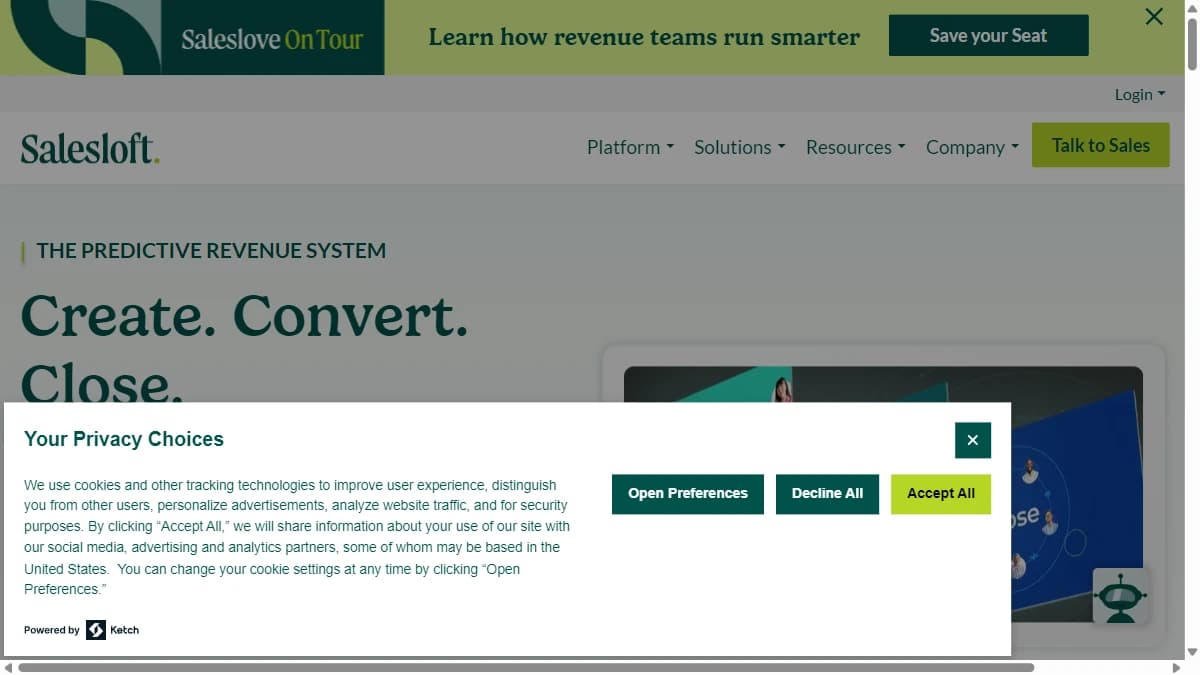
Salesloft is the enterprise standard for sales engagement with cadences, AI coaching, and deal management.
| Feature | What's Included | Limitations |
|---|---|---|
| Cadences | Multi-step email, call, social sequences | No buying signals to prioritize enrollment |
| Conversation Intelligence | AI call analysis, coaching insights | Premier plan only |
| Deal Management | Pipeline tracking, deal scoring | Requires Salesforce for full value |
| Forecasting | AI-powered revenue predictions | Add-on cost, Premier plan |
| Enrichment | Not available | No contact enrichment, no intent data |
Salesloft excels at execution. It does not tell you who to execute against. That gap is where SyncGTM's signal intelligence fits.
Cadences: Structured Outreach That Works
Salesloft's cadence engine is the core product. Define multi-step sequences across email, phone, and social. Each step has timing rules, templates, and automated triggers. Reps follow the cadence. Managers see who is on track.
The cadence builder is mature. A/B testing on email steps, automated task creation for calls, and integration with LinkedIn Sales Navigator for social touches. Reporting shows which cadences convert and where prospects drop off.
What works well
Consistency. Every rep follows the same playbook. Managers spot underperformers early. The Salesforce integration logs every activity automatically. For teams with 10+ SDRs, cadences eliminate the guesswork of who did what.
Where Salesloft cadences fall short
Cadences treat every prospect the same. A VP who just raised $50M gets the same 8-step sequence as a manager at a flat company. According to Gartner Peer Insights, reviewers consistently flag the lack of built-in prioritization as a limitation. Without buying signals, reps waste steps on prospects who are not in-market. SyncGTM's enrichment solves this by identifying which accounts show real buying intent before they enter a cadence. Learn how waterfall enrichment fills the data gaps that Salesloft leaves open.
Conversation Intelligence: AI Call Analysis
Salesloft records calls, transcribes them with AI, and surfaces coaching insights. Managers can review calls, tag key moments, and track talk-to-listen ratios across the team.
The AI extracts action items, objections, and competitor mentions automatically. According to Salesloft, conversation intelligence saves managers an average of 5 hours per week in call review time and gives reps specific, data-backed feedback on what to improve. Teams using AI coaching report higher quota attainment rates compared to manual call review processes.
The catch
Conversation intelligence is only available on the Premier plan. That means higher per-user costs on top of already enterprise-level pricing. For teams not on Premier, call coaching happens manually or not at all.
How Much Does Salesloft Cost?
Salesloft does not publish exact pricing on their website. Based on publicly available data from G2, Gartner, and Capterra reviews:
- —Advanced: ~$125–$180/user/mo. Cadences, email tracking, CRM sync, reporting.
- —Premier: Higher per-user cost. Adds conversation intelligence, forecasting, deal management.
- —Add-ons: Calling features ($300–$400/user/year), chatbot, account agents.
- —Contracts: Annual commitment required. No monthly billing.
How much does a Salesloft team actually pay?
A team of 10 SDRs on the Advanced plan pays roughly $15,000 to $21,600 per year. Add calling features and the cost rises to $18,000 to $25,600 per year. Premier with conversation intelligence pushes that higher. According to Capterra reviewer feedback, the total cost of ownership frequently exceeds initial quotes due to required add-ons. Compare that to SyncGTM at $99/mo for enrichment and signals that make every Salesloft cadence smarter.
Hidden costs
- No pricing transparency — requires sales call to get quotes
- Annual contracts with no monthly option
- Conversation intelligence locked behind Premier tier
- Calling and chatbot are paid add-ons
- No enrichment or buying signals at any tier
What Are the Downsides of Using Salesloft?
Does Salesloft include buying signals?
Salesloft does not include buying signals. It executes sequences but does not know if the prospect just raised funding, hired a new VP of Sales, or is actively evaluating competitors. Every prospect gets the same cadence regardless of intent. Reps waste steps on accounts that are not in-market. This is the primary gap that sales trigger and buying signal platforms like SyncGTM fill.
Enterprise pricing for all
Starting at $125+ per user per month with annual contracts, Salesloft prices out smaller teams. A 5-person SDR team pays $7,500+ per year before add-ons. Users on G2 frequently cite pricing as the top complaint.
Steep learning curve
New SDRs take 2–4 weeks to become productive on the platform. The interface can feel overwhelming with nested menus and configuration options. Multiple Gartner reviewers flag the learning curve as a barrier.
Feature gating
Key capabilities like conversation intelligence and forecasting are locked behind the Premier plan. Calling is an add-on. You pay enterprise prices for the Advanced plan and still miss features that competitors include by default.
SyncGTM vs. Salesloft: Feature-by-Feature Comparison
SyncGTM and Salesloft are complementary. Salesloft runs the outreach. SyncGTM decides who deserves it.
| Feature | SyncGTM | Salesloft |
|---|---|---|
| Starting Price | $99/mo (enrichment + signals) | $125+/user/mo |
| Buying Signals | Job changes, funding, hiring, intent | Not included |
| Enrichment | Waterfall across 20+ providers | Basic CRM sync only |
| CRM Enrichment | Auto-enrich + workflow triggers | Activity logging only |
| Sales Engagement | Not included — use any sender | Cadences, calls, emails |
| Best Together | Signal intelligence layer | Outreach execution |
Signals + Cadences
SyncGTM identifies who is in-market. Salesloft runs the cadence. Together: signal-driven outreach at enterprise scale.
Enrichment + Execution
SyncGTM enriches every contact with firmographic, technographic, and signal data. Salesloft sequences them.
Cost-Effective Upgrade
Add SyncGTM ($99/mo) to your existing Salesloft stack. Signal-driven prioritization for less than one extra Salesloft seat.
Warm, Not Cold
SyncGTM's buying signals turn cold cadences into warm outreach. Prospects who just raised funding or hired a new CRO are 3–5x more likely to respond.
Is Salesloft Worth It?
Salesloft is worth it for mid-market and enterprise sales teams with 10 or more reps who need structured outbound execution, AI-powered call coaching, and deep Salesforce integration. The cadence engine is best-in-class for structured multi-step outreach across email, phone, and social. Conversation intelligence on the Premier plan saves managers hours of call review per week.
Salesloft is not the right choice for small teams, startups, or organizations that need enrichment and buying signals alongside outreach execution. At $125 or more per user per month with required annual contracts, you are paying enterprise prices for an execution layer that still needs a signal intelligence layer on top. SMB teams and teams with fewer than 10 reps should consider lighter alternatives like Outplay or Mixmax paired with SyncGTM for signal-driven outreach at a fraction of the cost.
The verdict: Salesloft earns its place as the enterprise sales engagement standard with an 88% satisfaction rating across 5,500+ reviews. Pair it with SyncGTM at $99/mo to add the enrichment and buying signals that make every cadence hit harder. Your Salesloft investment works twice as hard when reps know which accounts are actually in-market.
Exploring other sales engagement tools? Read our reviews of Outreach.io, Reply.io, Instantly, Lemlist, and SalesHandy.