5 Best SBL.so Alternatives for Signal-Based Outbound in 2026

By Kushal Magar · September 20, 2026 · 13 min read
Key Takeaway
SBL.so is a capable LinkedIn and WhatsApp AI SDR — it detects buying intent within its own graph, handles two-way conversations autonomously, and runs from dedicated SDR profiles to protect personal accounts. The constraint is data reach: its signals stay close to LinkedIn-native activity, and enrichment does not waterfall across the major providers. Teams that need 10+ signal types and leads from outside the LinkedIn graph need a different platform. SyncGTM is the best overall alternative — 15 intent signals, 33+ lead sources, and waterfall enrichment across 50+ providers from $49/mo with a free tier. Coldreach.ai wins on custom signal configuration. Amplemarket wins on multi-channel depth. Apollo.io wins on raw database scale. Clay wins on workflow flexibility.
Most teams searching for SBL.so alternatives are not switching because the LinkedIn outreach is bad. They are switching because the data behind it runs out.
SBL.so (Signal-Based Leads) bundles intent signal detection, LinkedIn and WhatsApp sequencing, and AI conversation handling into one AI SDR. What it does not bundle is breadth — its signals are primarily LinkedIn-native, its enrichment does not cascade across major providers, and its data graph thins out quickly once you move beyond the accounts already active on LinkedIn.
We ranked these five alternatives on the two things that decide whether signal-based outbound actually fills pipeline: how wide the signal coverage is across data sources, and how well the outreach converts once those signals fire.
For a full breakdown of what SBL.so offers before you decide to leave, read our SBL.so review.
TL;DR
| Tool | Best For | Starting Price | Free Tier |
|---|---|---|---|
| SBL.so (baseline) | LinkedIn + WhatsApp AI SDR with conversation handling | ~$50–$200/mo (opaque) | No (demo only) |
| SyncGTM | 15 intent signals + 33+ lead sources under one subscription | $49/mo | Yes (50 credits) |
| Coldreach.ai | Custom signal monitoring with AI-personalized outreach | ~$899/mo | No (demo-led) |
| Amplemarket | Multi-channel AI outbound with built-in enrichment | Custom (quote-based) | No (trial available) |
| Apollo.io | Largest B2B database + basic signal filters | $49/user/mo | Yes |
| Clay | Custom signal-powered enrichment workflows | $149/mo | No (14-day trial) |
Verdict:SyncGTM is the best overall SBL.so alternative because it solves the core gap — it monitors signals across 15 dimensions and sources from 33+ lead channels rather than staying within one platform's own graph, all from $49/mo.
If you need custom signal configuration on bespoke triggers, Coldreach.ai goes deeper. If multi-channel autonomy matters more than signal breadth, Amplemarket is purpose-built for that.
Why Teams Look for SBL.so Alternatives
SBL.so built something genuinely useful: an AI that runs LinkedIn and WhatsApp outreach autonomously, handles replies and objections, and operates from dedicated SDR profiles so personal accounts stay clean. The platform claims 15–25% booked meeting rates and zero bans across 50M+ messages sent — numbers that, if accurate, put it well ahead of most LinkedIn automation tools.
According to G2's 2026 Sales Intelligence category data, teams running outbound from three or more intent signals report 2–3x higher qualified pipeline than single-signal approaches. The friction with SBL.so shows up precisely when teams try to scale beyond what LinkedIn alone surfaces.
Four structural limits push buyers toward alternatives.
- Signal coverage is LinkedIn-native. SBL.so detects intent from LinkedIn activity — profile views, engagement, connection patterns. It does not monitor job change data from external providers, funding databases, technographic shifts, web traffic signals, or hiring surges pulled from job board APIs. For teams running multi-signal outbound, that is a narrow foundation.
- Enrichment does not waterfall. SBL.so identifies and contacts prospects but does not cascade enrichment requests across multiple providers to maximize data coverage. Teams that need verified emails plus mobile numbers plus firmographic depth still need a second tool.
- Pricing is opaque. SBL.so does not publish fixed tiers. Community references put entry at $50–$200/mo, but agency and volume plans require a custom quote. Forecasting outbound costs becomes guesswork at anything beyond a single seat.
- Channel set is narrow. LinkedIn and WhatsApp cover a specific slice of the outbound market. Teams that primarily run email-first or phone-assisted sequences need a platform built around those channels, not retrofitted to them.
None of these are fatal for every buyer. For a founder running LinkedIn-first outreach against a tight ICP already active on the platform, SBL.so can be exactly right. For a sales team that needs to fire on ten signal types and source from outside the LinkedIn graph, it is not.
What Signal-Based Outbound Actually Requires
Signal-based outbound is not a single feature. It is a stack of three decisions, and most tools are strong in one and underbuilt in the other two.
Signal breadth is how many distinct intent types the platform monitors — and where the underlying data comes from. A platform watching only LinkedIn activity is reading one signal from one source. A platform monitoring job changes, funding events, hiring surges, technology switches, web traffic shifts, and social engagement across multiple provider feeds is reading six signals from dozens of sources. The difference in contact timing is measurable.
Data reach is how far the enrichment extends past the initial signal trigger. Detecting a funding round means nothing if the platform cannot then find the VP of Sales who just joined, verify their work email through a waterfall of providers, and surface their recent LinkedIn activity as personalization context. Signal detection and data enrichment have to be connected, not separate subscriptions.
Reply quality is what actually determines conversion. The best signal in the world sent in a generic message converts the same as cold spray-and-pray. The email or message needs to name the specific signal, explain why it matters to the recipient, and give them one clear next step — a job that is harder than it looks without per-lead research feeding the writer. Our roundup of best AI agent tools for GTM covers the research-to-write layer in more depth.
The five tools below each handle this stack differently. None of them score the same across all three dimensions.
1. SyncGTM
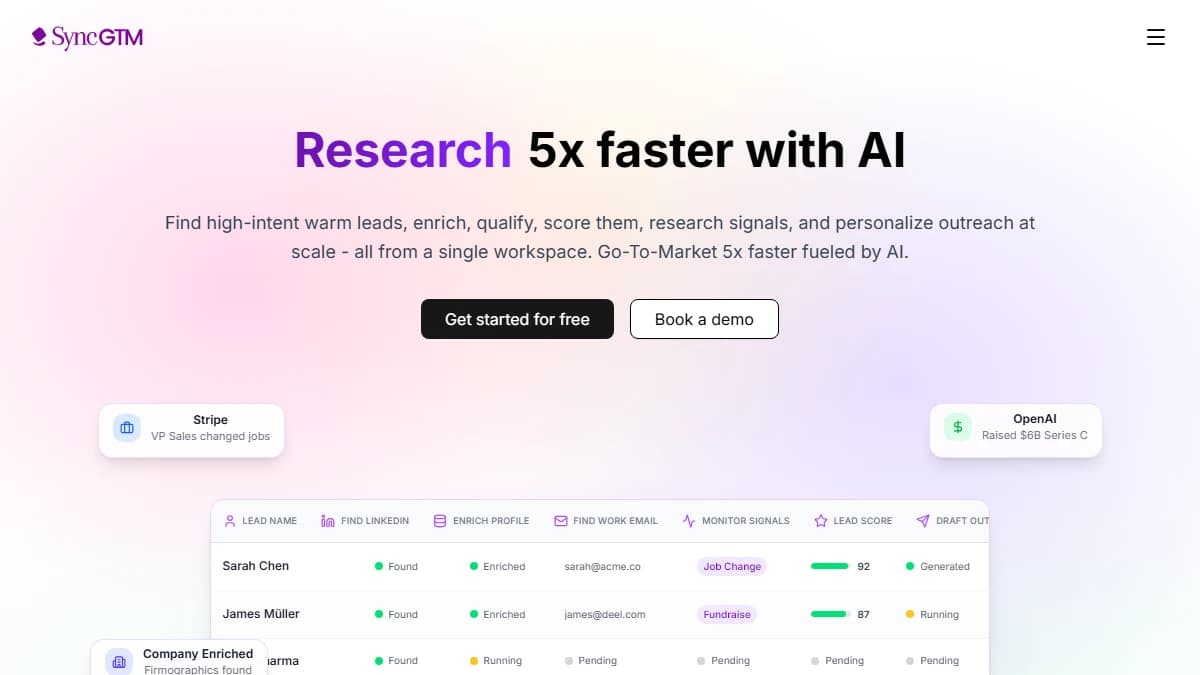
SyncGTM — 15 intent signals, 33+ lead sources, and waterfall enrichment across 50+ providers in one subscription
SyncGTM is a signal-based outbound and lead enrichment platform best suited for GTM teams that need broader signal coverage than LinkedIn alone can provide, starting at $49/mo with a free tier.
It replaces SBL.so's narrow signal graph with 15 distinct intent signals monitored in real time: job changes, promotions, new executive hires, funding rounds, headcount growth, revenue shifts, technology adoptions, web traffic changes, LinkedIn post activity, job postings, company news events, social media engagement, conference attendance, product launches, and custom AI-configured signals. Where SBL.so reads LinkedIn activity, SyncGTM reads across the full account lifecycle.
Lead sourcing feeds directly from 33+ channels — LinkedIn engagement, technographic databases, funding round announcements, CRM imports, conference attendee lists, user signups, webhooks, and file uploads among them. A signal fires, a lead is sourced, enrichment waterfalls across 50+ providers to fill in verified email, mobile, firmographics, and 76+ additional data points, and the AI writes outreach referencing the specific trigger.
Outreach connects to Instantly and Smartlead for sending. 2-way CRM sync covers HubSpot, Salesforce, Pipedrive, Attio, and Zoho. Full plan details are on the pricing page.
The gap versus SBL.so: no native LinkedIn or WhatsApp message sending, and no autonomous AI conversation handling for inbound replies. SyncGTM is built for the signal-detect-enrich-email motion; SBL.so is built for the signal-detect-LinkedIn-chat motion. The right choice depends on which channel your ICP responds to.
Pros
- 15 intent signals — broadest coverage on this list
- 33+ lead sources without depending on LinkedIn alone
- Waterfall enrichment across 50+ providers
- 76+ data points per lead, charged only on verified records
- 2-way CRM sync — HubSpot, Salesforce, Pipedrive, Attio, Zoho
- Free tier (50 credits) and $49/mo entry, no annual contract
- Transparent fixed pricing — no sales call required
Cons
- No native LinkedIn or WhatsApp message sending
- No autonomous AI reply handling for inbound messages
- Free tier capped at 50 credits
- Does not operate from dedicated SDR profiles like SBL.so
Best for: Teams that need signal breadth beyond LinkedIn — funding signals, job changes, tech adoption, hiring surges — feeding into email-first outreach with CRM sync.
Pricing: Free (50 credits) · Solo $49/mo · Growth $99/mo · Pro $249/mo · Business $649/mo
2. Coldreach.ai
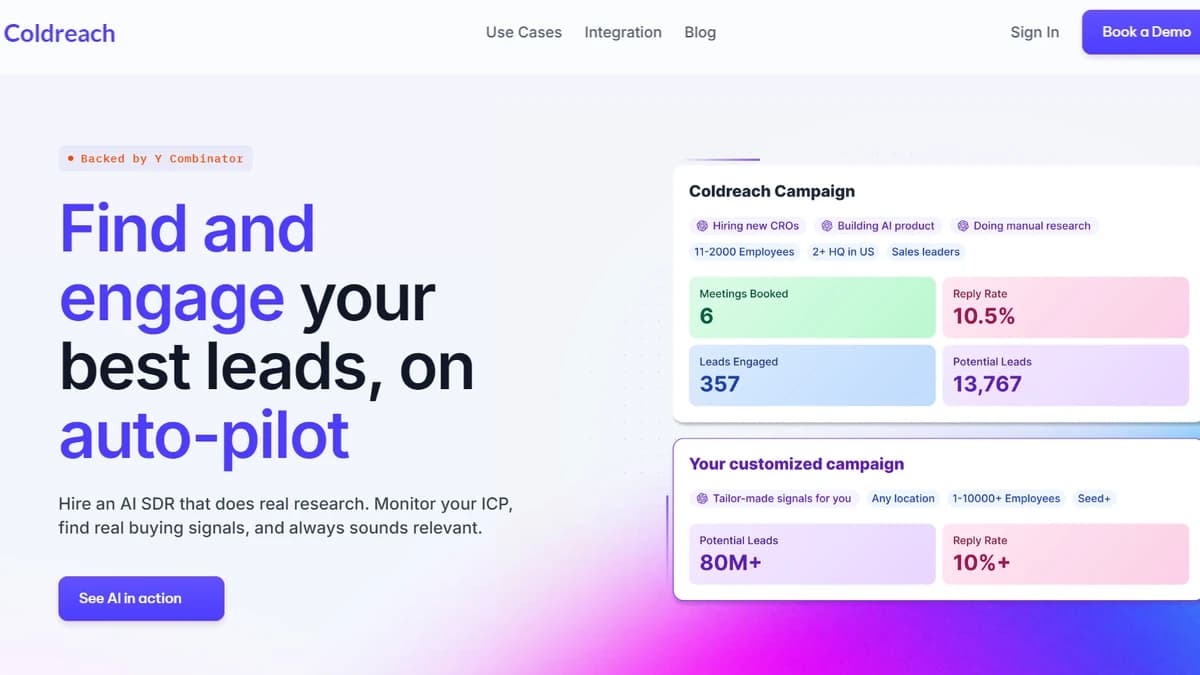
Coldreach.ai — custom signal monitoring across 79M+ accounts with AI-personalized outreach per trigger
Coldreach.ai is a research-driven signal-based AI SDR best suited for sales teams that need to define custom buying signals beyond what standard intent providers offer, with pricing starting around $899/month.
The core differentiator is signal configurability. Rather than picking from a fixed list of triggers, Coldreach lets teams define their own signal logic — a specific combination of hiring patterns, news events, LinkedIn activity, and technographic changes — monitored continuously across 79M+ accounts. When a signal fires, the AI writes outreach that references the specific trigger, not a generic template.
Reply rates published by Coldreach average 3.8% across campaigns — roughly 2–3x the cold email baseline — which reflects signal precision more than volume. Coldreach operates at the intersection of signal detection and message quality rather than send volume.
The main tradeoff versus SBL.so is channel coverage. Coldreach focuses on email and LinkedIn outreach; it does not handle WhatsApp or the kind of autonomous two-way conversation management that SBL.so uses as a differentiator.
Pros
- Fully custom signal configuration — not a fixed dropdown
- 79M+ accounts monitored continuously
- AI personalization tied to the specific signal event
- 3.8% average reply rate across campaigns
- Strong signal-to-copy pipeline — research feeds message
Cons
- ~$899/mo starting price — expensive vs. SyncGTM or Apollo
- No WhatsApp channel or autonomous conversation handling
- Demo-led onboarding — no self-serve free tier
- Setup complexity is higher than point-and-click tools
Best for: Teams with a clearly defined ICP that need custom signal logic — specific hiring titles, news event types, or technographic combos — not available in standard intent tools.
Pricing: ~$899/mo (custom packages available for volume and enterprise)
3. Amplemarket
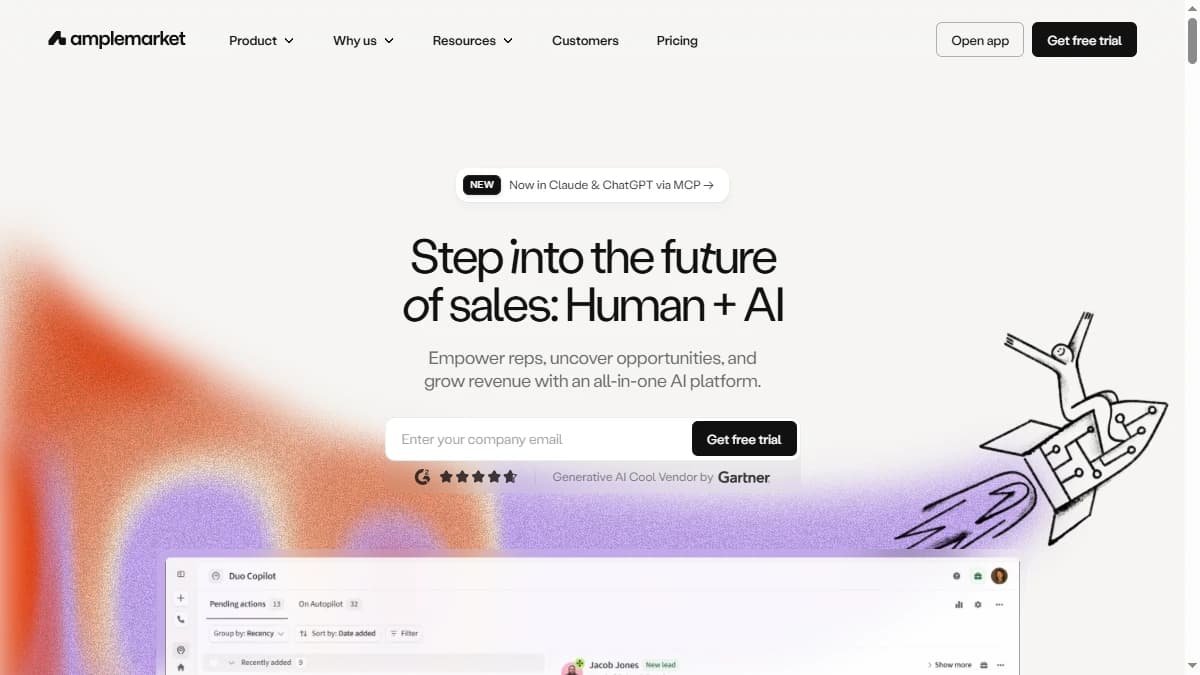
Amplemarket — AI-powered multi-channel sequences with job change signals, enrichment, and LinkedIn outreach in one platform
Amplemarket is an AI-powered multi-channel outbound platform best suited for B2B sales teams that want signal detection, enrichment, and sequencing bundled rather than assembled from separate tools. Pricing is custom and quote-based.
The platform runs multiple AI agents in parallel — one for research, one for signal detection, one for sequence management — across email, LinkedIn, and phone. Signal coverage includes job changes, LinkedIn activity, and intent triggers pulled from partner integrations, giving it broader signal reach than SBL.so while preserving the multi-channel approach that defines SBL.so's positioning.
Built-in enrichment handles data coverage without requiring a separate waterfall tool. The AI agents write and send outreach, monitor replies, and surface escalation prompts for reps — a more human-in-the-loop model than SBL.so's fully autonomous conversation handling.
For teams already using Amplemarket, our Amplemarket review covers pricing, coverage benchmarks, and how it stacks up against full-stack alternatives.
Pros
- Email, LinkedIn, and phone in one coordinated sequence
- Multiple AI agents handling research, signals, and outreach
- Broader signal coverage than SBL.so's LinkedIn-only layer
- Built-in enrichment — no separate waterfall needed
- Strong CRM integrations and two-way sync
Cons
- Custom pricing — no public starting rate or free tier
- No WhatsApp channel, unlike SBL.so
- Less autonomous conversation handling than SBL.so
- Requires a demo before you can evaluate the product
Best for: Mid-market sales teams that need email, LinkedIn, and phone coordinated under one AI-managed sequence with signal detection and enrichment included.
Pricing: Custom (quote-based) — requires a demo
4. Apollo.io
Apollo.io — 275M+ contacts with a built-in intent data layer, email sequencing, and a dialer
Apollo.io is a sales intelligence and engagement platform best suited for teams that want the largest possible contact database paired with basic intent signals, with a free plan and paid tiers from $49/user/mo billed annually.
Signal coverage in Apollo runs through its intent data layer — technographic filters, hiring signal detection, and keyword-based intent scoring pulled from third-party data networks. It is shallower than SBL.so's LinkedIn conversation signals or SyncGTM's 15-signal stack, but the raw database depth — 275M+ contacts, 73M+ companies — means the list you build against those signals is unmatched in size.
Outreach bundles email sequences with A/B testing, a built-in dialer, and a LinkedIn Chrome extension. AI-assisted research summaries add per-lead context, though they are shallower than a dedicated research agent. For teams running volume-heavy outbound against a broad ICP, Apollo covers more of the workflow than SBL.so — it just handles signals less precisely.
For a full look at what Apollo does and where it falls short, see our roundup of the best AI outbound alternatives where Apollo is covered alongside other tools.
Pros
- 275M+ contacts — largest database on this list
- Free-forever plan available
- Intent data layer with technographic and hiring filters
- Email sequences, dialer, and LinkedIn extension bundled
- Deep CRM integrations — Salesforce, HubSpot, and more
- Most recognized brand — fast rep onboarding
Cons
- Signal depth is shallower than SBL.so or Coldreach
- No autonomous AI conversation handling
- Data accuracy varies significantly outside the US
- Per-seat pricing scales fast with team growth
- Advanced analytics gated to Organization at $119/user/mo
Best for: Teams that prioritize database size and email sequencing over signal sophistication, especially those running high-volume outbound against a wide US market.
Pricing: Free · Basic $49/user/mo · Professional $79/user/mo · Organization $119/user/mo (3-seat minimum)
5. Clay
Clay — 100+ data integrations and a workflow engine for building custom signal-powered enrichment pipelines
Clay is a data enrichment and workflow engine best suited for technically capable GTM teams that want to build custom signal-powered outbound pipelines, with a 14-day trial and paid plans from $149/mo.
Clay is not an AI SDR. It is the engine that powers many of the best ones. The platform connects to 100+ data providers and enrichment sources, letting teams pull signals from wherever they are — Apollo for contact data, LinkedIn for activity signals, Clearbit for firmographics, news feeds for company events — and route the enriched records into any sequencer via Zapier, Make, or native integrations with Instantly and Smartlead.
Where SBL.so gives you a pre-built signal-to-outreach motion, Clay gives you the building blocks to construct your own. That means unlimited signal flexibility and no ceiling on enrichment depth — but also no autonomous conversation handling, no native sending, and meaningful setup complexity for teams without a technical operator.
Pricing is credit-based and can scale quickly at volume. A team running 5,000+ enrichments per month regularly spends $400–$800+ before sequencer costs. Clay works well as a signal enrichment layer feeding into SyncGTM, Instantly, or another sequencer — it works poorly as a standalone outbound system for teams that want results without building infrastructure.
Pros
- 100+ data integrations — maximum enrichment flexibility
- Waterfall across 75+ enrichment providers in one tool
- Any signal type configurable via workflow logic
- Pairs with any sequencer — Instantly, Smartlead, Outreach
- Strong operator community and template library
Cons
- No native outreach — requires a separate sequencer
- No autonomous AI conversation handling
- Credit costs scale sharply at volume
- Requires a technical operator to build and maintain
- Not a complete replacement for SBL.so — needs pairing
Best for: RevOps engineers and technical GTM operators building custom signal pipelines, not teams that want a pre-built outbound motion out of the box.
Pricing: 14-day trial · Starter $149/mo · Explorer $349/mo · Pro $800/mo · Custom enterprise
Side-by-Side Comparison
Signal breadth, data sources, and outreach channel are the three axes that separate these tools from SBL.so. Read the signal column carefully — "has signals" and "monitors 15 signal types across external data feeds" are not the same thing.
| Tool | Signal Coverage | Data Sources | Outreach Channels | Starting Price |
|---|---|---|---|---|
| SBL.so | LinkedIn-native signals (activity, engagement, intent) | Own graph, LinkedIn Sales Navigator | LinkedIn + WhatsApp, AI conversation handling | ~$50–$200/mo (opaque) |
| SyncGTM | 15 intent signals — job changes, funding, hiring, tech adoption, web traffic | 33+ lead sources, waterfall across 50+ enrichment providers | AI Email Writer, sequencer integrations, 2-way CRM sync | $49/mo |
| Coldreach.ai | Custom signals — hiring, news, LinkedIn, funding, web | 79M+ accounts monitored, custom data connections | Email + LinkedIn, AI personalization per signal | ~$899/mo |
| Amplemarket | Job changes, LinkedIn signals, intent triggers | Built-in enrichment + partner integrations | Email, LinkedIn, phone — multi-channel AI sequences | Custom |
| Apollo.io | Intent data layer, technographic filters, hiring signals | 275M+ contacts, 73M+ companies | Email sequences, dialer, LinkedIn Chrome extension | $49/user/mo |
| Clay | Any signal via 100+ integrations (fully custom) | Waterfall across 75+ enrichment providers | No native sequencer — exports to Instantly, Smartlead, etc. | $149/mo |
Clay's "any signal via 100+ integrations" is technically the broadest but also the most expensive to operationalize. SyncGTM's 15 pre-built signals cover the signals most B2B teams actually need without custom engineering.
How to Choose the Right SBL.so Alternative
Start by naming which limit you are actually hitting with SBL.so. Different limits point to different replacements.
- Signal coverage is too narrow — you need more than LinkedIn activity. Pick SyncGTM. 15 intent signals across funding, hiring, tech adoption, web traffic, job changes, and more — from $49/mo with a free tier.
- You need fully custom signal logic for a specific niche. Pick Coldreach.ai. Define your own signal combinations monitored across 79M+ accounts. Starting around $899/mo but worth it for tight ICP precision.
- Multi-channel sequencing across email, LinkedIn, and phone matters more than signal depth. Pick Amplemarket. Multi-channel AI sequences with enrichment and signal detection bundled. Custom pricing but built for team-scale outbound.
- Raw database size and email volume are the bottleneck. Pick Apollo.io. 275M+ contacts, basic intent signals, email sequencing, and a dialer from $49/user/mo with a free plan.
- You have a RevOps engineer and want maximum flexibility. Pick Clay. Build any signal workflow, connect to any enrichment provider, route to any sequencer. The most powerful option and the highest setup cost.
- LinkedIn-first outbound with AI conversation handling is exactly what you need. Stay with SBL.so. Nothing on this list beats it for that specific combination at its price point.
One principle holds across all five. Signal detection is only valuable when the data behind it is accurate and the message that follows is worth replying to. Price all three layers — signals, enrichment, and outreach — before committing to any platform. Our overview of the best revenue orchestration platforms covers how these layers connect at the team level.
Final Verdict
SBL.so is a focused tool that does one thing extremely well: it turns LinkedIn activity into booked meetings through AI conversation handling, from dedicated SDR profiles that protect your personal accounts. For founders and agencies running LinkedIn-first outbound against a tight ICP already visible on the platform, it is hard to beat.
The ceiling arrives when signal coverage matters. SBL.so does not monitor funding rounds, job changes from external providers, technology adoption signals, or headcount shifts. Teams that need outreach to arrive at the right account at the right moment — because a VP just changed roles, or funding just landed, or a competitor just got acquired — need a broader signal stack.
SyncGTM is the best overall SBL.so alternative for that reason. 15 intent signals, 33+ lead sources, waterfall enrichment across 50+ providers, and email outreach with 2-way CRM sync in one subscription from $49/mo. It handles the signal breadth problem that SBL.so was not built to solve.
Coldreach.ai is the pick if custom signal logic is the core requirement. Amplemarket is the pick for teams that need true multi-channel coordination. Apollo.io wins on database scale. Clay wins on workflow flexibility — at the cost of needing a technical operator to run it.
For a broader view of where these tools fit in the outbound automation landscape, see our overview of best revenue automation platforms for B2B teams.