

By Kushal Magar · September 22, 2026 · 11 min read · Last updated: September 30, 2026
5 Best Shopify App Detector Alternatives for B2B (2026)
Shopify App Detector tells you which apps a store is running. That is useful for research. It is not a prospecting workflow. B2B teams selling to Shopify merchants — SaaS tools, agencies, payment solutions, logistics software — need to know who runs the store, how to reach the decision-maker, what the store's revenue looks like, and whether there is a buying signal right now. App detection is the starting line, not the finish — which is why B2B teams go looking for Shopify App Detector alternatives.
The standard Shopify app detection workflow stops at the tech stack. You get a list — Klaviyo for email, ReCharge for subscriptions, Gorgias for support — but no owner name, no verified email, no company size, no signal that this merchant is evaluating an alternative. That is not enough to qualify a lead, let alone write an outreach message that converts.
Shopify powers over 4.5 million active merchants globally as of 2026 — making it the largest single-platform addressable market in B2B ecommerce prospecting. The shift for sales teams targeting those merchants is from detection to enrichment. Store Leads indexes over 4 million Shopify stores with weekly refreshes. BuiltWith tracks 28,000+ technologies across the web with multi-year historical data.
We compared five tools B2B teams actually use when targeting Shopify merchants in 2026, evaluated on data depth, contact quality, outreach integration, and what each one costs at volume — not the entry-tier sticker price. SyncGTM is in this list and we say so upfront — every tool here, including ours, gets the same treatment.
Quick Summary
Five alternatives to Shopify App Detector for B2B enrichment and prospecting in 2026. SyncGTM is the contact-enrichment option: it runs a waterfall across 50+ providers to return verified emails, phone numbers, and firmographics for the people behind Shopify stores, and it is free to start. BuiltWith ($295/mo) covers 28,000+ technologies with historical data but no contacts; Store Leads ($89/mo) indexes 4M+ Shopify stores with weekly refreshes but limited contact depth; Wappalyzer ($250/mo) gives real-time detection via extension and API; StoreInspect ($17/mo) is the entry-level option with a basic contact finder.
TL;DR
- SyncGTM — Best for contact enrichment: verified emails, phone numbers, and firmographics for the people behind Shopify stores, from a 50+ provider waterfall. Free to start.
- BuiltWith — Best for deep tech intelligence: 28,000+ tracked technologies, multi-year historical data, strong Shopify app filtering, from $295/mo.
- Store Leads — Best Shopify-native database: 4M+ indexed stores, weekly refreshes, app-stack filtering, from $89/mo.
- Wappalyzer — Best for real-time detection: 3,000+ technologies via browser extension and bulk URL API, from $250/mo.
- StoreInspect — Best entry-level option: 1.46M+ Shopify stores, 400+ app fingerprints, built-in contact finder, from $17/mo.
What We Evaluated
- Data depth — how many data points the tool returns per Shopify merchant beyond the app list
- Contact data quality — whether the tool provides verified decision-maker email, direct phone, and LinkedIn
- Outreach integration — whether sending sequences is native to the platform or requires exporting to another tool
- Database freshness — how frequently the underlying store and app data is updated
- Pricing model — whether costs are flat-rate, per-store, or credit-metered, and how that scales at volume
1. SyncGTM — Contact and firmographic enrichment for Shopify merchants — verified emails, phone numbers, and buying signals
SyncGTM — Contact and firmographic enrichment for Shopify merchants — verified emails, phone numbers, and buying signals
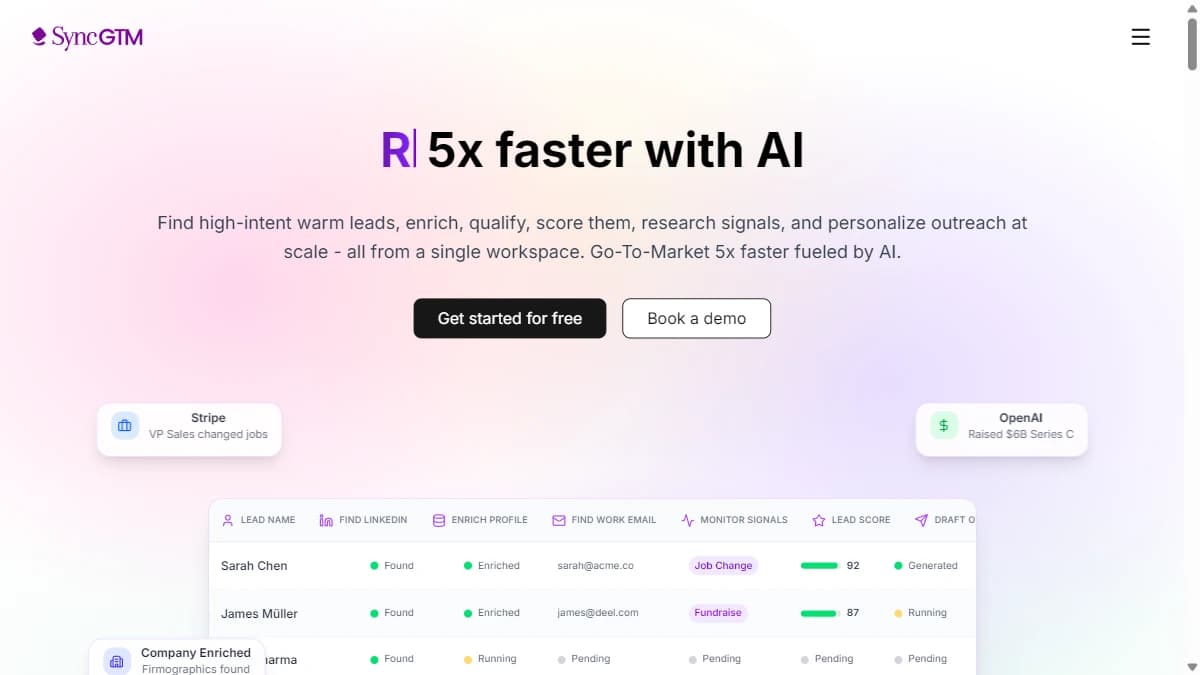
SyncGTM goes beyond Shopify App Detector by treating app detection as the starting point, not the endpoint. When you identify a Shopify store running Klaviyo, ReCharge, or Yotpo, SyncGTM runs a waterfall across 50+ data providers to surface the decision-maker behind the store — verified email, phone number, company size, revenue band, headcount, and buying signals — all in one enrichment run.
For teams selling to Shopify merchants, that means you go from "this store uses Klaviyo" to "here's the decision-maker's verified email and the latest buying signal" without stitching together a separate enrichment tool. Each record combines contact data (verified work email and phone number), firmographics (company size and revenue range), and buying signals such as hiring, funding, and headcount growth.
SyncGTM has native CRM integrations with Salesforce, HubSpot, Pipedrive, Attio, and Close, so enriched Shopify merchant records can move into the CRM your team already uses. It is free to start, and you can explore ready-made workflows in the templates library or see what it connects to under integrations.
Pros
- +Waterfall enrichment across 50+ providers for verified emails, phone numbers, and firmographics on each Shopify merchant
- +Contact intelligence included — verified email and phone for the decision-maker, not a separate add-on
- +Buying signals such as job changes, funding, headcount growth, and hiring to help time outreach
- +Native CRM integrations with Salesforce, HubSpot, Pipedrive, Attio, and Close
- +Free to start, so you can test enrichment output before paying
Cons
- −Not a purpose-built Shopify detection database — pair it with a detection tool to build the store list
- −Newer platform than established tech-intelligence databases like BuiltWith
Best for: Contact and firmographic enrichment for Shopify merchants — verified emails, phone numbers, and buying signals
Pricing: Free to start. Paid plans add more monthly data credits; see the SyncGTM pricing page for current tiers.
2. BuiltWith — Deep historical tech intelligence across 28,000+ technologies including Shopify apps
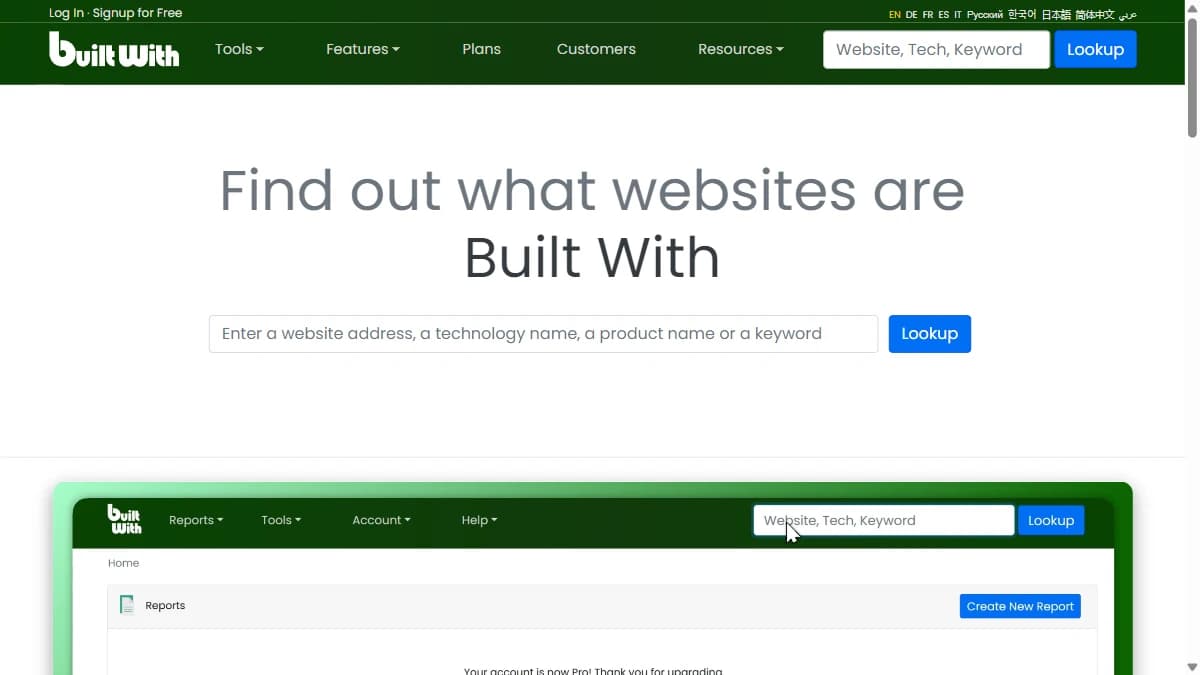
BuiltWith — Deep historical tech intelligence across 28,000+ technologies including Shopify apps
BuiltWith is the oldest and broadest technology intelligence platform on the web, indexing over 28,000 technologies across more than 700 million websites. For teams targeting Shopify merchants by their app stack, BuiltWith gives the most comprehensive historical data — you can see not just what apps a store uses today, but what it used to run, when it switched, and how its tech stack evolved over time.
For B2B sales teams, BuiltWith's Shopify-specific filtering is a strong ICP tool: build lists of stores using Klaviyo for email, ReCharge for subscriptions, or Gorgias for support, and filter by geography, traffic tier, or company size. The platform also surfaces spend estimates and technology adoption trends across entire Shopify segments, which is useful for timing outreach to stores actively evaluating replacements.
The gap is enrichment and outreach. BuiltWith returns a list of domains and basic firmographic signals — it does not find the decision-maker, verify an email, or send a sequence. Teams using BuiltWith for Shopify targeting typically stack it with Hunter or Snov.io for contacts and a separate sequencer, which adds cost and workflow overhead.
Pros
- +28,000+ tracked technologies with multi-year historical trend data
- +Strong Shopify-specific filtering by app, theme, traffic tier, and geography
- +Spend estimates and technology adoption reports across segments
- +API access on higher tiers for programmatic list building
Cons
- −No contact data — returns domains and firmographics only, not decision-maker emails or phones
- −No outreach integration — export-only workflow
- −Expensive relative to what it provides when stacked with a separate contact tool: $295/mo covers tech intelligence only
Best for: Deep historical tech intelligence across 28,000+ technologies including Shopify apps
Pricing: Starts at $295/mo. No meaningful free tier for B2B prospecting.
3. Store Leads — Shopify-native lead database with 4M+ stores tracked and weekly data refreshes
Store Leads — Shopify-native lead database with 4M+ stores tracked and weekly data refreshes
Store Leads is a Shopify-native lead database that indexes over 4 million Shopify and WooCommerce stores, refreshes data weekly, and lets you filter by installed apps, platform theme, product categories, traffic tier, and geography. It is the closest purpose-built alternative to a Shopify App Detector for bulk prospecting — designed specifically for B2B sales teams targeting ecommerce merchants at scale.
Where a Shopify App Detector gives you a single-store snapshot, Store Leads lets you pull thousands of stores matching a filter — "give me all Shopify stores using Klaviyo with over 500 products, based in the US, generating estimated revenue above $500K." That bulk discovery workflow is what teams building targeted Shopify prospect lists actually need. G2 reviewers consistently cite Store Leads as a strong replacement for manual Shopify app detection at volume.
Contact data is the gap. Store Leads provides the store owner name and email in many cases, but it is not a full enrichment platform — verified work email, direct phone, LinkedIn, and firmographic depth require a separate step. For teams that need contacts beyond the store owner, a dedicated enrichment tool is needed for that second layer.
Pros
- +4M+ Shopify and WooCommerce stores with weekly data refreshes
- +Shopify-specific filters: apps, themes, product volume, revenue tier, geography
- +Export available on all paid plans for list building
- +Competitive price at $89/mo versus enterprise tech intelligence platforms
Cons
- −Contact data limited to store owner — no team member discovery
- −No outreach integration — CSV export workflow only
- −Data freshness varies; high-traffic stores refresh faster than small shops
Best for: Shopify-native lead database with 4M+ stores tracked and weekly data refreshes
Pricing: Starts at $89/mo.
4. Wappalyzer — Real-time tech stack detection via browser extension and bulk URL API for Shopify qualification
Wappalyzer — Real-time tech stack detection via browser extension and bulk URL API for Shopify qualification
Wappalyzer is a technology profiler best known for its Chrome extension, which shows the tech stack of any website you visit — frameworks, CMS, marketing tools, and Shopify apps — in real time. For B2B teams that want to quickly qualify a Shopify prospect by their app stack without a database lookup, Wappalyzer's extension is the fastest way to check a store's technology in a single click.
Beyond the extension, Wappalyzer's API and lead database let teams run bulk technology lookups across lists of URLs — useful for qualifying an inbound lead list or enriching a CSV of Shopify store domains with their current app stack. The Business plan at $250/mo includes access to 3,000+ tracked technologies and a leads database with email addresses sourced from public data.
The trade-off is coverage and depth. Wappalyzer detects apps from page-level signals, so it misses server-side apps that do not expose a frontend signature — which in Shopify can mean newer or headless-installed apps go undetected. Contact data is also thin: the included emails are scrape-sourced from public data.
Pros
- +Real-time detection via Chrome extension — fastest way to check any Shopify store's app stack on the fly
- +Bulk URL API for programmatic tech stack enrichment across large lists
- +3,000+ tracked technologies on the Business plan
- +Leads database includes email on Business and higher plans
Cons
- −Detects apps from public frontend signals only — misses server-side and headless-installed apps
- −Thin contact data — included emails are scrape-sourced from public data
- −$250/mo Business plan is expensive for the level of contact enrichment provided
Best for: Real-time tech stack detection via browser extension and bulk URL API for Shopify qualification
Pricing: Business plan starts at $250/mo. Chrome extension is free for single-store detection.
5. StoreInspect — Entry-level Shopify store detection with a built-in contact finder at minimal cost
StoreInspect — Entry-level Shopify store detection with a built-in contact finder at minimal cost
StoreInspect is a Shopify-focused detection and lead platform that indexes over 1.46 million Shopify stores, detects 400+ apps and pixels, and includes a built-in contact finder to surface emails for store decision-makers. For teams early in their Shopify prospecting journey who want app detection and basic contact data without a large budget, it is the most affordable option on this list at $17/mo.
The tool covers the core workflow: paste or upload Shopify store URLs, detect the apps installed, filter by technology, and get associated contact emails. StoreInspect runs each store against a database of 400+ app fingerprints — covering the major marketing, subscription, and support apps — and flags the ones matching your ICP filter, which is close to what Shopify App Detector does but with a contact layer on top.
StoreInspect is best at the top of the funnel. It answers "which Shopify stores are using App X" and provides a first-pass contact, but firmographic depth, buyer intent signals, and verified direct phone are not in scope. Teams that want to go beyond the store owner email need to route those contacts through a dedicated enrichment tool for the next layer.
Pros
- +1.46M+ indexed Shopify stores with 400+ app fingerprints
- +Built-in contact finder — basic email for the store decision-maker
- +Cheapest paid plan on this list at $17/mo
- +Straightforward interface suited to solo sellers and small teams
Cons
- −Contact data is basic store-owner email — no direct phone or firmographic depth
- −400+ app fingerprints, while solid, is narrower than BuiltWith's 28,000+ technology database
- −No outreach integration — export-only workflow
Best for: Entry-level Shopify store detection with a built-in contact finder at minimal cost
Pricing: Starts at $17/mo.
Comparison Table
| Tool | Best For | Free Tier | Starting Price | Standout Feature |
|---|---|---|---|---|
| SyncGTM | Contact and firmographic enrichment for Shopify merchants — verified emails, phone numbers, and buying signals | Yes | Free plan available | 50+ provider waterfall enrichment returning verified contacts and firmographics for Shopify merchants |
| BuiltWith | Deep historical tech intelligence across 28,000+ technologies including Shopify apps | No | $295/mo | 28,000+ tracked technologies with multi-year historical data and spend estimates |
| Store Leads | Shopify-native lead database with 4M+ stores tracked and weekly data refreshes | No | $89/mo | 4M+ Shopify and WooCommerce stores with weekly refreshes and Shopify app-stack filtering |
| Wappalyzer | Real-time tech stack detection via browser extension and bulk URL API for Shopify qualification | Extension only (no bulk or leads) | $250/mo | Browser extension + REST API covering 3,000+ technologies with real-time detection |
| StoreInspect | Entry-level Shopify store detection with a built-in contact finder at minimal cost | Limited free plan | $17/mo | 1.46M+ indexed Shopify stores with 400+ app fingerprints and a built-in contact finder |
How to Choose
- SyncGTM if you need contact and firmographic enrichment for Shopify merchants — verified emails, phone numbers, and buying signals
- BuiltWith if you need deep historical tech intelligence across 28,000+ technologies including Shopify apps
- Store Leads if you need shopify-native lead database with 4M+ stores tracked and weekly data refreshes
- Wappalyzer if you need real-time tech stack detection via browser extension and bulk URL API for Shopify qualification
- StoreInspect if you need entry-level Shopify store detection with a built-in contact finder at minimal cost