Slintel Review 2026: Coverage, Pricing, and Alternatives

By Kushal Magar · August 4, 2026 · 12 min read
Key Takeaway
Slintel is no longer a product you can buy — slintel.com redirects to 6sense Sales Intelligence, and the technographic engine now ships inside a five-figure enterprise platform. The data is still excellent; the packaging is the problem. If you wanted technographics and contacts rather than enterprise ABM, a focused tool will cost you 1–2% as much.
Short version of this Slintel review: Slintel is not a product you can buy in 2026. 6sense acquired it in October 2021, and slintel.com now 301-redirects to the 6sense Sales Intelligence page. The technographic engine behind it is still one of the best in B2B — it just now costs $35,000–$130,000+ per year because it only ships inside the 6sense platform. Our rating: 3.4/5.
That redirect is the whole story. Most “Slintel review” articles still describe a standalone product with its own login, its own Chrome extension, and its own pricing page.
None of that exists anymore. So this review answers the question people are actually asking — what do I get if I go looking for Slintel today, and is it worth what 6sense charges for it?
We verified the redirect ourselves in August 2026, pulled the current packaging off the 6sense pricing page, and compared it against SyncGTM, BuiltWith, and TheirStack.
If you want the full platform evaluation rather than the Slintel-specific angle, read our dedicated 6sense review. This post focuses on what Slintel contributed and what happened to it.
What Is Slintel? (And Does It Still Exist in 2026?)
Slintel was a B2B sales intelligence company built around technographic-powered buying intent — identifying which companies run which software, and predicting when they were about to switch. It no longer operates as an independent product.
Before the acquisition, Slintel captured 60+ attributes across 15 million companies every week. It tracked 250 million B2B profiles, 100 million decision-makers, 50 million business emails, and 20 million direct dial numbers.
That dataset is why 6sense bought it. The technographic layer answered a question 6sense’s intent models could not on their own: not just is this account in-market, but what are they running right now, and what would they replace.
Today, typing slintel.com into a browser lands you here — the 6sense Sales Intelligence product page. There is no Slintel app, no Slintel login, and no Slintel pricing.
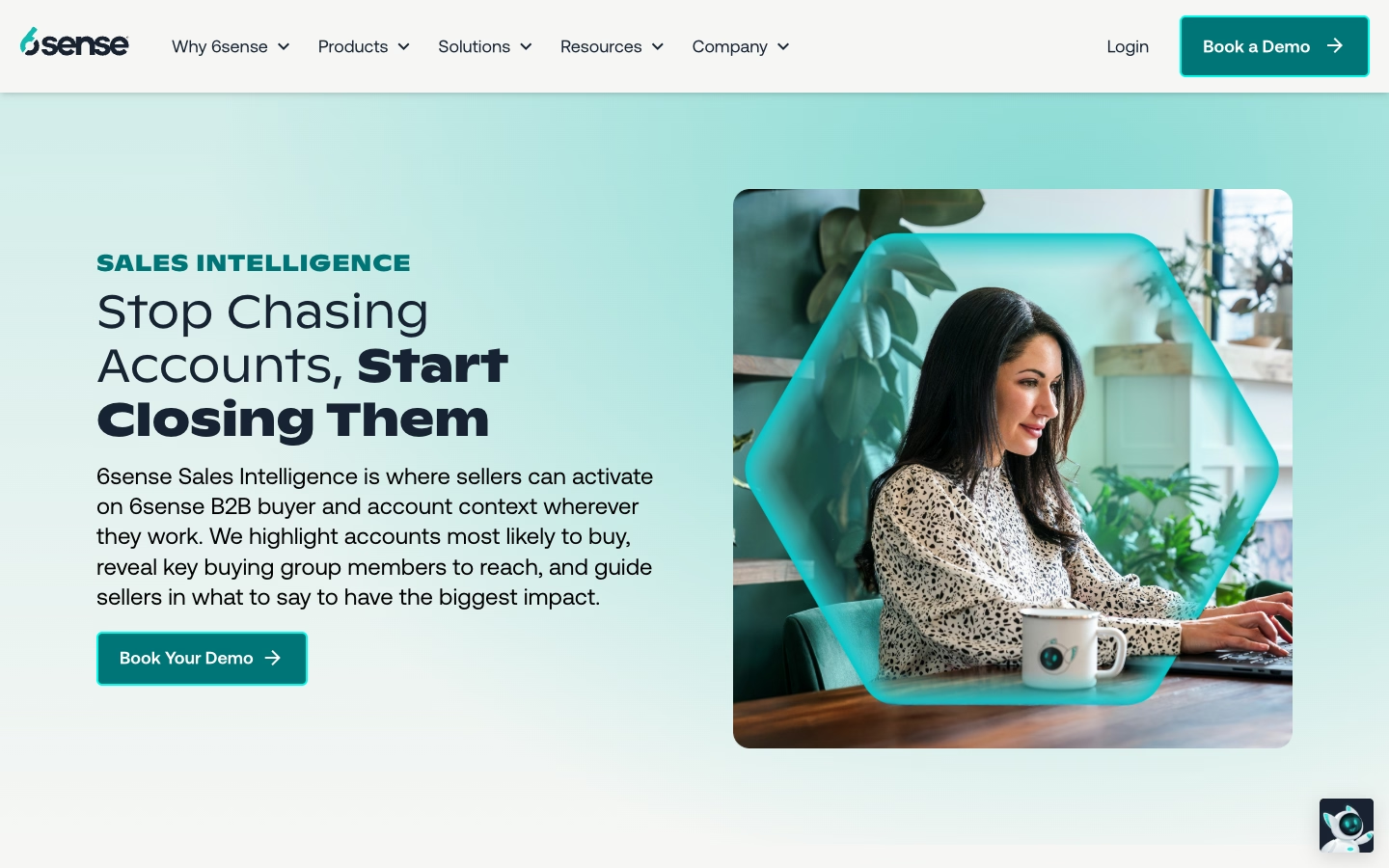
slintel.com now 301-redirects to 6sense Sales Intelligence (verified August 2026).
This matters for buyers in a specific way. Any listing, directory, or reseller still advertising “Slintel pricing” is working from pre-2022 information.
What Happened to Slintel After the 6sense Acquisition
6sense announced the Slintel acquisition on October 5, 2021, for an undisclosed sum. It followed 6sense’s acquisition of Fortella and was pitched as adding foundational data beneath 6sense’s intent models.
Per 6sense’s own announcement, Slintel strengthened the platform across four dimensions: modern business contact data, enhanced technographics with AI confidence scores, account and contact-level psychographics, and market insights on company events and expansions. The deal terms are listed as undisclosed on Crunchbase.
The absorption was gradual. Slintel kept its branding for a while, then the docs moved, then the app merged, and finally the domain started redirecting.
Here is the honest assessment of the transition. The technographic and psychographic data got better — it now sits alongside far richer intent and predictive signals than Slintel could have built alone.
The commercial access got dramatically worse. Slintel was a mid-market-accessible data vendor; 6sense is an enterprise platform sale with a discovery call and a multi-year contract.
The buyer’s takeaway: if a colleague recommends Slintel from memory, they are recommending a 2021 product at a 2021 price point. Budget accordingly, or evaluate a 6sense alternative instead.
Slintel Pricing: Plans, Credits, and What You Actually Pay
There is no Slintel pricing in 2026. There is only 6sense pricing, and 6sense does not publish a single number.
The pricing page presents two Sales Intelligence packages and routes every one of them to a demo booking. The Slintel-derived capabilities — technographics, psychographics, contact insights — appear as line items inside those bundles, not as something you can license separately.
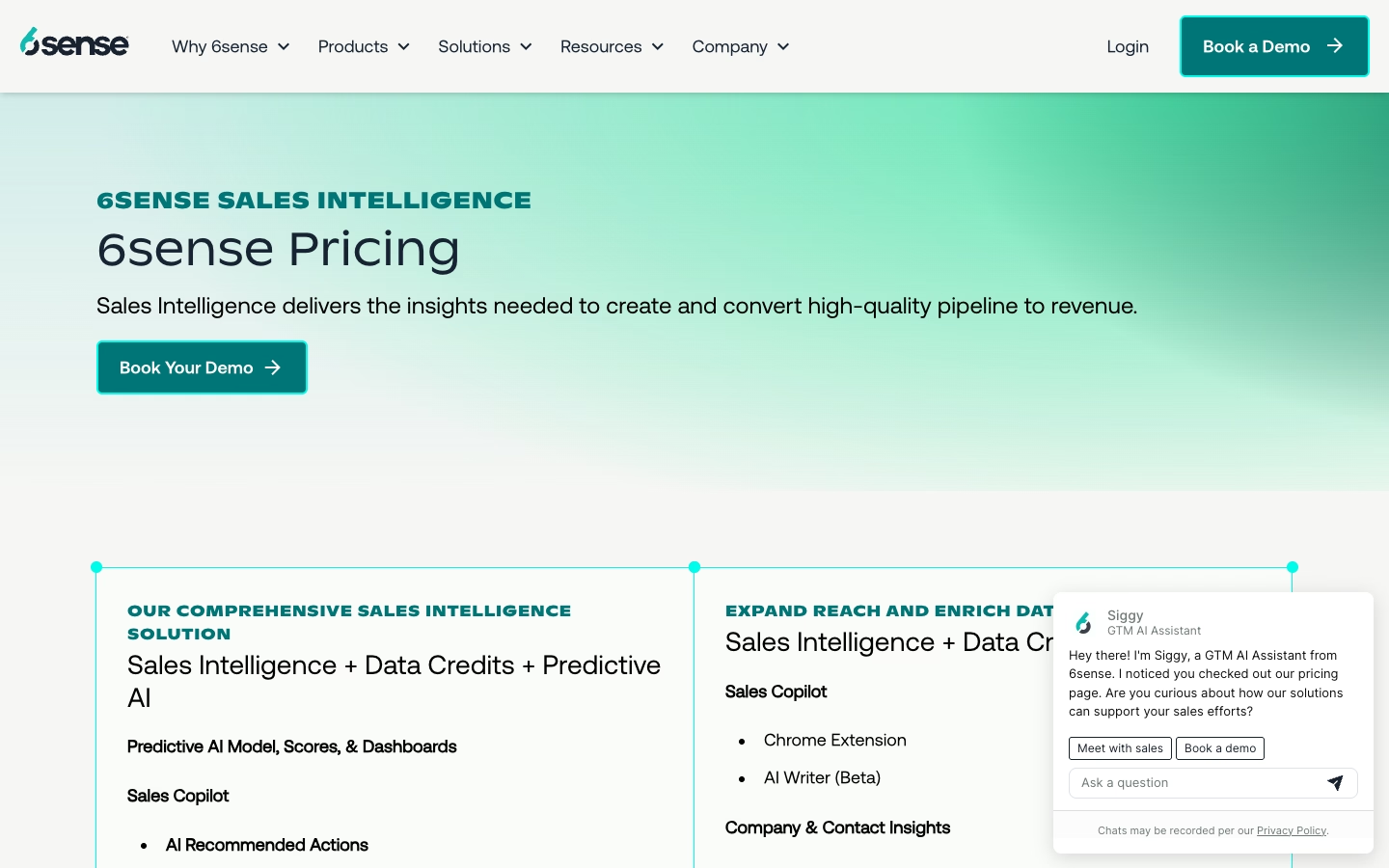
The 6sense pricing page: two Sales Intelligence bundles, zero dollar figures, one “Book Your Demo” button.
| Package | What’s Included | Published Price |
|---|---|---|
| Sales Intelligence + Data Credits | Sales Copilot, Chrome extension, AI Writer (beta), persona map, technographics, psychographics, web visitor ID, job postings, third-party intent. | None — demo required |
| Sales Intelligence + Data Credits + Predictive AI | Everything above plus the predictive AI model, account scores and dashboards, AI recommended actions, corporate hierarchy. | None — demo required |
| Real-world contract range | Reported third-party spend data across modules, credits, and add-ons. Contracts typically 12–24 months. | ~$35,000–$130,000+/yr (median ≈ $55,000) |
| SyncGTM (for comparison) | Waterfall enrichment across 50+ providers, signals, CRM sync, API and MCP access. | Free plan; paid from $99/month |
The credit model is worth flagging. Data credits are consumed when you reveal contacts, and they are negotiated per contract rather than listed — so two companies on the same package can pay very different effective rates.
For context on how opaque enterprise data pricing plays out in practice, our ZoomInfo cost breakdown walks through the same dynamic. SyncGTM publishes its numbers on the pricing page precisely because this pattern wastes so much buyer time.
Slintel Key Features: Technographics, Intent, and Contact Data
Slintel’s contribution to 6sense splits into three data layers plus the delivery surface. Here is what each one actually does and where it holds up.
| Capability | What You Get | Notable Gaps |
|---|---|---|
| Technographics | 60+ attributes across 15M companies, refreshed weekly, with AI confidence scores and adoption predictions rather than binary flags. | Batch refresh means recent tool switches can lag. Strongest for well-known SaaS, thinner for niche or internal tooling. |
| Buying Intent & Renewal Signals | Contract renewal windows, competitive displacement signals, and 6sense third-party intent with buying-stage prediction. | Requires the higher Predictive AI package to get full scoring and dashboards. |
| Contact Data | Business emails and direct dials, consumed via negotiated data credits, surfaced in-app and via Chrome extension. | The weakest layer. 6.1/10 contact accuracy in G2 comparison data; coverage thins outside North America. |
| Psychographics & Buying Groups | Persona mapping and account/contact-level psychographic context to identify who sits in the buying committee. | Genuinely differentiated, but only useful if you run structured ABM motions. |
| Delivery & Integrations | CRM and sales-engagement sync, Chrome extension, alerts, intelligent workflows, corporate hierarchy. | Setup and ongoing operation realistically need a RevOps owner. |
The renewal and displacement signals deserve special mention. If you sell against an incumbent, knowing that an account is 60 days from a renewal is worth more than any firmographic filter.
That specific capability is why teams still search for Slintel by name five years after the acquisition. It is also the hardest thing on this list to replicate elsewhere.
Slintel Pros: What It Does Well
- Technographic depth is genuinely best-in-class. Slintel's original engine tracked 60+ attributes across 15 million companies on a weekly refresh, and that dataset still powers 6sense's technographic layer today. For identifying who runs which software, it remains one of the strongest datasets on the market.
- Confidence scores and predictions, not just flat detections. Rather than a binary "uses Salesforce" flag, the Slintel-derived data carries AI-generated confidence scoring and adoption predictions. That extra layer helps you separate a confirmed deployment from a weak inference.
- Contract renewal and switching signals. The dataset flags when a company is approaching a renewal window or showing signs of evaluating a replacement. For competitive displacement campaigns, this is the single most valuable thing Slintel brought to 6sense.
- Psychographics and buying-group context. 6sense layers account and contact-level psychographic data on top of the technographics, mapping who sits in the buying group and what they care about. Very few technographic vendors attempt this at all.
- Intent signals are the category benchmark. 6sense's buying-stage prediction and third-party intent are consistently the most-praised part of the platform in G2 reviews. If intent is your primary need, this is the strongest product in the category.
- Deep enterprise integrations. Native CRM and sales-engagement sync, corporate hierarchy mapping, and a Chrome extension mean the data lands where reps already work rather than in a CSV.
Slintel Cons: Where It Falls Short
- You cannot buy Slintel anymore. The standalone product is gone — slintel.com 301-redirects to the 6sense Sales Intelligence page. Any vendor still selling you "Slintel" is reselling 6sense or serving stale data.
- No public pricing, ever. 6sense does not publish a single number. Every path on the pricing page ends at "Book Your Demo," which means a discovery call and a quote before you learn whether it is affordable.
- Enterprise-only cost structure. Reported spend lands between $35,000 and $130,000+ per year, with a median around $55,000. For a team that just wanted technographic filters, that is a category-level price for a platform-level purchase.
- 12–24 month contracts. There is no monthly plan and no self-serve tier. You commit for a year or more before you know whether the data hits on your ICP.
- Contact data is the weakest layer. 6sense Sales Intelligence scores 6.1 on contact data accuracy in G2's comparison data, well behind category leaders, and 131 of its 891 reviews flag inaccurate data. Coverage thins noticeably outside North America.
- Technographic freshness can lag. Detections are refreshed on a batch cadence rather than continuously, so a company that switched tools recently may still show the old stack for a period.
- Overkill for non-tech targeting. If your ICP is not defined by software usage, you are paying for the most expensive part of the platform and using none of it.
The contact-data complaint is the one that shows up most in reviews. On G2, 6sense Sales Intelligence holds roughly 4.0/5 across 891 reviews, with 131 of those reviews specifically flagging inaccurate data.
For historical contrast, the legacy Slintel profile on Software Advice still sits at 4.4/5 from 37 reviews. That gap is mostly a story about a focused tool becoming one module in a much larger platform.
Slintel vs SyncGTM vs BuiltWith vs TheirStack
These four tools all touch technographics, but they are not substitutes for each other. The right comparison depends on whether you need account identification, contact data, or enterprise intent.
| Dimension | Slintel (6sense) | SyncGTM | BuiltWith | TheirStack |
|---|---|---|---|---|
| Starting Price | Unpublished; ~$35k–$130k+/yr | Free plan; $99/mo | $295/mo | Free tier; $59/mo |
| Self-Serve Signup | No — demo required | Yes | Yes | Yes |
| Tech Detection Method | Multi-signal ML with confidence scores | Multi-source signals + enrichment | Website crawl (frontend) | Job-posting NLP (backend) |
| Contact Data Included | Yes, via credits — accuracy is the weak point | Yes — 50+ provider waterfall | Limited | No |
| Buying Intent / Renewal Signals | Best in class | Signal library (hiring, funding, job change) | No | Hiring signals only |
| Contract Term | 12–24 months | Monthly | Monthly | Monthly |
| Best For | Enterprise ABM with budget and RevOps | Teams needing signals + verified contacts | Frontend tech targeting | Backend stack targeting on a budget |
Where 6sense genuinely wins: intent modeling and buying-stage prediction. Nothing in this table competes with it on that dimension, and pretending otherwise would be dishonest.
Where it loses: cost of entry and contact quality. If your job is to find the right accounts and get a deliverable email for the right person, a waterfall enrichment approach across 50+ providers will beat a single-vendor contact database on hit rate for a fraction of the spend.
If technographics specifically are your priority, our Datanyze review covers another technographic vendor that went through a similar decline in focus.
Who Should Use Slintel in 2026?
Since Slintel is now 6sense, the buying decision is a 6sense decision. Here is the split.
Buy it if
- You run enterprise ABM with a defined six-figure GTM data budget and a RevOps owner to operate the platform.
- Your ICP is defined by software usage, and competitive displacement at renewal is a core motion.
- You need buying-stage prediction across a large account list, not just a contact list.
- You already own 6sense for marketing and want the sales layer on the same data spine.
Skip it if
- You wanted technographic filters and nothing else — you will pay platform prices for one module.
- Verified email and phone coverage is your primary need, especially outside North America.
- You are a startup or SMB without budget for a 12–24 month enterprise contract.
- Your targeting is firmographic or signal-based rather than software-usage-based.
For the second and third groups, the practical move is a self-serve enrichment layer plus a focused technographic tool. That combination typically lands under $200/month against a five-figure annual commitment.
Teams working intent specifically should also compare the focused options in our buying intent data tools breakdown before committing to a platform contract.
Slintel Review Verdict: Is It Worth It in 2026?
Rating: 3.4/5. The data is excellent. The way you are required to buy it is not.
Slintel built one of the best technographic engines in B2B, and 6sense has kept improving it — confidence scores, renewal signals, and psychographics are all real advantages that competitors have not matched. If you are running enterprise ABM, that is worth paying for.
But the product that made people search for “Slintel” — an accessible, focused technographic data tool — no longer exists. What replaced it is a demo-gated enterprise platform with a five-figure floor and a contact-data layer that reviewers rate as its weakest component.
If you came here to buy Slintel, the honest answer is that you cannot. Decide whether you want 6sense, and if the answer is no, build the stack from focused tools instead.
SyncGTM covers the enrichment half of that stack — waterfall enrichment across 50+ providers, signal monitoring, and CRM sync, starting free and priced publicly from $99/month. No discovery call required to find out what it costs.