4 Best SourceStack Alternatives for B2B Enrichment in 2026

By Kushal Magar · June 16, 2026 · 11 min read
Key Takeaway
SourceStack provides tech stack, job posting, and eCommerce data — but has no contact enrichment, email finding, phone discovery, or CRM sync. This guide ranks 4 alternatives that cover the full B2B prospecting workflow in 2026. SyncGTM leads with waterfall enrichment across 50+ providers, 76+ data points per lead, and AI-powered outreach automation at $89/mo. TheirStack is the strongest like-for-like replacement for tech stack and hiring signals. Crustdata suits developer teams that need a real-time API. Apollo.io is best for teams that want contacts, sequences, and a searchable database in one tool.
SourceStack does a specific job well: it tracks what software companies use, what jobs they're hiring for, and what eCommerce inventory they carry. For market researchers and data engineers building signal feeds, that coverage is genuinely useful.
The gap shows up the moment a B2B sales team needs to act on those signals. SourceStack has no email finder, no phone discovery, no LinkedIn-to-contact lookup, and no CRM sync. It tells you which companies use Salesforce — but not who to call at those companies or how to reach them. That requires a separate tool, a separate budget, and a separate workflow to stitch them together.
We evaluated four SourceStack alternatives on the dimensions that matter for B2B prospecting in 2026: contact enrichment depth, signal quality, pricing transparency, and how much of the workflow each tool owns end-to-end.
What is SourceStack?
SourceStack is a B2B data-as-a-service platform covering 15.8M+ companies across 219 data fields. It tracks SaaS and OSS technology usage across 8,400+ products, 8M+ active job postings, and 683M+ eCommerce SKUs. Pricing is credit-based and one-time: Startup ($249 for 100,000 credits), Scaling ($699 for 1,000,000 credits), and High Volume (custom). Credits never expire. SourceStack does not include contact enrichment — no email finding, phone discovery, or outreach capabilities.
According to Gartner, B2B contact data decays at roughly 2% per month. Intent signals age even faster — a hiring spike is useful for days, not weeks. The alternatives below close the gap between "company signal" and "contact reached."
For background on how modern enrichment stacks sequence multiple providers, see our guide on what waterfall enrichment is and our ranked list of the best waterfall contact providers.
TL;DR
| Tool | Best For | Starting Price | Free Tier | Contact Enrichment |
|---|---|---|---|---|
| SyncGTM | Waterfall enrichment + AI outreach automation | $89/mo (annual) | Yes (50 credits) | Yes — 50+ providers |
| TheirStack | Tech stack signals + job hiring data | $59/mo (API) | Yes (50 company credits) | No |
| Crustdata | Developer-grade real-time company + people data API | Custom (quote only) | No | Yes — 90+ datapoints |
| Apollo.io | All-in-one prospecting + sequencing | $49/mo (annual) | Yes (10,000 email credits/mo) | Yes — 275M+ contacts |
Why Teams Switch from SourceStack
SourceStack fits a narrow use case: building company-level signal feeds for data teams or market researchers. Three gaps push B2B sales and GTM teams toward alternatives:
- No contact enrichment. SourceStack tracks which companies use which tools — not who works there or how to reach them. A tech stack signal without a verified email address is unusable for outbound. Sales teams need a separate email finder, phone enrichment tool, and LinkedIn lookup on top of SourceStack, adding cost and workflow friction.
- No outreach layer. SourceStack exports data to CSV, Google Sheets, or via API. It has no sequencing, no CRM sync beyond export, and no automation for acting on signals. Every enriched company requires manual handoff to another tool before a rep can actually reach out.
- Data freshness limitations. Users on Crozdesk report that certain data categories aren't refreshed as frequently as needed for time-sensitive sales signals. Hiring spikes and tech install events lose their prospecting value quickly — stale signals don't convert.
The alternatives below solve at least one of these gaps. For the full picture on what a modern enrichment stack looks like, see our top data enrichment tools for 2026.
1. SyncGTM
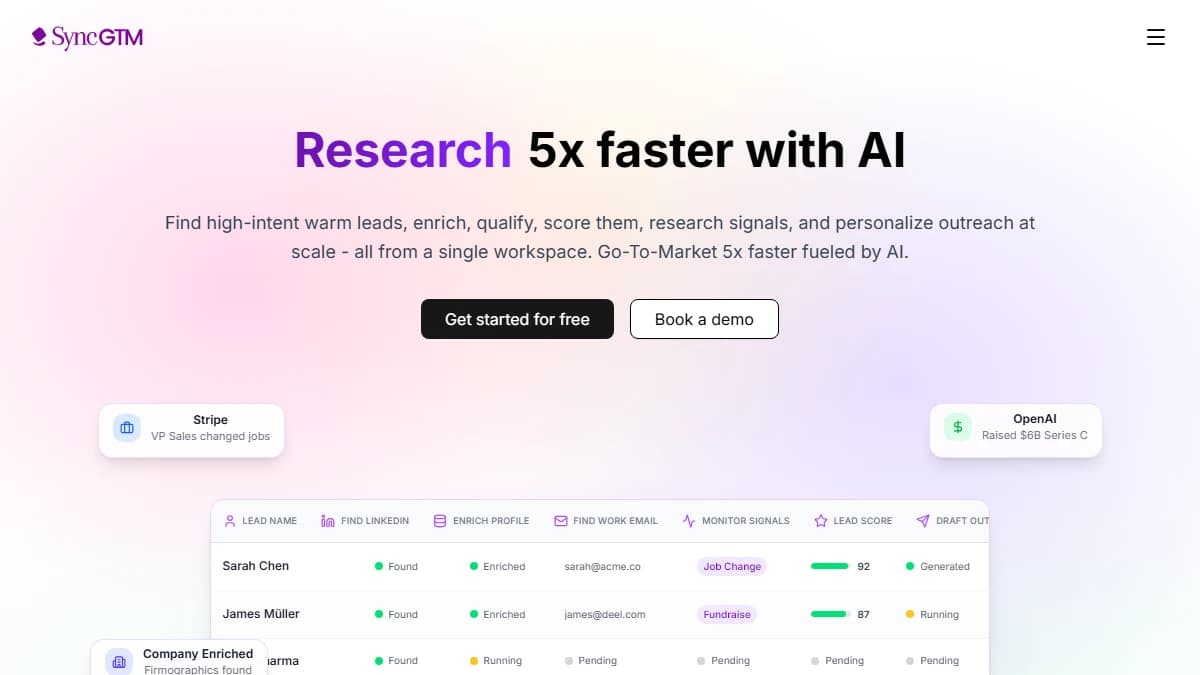
SyncGTM — waterfall enrichment across 50+ providers with AI outreach agents and CRM sync
SyncGTM is a B2B enrichment platform best suited for outbound sales teams that need to go from company signal to verified contact to booked meeting in one workflow — offering waterfall enrichment across 50+ providers at $89/mo (annual).
Where SourceStack stops at "this company uses Salesforce and is hiring 3 SDRs," SyncGTM answers "here is the verified email, direct dial, and LinkedIn profile for the VP of Sales at that company — and an AI agent has already queued a personalized sequence." The contact enrichment layer runs through 50+ providers in waterfall sequence — if Provider 1 returns no email, Provider 2 tries, then Provider 3, until coverage reaches 80%+ on most ICPs. Single-source tools like SourceStack's tech stack API top out at 40–60% without this fallback logic.
Each enriched record returns up to 76+ data points: verified work email, direct dial, mobile number, company firmographics, technographics, funding stage, headcount growth, LinkedIn URL, job title history, and buying signal flags. Technographic coverage mirrors what SourceStack tracks — SaaS product usage, tech stack composition — but combines it with the contact layer needed to act on the signal.
Buying signal triggers automate the workflow layer. When a target company posts a hiring signal — a new SDR role, a "Salesforce Admin" job opening — SyncGTM flags the account, enriches the decision-maker contacts, and triggers a tailored sequence. SourceStack identifies that signal. SyncGTM acts on it.
For a detailed look at how waterfall enrichment stacks compare on hit rate and cost, see our best waterfall enrichment tools for 2026.
Pros
- Waterfall enrichment across 50+ providers — 80%+ email coverage
- 76+ data points per enriched record including technographics
- AI agents trigger outreach on buying signals automatically
- Native CRM sync (HubSpot, Salesforce, Pipedrive, Attio, Zoho)
- Only charged when a valid contact result is returned
- Cloud-native — works on any OS, no desktop install
- Free tier available (50 credits)
Cons
- Less suited for pure data-team / API-only use cases than Crustdata
- Free tier limited to 50 credits
- No standalone eCommerce SKU data (SourceStack covers this; SyncGTM does not)
Best for: GTM and outbound sales teams that need technographic signals plus verified contacts plus automated outreach — all under one subscription.
Pricing: Free (50 credits) · Starter $89/mo (annual, 24,000 credits/yr) · Pro $224/mo (annual, 120,000 credits/yr) · Business $584/mo (annual, 600,000 credits/yr)
2. TheirStack
TheirStack — technographic signals and job posting intelligence for B2B sales teams
TheirStack is a technographic and hiring signal platform best suited for B2B sales teams that need to identify target accounts by tech stack usage and job posting activity — covering 207M+ job postings from 195+ countries at $59/mo (API).
TheirStack is the closest like-for-like SourceStack alternative on the signal side. Both platforms track what technology companies use and what jobs they're posting. The key operational difference is freshness: TheirStack updates job data at the minute level with automatic cross-source deduplication across 344,000+ sources. SourceStack users report update delays that reduce signal quality for time-sensitive outbound.
TheirStack covers 32,000+ technologies with job description-level detection — identifying tech stack composition from how companies describe their engineering roles. The platform also filters out staffing agencies by default, so job signals reflect actual company hiring intent rather than recruiter noise. SourceStack does not offer this filtering.
The trade-off: like SourceStack, TheirStack provides company-level intelligence but no contact-level enrichment. It pairs well with a contact enrichment tool or CRM enrichment workflow. For teams already running a contact enrichment stack and looking for a cleaner signal layer, TheirStack is a direct upgrade.
For more context, see our full TheirStack review and our comparison of TheirStack alternatives.
Pros
- 207M+ job postings — minute-level updates, auto-deduplicated
- 32,000+ technologies tracked with job description-level detection
- Filters out staffing agencies for cleaner hiring signals
- Free tier available (50 company credits + 200 API credits/mo)
- Transparent pay-as-you-go pricing from $0.005/credit
- Trusted by Google, Amazon, IBM, and Uber
Cons
- No contact enrichment — email finding requires a separate tool
- No built-in outreach or CRM sync
- Smaller eCommerce and SKU dataset compared to SourceStack
- No webhook/push delivery for real-time alerting on free plan
Best for: Sales teams that need cleaner, fresher tech stack and hiring signals than SourceStack and already have a contact enrichment layer in place.
Pricing: Free (50 company credits + 200 API credits/mo) · App subscriptions from $109/mo (1,000 credits) · API plans $59–$1,500/mo (1,500–1,000,000 credits)
3. Crustdata

Crustdata — real-time B2B data API covering 1B+ people and 70M+ companies across 250+ datapoints
Crustdata is a real-time B2B data API best suited for engineering and data teams that need programmatic access to company signals and contact enrichment at scale — covering 1B+ people and 70M+ companies with custom enterprise pricing.
Crustdata solves the core gap SourceStack leaves open: contact enrichment. Its People Enrichment API pulls 90+ live datapoints per person — current job title, work email, past experience, education, and LinkedIn data — drawn from real-time web sources rather than periodic snapshots. The company data layer covers 250+ firmographic and signal fields: hiring velocity, funding events, technographics, headcount growth, and job posting patterns. That combines what SourceStack tracks with the contact layer SourceStack omits.
The platform is YC-backed and built for API-first workflows. Data delivery is via REST API or flat file datasets (CSV/JSON). Crustdata refreshes its unified company dataset monthly from 11+ trusted sources, with real-time capability for contact-level queries. Pricing is custom and quote-only — teams typically see $1,000–$3,000/mo for growth-stage usage.
The trade-off versus SyncGTM is workflow completeness. Crustdata is a data API, not a GTM platform. It has no outreach, no CRM sync, and no AI agent layer. Data teams that want to build custom enrichment pipelines will prefer Crustdata's flexibility. Sales teams that need a finished workflow will find SyncGTM or Apollo.io more practical.
Pros
- 90+ live datapoints per person — real-time contact enrichment
- 250+ company datapoints including hiring, funding, and technographics
- 1B+ people and 70M+ companies in coverage
- Unified from 11+ trusted sources with monthly refresh
- API-first — integrates cleanly into custom data pipelines
- YC-backed with strong data compliance posture
Cons
- No self-serve pricing — requires demo and custom quote
- No outreach, sequencing, or CRM sync
- Built for technical teams — steeper integration effort than SaaS tools
- No free tier for company-level API access
Best for: Engineering and data teams that need a flexible, real-time API for both company-level signals and contact enrichment at enterprise scale.
Pricing: Custom — contact sales. Estimated $1,000–$3,000/mo for growth-stage usage; enterprise datasets $5,000+/mo.
4. Apollo.io
Apollo.io — 275M+ contact database with built-in sequencing and intent data
Apollo.io is an all-in-one B2B prospecting platform best suited for sales teams that want a searchable contact database, email sequencing, and CRM integration in one tool — covering 275M+ contacts starting at $49/user/mo (annual) with a generous free tier.
Apollo solves the structural gap SourceStack has: it is a complete prospecting workflow, not just a data layer. You search 275M+ contacts by industry, company size, job title, technology usage, and 65+ other filters. You build a list. You run a sequence from the same dashboard. CRM sync to HubSpot or Salesforce happens natively. SourceStack requires a separate tool for every step after the initial company signal.
The technographic filter in Apollo covers 10,000+ technologies — narrower than SourceStack's 8,400 SaaS products but combined with 275M contacts it means you can immediately query "VP of Sales at companies using Salesforce with 50–500 employees" and get a list of people to reach, not just a list of companies to research further.
Apollo's free tier is the most generous on this list: 10,000 email credits per month with full database access. That alone makes it worth evaluating for teams currently paying SourceStack one-time credits to identify prospects they then can't reach.
One honest limitation: Apollo relies primarily on its own database. Heavy outbound teams on tight ICPs see email coverage drop below 60% without a waterfall fallback. For that use case, SyncGTM's multi-provider waterfall closes the gap.
Pros
- 275M+ contacts searchable with 65+ filters including technographics
- Built-in email sequencing and LinkedIn outreach steps
- Native CRM sync (HubSpot, Salesforce, Pipedrive, and more)
- Generous free tier — 10,000 email credits/mo permanently
- Intent data overlay for buying signal identification
- Chrome extension for LinkedIn-based lookups
Cons
- Single-source database — email coverage drops on tight ICPs vs. waterfall tools
- Credit overages can push real cost to $150–$400/user/mo for active teams
- Technographic coverage (10k technologies) narrower than SourceStack's 8,400 SaaS products
- No eCommerce SKU or raw job dataset export at scale
Best for: Sales teams that want an all-in-one database, sequencing, and CRM sync without needing to connect multiple tools — and want a meaningful free tier to start.
Pricing: Free (10,000 email credits/mo) · Basic $49/user/mo (annual) · Professional $79/user/mo (annual) · Organization $119/user/mo (annual, 3-user minimum)
Side-by-Side Comparison
| Tool | Tech Stack Data | Job Signal Data | Contact Enrichment | Outreach / Sequences | CRM Sync | Starting Price |
|---|---|---|---|---|---|---|
| SourceStack | Yes — 8,400 SaaS products | Yes — 8M+ postings | No | No | No (CSV/API export only) | $249 one-time |
| SyncGTM | Yes — included in 76+ datapoints | Yes — buying signal triggers | Yes — 50+ provider waterfall | Yes — AI agents + sequences | Yes — HubSpot, Salesforce, more | $89/mo (annual) |
| TheirStack | Yes — 32,000+ technologies | Yes — 207M+ postings, minute-level | No | No | No | Free / $59/mo API |
| Crustdata | Yes — 250+ company datapoints | Yes — hiring signals via API | Yes — 90+ live datapoints/person | No | No (API delivery only) | Custom (quote required) |
| Apollo.io | Yes — 10,000+ technologies | Partial — intent data overlay | Yes — 275M+ contacts | Yes — email + LinkedIn sequences | Yes — HubSpot, Salesforce, more | Free / $49/user/mo (annual) |
How to Choose the Right SourceStack Alternative
- Need contact enrichment + outreach automation: Choose SyncGTM. It is the only option on this list that combines technographic signals, waterfall contact enrichment across 50+ providers, AI outreach agents, and CRM sync in one platform. Ideal for outbound-heavy GTM teams.
- Need fresher, cleaner tech stack and hiring signals only: Choose TheirStack. Minute-level job data updates, 32,000+ technologies tracked, and staffing agency filtering make it a direct SourceStack upgrade on signal quality. Pair it with SyncGTM or Apollo for contact data.
- Building a custom enrichment pipeline via API: Choose Crustdata. The 90+ live datapoints per person and 250+ company fields give developer teams the deepest programmatic access to both signals and contacts. Requires technical integration effort and a custom pricing conversation.
- Want an all-in-one tool with a meaningful free tier: Choose Apollo.io. The 275M+ contact database, built-in sequencing, and 10,000 monthly free email credits make it the lowest-friction starting point for teams migrating off a signal-only tool like SourceStack.
- Running tight ICP targeting with high outbound volume: Choose SyncGTMfor the waterfall enrichment. Single-source tools like Apollo top out at 40–60% email coverage on tight ICPs. SyncGTM's 50+ provider waterfall pushes that to 80%+, which materially reduces cost-per-booked-meeting. See our comparison of the best Coresignal alternatives for more options in the enterprise data tier.
Final Verdict
SourceStack is a capable data-as-a-service tool for market research and signal collection. It is not a prospecting platform. It has no email finder, no phone enrichment, no outreach layer, and no CRM sync — which means every sales team using it needs at least two additional tools to turn a signal into a conversation.
For most B2B GTM teams, SyncGTM is the strongest replacement. It covers technographic and hiring signals, adds waterfall contact enrichment from 50+ providers (pushing email coverage to 80%+), fires AI-driven outreach on signal triggers, and syncs to your CRM. One subscription replaces the SourceStack + email finder + outreach tool stack most teams are running.
TheirStack is the right call if you specifically need deeper, fresher hiring and tech stack data and already have a contact enrichment solution in place.Crustdata suits engineering teams building custom pipelines.Apollo.io is the most accessible starting point with its generous free tier and all-in-one interface.
For teams evaluating the full enrichment landscape, see our guide on the best People Data Labs alternatives and our breakdown of Clearbit alternatives for additional context on where the market is heading.