

4 Best Visitor Queue Alternatives for B2B Enrichment in 2026

By Kushal Magar · June 18, 2026 · 11 min read
Key Takeaway
Visitor Queue was acquired by Leadinfo and only identifies companies — not individual contacts. The best alternatives in 2026 give you person-level enrichment, verified contact data, and outreach in one platform. SyncGTM leads with waterfall enrichment from 50+ providers. RB2B is the best free entry point. Warmly is the enterprise play. Dealfront wins for European compliance.
Visitor Queue identified companies visiting your website — but it never told you who from that company to contact, how to reach them, or whether they were actually in-market.
In 2025, Visitor Queue was acquired by Leadinfo. The platform now redirects to Leadinfo, which still only identifies companies — not individuals.
B2B teams in 2026 need more: person-level contact data, enrichment from multiple providers, buying signals, and outreach in one place.
This guide compares the 4 best visitor queue alternatives based on enrichment depth, pricing, and what you can actually do with the leads they surface. SyncGTM is listed first because it most directly replaces the full workflow — not just the visitor ID piece.
TL;DR
| Tool | Best For | Starting Price | Person-Level Data |
|---|---|---|---|
| SyncGTM | Full enrichment + outreach replacement | $89/mo (billed yearly) | Yes — 76+ data points, 50+ providers |
| RB2B | Free person-level visitor ID (US) | Free (150 resolutions/mo) | Yes — name, LinkedIn, email |
| Warmly | Enterprise AI revenue orchestration | $15,000/year | Yes — with AI engagement layer |
| Dealfront | GDPR-compliant European visitor ID | ~$99/mo (Leadfeeder tier) | Company-level; contact directory included |
Why Teams Leave Visitor Queue
Visitor Queue started at $31/month and identified companies visiting your site using IP-to-company matching. It gave you a company name, industry, and sometimes a few contacts from that domain.
That is where it stopped. No person-level identification, no verified emails, no phone numbers, no buying signal tracking, and no outreach automation.
Most B2B teams hit three specific friction points:
- Company visits ≠ contact data.Knowing “Acme Corp visited your pricing page” is useless without a name and email to follow up with.
- No enrichment depth. Visitor Queue returned basic firmographics. It did not cascade through multiple data providers to find verified contacts.
- No integrated outreach. You had to export a CSV, enrich it in a separate tool, then build a sequence in yet another platform.
According to G2's Visitor Queue alternatives page, the top reasons users switch are limited contact data quality and lack of outreach automation. The acquisition by Leadinfo did not change those limitations — it just rebranded them.
The best visitor queue alternatives in 2026 solve the full problem: identify, enrich, and act — not just identify.
1. SyncGTM
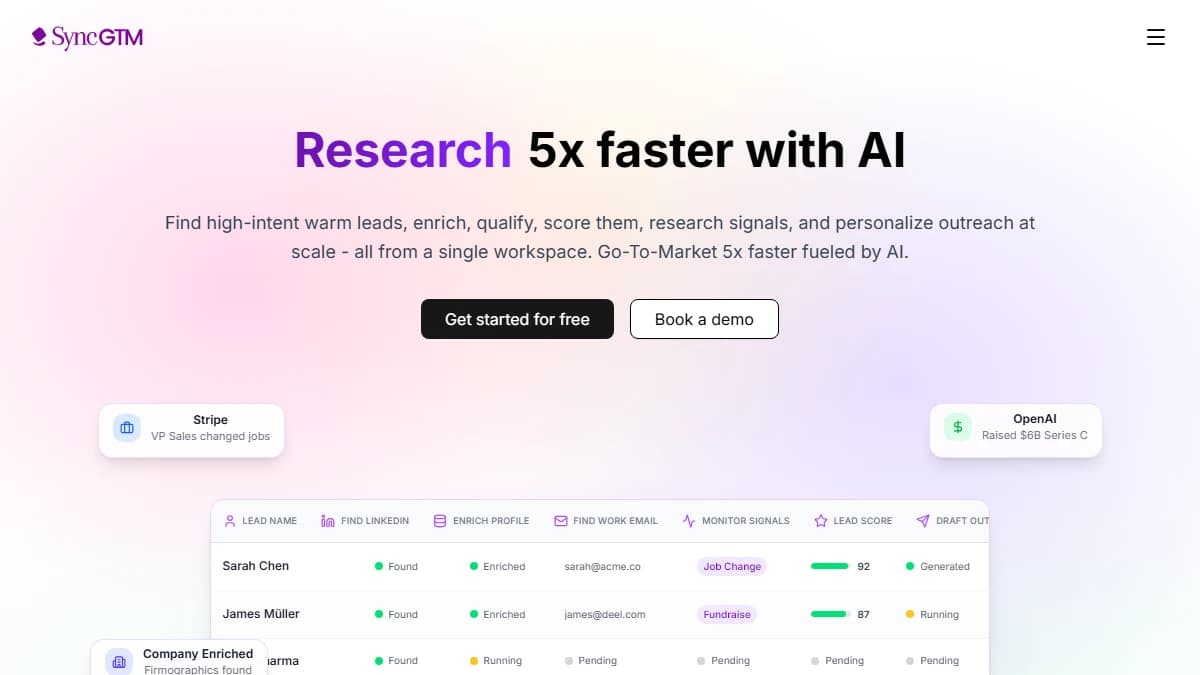
SyncGTM — waterfall enrichment from 50+ providers, ICP scoring, and outreach in one platform
SyncGTM is a B2B go-to-market platform that replaces Visitor Queue and the stack of enrichment, scoring, and outreach tools that typically sit around it. Instead of identifying a company and leaving you to figure out who to call, SyncGTM enriches every lead with verified contact data from 50+ providers using waterfall logic — cascading through sources until it returns a verified email or phone number.
The platform surfaces 76+ data points per lead: work email, mobile number, LinkedIn profile, company firmographics, tech stack, headcount growth, job change signals, and funding rounds. You can score leads against your ICP automatically (0–100 scale), set up buying signal monitors, and launch personalized outreach sequences — all without leaving the platform.
For teams frustrated by Visitor Queue's company-only output, SyncGTM is the most complete replacement. It is not a visitor identification tool in the traditional sense — it takes a proactive approach, enriching prospects before they even visit your site, and building the pipeline you would otherwise have to chase after the fact.
The waterfall enrichment model means you pay only for valid records returned. At the Starter plan ($89/mo billed yearly), you get 24,000 credits per year — enough for roughly 24,000 email lookups or 1,600 phone number enrichments.
Pros
- Waterfall enrichment across 50+ providers — highest contact coverage in the category
- 76+ data points per lead including mobile numbers, tech stack, and buying signals
- ICP scoring, signal monitoring, and outreach sequences built in — replaces 3–4 separate tools
- Pay-only-for-valid-records pricing model keeps cost per contact low
- Free tier available (50 credits on signup); no credit card required
Cons
- Not a real-time website visitor ID tool — does not track who visits your site session-by-session
- Learning curve for teams new to waterfall enrichment workflows
Best for: B2B teams that want proactive enrichment, contact data depth, and outreach automation — replacing Visitor Queue plus 2–3 other tools in one subscription.
Pricing: Starts at $89/mo (Starter, billed yearly). Free tier: 50 credits. Add-on credits: $0.05/credit.
2. RB2B
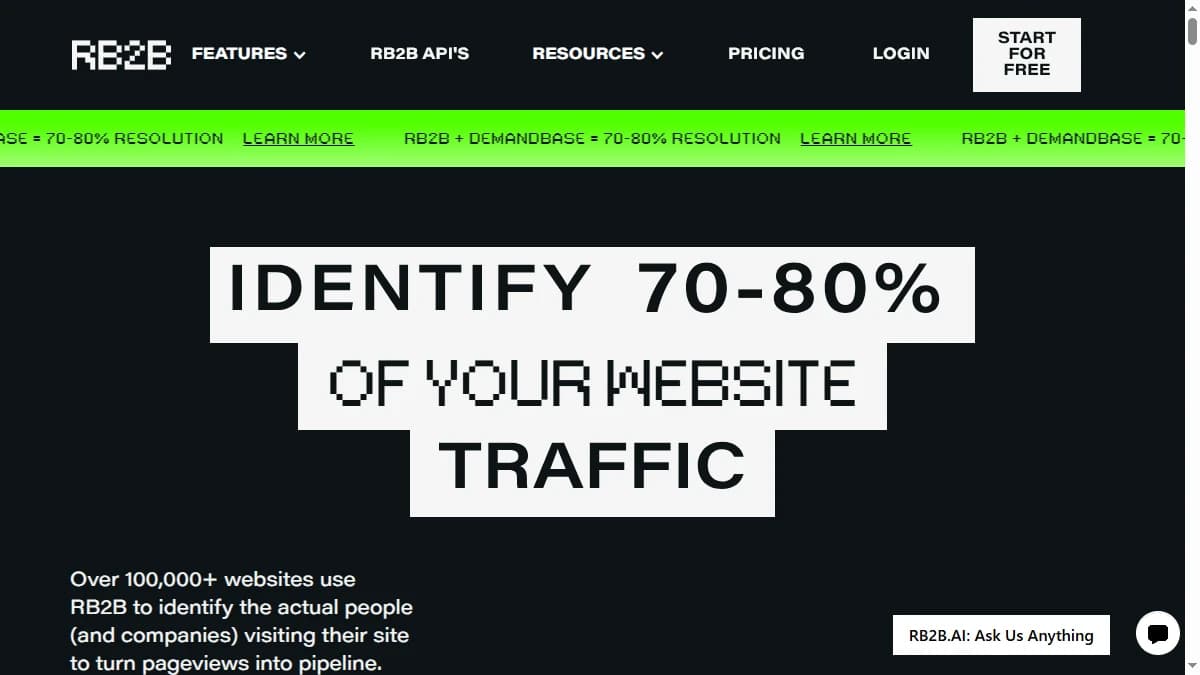
RB2B — identifies individual visitors (not just companies) and pushes them to Slack in real time
RB2B is a person-level website visitor identification tool that solves Visitor Queue's core limitation head-on. Where Visitor Queue told you a company visited, RB2B tells you the individual — name, LinkedIn profile, and business email — pushed to Slack in real time.
The free plan resolves up to 150 visitors per month and pushes them directly to a Slack channel. Paid plans start at $79/month for 300 resolutions and unlock CRM integrations with HubSpot and Salesforce.
The catch: RB2B's coverage is currently US-only. It also does not enrich beyond the visitor identification layer — no phone numbers, no buying signals, no tech stack data. For the enrichment depth that replaces a full stack, pair RB2B with a dedicated enrichment platform.
That said, for a team that simply wants to know who is visiting their site and follow up immediately, RB2B is the best free entry point in the category. The full RB2B review covers hit rates and setup in detail.
Pros
- Person-level identification — name, LinkedIn, business email per visitor
- Free plan with 150 resolutions/month — zero-risk trial
- Real-time Slack push means reps can follow up within minutes of a visit
- Simple setup (JavaScript snippet + Slack connection)
Cons
- US traffic only — not suitable for teams targeting Europe, APAC, or LATAM
- No enrichment beyond visitor ID — phone, tech stack, signals require a separate tool
- No outreach automation built in
Best for: US-focused teams that want person-level visitor identification at low cost, with a free plan to validate ROI before committing.
Pricing: Free (150 resolutions/mo) · Starter $79/mo · Pro from $140/mo · Pro+ from $199/mo.
3. Warmly
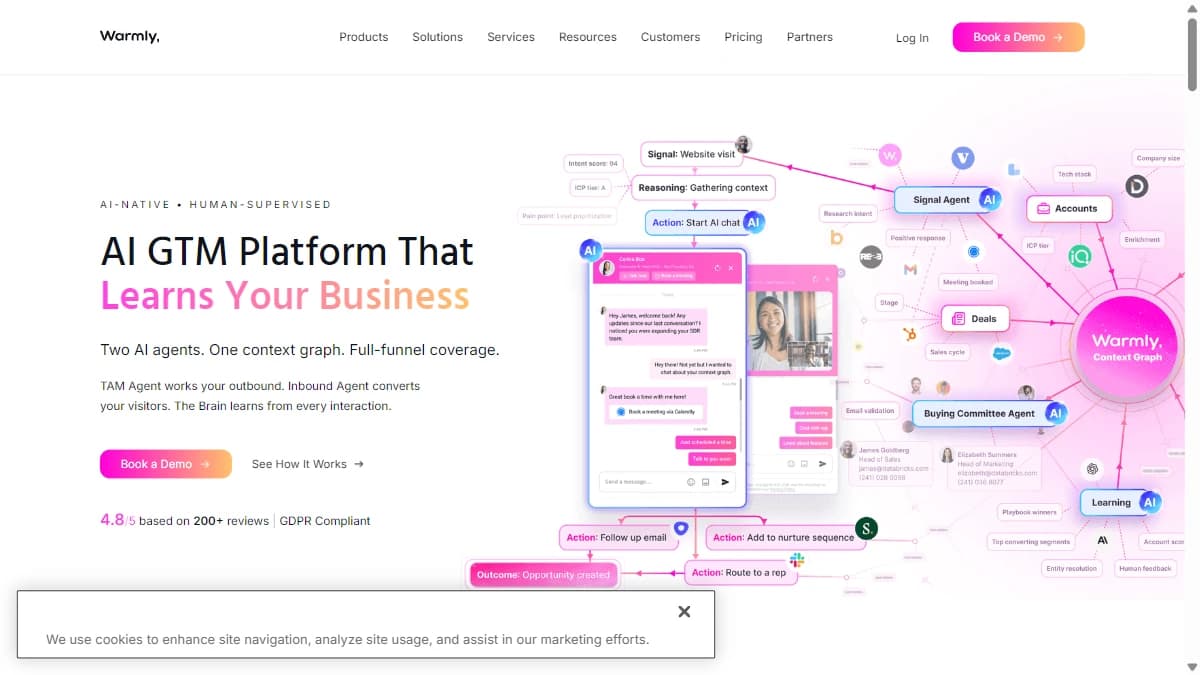
Warmly — AI-first signal-based revenue platform combining visitor de-anonymization, intent signals, and AI SDR outreach
Warmly is an AI-first signal-based revenue platform that combines website de-anonymization, account-level intent signals, live chat engagement, and AI SDR outbound into one system. It is the most feature-complete visitor identification alternative in this list — and the most expensive.
Warmly identifies both the company and the individuals visiting your site, overlays third-party intent signals (6sense, Bombora), and can trigger AI chat conversations or automated outbound sequences when a target account shows engagement. The platform is designed for revenue teams that want to convert inbound intent in real time, not just log it.
The tradeoff is price: Warmly starts at $15,000/year for its AI agent tier. That is roughly 480× Visitor Queue's starting price. The ROI case is strongest for teams with high-value deals (ACV $20k+) where a single additional conversion justifies the annual cost. See the Warmly review for a deeper breakdown of pricing tiers and orchestration features.
Pros
- Person-level and account-level identification in one platform
- Intent signal overlay from 6sense and Bombora — shows accounts actively in-market
- AI chat engagement and AI SDR outbound triggered by visitor behavior
- CRM sync with Salesforce and HubSpot; Slack notifications for hot accounts
Cons
- Starts at $15,000/year — inaccessible for SMB and early-stage teams
- Significant onboarding and configuration required to realize full value
- Overkill if your primary need is contact enrichment, not real-time visitor conversion
Best for: Enterprise revenue teams ($5M+ ARR) with high ACV deals where real-time AI engagement with in-market visitors can materially move pipeline.
Pricing: Starts at $15,000/year for AI agent tier.
4. Dealfront
Dealfront (formerly Leadfeeder) — GDPR-compliant company-level visitor identification with European database coverage
Dealfront is the merger of Leadfeeder (visitor identification) and Echobot (European sales intelligence). It is the most natural like-for-like replacement for Visitor Queue for teams that need GDPR-compliant company-level identification — particularly in European markets.
Dealfront identifies companies visiting your site using a database of 220 million companies across 195 countries. It includes behavioral scoring (which pages visited, how long, repeat visits), contact directory lookups for key stakeholders at visiting companies, and CRM integrations with Salesforce, HubSpot, Pipedrive, and others.
Unlike Visitor Queue, Dealfront layers on intent scoring and behavioral qualification — so you are not just getting a raw list of company names, but a prioritized list of accounts showing buying signals. The Dealfront review covers post-merger pricing and European data depth in full.
The limitation: Dealfront is still company-level at its core. You get a contact directory of likely decision-makers, but not the direct verified emails and phone numbers you get from a dedicated enrichment-first platform.
Pros
- GDPR-compliant visitor identification — the safest choice for EU-focused teams
- 220 million companies across 195 countries — best global coverage in the category
- Behavioral scoring surfaces highest-intent accounts automatically
- Contact directory at visiting accounts included (key stakeholders by role)
Cons
- Still company-level by default — does not identify the individual visitor
- Contact data quality is inconsistent outside Europe and North America
- Full pipeline with Echobot intelligence layers can reach $1,500–$3,750/month
Best for: European B2B teams that need GDPR-compliant visitor identification with strong behavioral scoring and a large contact directory for account-based outreach.
Pricing: Leadfeeder tier ~$99/mo; full Dealfront pipeline $1,500–$3,750/mo.
Side-by-Side Comparison
All four visitor queue alternatives compared across the dimensions that matter for B2B prospecting teams.
| Feature | SyncGTM | RB2B | Warmly | Dealfront |
|---|---|---|---|---|
| Identification type | Person-level (proactive enrichment) | Person-level (real-time visitor) | Person + company (real-time) | Company-level + contact directory |
| Data providers | 50+ (waterfall) | Proprietary graph | Proprietary + 6sense + Bombora | 220M company database |
| Verified emails | Yes | Yes (business email) | Yes | Via contact directory |
| Phone numbers | Yes (direct + mobile) | No | Limited | Limited |
| Buying signals | Yes (job changes, funding, tech) | No | Yes (intent data overlay) | Behavioral scoring only |
| Outreach automation | Yes (built-in sequences) | No | Yes (AI SDR) | No |
| GDPR compliant | Yes | US-only | Yes | Yes (EU-first) |
| Starting price | $89/mo (yearly) | Free | $15,000/year | ~$99/mo |
| Free tier | 50 credits on signup | 150 resolutions/mo | No | No (14-day trial) |
How to Choose the Right Tool
The right visitor queue alternative depends on what you actually need beyond company identification. Here is a quick decision framework:
- Need full enrichment + outreach in one tool? SyncGTM. It replaces Visitor Queue plus your contact enrichment tool plus your sequence platform — with waterfall coverage across 50+ providers and 76+ data points per lead.
- Want to test person-level visitor ID for free? RB2B. The free plan resolves 150 US visitors per month and pushes them to Slack. Zero risk, fast setup, immediate value signal.
- Running an enterprise inbound motion with high ACV? Warmly. The AI engagement layer — live chat, AI SDR, intent overlay — justifies the $15k/year investment when a single activated deal covers the cost.
- Selling primarily in Europe and need GDPR compliance? Dealfront. Best European company database in the category with behavioral scoring and a contact directory built in.
- On a tight budget and targeting global audiences?Start with SyncGTM's free tier (50 credits) to validate enrichment quality on your ICP, then upgrade to the $89/mo Starter plan.
Most teams find the Visitor Queue → SyncGTM migration is the most impactful switch. You move from “company visited your site” to “here is the verified email, phone, LinkedIn, tech stack, and recent job change signal for the CFO at that company.”
Final Verdict
Visitor Queue was a reasonable starting point for B2B teams that wanted basic company-level visitor data at low cost. Its acquisition by Leadinfo did not expand what the platform could do — it is still company-level identification without the enrichment depth or outreach tools that modern GTM teams need.
The four best visitor queue alternatives in 2026 each solve a distinct part of the problem:
- SyncGTM — best for teams that want to replace Visitor Queue and their enrichment stack with one platform
- RB2B — best free entry point for US-focused person-level visitor identification
- Warmly — best for enterprise teams that need AI-driven real-time engagement with in-market visitors
- Dealfront — best for European teams that need GDPR-compliant company identification with behavioral scoring
If you are switching from Visitor Queue, start with SyncGTM's free tier to see how waterfall enrichment compares to what you were getting. Fifty free credits is enough to enrich 50 contacts from your most visited accounts and judge the data quality yourself.
For more on the enrichment landscape, see the 3 best B2B website visitor identification tools and the best website visitor monitoring platforms ranked for 2026.