

Wappalyzer Review 2026: B2B Data Coverage, Pricing & SyncGTM Comparison

By Kushal Magar · June 10, 2026 · 12 min read
Key Takeaway
Wappalyzer is the go-to browser tool for identifying website technology stacks — strong for quick lookups and technographic lead filtering. Pro starts at $250/month with 5,000 lookups. Contact data accuracy is inconsistent and requires external validation. Coverage is narrower than BuiltWith. No outbound sequencing. For B2B sales teams needing waterfall contact enrichment across 50+ providers, buying signals, and outbound sequences, SyncGTM is the purpose-built alternative from $99/mo.
Quick Verdict — Wappalyzer Review 2026
Wappalyzer is a web technology profiler that identifies which software any website runs — CMS platforms, marketing tools, e-commerce solutions — across 4,500+ technologies on tens of millions of sites. Pro costs $250/month (5,000 lookups, 2 monitoring targets). Contact data accuracy is a documented weakness in 2026 reviews. Best for: technographic lead lists and ICP filtering by tech stack. Not a replacement for B2B contact enrichment. Rating: 4.0/5 for technographics; 2.5/5 for contact enrichment.
Wappalyzer is a web technology profiler that tracks 4,500+ technologies across tens of millions of websites. Pro starts at $250/month with 5,000 lookups. Contact data accuracy is a recurring complaint from 2026 reviewers. The browser extension is free for up to 50 lookups. Our rating: 4.0/5 for pure technographic research; 2.5/5 for B2B contact enrichment use cases.
Two audiences land on Wappalyzer reviews. Sales and marketing teams want to know if the technographic filters and lead lists are worth $250/month — and whether the contact data is reliable enough for outbound without a second enrichment pass. RevOps teams sometimes evaluate Wappalyzer as a B2B prospecting tool and find it covers only part of the problem.
This review covers both angles honestly. For technographic prospecting: what Wappalyzer actually delivers, where it earns its price, and where it frustrates. For contact enrichment at scale: why Wappalyzer alone is not sufficient and how SyncGTM handles the waterfall enrichment use case that Wappalyzer does not address.
Key facts upfront: the free browser extension handles basic tech identification well. The paid plans are primarily valuable for teams building technographic lead lists at scale. Contact data accuracy requires validation. For teams needing verified contacts, waterfall enrichment providers deliver far better hit rates.
What Is Wappalyzer?
Wappalyzer is a web technology profiler and B2B data platform that identifies which software, CMS platforms, e-commerce solutions, marketing tools, and web frameworks any website uses. It tracks 4,500+ technologies across tens of millions of company websites, and offers lead list generation, email finding, website change monitoring, and CRM integrations for sales and marketing teams.
Wappalyzer is a web technology profiler and B2B data platform. Its core capability is identifying which technologies any website runs — CMS platforms, e-commerce solutions, marketing automation tools, analytics software, CDN providers, web frameworks, and more. The company tracks 4,500+ technologies across the websites of tens of millions of companies.
The platform started as a browser extension for quick tech identification and evolved into a full B2B lead generation tool. Today it offers lead list creation based on technographic filters, email finding, CRM integrations, website change monitoring, and an API for bulk technology lookups. According to G2, Wappalyzer holds a 4.0/5 rating based on user reviews, with strong marks for technology detection accuracy and usability.
Primary users are outbound sales teams and marketing ops teams whose ICP is defined by technology stack — for example, agencies targeting Shopify merchants, sales tools targeting HubSpot users, or competitor sales teams targeting customers of a specific platform.
| Capability | What Wappalyzer Provides | Notable Gaps |
|---|---|---|
| Technology Identification | 4,500+ technologies detected from public web signals. Browser extension + API + bulk lookup. | Coverage is narrower than BuiltWith (50,000+). Misses internal/private tech stacks. |
| Lead List Generation | Filter prospects by technology stack. Export lists with company and contact fields. | Advanced filters and bulk analysis locked to Business+. Contact accuracy requires validation. |
| Email Finding | Email verification included on Pro+. Direct email fields for contacts. | Single-source lookup — no waterfall fallback. Accuracy complaints in 2026 reviews. |
| Website Change Alerts | Monitor when a target company adopts or drops a technology. Email notifications. | Real-time monitoring at scale requires Business+ plan. |
| CRM Integrations | Salesforce, HubSpot, Pipedrive, Zapier native integrations. | Integration depth is lighter than purpose-built enrichment tools. |
| Buying Signals | Technology change alerts only. | No hiring signals, funding data, or job change detection. No outbound sequencing. |
Wappalyzer Pricing: Plans, Credits, What You Actually Pay
Wappalyzer pricing in 2026: Free browser extension (50 lookups) → Pro at $250/month (5,000 lookups, 2 monitoring targets) → Business at $450/month (20,000 lookups, 5 seats, unlimited filters) → Enterprise (custom, contact sales). Annual billing saves 15–20%.
Wappalyzer publishes pricing for three tiers. Enterprise requires a sales call. Annual billing typically saves 15–20% versus monthly. The free browser extension provides 50 lookups — enough for one-off research but not for building lead lists at scale.
| Plan | Price | Lookups / Seats | Key Inclusions |
|---|---|---|---|
| Free (Extension) | $0 | 50 lookups / 1 user | Browser extension tech detection, sample lead lists, single user only |
| Pro | $250/mo (monthly) or annual discount | 5,000 lookups / 2 targets | Technology lookup API, lead lists, email finding, email verification, CRM integrations (Salesforce, HubSpot, Pipedrive, Zapier), website monitoring for 2 targets |
| Business | $450/mo (monthly) or annual discount | 20,000 lookups / 5 seats | Everything in Pro + unlimited technology filters, advanced segmentation, bulk analysis, 5 team seats, priority support, unlimited website monitoring targets |
| Enterprise | Custom (contact sales) | Custom | Everything in Business + dedicated account manager, custom lookup volumes, SLA-backed uptime, SSO, custom data integrations |
The most important pricing reality: $250/month for Pro covers 5,000 lookups and only 2 website monitoring targets. Teams doing serious technographic prospecting — building ICP lists, monitoring competitor customers, tracking tech adoption at scale — will exhaust Pro quickly and need Business at $450/month. The advanced filters that make Wappalyzer most valuable for B2B targeting are locked to Business.
Compare that against SyncGTM at $99/month — no seat fees, waterfall enrichment across 50+ providers, buying signals, and outbound sequences included. For teams that need more than technographic data, the value calculation shifts significantly.
Wappalyzer 2026 — technographic profiling from $250/month, with enterprise pricing for high-volume teams.
Wappalyzer Key Features
Technology Profiler: Browser Extension and API
The core of Wappalyzer is its technology detection engine. The browser extension identifies 4,500+ technologies on any website in real time — CMS, e-commerce platforms, JavaScript frameworks, analytics tools, marketing automation, CDNs, server infrastructure, and more. The extension is the feature most users interact with daily and is reliably accurate for publicly visible technologies.
The Lookup API extends this to bulk workflows — feed a list of domains, receive back the technology stack for each. This powers the lead list and segmentation use cases that justify the paid plans.
Lead Lists with Technographic Filtering
Wappalyzer's B2B application is generating lists of companies filtered by the technologies they use. An agency targeting Shopify stores can pull a list of companies using Shopify with matching industry, company size, and geography filters. A sales tool can target HubSpot users in the US with revenue above $10M.
The advanced filters that make these lists precise — combining multiple technology conditions, firmographic attributes, and geography — require the Business plan. Pro allows filtering by 2 technology targets only.
Website Change Monitoring
Wappalyzer monitors target company websites and sends alerts when their technology stack changes — a company adopts Salesforce, drops Marketo, or adds a new e-commerce platform. This is arguably Wappalyzer's most powerful signal for timely outbound: technology changes often correlate with budget cycles, new leadership, or organizational shifts that make companies receptive to outreach.
Pro is limited to 2 monitoring targets. Business unlocks unlimited monitoring. Teams doing serious competitive displacement or technology migration targeting need Business minimum.
Email Finding and Verification
Pro and above include email finding and verification integrated with Wappalyzer's company data. In theory, this means one platform covers both tech identification and contact finding. In practice, the accuracy complaints from 2026 reviewers suggest the email data quality lags behind purpose-built enrichment tools. Teams using Wappalyzer for email finding at scale should budget for a verification pass or a waterfall enrichment fallback.
CRM Integrations
Wappalyzer integrates natively with Salesforce, HubSpot, Pipedrive, and Zapier. The integration pushes technographic data into CRM records — enriching existing accounts with technology stack information or routing new leads based on tech signals. Integration depth is functional but lighter compared to purpose-built enrichment platforms that push 76+ data fields per record.
Wappalyzer Pros: What It Does Well
Wappalyzer's main strengths are its best-in-class browser extension for one-click tech stack identification, a 4,500+ technology fingerprint library, native CRM integrations (Salesforce, HubSpot, Pipedrive), website change alerts for timely outreach, and a clean Lookup API for bulk enrichment pipelines. It holds a 4.0/5 rating on G2 across hundreds of reviews.
- Best-in-class browser extension for tech lookups. The Wappalyzer Chrome/Firefox extension is the go-to tool for instant website technology identification. Fast, accurate for public-facing technologies, and free for 50 lookups. No competitor matches it for one-click tech stack detection in a browser workflow.
- 4,500+ technology fingerprints. The detection library covers CMS, e-commerce, analytics, marketing automation, CRM, CDN, web frameworks, payment processors, and infrastructure. For the ICP filtering use case, this coverage is sufficient for the vast majority of B2B SaaS targeting scenarios.
- CRM integrations out of the box. Salesforce, HubSpot, Pipedrive, and Zapier native connections mean technographic data flows into existing workflows without custom development. For teams enriching existing CRM accounts with tech stack data, the integration is functional and reduces manual work.
- Website change alerts for timely outreach. Technology adoption and abandonment are strong buying signals. Wappalyzer's monitoring feature surfaces these changes — an underutilized signal that many sales teams miss. A competitor customer dropping your competitor's tool is an ideal outreach trigger.
- API for programmatic use. The Lookup API enables developers to enrich company records at scale with technology data — useful for data pipelines, enrichment workflows, and product analytics. API access on Pro makes this available without enterprise negotiation.
- 4.0/5 on G2 across hundreds of reviews. Strong user satisfaction for the core use case: website technology identification and technographic prospecting. Reviewers consistently praise the browser extension and data freshness for major technologies.
Wappalyzer Cons: Where It Falls Short
Wappalyzer's main weaknesses: inconsistent contact data accuracy (flagged by multiple 2026 G2 reviewers), high price for the feature depth ($250/month Pro; $450/month for advanced filters), no waterfall enrichment fallback, narrower technology coverage than BuiltWith (4,500 vs 50,000+ technologies), no outbound sequencing, and limited firmographic depth.
- Contact data accuracy is inconsistent. Multiple G2 and Capterra reviewers in 2026 flag that email addresses returned via Wappalyzer's lead lists 'require additional validation.' Outdated data is a recurring issue — companies that switched platforms months ago still appear under old technology filters. Teams relying on Wappalyzer for contact enrichment at scale will see high bounce rates without supplementary verification.
- Expensive for the feature set. $250/month for 5,000 lookups and 2 technology targets is steep when free tools like Wappalyzer's own browser extension handle basic tech identification. Bulk analysis and advanced filters — the features that justify the price — are locked to Business ($450/month) and above. For teams needing technographic filtering as one signal among many, a broader platform like SyncGTM delivers more per dollar.
- No native contact enrichment waterfall. Wappalyzer surfaces technology data, not verified B2B contact records. Email finding is available on Pro, but the accuracy complaints above mean teams still need a second tool. There is no waterfall enrichment to cascade through multiple providers — a single-source lookup that fails means no data, with no fallback.
- Technographic coverage is narrow versus BuiltWith. Wappalyzer tracks 4,500+ technologies. BuiltWith tracks 50,000+. For niche or enterprise tech stack research, Wappalyzer's coverage gaps become significant — especially for identifying less common tools, internal frameworks, or CDN/infrastructure signals.
- No outbound sequencing. Wappalyzer builds lists and finds emails. It does not send outreach. Teams that need to act on the data they find must export to a separate tool — adding workflow friction and tool cost. Apollo and SyncGTM both provide sequencing natively, closing the loop from identification to outreach in one platform.
- Website change alerts are Basic+ only. The tech stack monitoring feature — arguably Wappalyzer's most powerful signal for timely outreach — requires a paid plan. Teams who want to trigger outreach when a prospect switches from a competitor's tool must be on Business or Enterprise to access real-time alerts at meaningful scale.
- Limited firmographic depth. Wappalyzer's firmographic data provides basic ranges for revenue and headcount but lacks standardized SIC/NAICS codes, funding data, org hierarchy, or decision-maker mapping. For account-based prospecting that requires rich firmographic context, it requires stacking with a dedicated firmographic data source.
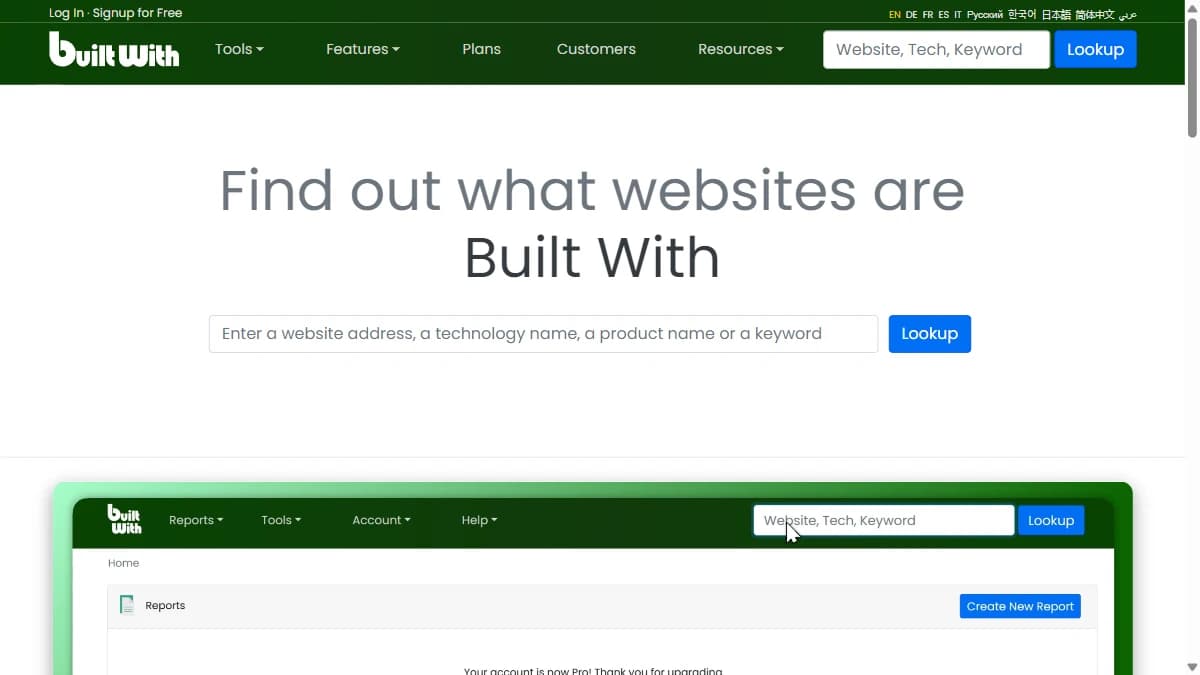
BuiltWith — the leading Wappalyzer alternative for teams needing broader technology coverage (50,000+ technologies vs. 4,500+).
Wappalyzer vs SyncGTM vs Alternatives
The comparison below covers Wappalyzer against SyncGTM (B2B waterfall enrichment), BuiltWith (technographic alternative), and Apollo (B2B sales prospecting). These are the most common tools teams evaluate when assessing Wappalyzer for B2B use cases.
| Feature | Wappalyzer | SyncGTM | BuiltWith | Apollo |
|---|---|---|---|---|
| Starting Price | $250/mo (Pro) | $99/mo (no seat fees) | $295/mo (Basic) | $59/mo (Basic) |
| Pricing Transparency | Pro/Business published; Enterprise — sales call | Published on website | Published | Published |
| Primary Use Case | Technographic prospecting & lead lists | B2B sales enrichment with waterfall across 50+ providers | Tech stack profiling & lead lists | B2B sales prospecting & outreach |
| Technology Tracking | 4,500+ technologies across tens of millions of sites | Tech stack signals via enrichment providers | 50,000+ technologies, deeper historical data | Basic technographic filtering via own DB |
| Contact Data (Email + Phone) | Basic — email only, accuracy concerns flagged | 75–90% hit rates via waterfall across 50+ providers | Limited — primarily firmographic, no native contacts | 60–75% (own database) |
| Buying Signals | Tech change alerts (website monitoring) | Hiring, funding, tech changes, job changes | Tech adoption trends only | Basic intent via Bombora |
| CRM Integration | Salesforce, HubSpot, Pipedrive, Zapier | HubSpot, Salesforce native | Via Zapier; no native CRM push | HubSpot, Salesforce native |
| Free Tier | Yes — 50 lookups (browser extension) | Free trial available | No — paid only | Yes — limited credits |
| API Access | Yes — lookup and lead APIs | Yes — enrichment API | Yes — REST API on paid plans | Yes — on paid plans |
| Bulk Analysis | Business plan and above | All plans — waterfall at scale | Yes — on paid plans | Yes — CSV export on paid plans |
| Outbound Sequences | None | Yes — built-in sales sequencing | None | Yes — sequences included |
Wappalyzer vs SyncGTM
Wappalyzer and SyncGTM solve adjacent but distinct problems. Wappalyzer identifies which technologies a company uses — strong for ICP filtering by tech stack, but limited to a single-source lookup with no waterfall fallback when data is unavailable. SyncGTM cascades contact enrichment through 50+ providers to achieve 75–90% email and phone hit rates, detects buying signals beyond just technology changes (hiring surges, funding rounds, job changes), and executes outbound sequences natively.
For teams that need technology filtering as one trigger among many, SyncGTM delivers technographic signals alongside richer buying context — without requiring a separate Wappalyzer subscription. SyncGTM starts at $99/month with no seat fees versus Wappalyzer's $250/month for Pro with 5,000 lookups and limited monitoring targets. For SDR teams building prospecting lists, SyncGTM is the more complete platform.
Wappalyzer vs BuiltWith
BuiltWith is Wappalyzer's closest direct competitor. BuiltWith tracks 50,000+ technologies versus Wappalyzer's 4,500+, and offers deeper historical adoption data — useful for market research and trend analysis. Wappalyzer wins on usability: the browser extension is more accessible, and the interface is cleaner for quick one-off lookups. BuiltWith starts at $295/month and is typically used by market researchers and enterprise data teams rather than sales reps. For most outbound use cases, Wappalyzer's coverage is sufficient and easier to use. For serious technographic research depth, BuiltWith wins.
Wappalyzer vs Apollo for B2B Sales
Apollo is the right comparison for B2B sales teams who evaluate Wappalyzer as a prospecting tool. Apollo has 275M+ contacts, a free tier, built-in sales sequences, native CRM integrations, and technographic filtering as a built-in prospect filter — without needing a separate Wappalyzer subscription. SyncGTM adds waterfall enrichment across 50+ providers for 75–90% hit rates. Wappalyzer is the right tool when your ICP is defined entirely by technology stack. It is not a replacement for a full B2B contact data platform.
Who Should Use Wappalyzer?
Wappalyzer is the right fit for:
- Agencies and service providers with tech-defined ICPs. If your ideal customer is defined primarily by which tools they use — Shopify agencies, HubSpot implementation partners, WordPress development shops — Wappalyzer's technographic filtering is purpose-built for your prospecting workflow.
- Sales teams doing competitive displacement. Wappalyzer's monitoring alerts flag when a competitor's customer changes their tech stack — an ideal moment for outreach. Business-plan monitoring at unlimited targets makes this viable at meaningful scale.
- Developers enriching data pipelines with tech signals. The Lookup API is clean and well-documented. For engineering teams building enrichment workflows that need technology detection at scale, Wappalyzer's API is the right tool.
- Market researchers tracking technology adoption trends. Wappalyzer's aggregate data on technology adoption across millions of websites is useful for market sizing, technology trend analysis, and competitive research reports.
Wappalyzer is not the right fit for:
- Teams needing verified contact data at scale. Wappalyzer's email finding is single-source and has documented accuracy issues. For verified B2B email and phone at scale, waterfall enrichment via SyncGTM or Apollo is the right choice. See our Wappalyzer alternatives guide for full options.
- Teams where technographics are one signal among many. If your ICP is defined by tech stack plus hiring signals, funding stage, or growth signals, Wappalyzer covers only one dimension. SyncGTM combines technographic signals with hiring data, funding rounds, and job changes in a single platform.
- Teams that need outbound sequencing. Wappalyzer identifies prospects and finds emails — it does not send outreach. Teams need to export and use a separate sequencing tool, adding workflow friction and cost. Apollo and SyncGTM close the loop natively.
- Budget-conscious teams needing advanced filters. The features that make Wappalyzer most useful for B2B targeting — unlimited technology filters, bulk analysis, unlimited monitoring targets — require the $450/month Business plan. At Pro ($250/month), the filtering capability is meaningfully limited.
- Teams needing deep historical or niche tech coverage. Wappalyzer covers 4,500+ technologies. BuiltWith covers 50,000+. For research into less common frameworks, internal tools, or infrastructure signals, BuiltWith provides materially deeper data.
The Full-Stack Alternative: SyncGTM Waterfall Enrichment
If you arrived at this Wappalyzer review because you need more than technographic data — verified contacts, buying signals beyond tech changes, outbound sequencing — here is what the right tool looks like:
- Waterfall enrichment across 50+ providers. SyncGTM does not rely on a single source. It cascades through 50+ data providers to achieve 75–90% email and phone hit rates on B2B contact records. Wappalyzer has no equivalent for contact enrichment at this hit rate.
- Buying signals beyond technology. SyncGTM detects hiring surges, funding rounds, job changes at target accounts, and tech stack changes — giving outbound teams a complete signal picture instead of one dimension. Wappalyzer monitors only tech changes.
- Outbound sequences built in. SyncGTM closes the loop from enrichment to outreach. No separate sequencing tool needed. Wappalyzer finds data and stops — teams must manage the outreach workflow separately.
- No seat fees or complex contracts. SyncGTM pricing is credit-based on enrichment volume — no per-seat charges, no annual minimums, no enterprise sales conversation required. Pricing from $99/month.
The bottom line: Wappalyzer excels at what it was built for — identifying which technologies websites use. SyncGTM takes that signal further, combining tech stack detection with verified contact data from 50+ providers, broader buying signals, and outbound automation. They are different tools for different scopes of the problem.