

6 Best Wappalyzer Alternatives for B2B Enrichment in 2026

By Kushal Magar · June 10, 2026 · 14 min read
Key Takeaway
This guide compares the six best Wappalyzer alternatives for B2B enrichment in 2026: SyncGTM, BuiltWith, Clearbit, ZoomInfo, Lusha, and Apollo.io. Wappalyzer only detects frontend technologies and provides no contact data, CRM integration, or outreach capabilities. SyncGTM is the strongest alternative for B2B sales teams, combining technology detection with waterfall enrichment across 50-plus providers, 76-plus data points per lead, buying signals monitoring, and integrated outreach from 99 dollars per month. BuiltWith is best for market research and technology adoption intelligence across 414M-plus domains from 295 dollars per month. Clearbit (now HubSpot Breeze) suits HubSpot users who need real-time automatic enrichment on form fills. ZoomInfo provides the largest enterprise database with Bombora intent data but starts at 15,000 dollars per year. Lusha offers fast LinkedIn contact lookups with a free tier of 50 credits per month. Apollo.io combines a technographic-filtered contact database with email sequencing from 49 dollars per month.
Wappalyzer built its reputation as the go-to browser extension for identifying technologies a website uses — CMS platforms, analytics tools, JavaScript frameworks, ecommerce engines, and more. For developers and marketers who need a quick technology fingerprint, it still works. But for B2B sales teams that need to act on that data, Wappalyzer has a fundamental limitation: it tells you what tools a company uses, but nothing about who to contact, whether they are ready to buy, or how to reach them.
In 2026, B2B sales teams need more than a technology list. They need enriched contact records, company firmographics, buying signals, and outreach capabilities — all connected. This post compares six Wappalyzer alternatives that actually serve that need, from dedicated market intelligence platforms to full waterfall enrichment stacks.
SyncGTM customers report 42% more qualified meetings and 80% lower tool costs compared to running separate technology detection, enrichment, and outreach tools.
Quick Summary
The best wappalyzer alternatives in 2026 are SyncGTM, BuiltWith, Clearbit (HubSpot Breeze), ZoomInfo, Lusha, and Apollo.io. SyncGTM is the top pick for B2B sales and GTM teams: it replaces Wappalyzer's tech-only view with waterfall enrichment across 50+ providers, 76+ data points per lead, buying signals monitoring, and integrated outreach — starting free with a paid Starter at $99/mo.
TL;DR: Best Wappalyzer Alternatives in 2026
- SyncGTM -- Best for B2B sales teams. Waterfall enrichment across 50+ providers, 76+ data points per lead, buying signals monitoring, and integrated outreach. Free tier + $99/mo Starter.
- BuiltWith -- Best for market research. 414M+ domain database with historical tech stack data, market share reports, and technology adoption trends. $295/mo.
- Clearbit (HubSpot Breeze) -- Best for HubSpot users. Real-time enrichment auto-triggered on form fills, native CRM sync, firmographic data. Bundled with HubSpot plans.
- ZoomInfo -- Best for enterprise contact data. Largest B2B database with 300M+ contacts, org charts, and Bombora intent data. Custom pricing (typically $15k+/yr).
- Lusha -- Best for quick LinkedIn lookups. Chrome extension surfaces direct dials and emails. Free tier (50 credits/mo) + $49/mo Pro.
- Apollo.io -- Best all-in-one starter. Technographic filters + 270M+ contact database + email sequencing. Free tier + $49/mo paid.
Why Teams Are Switching from Wappalyzer in 2026
Wappalyzerworks well as a technology fingerprinting tool. Install the browser extension, visit a website, and get a list of technologies the site is running. For a developer auditing a competitor's stack or a marketer checking which analytics tool a company uses, that is useful. But for B2B sales teams, it is only the beginning — and four limitations keep coming up.
No contact data. Wappalyzer tells you a company uses Salesforce and HubSpot. It does not tell you who the VP of Sales is, their email, direct dial, or LinkedIn. You still need a separate tool to enrich that technology signal into an actionable lead record.
Frontend-only detection. Wappalyzer detects technologies visible in a website's HTML, JavaScript, and HTTP headers — meaning it misses backend systems, CRMs, data enrichment tools, and internal infrastructure that does not surface in the page source. Tools like SyncGTM and BuiltWith use deeper methods to detect a broader range of technologies including backend and B2B-specific tools.
No CRM integration or automation. Wappalyzer has no native CRM sync. Every technographic data point you want in HubSpot or Salesforce must be manually transferred or built via a custom integration. For teams running automated enrichment workflows, this is a dealbreaker.
No buying signals. Wappalyzer is a point-in-time snapshot. It does not track when a company switches technology providers, posts new job openings for tech roles, raises funding, or shows other signals that indicate they are actively evaluating new solutions. Sales teams need signal monitoring to prioritize which technographic leads to act on first.
What we evaluated
- Enrichment depth: Does the tool go beyond tech detection to provide contact data, firmographics, and 76+ data points per lead?
- Technology detection coverage: How many domains tracked? Frontend only or backend + B2B tools?
- CRM integration: Can enriched data push automatically to HubSpot, Salesforce, or Pipedrive?
- Buying signals: Does the tool track technology changes, job postings, funding rounds, or other purchase intent indicators?
- Outreach integration: Can you act on the data directly, or do you need to export and switch tools?
1. SyncGTM -- Best Wappalyzer Alternative for B2B Enrichment
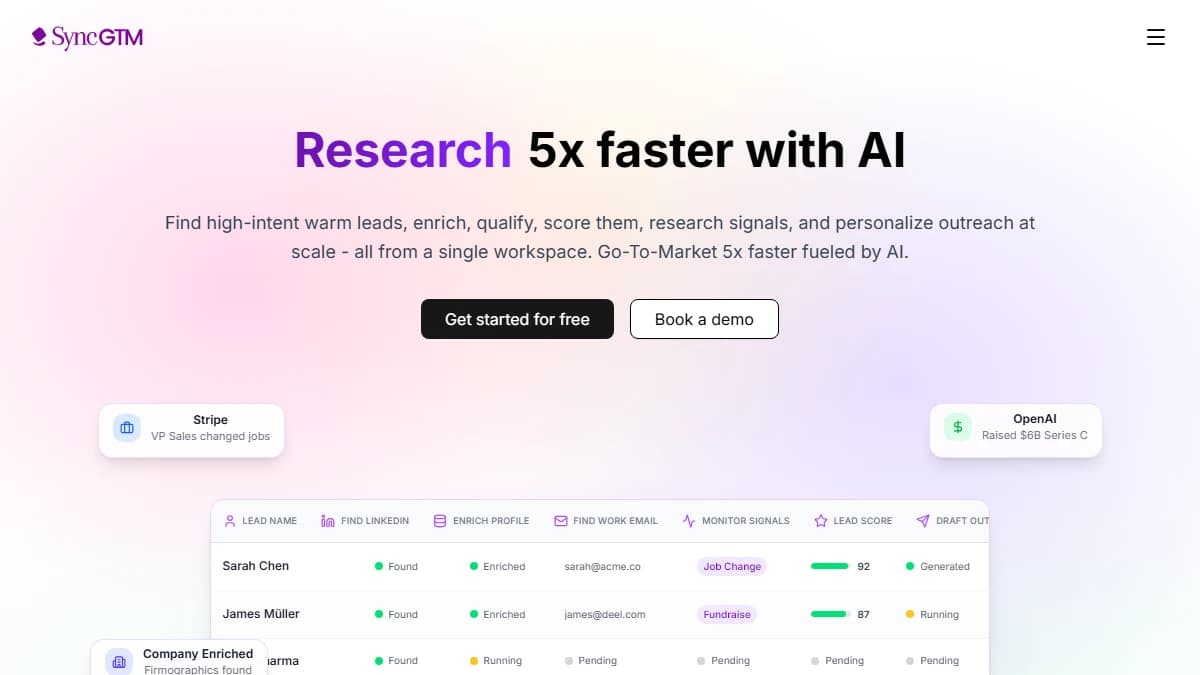
SyncGTM -- waterfall enrichment, buying signals, and integrated outreach replacing Wappalyzer for B2B teams
SyncGTM is the strongest Wappalyzer alternative for B2B sales and GTM teams because it replaces Wappalyzer's single-source technology fingerprint with a complete enrichment workflow. Where Wappalyzer tells you a company uses Salesforce, SyncGTM tells you that plusthe VP of Sales's name, verified email, direct dial, LinkedIn, company revenue, employee count, funding stage, recent job postings, and whether they are actively switching technology providers.
The core of SyncGTM's approach is waterfall enrichment — a method that queries 50+ data providers in sequence, cross-referencing results until every field in a lead record is filled. This is fundamentally different from Wappalyzer's single-source scan. The result is 76+ data points per lead covering technology usage, contact information, and company intelligence in one enriched record.
Beyond enrichment, SyncGTM includes buying signals monitoring that tracks job changes, funding rounds, hiring surges, and technology stack changes across target accounts. A no-code workflow builder lets teams automate the full pipeline from signal detection to CRM push to outreach trigger — without writing code. Native integrations push enriched records directly to HubSpot, Salesforce, Pipedrive, and Attio with field mapping and deduplication.
For the typical Wappalyzer use case — identifying which companies use a specific technology to build a prospect list — SyncGTM's lead sources let you filter by technology stack alongside 40+ other criteria (industry, company size, funding, location) and immediately enrich every match with contact data and buying signals. No manual export, no spreadsheet cleanup, no separate enrichment step.
Pros
- + Waterfall enrichment across 50+ providers — not locked to one database
- + 76+ data points per lead: contact, company, tech stack, signals
- + Buying signals: job changes, funding, hiring surges, tech stack changes
- + No-code workflow builder for end-to-end GTM automation
- + Free tier with AI agents and CRM integration included
Cons
- - No browser extension for ad-hoc single-site lookups like Wappalyzer
- - Built for B2B sales teams — not ideal for developer tech audits
- - Advanced workflow features require paid tiers
Best for: B2B sales and GTM teams that want to act on technology signals immediately — combining tech detection with enriched contact data, buying signals, and outreach in one platform.
Pricing: Free tier with AI agents and CRM integration. Starter $99/mo with waterfall enrichment, verified emails, and webhooks. Pro and Business tiers for higher volume. Take a product tour to see the enrichment workflow live.
2. BuiltWith -- Best for Technology Market Research at Scale
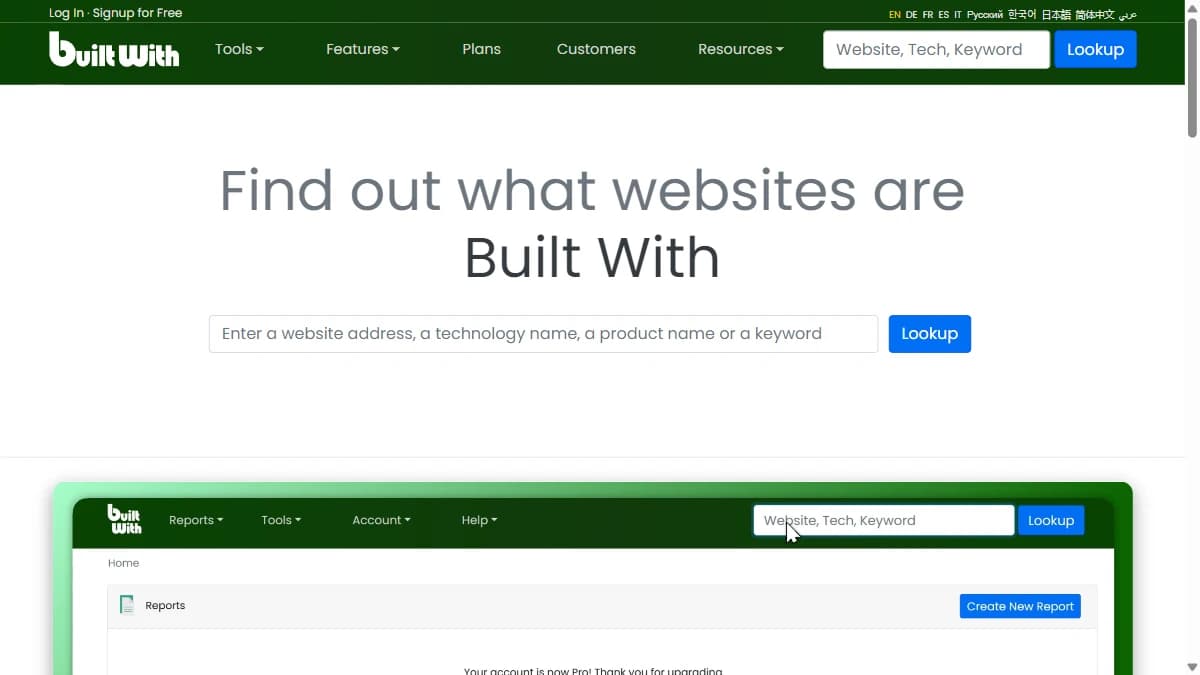
BuiltWith -- technology market research across 414M+ domains with historical adoption data
BuiltWithis the most established Wappalyzer alternative for technology intelligence at scale. Where Wappalyzer scans individual websites on demand, BuiltWith crawls and indexes 414M+ domains continuously, building a searchable database of technology adoption across the web. For market research — mapping which companies use a competitor's product, tracking technology adoption trends, or building prospect lists filtered by tech stack — BuiltWith is the most comprehensive tool available.
BuiltWith's standout capability is historical data. You can see not just what technologies a company uses today, but what they used six months or two years ago — including when they switched providers. For sales teams targeting companies that recently dropped a competitor's solution, this historical view creates high-intent prospect lists that no other technology detection tool provides. BuiltWith also tracks 90,000+ technology categories, significantly more than Wappalyzer's detection library.
The limitation is that BuiltWith is a technology intelligence tool, not a B2B enrichment platform. You get detailed tech stack data for companies, but you still need a separate tool to find and verify contact data for outreach. Teams typically export BuiltWith lists and enrich them in SyncGTM or a similar waterfall enrichment platform to add emails, phone numbers, and firmographic data.
Pros
- + 414M+ domain database — largest technology index available
- + Historical tech stack data: track when companies switch tools
- + 90,000+ technology categories including backend and B2B tools
- + Market share reports for competitive intelligence
- + Free browser extension for quick single-site lookups
Cons
- - No contact enrichment — tech data only
- - $295/mo starting price is high for smaller teams
- - No CRM integration or outreach tools built in
- - Requires separate enrichment tool for actionable B2B prospecting
Best for: Marketing and sales ops teams doing technology market research, competitive intelligence, or building prospect lists filtered by tech stack at scale.
Pricing: Free browser extension for basic lookups. Basic $295/mo (technology lookup API). Pro $495/mo (full dataset access). Teams and Enterprise custom pricing with CRM integrations.
3. Clearbit (HubSpot Breeze) -- Best for CRM-Native Enrichment
Clearbit (now HubSpot Breeze) -- real-time B2B enrichment native to HubSpot CRM
Clearbit, now integrated into HubSpot as Breeze Intelligence, is the leading Wappalyzer alternative for teams already on HubSpot. Where Wappalyzer requires manual lookups, Clearbit enriches CRM records automatically — triggering on form fills, new contact creation, or scheduled batch jobs to add firmographic data, technographic signals, and contact information without any manual intervention.
Clearbit's real-time enrichment API covers 100+ data fields across 44M+ companies and 350M+ contacts, including technology usage, company size, revenue range, industry, and employee count. For marketing teams focused on lead scoring and routing, the ability to automatically classify and enrich every inbound lead at form fill — before it reaches a sales rep — is a significant time and quality improvement over Wappalyzer's manual process.
Since the HubSpot acquisition, Clearbit's standalone pricing has been restructured, and the product is now primarily positioned as a HubSpot add-on. Teams not on HubSpot should evaluate other options. For HubSpot users, it provides deep CRM-native enrichment that integrates more tightly than any third-party alternative. Teams needing enrichment beyond HubSpot should look at SyncGTM for a platform-agnostic waterfall approach.
Pros
- + Native HubSpot integration — enriches records automatically
- + Real-time enrichment on form fills: no manual export required
- + 100+ data fields across 44M+ companies and 350M+ contacts
- + Technographic data included alongside firmographics
- + Free credits bundled with HubSpot Sales Hub plans
Cons
- - Primarily HubSpot-only post-acquisition — limited for other CRMs
- - Single-source enrichment — no waterfall across multiple providers
- - No buying signals or intent monitoring
- - Pricing now bundled with HubSpot tiers — not transparent for standalone use
Best for: HubSpot users who want automatic CRM enrichment on inbound leads and form fills without manual intervention.
Pricing: Bundled with HubSpot Sales Hub and Marketing Hub plans. Breeze Intelligence credits available from $30/mo add-on. Standalone Clearbit API pricing available for non-HubSpot users at custom rates.
4. ZoomInfo -- Best Enterprise Contact Database with Intent Data

ZoomInfo -- enterprise B2B database with technographic filters and Bombora intent data
ZoomInfo is the enterprise-grade Wappalyzer alternative for organizations that need the broadest possible coverage of B2B contact data, technographic filters, and buying intent signals. With 300M+ professional profiles, 100M+ company records, and Bombora intent data, ZoomInfo goes far beyond what Wappalyzer provides — but comes at enterprise pricing that most SMBs cannot justify (see our full ZoomInfo review).
ZoomInfo's technographic data covers 300+ technology categories and integrates directly with its contact search — letting sales teams filter by technology usage alongside firmographic criteria to build highly targeted prospect lists. The Bombora intent layer adds a behavioral signal: companies actively researching topics related to your product, so SDRs can prioritize outreach to accounts that are in-market rather than cold-targeting the entire technology-filtered list.
For enterprise sales organizations with budgets to match, ZoomInfo delivers capabilities no single alternative fully replicates. For most teams evaluating Wappalyzer alternatives, the $15k+ annual minimum makes ZoomInfo inaccessible — and waterfall enrichment platforms like SyncGTM can deliver comparable data coverage at a fraction of the cost by aggregating across multiple providers rather than relying on one proprietary database.
Pros
- + Largest B2B database: 300M+ contacts, 100M+ companies
- + Bombora intent data for account prioritization
- + Technographic filters across 300+ categories
- + Org charts and decision-maker hierarchy mapping
- + Native integrations with every major CRM
Cons
- - $15k+/yr minimum — prohibitive for SMBs and startups
- - No transparent pricing — requires sales call
- - Annual contracts with aggressive auto-renewal terms
- - Credit limits can restrict usage even on expensive plans
Best for: Enterprise sales organizations with 10+ reps and budget for premium data who need the deepest possible database, intent signals, and technographic coverage.
Pricing: Custom pricing only. Typical contracts start at $15,000/yr. Mid-market and enterprise plans range from $25,000 to $100,000+/yr depending on seats and add-ons.
5. Lusha -- Best Free Tier for LinkedIn Contact Lookups
Lusha -- Chrome extension for instant contact lookups from LinkedIn profiles
Lusha is a contact data platform best known for its Chrome extension that surfaces direct dial phone numbers and verified business emails while you browse LinkedIn profiles. Like Wappalyzer, Lusha operates at the point of discovery — but instead of revealing technology stacks, it reveals contact information. For SDRs who find technology-qualified prospects in Wappalyzer or BuiltWith and then need to find contact data, Lusha provides the fastest path from a company name to a phone call (see our detailed Lusha review).
Lusha's free tier gives you 50 contact lookups per month — enough to test data quality and support light prospecting without a credit card. The paid plans scale credit volume for teams running higher outreach volumes. Lusha also offers a prospecting platform with filters for industry, company size, technology usage, and revenue, making it a lightweight alternative to Wappalyzer + a separate contact database for teams that do not need enterprise-scale market research.
Lusha is not built for bulk enrichment workflows or waterfall data logic. It excels at individual lookups and LinkedIn-based prospecting, but cannot replace the systematic enrichment, signal monitoring, and CRM automation that SyncGTM provides. Most teams use Lusha as a complement to a broader enrichment platform rather than a complete replacement.
Pros
- + Chrome extension surfaces contact data directly on LinkedIn
- + Free tier: 50 credits/mo, no credit card required
- + Strong direct dial accuracy for phone-first outreach
- + Technology usage filters in the prospecting platform
- + CRM enrichment pushes to HubSpot and Salesforce
Cons
- - Credit-based pricing burns fast at volume
- - No waterfall enrichment or multi-provider data logic
- - Limited technographic depth vs BuiltWith or ZoomInfo
- - No buying signals or intent monitoring
Best for: AEs and SDRs who identify technology-qualified targets and need fast, accurate contact data for same-day LinkedIn-based outreach.
Pricing: Free (50 credits/mo). Pro $49/mo (480 credits). Premium $79/mo (960 credits). Scale custom pricing. All plans include Chrome extension and CRM push.
6. Apollo.io -- Best All-in-One Starter with Technographic Filters
Apollo.io -- technographic-filtered prospecting combined with email sequencing
Apollo.io is a B2B prospecting and outreach platform that combines a 270M+ contact database with technographic filters and built-in email sequencing. For teams switching from Wappalyzer who need a single tool that covers technology detection, contact finding, and outreach — Apollo provides the most accessible all-in-one entry point, with a free tier that includes basic technographic filters.
Apollo's technographic database lets you filter prospects by technology usage (CRM type, email provider, analytics tool) alongside firmographic criteria like company size and industry. While not as deep as BuiltWith's technology coverage, it covers the most commonly searched categories for B2B sales prospecting. The built-in email sequencing means you can go from technology-filtered prospect list to email campaign without exporting to a separate tool. For a deeper dive, see our full Apollo.io review.
Apollo's limitation is single-source data. When Apollo's database has a gap — wrong email, missing phone, outdated job title — you are stuck. Teams that hit Apollo's data quality ceiling often move to waterfall enrichment platforms like SyncGTM that cross-reference 50+ providers to fill those gaps. See our Apollo alternatives guide for a full comparison.
Pros
- + Free tier includes technographic filters and basic sequencing
- + 270M+ contacts with emails, phones, and firmographics
- + Built-in email sequencing — no separate outreach tool needed
- + Chrome extension for LinkedIn prospecting
- + Self-serve signup with transparent pricing
Cons
- - Single-source database — no waterfall enrichment
- - Email accuracy issues: bounce rates above 10% reported
- - Technographic coverage less deep than BuiltWith or ZoomInfo
- - Key features like intent data gated behind expensive tiers
Best for: Early-stage teams switching from Wappalyzer who need technographic filters, contact data, and email outreach in one tool — and are willing to accept single-source data limitations.
Pricing: Free tier (unlimited email credits, limited phone/export). Basic $49/mo. Professional $99/mo. Custom enterprise. Technographic filters available on all tiers.
Side-by-Side Comparison: Wappalyzer Alternatives in 2026
| Tool | Best For | Free Tier | Starting Price | Standout Feature |
|---|---|---|---|---|
| SyncGTM | Full B2B enrichment with tech stack + contact + company data | Yes | $99/mo | Waterfall enrichment across 50+ providers, 76+ data points, integrated outreach |
| BuiltWith | Market research and technology adoption intelligence | Limited (browser ext.) | $295/mo | 414M+ domain database with historical tech stack data and market share reporting |
| Clearbit (Breeze) | CRM-native enrichment for HubSpot users | Via HubSpot | Bundled with HubSpot | Real-time enrichment auto-triggered on form fills, native HubSpot integration |
| ZoomInfo | Enterprise contact database with intent data | No | $15k+/yr | 300M+ contacts, org charts, Bombora intent data, direct dials |
| Lusha | Quick LinkedIn contact lookups | Yes (50 credits/mo) | $49/mo | Chrome extension for instant direct dials and emails on LinkedIn profiles |
| Apollo.io | Prospecting + outreach in one platform | Yes (limited) | $49/mo | Combined contact database, technographic filters, and email sequencing |
How to Choose the Right Wappalyzer Alternative
- If you need full B2B enrichment — contact data, tech stack, signals, and outreach — go with SyncGTM. Waterfall enrichment across 50+ providers, 76+ data points per lead, buying signals, and CRM push from $99/mo.
- If you need technology market research at scale with historical data — go with BuiltWith. 414M+ domain database, 90,000+ tech categories, and historical adoption tracking from $295/mo.
- If you are a HubSpot user who needs automatic CRM enrichment — go with Clearbit (Breeze). Native HubSpot integration, real-time enrichment on form fills, no manual export required.
- If you are an enterprise team with budget for the deepest database — go with ZoomInfo. Largest B2B database, Bombora intent data, org charts — but expect $15k+/yr minimum.
- If you need quick contact lookups from LinkedIn with a free tier — go with Lusha. Chrome extension, 50 free credits/mo, strong direct dial accuracy.
- If you want technographic filters + contact data + outreach in one tool — go with Apollo.io. Free tier with technographic filters and built-in email sequencing, best for early-stage teams.
Many B2B sales teams use a two-tool stack: one platform for technology market intelligence (BuiltWith for volume research) and one for enrichment and action (SyncGTM for waterfall enrichment, signals, and outreach). This combination delivers the depth of BuiltWith's technology database with the actionability of SyncGTM's full enrichment stack. For more on the full enrichment landscape, see our guide to the best B2B databases.
Final Verdict
Wappalyzer is a useful technology fingerprinting tool, but it is not a B2B prospecting platform. It tells you what tools a website runs — nothing more. For sales teams that need to act on that information, every tool in this list delivers more value.
For most B2B sales and GTM teams, the best Wappalyzer replacement is SyncGTM. It solves Wappalyzer's core limitation — technology detection without actionable enrichment — by combining tech stack data with waterfall enrichment across 50+ providers, 76+ data points per lead, buying signals monitoring, and outreach automation. All under one subscription, starting at $99/mo with a free tier available.
If pure technology market research is your primary need, BuiltWith's 414M+ domain database and historical data capabilities make it the strongest dedicated alternative. For everything else — contact enrichment, CRM sync, signal monitoring, and outreach — SyncGTM is the single platform that replaces the whole stack.
Ready to move beyond Wappalyzer? SyncGTM gives you technology detection plus full B2B enrichment, buying signals, and outreach — starting free. Start free — no credit card required. Or book a demo to see the waterfall enrichment workflow live.
This post was last reviewed in June 2026. Pricing and feature data verified against vendor websites.