


8 Best WhoisXML Email Verification API Alternatives in 2026

By Kushal Magar · August 4, 2026 · 14 min read
Key Takeaway
WhoisXML sells email verification as one SKU inside a 20+ product domain-data catalog, which shows up in the API contract: string booleans instead of real ones, no sandbox, and batch sold as a separate product with a separate integration. Purpose-built verifiers beat it on schema depth and price — Reoon at $1 per 1,000, ZeroBounce with the only real sandbox mode. SyncGTM goes further and removes the verification call entirely by returning contacts that arrive already verified from waterfall enrichment across 50+ providers.
Most teams searching for WhoisXML Email Verification API alternatives are not unhappy with the accuracy. They are unhappy with buying one endpoint from a catalog of twenty-plus domain, WHOIS, DNS and IP data products — and getting an API contract that reflects exactly that priority.
This post ranks eight alternatives on the things that actually cost engineering hours: response schema depth, sandbox and test-key support, batch endpoint design, SDK language coverage, and real per-call price. Not marketing accuracy claims.
We have written about email verification from three other angles already — enterprise list hygiene, cost per verification, and decoupling verification from your ESP. This one is for the engineer who has to write the integration.
TL;DR — Verdict on Each API
- SyncGTM — best when the real problem is that the contacts do not exist yet; verification is bundled into a 50+ provider enrichment waterfall.
- ZeroBounce API — richest response schema and the only documented sandbox mode; best pure API contract in the category.
- AbstractAPI — cleanest REST semantics and a quality score in the payload; billing is per-API, so multi-product use gets expensive.
- Reoon — cheapest credible option at $1 per 1,000, with a two-speed API (quick vs power) that most rivals do not offer.
- QuickEmailVerification — widest official SDK spread, eight languages including C# and VB.Net, plus a proper job-status batch flow.
- Byteplant Email Validator — strongest form-endpoint story with CRM plugins and 240+ country coverage; docs are dated but stable.
- Mailfloss — not really an API play; it is automated background cleaning across 35+ ESP integrations.
- Proofy — honest credit model that never charges for duplicates or unknowns, with an unlimited free single-check tool.
What WhoisXML's Verification Endpoint Actually Gives You
The WhoisXML Email Verification API is a single GET endpoint that runs six checks: syntax, DNS/MX, SMTP mailbox, free-provider, disposable, and catch-all. Each check can be toggled off with a query flag, which genuinely does save latency when you only need syntax and MX.
GET https://emailverification.whoisxmlapi.com/api/v3
  ?apiKey=YOUR_API_KEY
  &emailAddress=support@example.com
  &validateSMTP=1
  &checkCatchAll=1

200 OK
{
  "emailAddress": "support@example.com",
  "formatCheck": "true",
  "smtpCheck": "true",
  "dnsCheck": "true",
  "freeCheck": "false",
  "disposableCheck": "false",
  "catchAllCheck": "true",
  "mxRecords": [
    "aspmx.l.google.com",
    "alt1.aspmx.l.google.com"
  ],
  "audit": {
    "auditCreatedDate": "2026-08-04 09:12:03 UTC",
    "auditUpdatedDate": "2026-08-04 09:12:03 UTC"
  }
}
Look at the payload closely. Every boolean is a string — "true", not true — so every consumer needs a coercion layer before the value reaches business logic.
There is also no composite verdict. Nothing in the response says “deliverable” or “risky”; you write that rule yourself from six independent fields, and you own it forever.
Where it falls short for engineering teams
- No sandbox. Every integration test consumes a real query against a 100-query free allowance.
- Batch is a different product. Bulk Email Verification has its own base URL and credit line, so real-time and list-cleaning are two integrations, not one.
- No risk scoring or typo correction. No quality score, no did-you-mean suggestion, no role-account flag — all standard elsewhere in 2026.
- Catalog pricing. Roughly $8.90 per 1,000 at the $89/10,000 one-time tier, against $1 per 1,000 from the cheapest purpose-built verifier.
- Vague SDK claim.“Libraries for most programming languages” is not a versioned, per-language SDK matrix you can pin in a lockfile.
None of this makes WhoisXML a bad product. It makes it a domain-intelligence catalog that happens to sell an email endpoint — and if email is the only thing you buy, you are paying catalog prices for roadmap attention that goes elsewhere.
1. SyncGTM
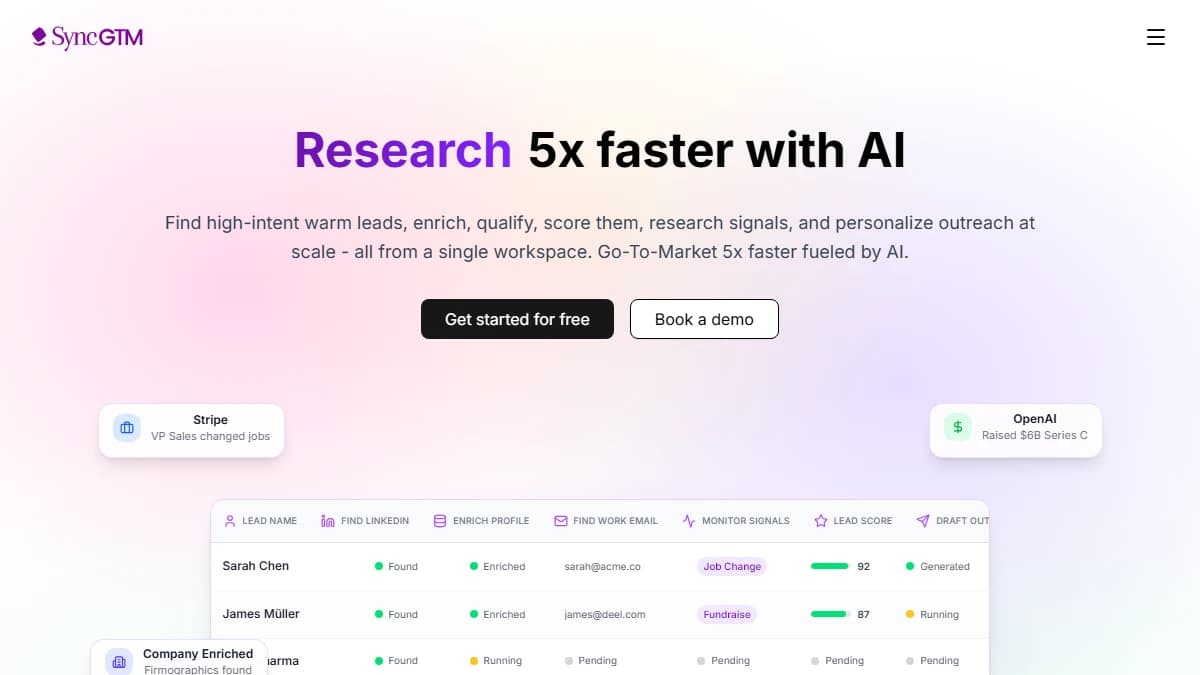
SyncGTM — waterfall enrichment across 50+ providers with verification built into the response.
SyncGTM is a B2B enrichment and outreach platform that removes the verification call rather than optimizing it. Contacts come back already verified because verification runs inside the enrichment waterfall, not after it.
Each lookup cascades through 50+ data providers in sequence — if provider A misses, provider B fires, then provider C. The response carries verified work email, direct dial, LinkedIn URL, firmographics and 76+ additional data points per lead.
For an engineering team the integration math is the interesting part. A verification API is one call in a pipeline that also needs a data source, a phone provider and a sequencing tool; SyncGTM collapses those into one API key and one credit line.
It also exposes an MCP server, so agents and internal tools can call enrichment actions directly without a bespoke HTTP client. Related reading: best waterfall contact providers.
Pros
- Verification is included in the enrichment response — no second API, no second vendor invoice
- Waterfall across 50+ providers means coverage no single verifier can match on hard domains
- 76+ data points per lead: phone, LinkedIn, technographics, headcount, funding and buying signals
- Pay only on valid results returned — misses cost nothing
- REST API plus an MCP server for agent-driven and internal tooling
- Outreach sequencing under the same subscription, so the verified address goes straight into a send
Cons
- Not a drop-in replacement for a single verification endpoint — if you literally only need to clean a purchased CSV, a point verifier is faster to wire up
- Broader surface area means a longer first integration than a one-endpoint API
Best for: GTM engineering and RevOps teams that want to stop paying separately for data, verification and sequencing.
Pricing: See SyncGTM pricing — credit-based with volume discounts; you pay for valid enriched records, not attempts.
2. ZeroBounce API

ZeroBounce — deepest response schema and the only documented sandbox in the category.
ZeroBounce is the strongest pure API contract on this list. Its v2 validate response returns real typed values plus a status / sub_status pair, so you get the verdict and the reason in one payload.
The schema goes well past deliverability: domain_age_days, smtp_provider, did_you_mean, catchall_domain, plus name, gender and geo fields.
Sandbox mode is the real differentiator. A fixed set of test addresses returns every possible status and sub_status combination, and none of it consumes credits — you can build and regression-test the whole state machine before spending a dollar.
Batch runs under the same API key: up to 100 emails per request, 30 requests per minute (40 on ONE plans), with a documented 10-minute cooldown if you exceed it. Full breakdown in our ZeroBounce review.
Pros
- Documented sandbox with test addresses and a test IP — zero credit burn during development
- status + sub_status pair removes the need to write your own verdict logic
- Official SDKs across C#, Java, PHP, Python, Ruby, Go and Node
- Batch endpoint shares the same key and dashboard as single lookups
- Single-lookup endpoint is not rate-limited, so burst traffic does not need a queue
Cons
- No SDK for the batch endpoint specifically — you hand-roll that client
- Single-call response time is documented as 1–30 seconds, which is a wide window for a signup form
- $7.50 per 1,000 at entry is 7x Reoon's rate
Best for: Teams that want the verification logic handed to them in the payload instead of rebuilding it.
Pricing: $15 for 2,000 credits pay-as-you-go ($0.0075/email), scaling to roughly $0.0015/email at high volume; 100 free credits per month.
3. AbstractAPI Email Validation
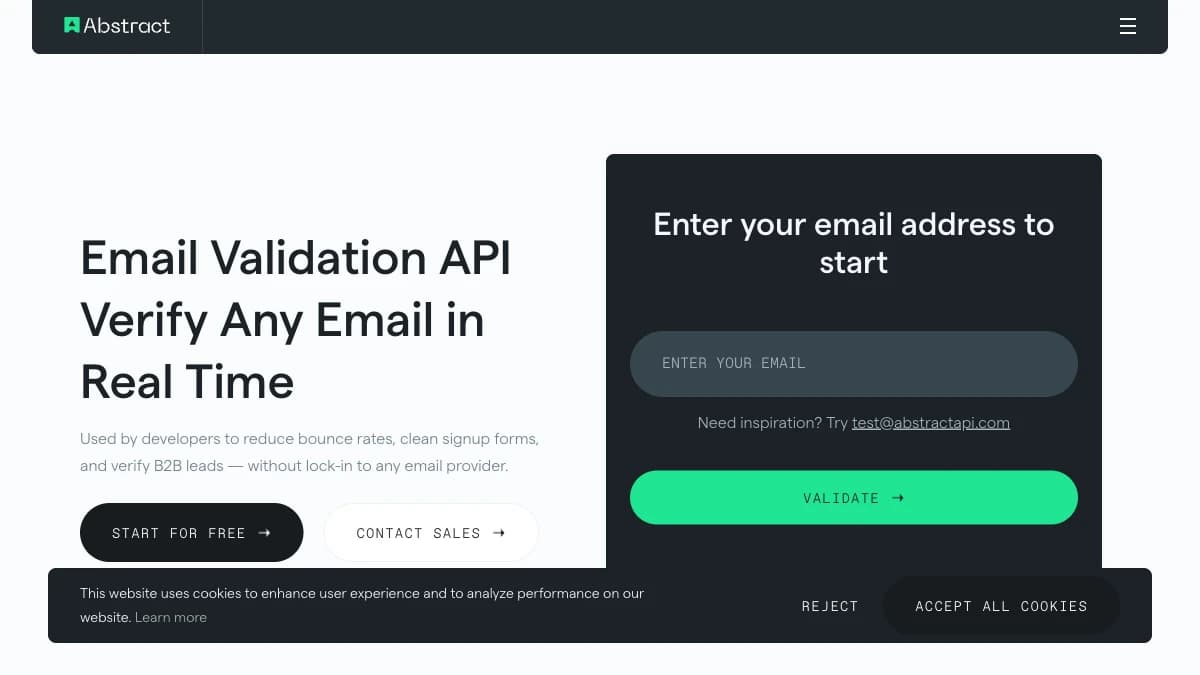
AbstractAPI — clean REST semantics and a numeric quality score per address.
AbstractAPI is the closest structural analogue to WhoisXML — a catalog vendor selling many small APIs — but with dramatically better developer ergonomics on each one. Its email validation response returns proper booleans plus a numeric quality_score.
That score matters in practice. It lets you set one threshold instead of maintaining a boolean truth table across six independent check fields.
The autocorrect field also catches the most common real-world failure: a user typing gmial.com. WhoisXML has no equivalent.
The catch is the same catalog problem in a different shape. Every Abstract product is its own subscription with its own key and its own free tier, so a team using email plus phone plus IP validation runs three billing relationships.
Pros
- quality_score turns six boolean checks into one tunable threshold
- Autocorrect suggestions for common domain typos
- 100 free requests with the full response shape — no fields hidden behind a paid tier
- $3.40 per 1,000 at the $17/month tier, roughly 60% below WhoisXML
- Documented SDKs and code samples across 10+ languages
Cons
- Free tier is restricted to non-commercial use, which rules it out for production trials
- Per-API subscriptions stack fast if you use more than one Abstract product
- Bulk is CSV upload rather than a true async batch endpoint with job polling
Best for: Product teams adding inline validation to a signup form who want one score, not six flags.
Pricing: Free for 100 requests (non-commercial); paid from $17/month for 5,000 checks. See also our cost-per-verification comparison.
4. Reoon Email Verifier
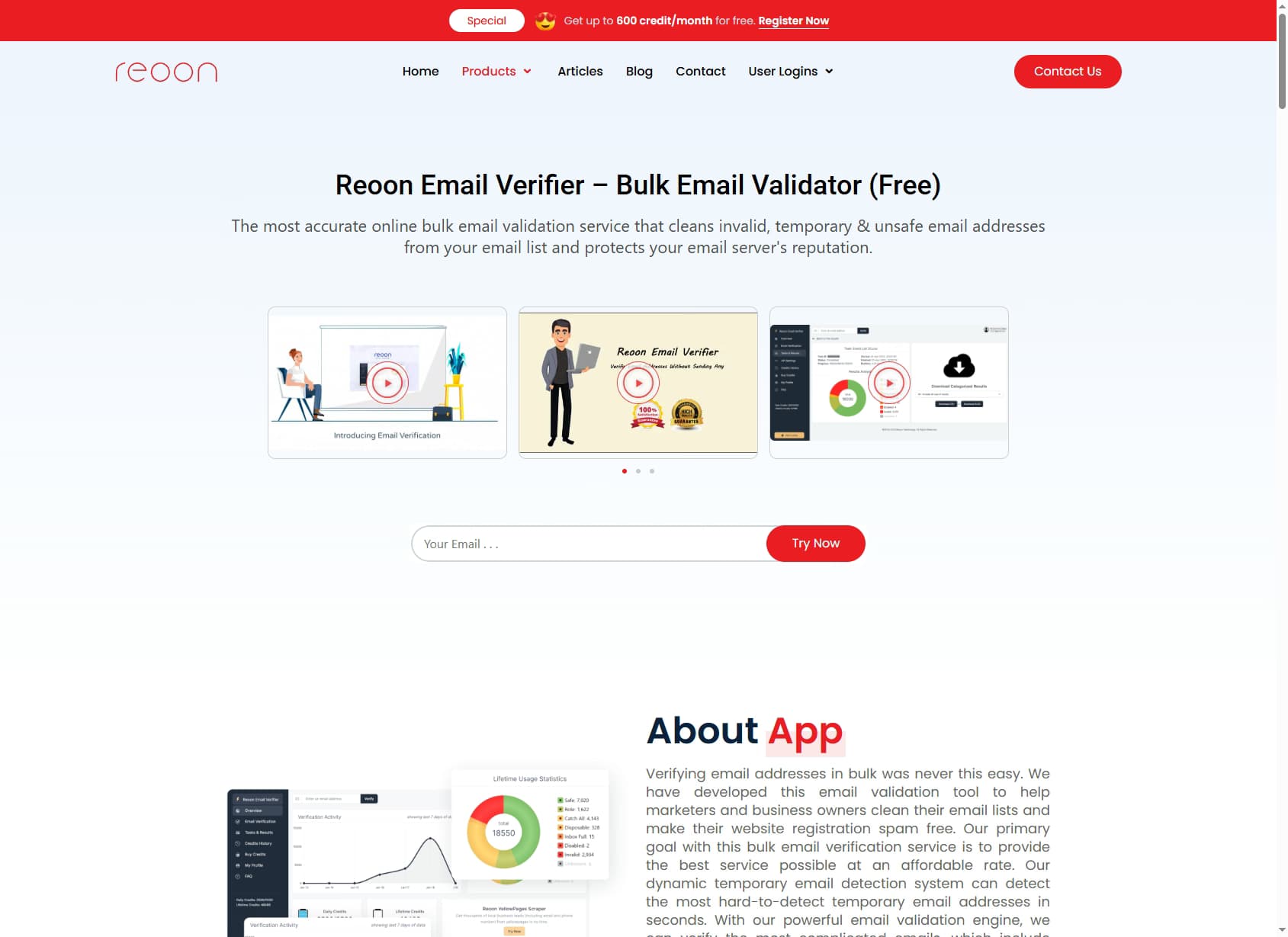
Reoon Email Verifier — quick and power modes at the same credit price.
Reoon Email Verifier is the cheapest credible option here at $1 per 1,000 pay-as-you-go — roughly one-ninth of WhoisXML's entry rate. Credits never expire.
The API design choice worth copying is the mode parameter. Quick mode returns in under 0.5 seconds for inline form validation; power mode runs deep MTA-level checks for list cleaning.
Both modes cost exactly one credit. That is unusual — most vendors charge a premium for the deeper check, which pushes teams into using the wrong mode to save money.
Where it loses to ZeroBounce is tooling maturity. There are no official versioned SDKs, so every language binds the REST endpoint by hand. Our full Reoon Email Verifier review covers accuracy testing.
Pros
- $1 per 1,000 at entry, dropping to about $0.0007/email at top PAYG tiers
- Quick mode (sub-0.5s) and power mode share one endpoint and one credit price
- Bulk task API lives under the same key as single lookups
- Credits never expire — no monthly use-it-or-lose-it pressure
- 100 free credits on signup, no card
Cons
- No official SDKs — REST only, hand-rolled clients everywhere
- No sandbox; testing spends the free credits
- Smaller company with a thinner support and uptime track record than ZeroBounce
Best for: Cost-sensitive teams verifying millions of rows where per-call price dominates every other factor.
Pricing: $1 per 1,000 PAYG credits; subscriptions from $9/month; 100 free credits on signup.
5. QuickEmailVerification
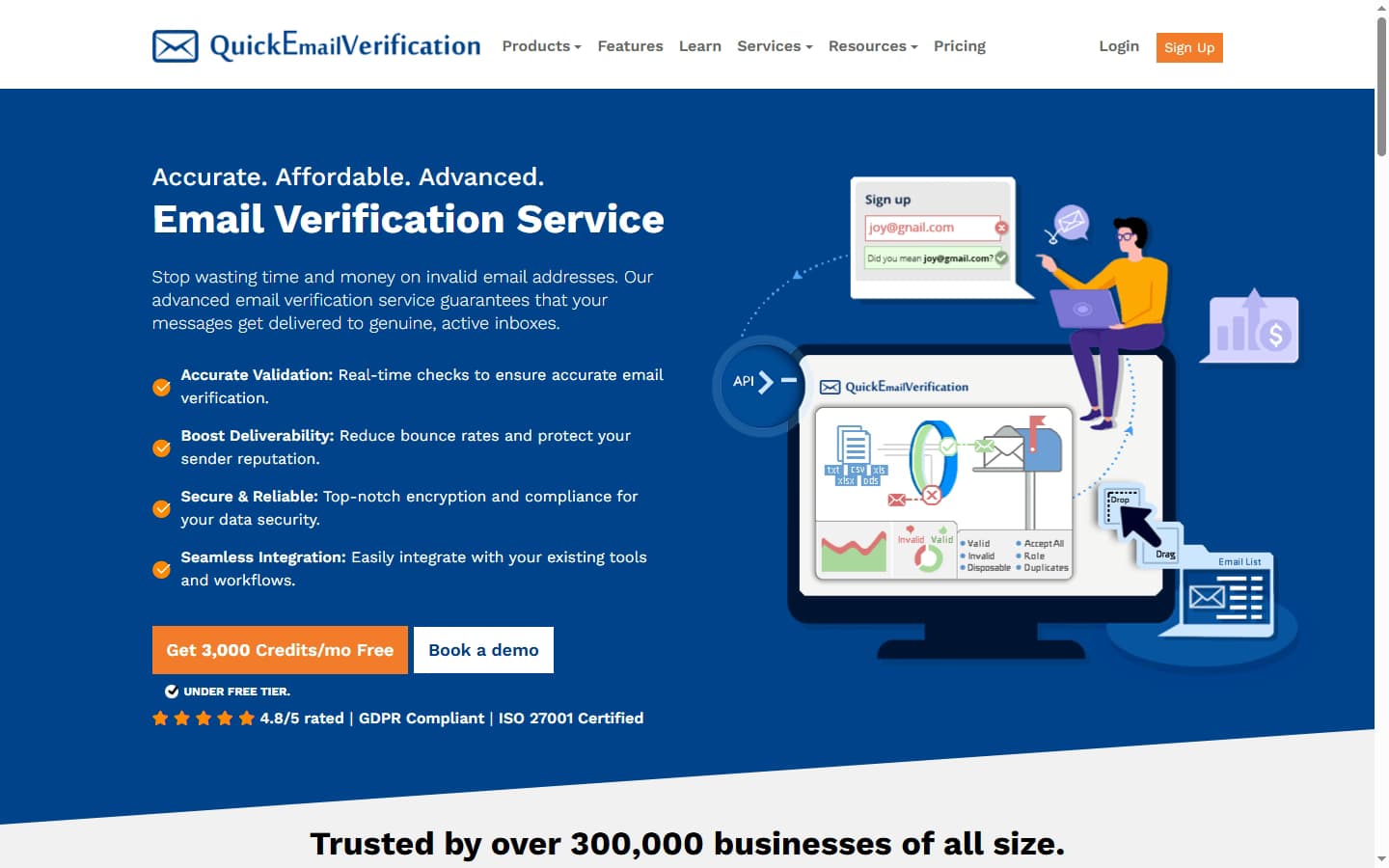
QuickEmailVerification — the widest official SDK spread in the category.
QuickEmailVerification wins on SDK coverage: PHP, Python, Node, Ruby, Go, Java, C# and VB.Net, all officially maintained. If your stack is .NET or legacy enterprise, this is often the only vendor that ships a supported client.
The batch flow is properly asynchronous. You submit a list, poll a job-status endpoint, then pull separate download URLs for safe, valid, invalid and unknown buckets.
That bucketed output is more useful than a flat CSV. It maps directly to send, suppress and re-verify actions without a post-processing step.
Documented response times sit under 1.2 seconds, which is tighter than ZeroBounce's stated ceiling and safe for inline form use. More detail in our QuickEmailVerification review.
Pros
- Eight official SDKs including C# and VB.Net — best legacy-stack coverage
- Async batch with job-status polling and bucketed download URLs
- Sub-1.2 second documented response time
- 100 free credits per day, resetting daily, indefinitely
- Credits never expire on paid PAYG bundles
Cons
- $8 per 1,000 at the $4/500 starter tier — roughly WhoisXML pricing, 8x Reoon
- Monthly plans cap at 500 daily credits, which resets, not rolls
- No sandbox mode; the daily free tier is the test environment
Best for: .NET and enterprise Java teams that need a vendor-supported client library rather than a hand-rolled one.
Pricing: Free 100/day; PAYG from $4 for 500 credits; subscriptions from $25/month.
6. Byteplant Email Validator
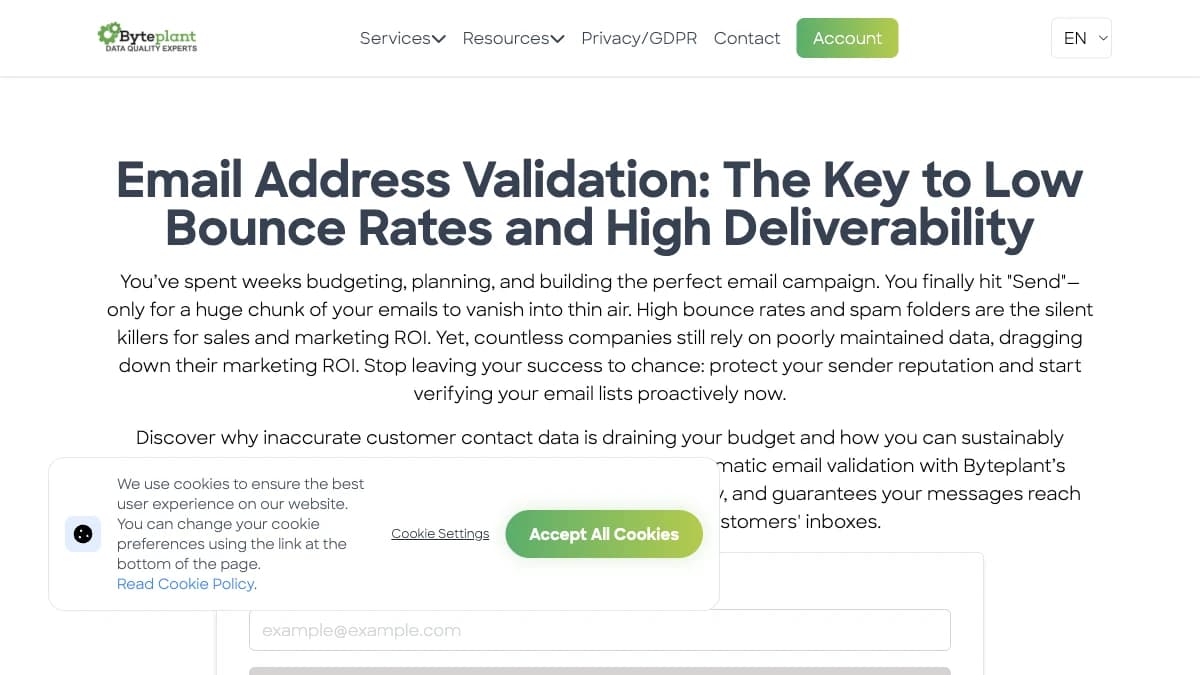
Byteplant Email Validator — API plus drop-in CRM and web-form plugins.
Byteplant Email Validator is the quiet veteran here, aimed squarely at point-of-capture validation across 240+ countries. Its differentiator is not the raw API — it is the plugin layer that sits on top.
Drop-in connectors for CRMs and web forms mean the non-engineering path is real, not a Zapier afterthought. That matters when marketing owns the form and engineering owns the backlog.
Pay-as-you-go sits at $0.0069 per email with no subscription, which undercuts WhoisXML on a like-for-like one-time purchase. One-time 1,000-email packs start at $10.68.
The weakness is developer experience. The docs read like 2018, there is no modern SDK matrix, and there is no sandbox — you are wiring REST by hand against a stable but dated contract.
Pros
- $0.0069/email PAYG with no subscription commitment — cheaper than WhoisXML one-time packs
- Drop-in CRM and web-form plugins for teams without engineering bandwidth
- 240+ country coverage with international syntax handling
- 100 free validations to trial, no card
- Long operating history and stable API contract
Cons
- Dated documentation with no versioned SDK matrix
- No sandbox or test key
- Volumes above 500,000 require a sales conversation instead of self-serve pricing
Best for: Teams validating at form and CRM entry points who want plugins over code.
Pricing: $0.0069/email PAYG; one-time packs from $10.68 per 1,000; monthly plans from about $10.41 per 1,000.
7. Mailfloss

Mailfloss — scheduled background cleaning across 35+ ESP integrations.
Mailfloss is the honest outlier: it is not really an API-first product. It is an automation layer that connects to Mailchimp, HubSpot, Campaign Monitor, Constant Contact and 30+ other platforms and cleans them on a schedule.
If your emails already live in an ESP, this deletes the integration work entirely. No endpoint to call, no job to poll, no results file to reconcile.
Typo correction runs automatically on the way in, which recovers real addresses instead of just discarding them. At $2.90 per 1,000 on the Lite plan, it is one of the cheapest options on this list.
But if you need a programmatic endpoint for a custom app, Mailfloss is the wrong tool — the API exists but plays second fiddle to the integrations. See our Mailfloss review for the full breakdown.
Pros
- 35+ native ESP and CRM integrations — zero integration code for most teams
- Automatic typo correction recovers addresses instead of dropping them
- Scheduled background cleaning with no manual list uploads
- $2.90 per 1,000 on the $29/month Lite plan
Cons
- API is secondary to the integration layer — thin docs, no SDK matrix
- Subscription only; no pay-as-you-go for one-off list cleans
- 7-day trial requires a credit card
Best for: Marketing teams whose lists live inside an ESP and who want hygiene to happen without anyone touching code.
Pricing: $29/month (10K credits), $59/month (25K), $209/month (125K); 20% off annual.
8. Proofy
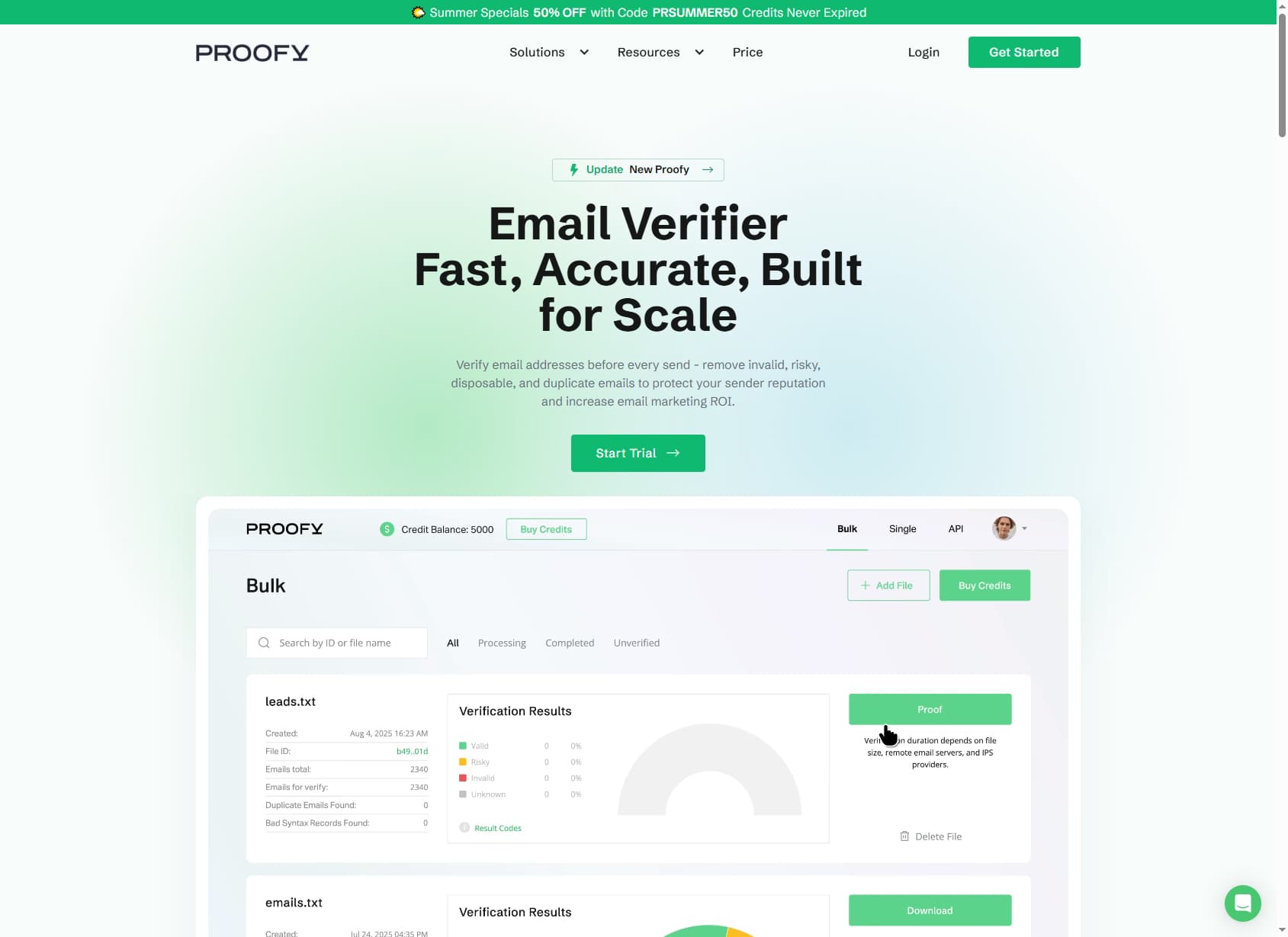
Proofy — credits charged only on successfully processed verifications.
Proofy has the fairest billing model in this comparison. Duplicates and unknowns do not consume credits — you pay only for verifications that actually resolved.
On a real B2B list with 15% duplicates, that is a 15% discount that never appears on a pricing page. Most vendors charge per row regardless of outcome.
The response is compact but well chosen: an exist verdict, a separate catch_all flag so “unknown” is disambiguated, and mx_domain so you can see the mail provider behind a lead.
Entry PAYG is $0.008/email, dropping to $0.001 at volume, with a $4 new-user trial for 1,000 credits. Full details in our Proofy review.
Pros
- Never charges for duplicates or unknowns — a real discount on messy lists
- mx_domain field surfaces the mail provider (Google Workspace, Microsoft 365, Proofpoint) per lead
- Unlimited free single-address checker with no account required
- Credits never expire on both PAYG and subscription
- $4 trial for 1,000 credits, no long commitment
Cons
- No official SDKs — REST only
- No sandbox or free API tier; the free checker is web-only
- $0.008/email at entry is 8x Reoon before volume discounts kick in
Best for: Teams cleaning imported lists with high duplicate rates who want billing tied to outcomes.
Pricing: Free unlimited single checker; $4 PAYG trial for 1,000 credits; $0.008–$0.001/email volume-tiered.
WhoisXML Email Verification API Alternatives Compared: Price, SDKs, Batch
Every WhoisXML Email Verification API alternative below is scored on the four things that decide an integration: entry price per 1,000, free tier, official SDK coverage, and whether batch shares the same API key.
| Tool | Entry price / 1,000 | Free tier | Official SDKs | Batch endpoint |
|---|---|---|---|---|
| WhoisXML (baseline) | ~$8.90 | 100 queries | Unversioned libraries | Separate product |
| SyncGTM | Credit-based (valid results only) | Free trial credits | REST + MCP server | Yes — bulk enrichment |
| ZeroBounce | $7.50 | 100/mo + sandbox | 7 languages | Yes — 100/request |
| AbstractAPI | $3.40 | 100 (non-commercial) | 10+ languages | CSV upload only |
| Reoon | $1.00 | 100 on signup | None (REST only) | Yes — bulk tasks |
| QuickEmailVerification | $8.00 | 100/day | 8 languages | Yes — job polling |
| Byteplant | $6.90 | 100 validations | Plugins, no SDK matrix | Yes — bulk upload |
| Mailfloss | $2.90 | 7-day trial (card) | None (35+ integrations) | Scheduled auto-clean |
| Proofy | $8.00 | Unlimited web checker | None (REST only) | Yes — bulk list API |
Entry price is the lowest self-serve rate per 1,000 verifications as published in August 2026. Volume tiers reduce all of these substantially.
How to Choose the Right Verification API
Pick on integration cost first, price second. A $1-per-1,000 API that costs two engineering weeks to wire up is not cheap.
- You need to test before you commit — ZeroBounce is the only one with a real sandbox. Everyone else makes you spend the free tier to learn the state machine.
- You are verifying at signup, inline — Reoon quick mode (sub-0.5s) or QuickEmailVerification (sub-1.2s). Avoid any vendor documenting a 30-second ceiling.
- Your stack is .NET or legacy Java— QuickEmailVerification's eight official SDKs are the only vendor-supported option.
- Per-call cost dominates — Reoon at $1 per 1,000, then Mailfloss at $2.90 and AbstractAPI at $3.40.
- Your lists live in an ESP — Mailfloss removes the integration entirely. Do not write code for a problem a connector solves.
- The addresses do not exist yet — no verifier helps you. That is an enrichment problem, and SyncGTM returns verified contacts from the waterfall instead of grading a list you had to buy first.
The last one is the case most teams misdiagnose. If you are buying a list and then buying verification for it, you are paying twice for data quality that should have arrived in the first payload.
Frequently Asked Questions
Common questions about replacing the WhoisXML Email Verification API, answered from the published documentation and pricing of each vendor as of August 2026. Independent review data is aggregated on G2's email verification category.
Final Verdict
If you want a straight swap for the WhoisXML verification endpoint, take ZeroBounce. It is the only vendor that lets you build the integration before paying for it, and its status/sub_status pair means you ship verdict logic instead of writing it.
If the invoice is what hurts, Reoon at $1 per 1,000 is nine times cheaper than WhoisXML and gives you two latency profiles on one endpoint. You trade away SDKs and support depth for that.
But the honest answer for most B2B teams is that the verification API is the wrong layer to be optimizing. Verification only matters because the addresses came from somewhere unreliable.
SyncGTM fixes the layer underneath. Waterfall enrichment across 50+ providers returns work emails, direct dials and 76+ data points per lead that are verified on arrival — so the verification API line item, and the integration behind it, both disappear.
See SyncGTM pricing or start free — no credit card required.