

7 Best MailboxValidator Alternatives for B2B Enrichment in 2026

By Kushal Magar · August 4, 2026 · 13 min read
Key Takeaway
MailboxValidator is cheap per check but expensive per usable contact — it validates addresses you already have and stops there. DeBounce wins on raw cost at volume, Verifalia on developer experience and free-tier renewal, and SyncGTM on the underlying problem: it finds the contact, verifies it during discovery, and hands you 76+ data points instead of a yes/no flag.
Most people searching for MailboxValidator alternatives are not unhappy with the accuracy. They are doing the arithmetic on a $19.95 pack of 1,000 credits and realising that works out to $0.02 per check — roughly 40x what the cheapest credible verifier charges at volume.
MailboxValidator does the fundamentals well: syntax parsing, MX record lookups, disposable and role-account detection, and greylisting retries. Its free API tier of 300 queries per month is genuinely useful for a developer wiring up a signup form.
The friction shows up in three places. Credits carry a 30-day validity window on several plans, the API documentation is thin next to modern competitors, and Yahoo addresses are not currently supported — which is a real gap if any part of your list is consumer-facing.
This comparison is built for the buyer MailboxValidator actually attracts: someone who cares about cost per verification, API rate limits, bulk file handling, and how big the free tier really is. If you want a broader roundup of enterprise-grade verification suites instead, our SafeToSend alternatives comparison covers NeverBounce, ZeroBounce, Kickbox, and BriteVerify in depth.
TL;DR — Verdict on Each Tool
- SyncGTM — best if the real problem is not verification but the list itself. Waterfall enrichment across 50+ providers with verification built into the output. From $99/mo.
- AbstractAPI — best documentation and cleanest REST contract. Sub-300ms responses, but a hard 3 req/sec cap on every tier. From $17/mo.
- Emailable — fastest bulk processing at 250,000 addresses in about 10 minutes, with refunds on duplicates and unknowns. 250 free credits, then ~$0.0076/email at 5k.
- DeBounce — cheapest per check at scale, from $0.00045. Credits never expire and the API is included at every tier. 100 free credits.
- Verifalia — best developer experience. Six official SDKs, tunable quality levels, 100MB bulk files, and 25 free verifications every single day.
- Clearout — strongest catch-all resolution plus a built-in email finder. About $0.0023/verification on the $23/mo 10,000-credit plan.
- Findymail — flips the model entirely: verification is bundled free with every email it finds, and you only pay for results. $99/mo.
Why Teams Look for MailboxValidator Alternatives
Four complaints come up repeatedly, and none of them are about accuracy. They are about economics, ergonomics, and scope.
The entry price per check is high. At $19.95 for 1,000 bulk credits, MailboxValidator costs $0.02 per verification — you need to commit to the $699.95 million-credit pack before the unit price becomes competitive.
Credits expire. Several plans carry a 30-day validity window, which penalises the exact team most likely to buy a small pack: one that verifies in irregular bursts rather than on a steady monthly cadence.
The developer surface is dated. There are no officially maintained SDKs, the docs are sparse compared to Verifalia or AbstractAPI, and Yahoo validation is unsupported.
It only validates what you already have. This is the structural limit. MailboxValidator tells you whether an address is deliverable — it will not tell you who the right person at an account is, or find their address if you do not have it.
That last point is why this list includes enrichment platforms alongside pure verifiers. If you are burning credits to discover that 30% of a purchased list is dead, the verification bill is the symptom rather than the disease.
1. SyncGTM

SyncGTM — waterfall enrichment across 50+ providers with verification built into the output
SyncGTM is a B2B prospecting platform that runs waterfall enrichment across 50+ data providers until it returns a verified contact. It is on this list because it removes the job MailboxValidator does rather than doing it cheaper.
The sequencing is the whole point. MailboxValidator starts with an address and asks whether it is real; SyncGTM starts with an ICP definition and returns a person, their verified email, direct dial, LinkedIn profile, and 76+ firmographic and technographic fields in one pass.
Because every address is cross-referenced across multiple providers before it is returned, a separate cleaning step becomes redundant. You are not paying $0.003 to discover that a scraped address was never valid — you never received the invalid address.
Catch-all domains are where the difference is most visible. Where a standalone verifier returns an unresolved "accept-all" flag, SyncGTM cross-checks the address across providers to recover a meaningful share as confirmed deliverable.
The platform also covers what happens after enrichment. Buying signal detection surfaces in-market accounts, native CRM sync pushes to HubSpot, Salesforce, Pipedrive, Attio, and Zoho, and built-in sequencing means no separate outreach tool.
Pros
- • Finds contacts as well as verifying them — removes the scraped-list problem at the source
- • Verification embedded in the waterfall, so no per-credit cleaning bill
- • 76+ data points per contact: email, direct dial, LinkedIn, firmographics, technographics, buying signals
- • Catch-all addresses cross-checked across providers, not just flagged
- • Native CRM sync and built-in outreach sequencing — no Zapier glue
- • Free tier with 200 credits/month, no credit card
Cons
- • Not a per-credit bulk validation API — wrong tool if you only need to clean a 500k list
- • $99/mo floor is higher than a one-off DeBounce or MailboxValidator credit pack
- • No standalone email-only validation endpoint priced per check
- • Overkill for a developer who just needs signup-form syntax validation
Best for: B2B teams whose verification spend is really a symptom of bad source data — building lists from ICP accounts rather than cleaning purchased ones.
Pricing: Free tier (200 credits/mo). Starter $99/mo. Pro $249/mo. Business $649/mo. Full breakdown on the SyncGTM pricing page.
2. AbstractAPI
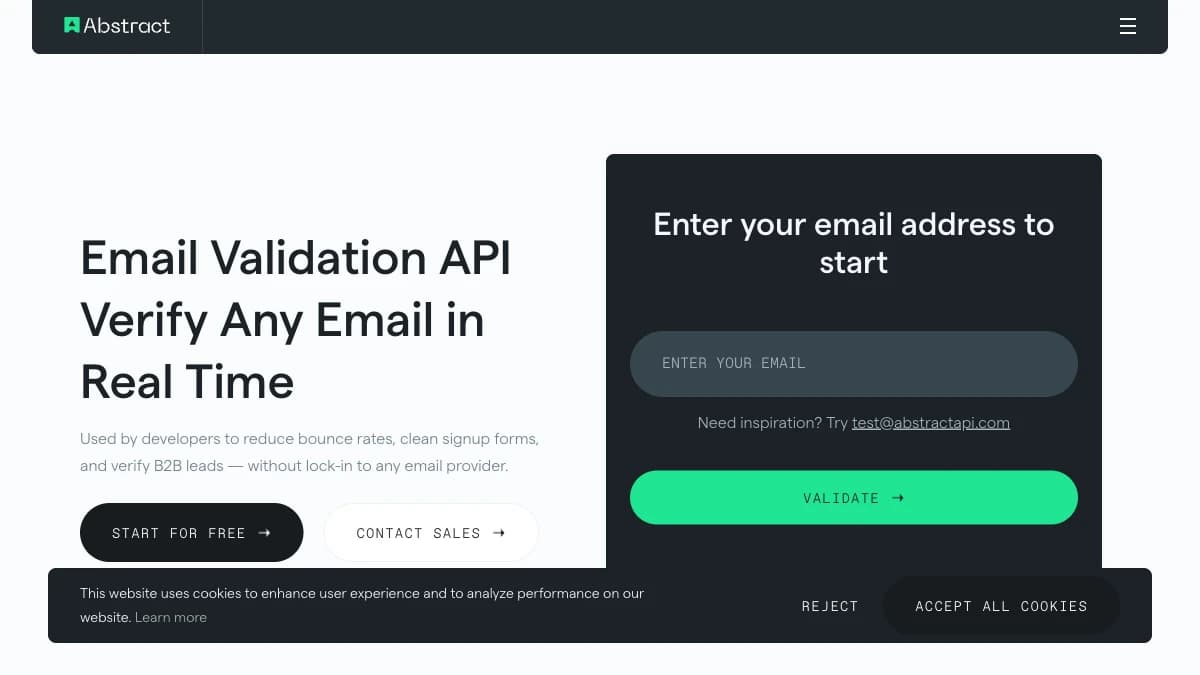
AbstractAPI — email validation API with sub-300ms responses and daily-updated disposable domain lists
AbstractAPI is the closest direct replacement for MailboxValidator's API product, aimed squarely at developers validating addresses at the point of form submission.
The documentation is the standout. Every field in the response — deliverability, quality score, disposable flag, role flag, free provider flag, catch-all, MX status, typo suggestions — is documented with example payloads, which is a noticeable step up from MailboxValidator's reference pages.
Response times are quoted under 300ms with real-time SMTP checks returning in under 50ms. The extras go further than most: breach checking, domain age assessment, and DMARC/SPF record analysis are included alongside standard validation.
The constraint is the rate limit. Every tier — free through Enterprise — is capped at 3 requests per second, which means a 100,000-address list takes over nine hours through the API and pushes you toward the bulk CSV upload flow instead.
Pros
- • Best-documented API on this list — worked examples for every response field
- • Sub-300ms typical response, under 50ms for the SMTP check
- • Disposable domain list updated daily
- • Extras included: typo suggestions, breach check, domain age, DMARC/SPF analysis
- • 100 free requests/month, no credit card required
Cons
- • Hard 3 req/sec cap on every tier, including Enterprise — the single biggest limitation
- • Free tier of 100/month is smaller than MailboxValidator's 300
- • No contact finding — validation only
- • Tier naming is confusing: Standard ($37) and Professional ($39) sit oddly close together
Best for: Developers adding real-time validation to signup forms and checkout flows, where per-request latency matters more than throughput.
Pricing: Free (100 requests/mo). Starter $17/mo. Standard $37/mo. Professional $39/mo. 10% off annual.
3. Emailable
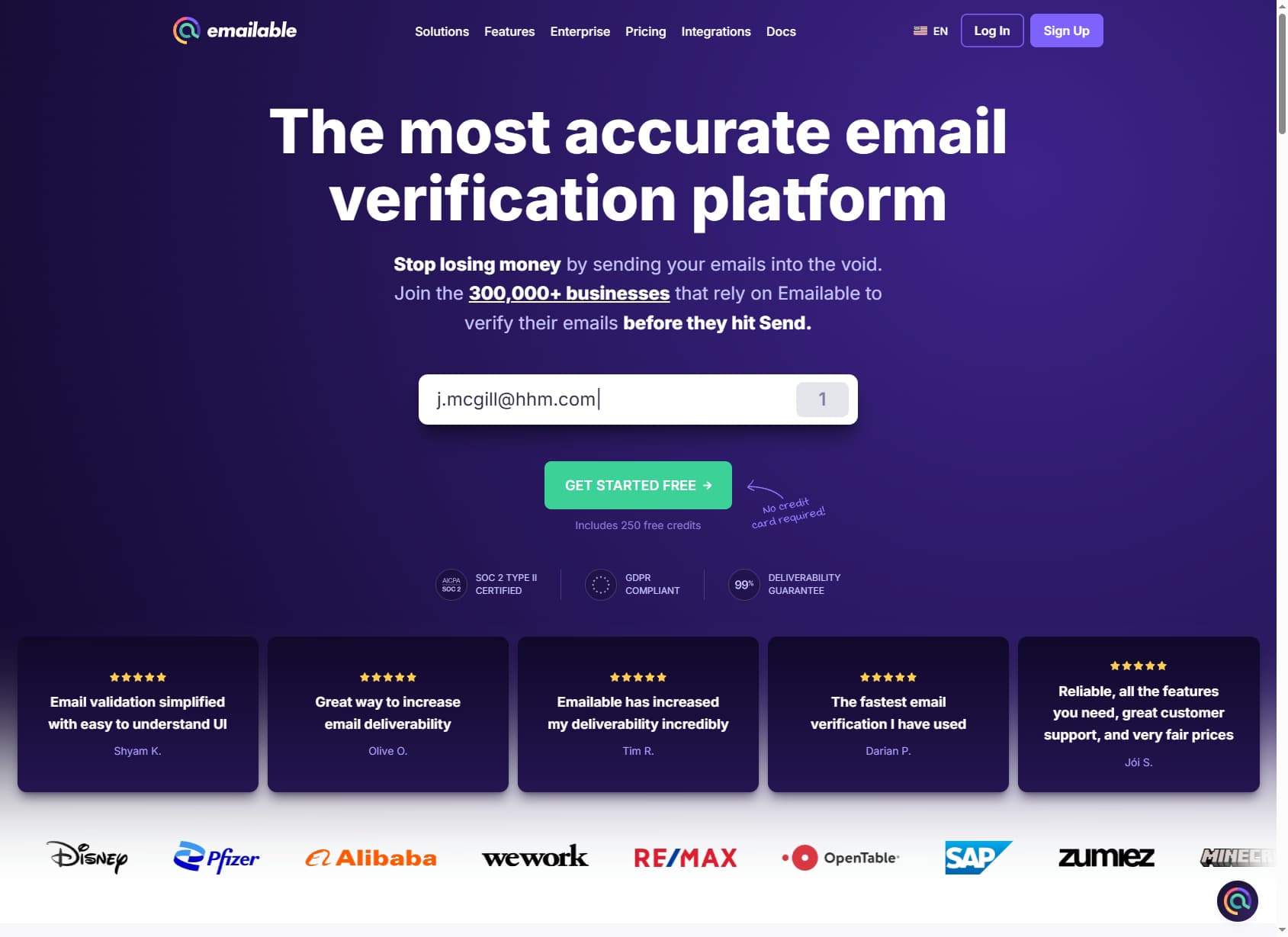
Emailable — bulk verification that clears 250,000 addresses in roughly ten minutes
Emailable wins on throughput. It processes roughly 10,000 addresses in two to three minutes and 250,000 in about ten, with no stated ceiling on file size.
The billing policy is unusually fair. Duplicates and "unknown" results are refunded as credits, so you are not charged for checks that failed to produce a usable answer — something MailboxValidator does not do.
Credits never expire, which directly addresses MailboxValidator's 30-day validity window. The free grant of 250 credits is the largest one-off allowance here and is enough to benchmark accuracy against a real sample before committing.
The trade-off is unit cost. At 5,000 credits you are paying about $0.0076 per verification — roughly 17x DeBounce's volume rate — though the 15% subscription discount narrows that gap. Our full Emailable review breaks down where the premium is and is not justified.
Pros
- • Fastest bulk processing tested — 250,000 addresses in ~10 minutes
- • Duplicates and unknown results refunded as credits
- • Credits never expire; subscription credits roll over
- • 250 free credits on signup — largest one-off free grant here
- • No file size limit on bulk uploads
Cons
- • ~$0.0076/verification at 5k is expensive next to DeBounce or Verifalia
- • 5,000-credit minimum purchase blocks small tests
- • API rate limits are not published on the pricing page
- • Verification only — no contact discovery
Best for: Teams cleaning large lists on a deadline, where minutes saved on a 250k file matter more than tenths of a cent per check.
Pricing: 250 free credits. From ~$0.0076/email at 5,000 credits ($38); 15% off with a monthly subscription.
4. DeBounce
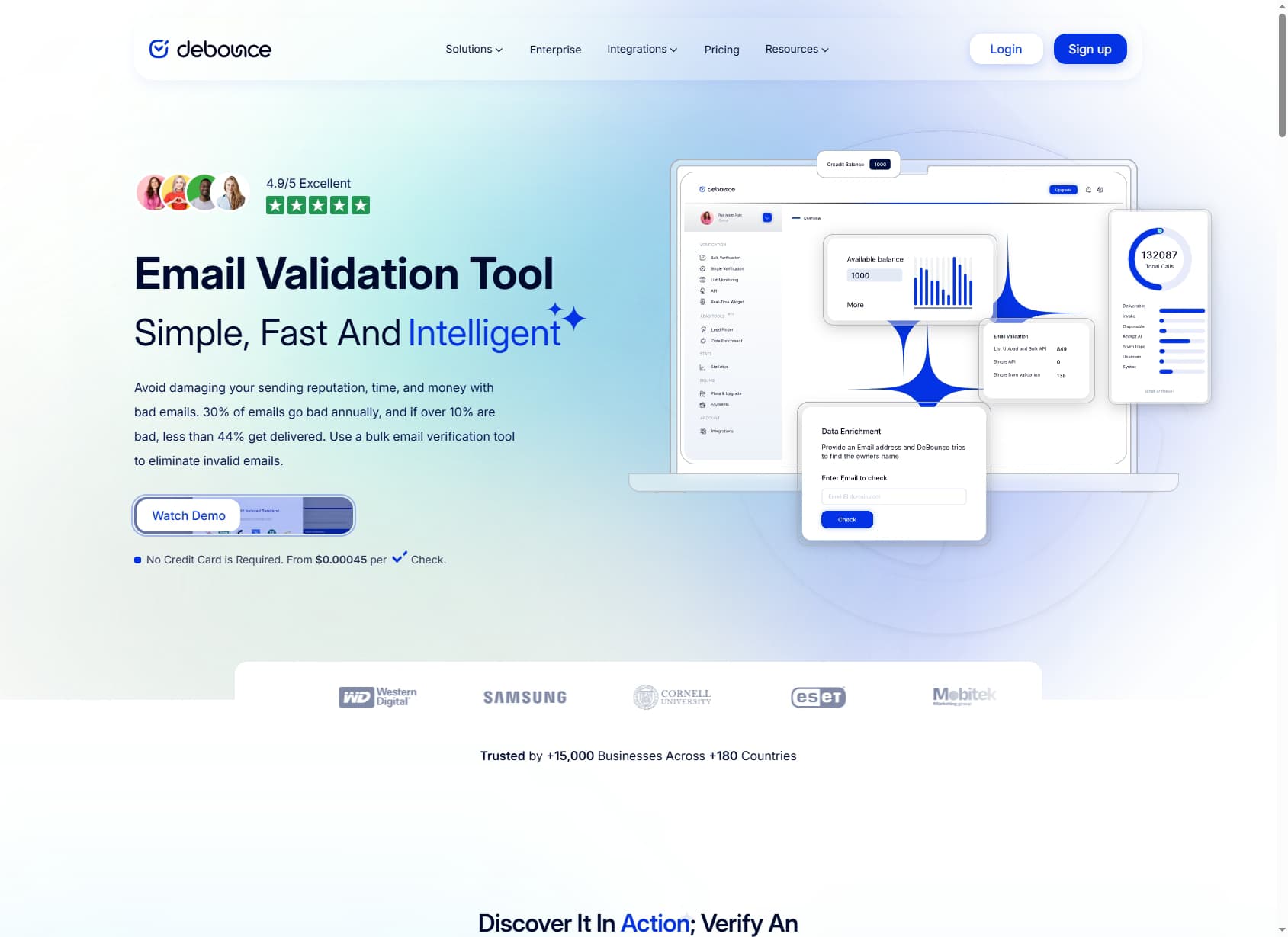
DeBounce — pay-as-you-go verification from $0.00045 per check with credits that never expire
DeBounce is the direct answer to the cost complaint. At high volume it quotes from $0.00045 per check, against MailboxValidator's $0.0007 on its equivalent million-credit pack.
Two policies make it genuinely developer-friendly. Credits never expire, and API access is included at every tier — there is no separate API subscription and no requirement to move to a monthly plan just to script against it.
The credit model is transparent about where the real work is. A standard validation costs 1 credit, a deep catch-all validation costs 10, and data enrichment costs 20 per successful detection.
That honesty is worth noting. Verifiers that charge a flat rate on catch-all domains are usually returning an unresolved flag rather than doing the deeper probe — see our DeBounce review for the accuracy testing behind that.
Pros
- • Cheapest credible per-check rate — from $0.00045 at volume
- • Credits never expire, no monthly commitment required at all
- • API included at every tier with no separate API-only pricing
- • Deep catch-all validation available, priced honestly at 10 credits
- • Credit packs from 5K to 5M — buy exactly what you need
- • 100 free credits on signup, no card
Cons
- • Headline $0.00045 rate needs the 5M pack — small-volume rates are nearer $0.004
- • Catch-all checks at 10x cost add up fast on B2B lists where catch-alls are common
- • No official SDKs — REST only
- • Enrichment at 20 credits is thin next to real B2B tools
Best for: Budget-driven teams verifying at high volume in irregular bursts, where non-expiring credits beat a monthly subscription.
Pricing: 100 free credits. Pay-as-you-go packs from 5K to 5M credits, from $0.00045/check at the top volume.
5. Verifalia
Verifalia — six official open-source SDKs, tunable quality levels, and 25 free verifications every day
Verifalia is the most developer-native tool here. It ships officially maintained, royalty-free open-source libraries for .NET, Go, Java, JavaScript, PHP, and Ruby.
Its signature feature is tunable verification depth, which no other tool on this list offers. Standard costs 1 credit and runs a single pass with a 5-second anti-tarpit window; High costs 2 credits for three passes and 50 seconds; Extreme costs 4 credits for nine passes and two minutes.
That matters because greylisting is the main source of false negatives — the exact failure mode MailboxValidator users report when a remote server throttles the probe. Verifalia lets you pay more only for the addresses that warrant a retry.
Bulk handling is best-in-class too: files up to 100MB, or roughly 72 million addresses, across plain text, TSV, CSV, XLS, and XLSX. The free plan renews 25 verifications daily rather than as a one-time grant — see our Verifalia review for how the quality levels perform in testing.
Pros
- • Six official open-source SDKs — .NET, Go, Java, JavaScript, PHP, Ruby
- • Tunable Standard/High/Extreme quality levels for greylisting and tarpit handling
- • 100MB bulk files (~72M addresses) across TXT, TSV, CSV, XLS, XLSX
- • 25 free verifications per day, renewing forever — ~750/month
- • Purchased credits never expire
Cons
- • Free daily credits do not accumulate — unused ones vanish at midnight
- • High and Extreme levels cost 2x and 4x, so real-world unit cost exceeds the headline rate
- • Extreme quality takes up to 2 minutes per address — unusable for real-time form validation
- • Verification only — no contact finding or enrichment
Best for: Engineering teams that want an SDK rather than raw REST, and control over the accuracy-versus-latency trade-off per request.
Pricing: Free plan (25 verifications/day). Pay-as-you-go credit packs from around $0.00049/email at volume.
6. Clearout

Clearout — verification plus email finder with non-expiring credits and strong catch-all resolution
Clearout sits between a pure verifier and a prospecting tool. It verifies at 1 credit per email and also finds addresses from a name and domain.
Pricing is the strongest mid-market value here. The $23/month subscription includes 10,000 credits every 30 days — about $0.0023 per verification — and unused credits carry forward indefinitely.
Catch-all resolution is Clearout's marketed strength, and it matters more for B2B than most buyers realise. A large share of corporate domains are configured accept-all, which is precisely where a syntax-and-MX verifier gives you nothing actionable.
You get 100 free credits on signup with no card, and all three billing modes — annual, monthly, and pay-as-you-go — are switchable at any time. Our Clearout review covers the accuracy testing in detail.
Pros
- • ~$0.0023/verification on the $23/mo 10,000-credit plan — strong mid-market rate
- • Catch-all resolution rather than an unresolved flag
- • Email finder included, so partial coverage of the discovery gap
- • Credits never expire and roll over indefinitely
- • Three billing modes, switchable at any time; up to 20% off PAYG
- • 100 free credits on signup, no card
Cons
- • Pay-as-you-go is far worse value — $21 for 3,000 credits is ~$0.007/check
- • No partial refunds when switching plans; you pay the new tier in full
- • Email finder is domain-pattern based, not a multi-provider waterfall
- • Per-credit volume tiers are not published up front
Best for: Mid-market B2B teams with predictable monthly volume that need catch-all resolution alongside basic email finding.
Pricing: 100 free credits. Subscription from $23/mo for 10,000 credits. Pay-as-you-go from $21 for 3,000 credits.
7. Findymail
Findymail — pay only for verified results, with a sub-5% bounce guarantee
Findymail inverts the MailboxValidator model. Verification is not a product you buy separately — it is bundled free into every email the finder returns.
The commercial terms follow from that. You are only charged when an email is found and verified, so failed lookups cost nothing, and the company backs a sub-5% bounce rate with refunds if you exceed it.
The Starter plan is $99/month for 5,000 finder credits plus 5,000 bonus verifier credits, so you can still clean externally sourced lists. Unused credits roll over up to 2x your monthly allowance.
The catch is scope: it is a B2B email finder, so consumer addresses and non-work domains are outside its remit. See the Findymail review for measured hit rates, or our waterfall email finder comparison for how single-source finders stack up against multi-provider ones.
Pros
- • Verification bundled free with every find — no separate cleaning spend
- • Pay only for results; failed lookups are not charged
- • Sub-5% bounce guarantee with refunds if exceeded
- • 5,000 bonus verifier credits included for externally sourced lists
- • Credits roll over up to 2x the monthly allowance
Cons
- • $99/mo floor with only 10 free trial credits — hard to evaluate cheaply
- • B2B work emails only; no consumer or personal address coverage
- • Phone lookups cost 10 credits each, which erodes the finder allowance fast
- • Single-source finder — lower hit rate than a multi-provider waterfall
Best for: Outbound teams that want to stop paying for verification as a line item and only pay for contacts that actually resolve.
Pricing: 10 free trial credits. Starter $99/mo (5,000 finder + 5,000 verifier credits). ~$83/mo billed annually.
MailboxValidator Alternatives Compared: Cost per Verification
Cost per verification is the number most buyers optimise for, so it leads the table. MailboxValidator is included as the baseline.
| Feature | SyncGTM | MailboxValidator | AbstractAPI | Emailable | DeBounce | Verifalia | Clearout | Findymail |
|---|---|---|---|---|---|---|---|---|
| Cost per verification | Included in enrichment credit | $0.02 (1k) → $0.0007 (1M) | ~$0.0034 at 5k | ~$0.0076 at 5k | ~$0.004 → $0.00045 (5M) | From ~$0.00049 | ~$0.0023 at 10k/mo | Bundled with find |
| Free tier | 200 credits/mo, recurring | 300 API/mo; 100 bulk trial | 100 requests/mo | 250 credits (one-off) | 100 credits (one-off) | 25/day, forever | 100 credits (one-off) | 10 credits (one-off) |
| Credits expire? | Monthly allowance | Yes — 30-day validity | Yes — monthly quota | No | No | No (paid packs) | No | Rolls over to 2x |
| API rate limit | Plan-based, no hard cap | Plan-based quota | 3 req/sec, all tiers | Not published | Included every tier | Async job submission | Included every tier | Documented REST API |
| Official SDKs | REST + MCP server | No | No — REST only | No — REST only | No — REST only | 6 — .NET, Go, Java, JS, PHP, Ruby | No — REST only | No — REST only |
| Bulk file handling | CSV in/out + CRM sync | Bulk packs, web UI | CSV upload, paid tiers | 250k in ~10 min, no size cap | Bulk lists + monitoring | 100MB (~72M addresses) | Bulk upload + integrations | CSV enrichment upload |
| Disposable + role detection | Yes — via waterfall | Yes | Yes — daily list updates | Yes | Yes | Yes | Yes | Filtered at source |
| Catch-all resolution | Multi-provider cross-check | Flagged only | Flagged only | Scored | Deep check at 10 credits | Via High/Extreme levels | Yes — headline feature | Handled pre-delivery |
| Finds contacts | Yes — 50+ provider waterfall | No | No | No | No | No | Yes — domain pattern | Yes — B2B finder |
| Starting price | Free tier; $99/mo paid | $19.95 bulk / $29.95 API | $17/mo | $38 / 5,000 credits | PAYG packs from 5K | Free; PAYG packs | $23/mo | $99/mo |
How to Choose the Right One
Pick on the constraint that actually binds you, not on the headline rate. Five decision rules cover most cases.
Optimising purely for unit cost at 100k+ addresses? DeBounce or Verifalia. Both go below $0.0005 per check at volume and neither expires your credits.
Verifying in irregular bursts?Avoid anything with a 30-day validity window — that rules out MailboxValidator's bulk packs. DeBounce, Emailable, and Clearout all hold credits indefinitely.
Writing code against it every day? Verifalia for the six maintained SDKs and tunable quality levels, or AbstractAPI if documentation quality matters more than throughput.
Cleaning huge lists against a deadline? Emailable for raw speed, or Verifalia if your file is genuinely enormous — 100MB covers roughly 72 million addresses in one job.
Discarding 20-40% of every list as invalid? Stop buying verification and fix the source. Findymail or SyncGTM charge for contacts that resolve rather than for the discovery that they do not.
One number worth internalising: B2B contact data decays at roughly 20-30% per year through job changes alone. A perfectly verified list is still a stale list twelve months later, which is why re-enrichment beats re-verification for outbound teams.
Final Verdict
If you want a like-for-like swap that costs less, DeBounce is the answer. Non-expiring credits, API on every tier, and the lowest volume rate here.
If you write code against the API daily, Verifalia is the better home. Six official SDKs, 25 free checks that renew every day, and per-request control over how hard it probes a greylisting server.
AbstractAPI owns real-time form validation, Emailable owns bulk throughput, and Clearout is the best mid-market value at roughly $0.0023 per check with real catch-all resolution.
But if you are here because verification spend keeps climbing, the honest answer is that a cheaper verifier only slows the bleeding. SyncGTM removes the step entirely — waterfall enrichment across 50+ providers returns a verified contact with 76+ data points, catch-alls cross-checked rather than flagged, and outreach built in.
Start with the free tier of whichever fits. DeBounce and Clearout give 100 credits, Emailable gives 250, Verifalia renews 25 daily, and SyncGTM gives 200 enrichment credits every month with no card required.