
By Kushal Magar · October 3, 2026 · 12 min read
ZoomInfo vs Clay: Enterprise Data or Enrichment Builder 2026
ZoomInfo vs Clay isn't a fight between two databases. It's a choice about where your data comes from. ZoomInfo is the source: 500M+ professional profiles it collects and verifies itself, sold on a negotiated annual contract. Clay is the plumbing: a table that pulls from 150+ providers, AI web research, and your CRM, billed by usage. And Clay can call ZoomInfo as one of its providers, so for some teams the honest answer is both.
ZoomInfo vs Clay is the comparison that comes up when a team has to choose between buying one big dataset and building its own enrichment stack. ZoomInfo is the incumbent enterprise data platform, now pitched as a GTM intelligence layer. Clay is the spreadsheet-style workflow tool that GTM engineers use to chain data providers together.
Both moved toward each other in 2026. Clay launched Audiences for unlimited people and company search in June, made its email Sequencer generally available on September 1, and raised a $115M Series D at a $7.1B valuation on September 9. ZoomInfo now sells GTM Studio, a codeless play builder that runs a waterfall across 25+ sources on top of its own data, which puts it squarely on Clay's turf.
Below, we compare coverage, flexibility, total annual cost, signals, and contract terms, using figures from each vendor's site and Vendr's buyer data checked in October 2026. For single-tool deep dives, read our ZoomInfo review and Clay review.
Quick Summary
ZoomInfo vs Clay is a choice between one proprietary B2B dataset and a workflow that buys data from many. ZoomInfo lists 500M+ professional profiles, 122M+ companies, 300M+ verified emails, 135M+ direct dials, and 4,500+ intent topics, sold on quote-based annual contracts: the entry package is widely reported at about $14,995 a year for 3 seats, and Vendr puts the median contract at $33,500. Clay is a spreadsheet-style platform where each column can call one of 150+ data providers, its Claygent AI research agent, or an API, arranged into waterfalls you control. It costs $0, $167, or $446 a month on annual billing with unlimited seats, plus custom Enterprise, and Clay estimates 6–20 data credits per fully enriched record. Clay can also call ZoomInfo directly if you bring your own ZoomInfo account. ZoomInfo fits enterprise teams that want one vendor and deep North American coverage; Clay fits teams with a builder who want coverage beyond any single database.
TL;DR
- Short answer: ZoomInfo wins when you need the deepest single source of North American enterprise contacts, direct dials, and native intent, and can sign an annual contract. Clay wins when you want coverage from many providers, custom research fields, and a monthly bill you control.
- Coverage: ZoomInfo lists 500M+ professional profiles, 122M+ companies, 300M+ verified emails, and 135M+ direct dials. Clay owns no comparable contact database; it waterfalls across 150+ providers plus Claygent web research, and charges nothing when a lookup comes back empty.
- Flexibility: In Clay, every column can call a provider, an AI model, or an API, in the order you choose. ZoomInfo's GTM Studio adds a play builder and a 25+ source waterfall, but it runs on ZoomInfo's data and inside ZoomInfo's contract.
- Cost (annual billing): Clay costs $0, $167, or $446 a month with unlimited seats, so Growth comes to $5,352 a year. ZoomInfo is quote-only; its entry package is widely reported at ~$14,995 a year for 3 seats, and Vendr puts the median contract at $33,500.
- Use both: Clay has a native ZoomInfo integration that requires your own ZoomInfo account. Lookups through it skip Clay data credits and use only actions, so ZoomInfo customers can make it the first step in a Clay waterfall.
- Pick ZoomInfo for a phone-heavy enterprise team with a RevOps owner and budget for a negotiated contract. Pick Clay if someone will build and maintain enrichment workflows and you sell into markets that one database covers unevenly.
What We Evaluated
- ZoomInfo vs Clay coverage: one proprietary database's size and vendor accuracy claims vs a waterfall across 150+ providers, and what each charges when a lookup misses
- Flexibility: custom fields, AI web research, provider order, CRM and API automation, and how ZoomInfo's GTM Studio play builder compares
- Total annual cost: quote-based contracts (ZoomInfo) vs workspace plans with unlimited seats and two usage meters (Clay), using vendor pricing and Vendr buyer data checked in October 2026
- Signals: intent, website visitors, job changes, hiring, and company news, and which plan or package unlocks each
- Execution: sequencing, dialing, and how much of the outbound motion each tool covers on its own
- Contract and ownership: billing cadence, renewal terms, setup effort, and who on the team has to run it
1. ZoomInfo — Enterprise teams that want one deep North American dataset, direct dials, and native intent under one contract
ZoomInfo — Enterprise teams that want one deep North American dataset, direct dials, and native intent under one contract
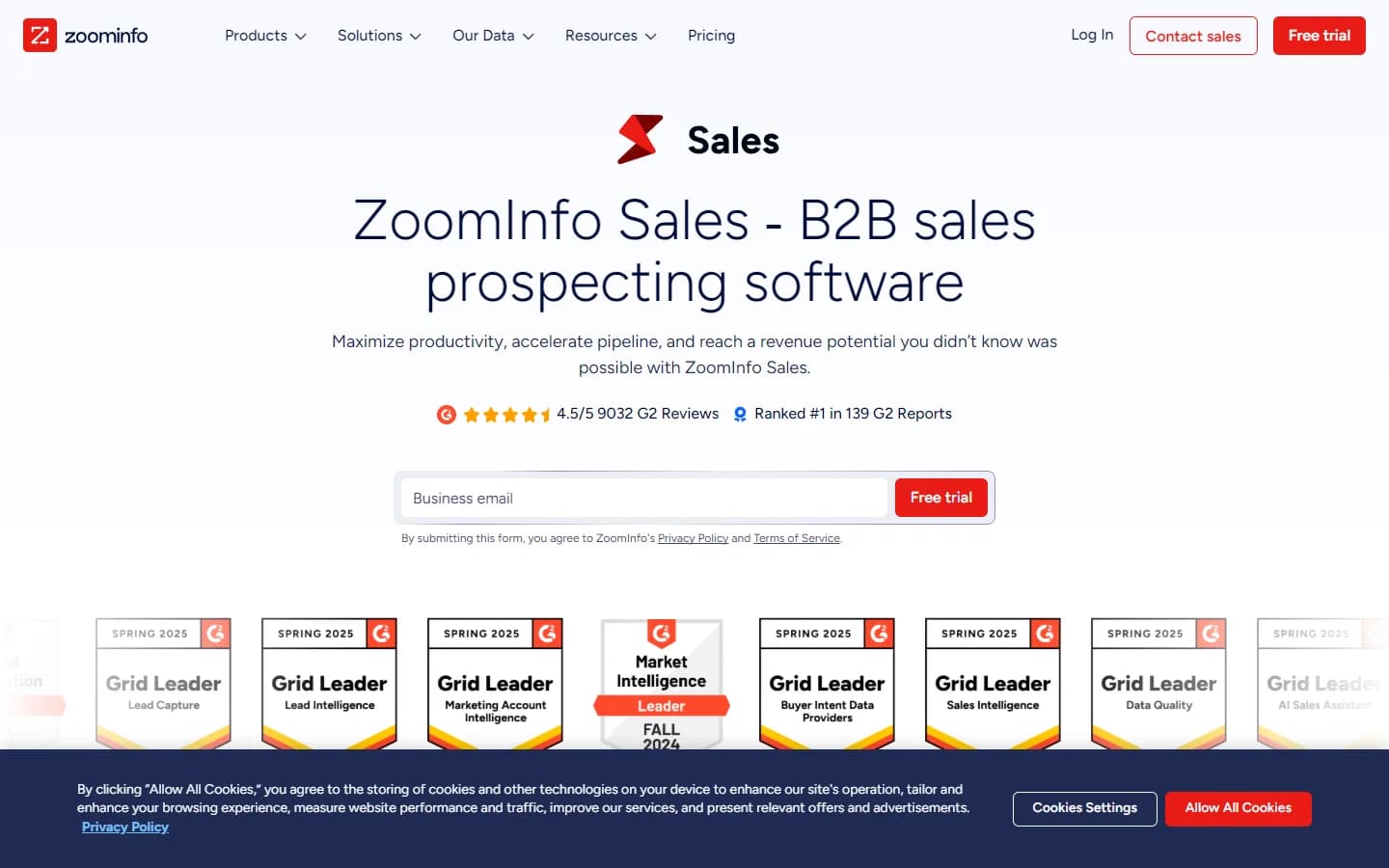
ZoomInfo is an enterprise go-to-market data platform that collects and maintains its own B2B dataset. Its data page lists 500M+ professional profiles, 122M+ companies, 300M+ verified emails, 135M+ direct dial numbers, and 4,500+ intent topics.
ZoomInfo also publishes its own quality figures: a 96% email deliverability rate and 87% mobile number accuracy, backed by human researchers and machine learning. Treat them as vendor claims; G2 reviewers report stale records and thinner coverage in APAC and LATAM than in the US.
The signal layer is where ZoomInfo pulls ahead of a do-it-yourself stack. WebSights identifies companies visiting your site, Champion Tracking flags job changes, Job Trends watches hiring, Scoops surfaces company news, and intent is scored across those 4,500+ topics at the company level rather than the person.
ZoomInfo now competes on workflow too. Its own Clay comparison describes GTM Studio as a codeless play builder running on ZoomInfo data with waterfall enrichment across 25+ sources, next to Engage for sequencing and dialing, Copilot, and ZoomInfo MCP.
Pricing is quote-only and annual. The entry package is widely reported at ~$14,995 a year for 3 seats, and Vendr's data from 1,574 purchases puts the median contract at $33,500, with a range of $7,220 to $155,730 and about 22% average savings through negotiation.
For seat math and negotiation tactics, see our ZoomInfo cost guide, or see how it stacks up against a self-serve database in Apollo.io vs ZoomInfo.
Pros
- +Largest single source in this comparison: 500M+ professional profiles, 300M+ verified emails, and 135M+ direct dials by ZoomInfo's count
- +Native signals from the same source as the contacts: 4,500+ intent topics, WebSights, Champion Tracking, Job Trends, and Scoops
- +Deepest North American enterprise coverage, the strongest fit for phone-heavy teams selling into large accounts
- +One vendor for data, orchestration (GTM Studio), and execution (Engage, Copilot), with ISO 27001, ISO 27701, and SOC 2 Type II for security reviews
- +Works as a provider inside Clay through Clay's native ZoomInfo integration, so the contract still pays off if you add a workflow layer later
Cons
- −No published pricing; Vendr's median contract is $33,500 a year, and the reported entry package covers only 3 seats
- −Annual auto-renewing contracts, with users reporting 60–90 day cancellation windows and 15–20% renewal increases
- −Intent is company-level and sits above the entry Professional package, in the higher Copilot tiers or as an add-on
- −Coverage outside North America trails the US, according to G2 reviewers
- −Integrations, GTM Studio plays, and contract administration work best with a dedicated RevOps owner
Best for: Enterprise teams that want one deep North American dataset, direct dials, and native intent under one contract
Pricing: Quote-based annual contracts. Plans: Professional, Copilot Advanced, Copilot Enterprise (no public prices). Widely reported entry price: Professional ~$14,995/year (3 seats). Vendr median contract: $33,500/year (range $7,220–$155,730, 1,574 purchases, February 2026).
2. Clay — Teams with a builder who want multi-provider coverage and custom enrichment workflows
Clay — Teams with a builder who want multi-provider coverage and custom enrichment workflows
Clay is a spreadsheet-style GTM data platform: each row is a company or a person, and each column can call a data provider, an AI model, or an API. Instead of owning one database, it gives you a marketplace of 150+ providers, waterfalls that try them in the order you set, and Claygent, an AI agent that researches custom data points on the web.
The 2026 releases filled two old gaps. Audiences (June 23) added unlimited people and company search on paid plans, and the native Clay Sequencer became generally available on September 1, email-only and capped at four steps per campaign.
Clay can also sit on top of ZoomInfo. Its ZoomInfo integration offers Enrich Company, Enrich Contact, Enrich contact(s) by ID, and Search contacts on every plan, each requiring your own ZoomInfo account, and Clay's docs confirm that bring-your-own-key lookups skip data credits and use only actions.
Pricing as of October 2026, per clay.com/pricing: Free, Launch ($167 a month annual, $185 monthly; 2,500 data credits and 15,000 actions a month), Growth ($446 / $495; 6,000 data credits and 40,000 actions, plus CRM auto-sync, HTTP API, webhooks, and web intent), and custom Enterprise, all with unlimited seats. Data credits start at $0.05, actions cost under a cent, and an enrichment that returns nothing costs neither.
Clay closed a $115M Series D at a $7.1B valuation on September 9, 2026. The catch is build time: production tables need an owner, often a GTM engineer; our Clay pricing change breakdown explains the two meters.
Pros
- +Coverage from 150+ providers in waterfalls you order, plus Claygent web research for data points no database sells
- +Unlimited seats on every plan, so cost tracks usage instead of headcount
- +No data credits or actions charged when an enrichment returns nothing
- +Bring your own API keys, ZoomInfo included, to skip data credits and pay only actions
- +Published monthly or annual pricing from $167 a month, a free plan, and a 14-day trial on Launch and Growth
Cons
- −Steep learning curve: waterfalls, formulas, and Claygent prompts take real build time and a dedicated owner
- −A fully enriched record costs 6–20 data credits by Clay's own estimate, and actions reset every billing cycle
- −CRM auto-sync, HTTP API, webhooks, and web intent start at Growth ($446 a month on annual billing)
- −No proprietary contact database or direct-dial depth of its own; results depend on the providers you chain
- −The native Sequencer is email-only with up to four steps, and there is no built-in dialer
Best for: Teams with a builder who want multi-provider coverage and custom enrichment workflows
Pricing: Free ($0, 100 data credits + 500 actions per month, up to 200 rows per table); Launch $167/month billed annually or $185 monthly (2,500 data credits + 15,000 actions); Growth $446/month billed annually or $495 monthly (6,000 data credits + 40,000 actions); Enterprise custom (100,000+ data credits, 200,000+ actions). Unlimited seats on every plan; top-ups cost a 30% premium. Verified on clay.com/pricing, October 2026.
Comparison Table
| Tool | Best For | Free Tier | Starting Price | Standout Feature |
|---|---|---|---|---|
| ZoomInfo | Enterprise teams that want one deep North American dataset, direct dials, and native intent under one contract | Yes (ZoomInfo Lite, 10 credits/month; free trials of paid plans) | ~$14,995/year for 3 seats (entry package, quote-based) | 500M+ professional profiles and 135M+ direct dials, with 4,500+ intent topics from the same source |
| Clay | Teams with a builder who want multi-provider coverage and custom enrichment workflows | Yes (100 data credits + 500 actions per month, 200 rows per table) | $167/month (Launch, annual, unlimited seats) | Waterfalls across 150+ providers, with ZoomInfo available as a bring-your-own-account step |
How to Choose
- ZoomInfo if you need enterprise teams that want one deep North American dataset, direct dials, and native intent under one contract
- Clay if you need teams with a builder who want multi-provider coverage and custom enrichment workflows
Final Verdict
Pick ZoomInfo if you sell into large North American accounts, your reps live on the phone, and you want intent, website visitors, and job changes coming from the same source as the contacts. It is the simpler buy for an enterprise that wants one vendor, one security review, and one contract. Budget for the real number, not the entry quote: Vendr's median is $33,500 a year, renewals roll automatically, and buyers average about 22% off through negotiation.
Pick Clay if someone on the team will own the build and your edge comes from data no single vendor sells: niche titles, international contacts, custom research fields, or signal-triggered plays. Growth costs $5,352 a year on annual billing with unlimited seats, about a third of ZoomInfo's reported entry package, and lookups that miss cost nothing. Plan for 6–20 data credits per fully enriched record and a learning curve measured in weeks, not hours.
If you already pay for ZoomInfo, the question changes. Connect it to Clay, run it first in the waterfall at no data-credit cost, and let other providers and Claygent cover the gaps. That stack costs more than either tool alone, so keep it only if the extra coverage shows up in connect and reply rates.
Whichever you choose, SyncGTM can strengthen the enrichment behind it with verified emails, phone numbers, and firmographics from 50+ providers.