

By Kushal Magar · October 2, 2026 · 12 min read
Apollo.io vs ZoomInfo: Data Accuracy and Pricing Ranked 2026
Apollo.io vs ZoomInfo usually gets framed as "cheap data vs good data." That framing is out of date. Both vendors now publish accuracy claims you can't compare directly, and third-party tests disagree with each other. The bigger gap is how you buy: Apollo publishes per-seat prices you can start on today, while ZoomInfo sells negotiated annual contracts with a median value of $33,500 a year. Pick on pricing model, where your buyers sit, and whether you need sequencing in the same tool. Then test accuracy on your own records.
Apollo.io vs ZoomInfo is the shortlist most B2B sales teams end up with when they need a contact database. They overlap on the core job, finding a verified email or direct dial for the right buyer, but they're built for different teams and sold in very different ways.
Apollo.io is a self-serve platform: a 240M+ contact database with waterfall enrichment, buying signals, sequences, and a dialer in one product, priced per seat on a public pricing page. ZoomInfo is an enterprise data platform: 500M+ contacts by its own count, a deep native signal layer, and execution modules sold on quote-based annual contracts.
Below, we compare contact accuracy (and why vendor percentages don't settle it), buying signals, true annual cost, contract terms, and how each tool keeps the CRM it feeds from going stale. For single-tool deep dives, see our Apollo.io review and ZoomInfo review.
Quick Summary
Apollo.io vs ZoomInfo comes down to how you buy and who you sell to, not whose accuracy number is higher. Apollo.io is a self-serve AI GTM platform with 240M+ contacts and 30M+ companies, 98% reported email accuracy, waterfall enrichment across 20+ data partners, buying signals (intent, job changes, news, website visitors), and multi-channel sequences that send from your own connected mailbox. It is priced at $49, $79, and $119 per user per month on annual billing, with a free plan and custom plans for larger teams. ZoomInfo is an enterprise data platform that claims 500M+ contacts, 122M+ companies, 135M+ direct dials, and up to 95% first-party email accuracy, with native signals such as WebSights, Champion Tracking, Job Trends, and Scoops. ZoomInfo pricing is quote-based: the entry Professional package is widely reported at about $14,995 a year for 3 seats, and Vendr's buyer data puts the median contract at $33,500 a year. Neither vendor's accuracy claim is independently audited, so the practical test is a side-by-side pull of 200–300 records from your own ICP. Apollo fits SMB and mid-market teams that want data and outreach in one tool; ZoomInfo fits enterprise teams selling into large North American accounts that have a RevOps owner and budget for an annual contract.
TL;DR
- Short answer: Apollo.io wins for most SMB and mid-market teams on price, speed to value, and built-in sequencing. ZoomInfo wins for enterprise teams that need the deepest North American coverage, direct dials, and native buying signals, and can absorb a negotiated annual contract.
- Data accuracy: Apollo reports 98% email accuracy across 240M+ contacts and 30M+ companies. ZoomInfo claims up to 95% first-party email accuracy across 500M+ contacts and 122M+ companies. Neither figure is independently audited, so test both on a sample of your own ICP before you sign.
- Buying signals: Apollo's signals cover buyer intent, job changes, news, and website visitors, in the same platform reps sequence from. ZoomInfo's set (WebSights, Champion Tracking, Job Trends, Scoops) runs deeper, but intent isn't in the entry Professional package; it comes with the higher Copilot tiers or as an add-on.
- Cost (annual billing): Apollo runs $49–$119 per user per month, so 10 reps on Professional cost $9,480 a year. ZoomInfo doesn't publish prices; its entry package is widely reported at ~$14,995/year for 3 seats, and Vendr puts the median contract at $33,500/year.
- Execution: Apollo sequences send from your own connected mailbox on every plan, free included. ZoomInfo's sequencing and AI tools (Engage, GTM Studio, Copilot) are packaged as separate modules.
- Pick Apollo if you want data and outreach in one self-serve tool. Pick ZoomInfo if you sell into large North American accounts, call a lot, and have a RevOps owner for the contract and integrations.
What We Evaluated
- Apollo.io vs ZoomInfo contact coverage and each vendor's published accuracy claim, with the caveat that neither is independently audited
- Buying signals: which intent, job-change, hiring, news, and website-visitor signals are included, and which cost extra
- True annual cost at 10 seats on annual billing, including seat minimums, credit rules, and add-ons
- Built-in execution: sequencing, dialer, and AI tooling, and whether it's bundled or packaged separately
- Contract terms: billing cadence, renewal mechanics, and negotiation leverage
- CRM fit: native integrations and how each tool keeps existing records from going stale
1. Apollo.io — Self-serve prospecting and built-in sequences at a published per-seat price
Apollo.io — Self-serve prospecting and built-in sequences at a published per-seat price
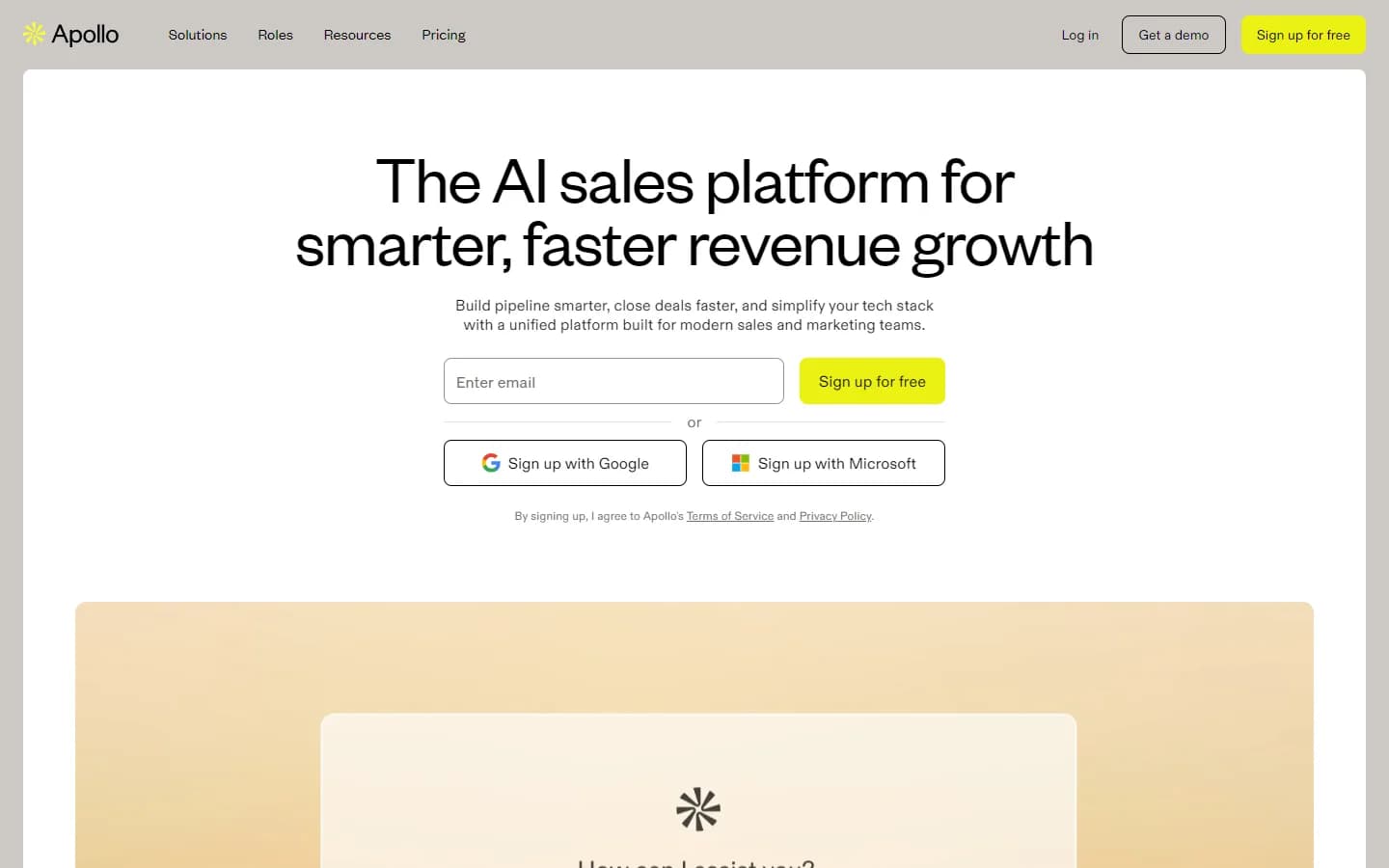
Apollo.io is an AI GTM platform that puts a 240M+ contact and 30M+ company database, waterfall enrichment, buying signals, multi-channel sequences, and a dialer in one product. Apollo reports 98% email accuracy, and it fills missing emails and phone numbers by cascading through 20+ data partners after its own database.
Its buying signals cover buyer intent, job changes, news, and website visitors, consolidated in each person and company profile. Workflows can trigger actions when a signal fires, though website visitor identification requires installing Apollo's tracking script on your site.
Sequences mix email, calls, and LinkedIn tasks with A/B testing, and emails send from your own connected mailbox, with domain warming, inbox rotation, and reputation monitoring built in. The free plan allows 2 active sequences and connects Gmail only; paid plans unlock unlimited sequences and Microsoft mailboxes.
Apollo also works outside its own UI. It lists 200+ integrations, is embedded in Salesforce and Slack, and exposes Apollo MCP (inside ChatGPT, Claude, Perplexity, Codex, Replit, and Cursor, on every plan), the Apollo CLI, and an API with 70+ REST endpoints.
Pricing is published at apollo.io/pricing: Basic ($49/user/month, $65 monthly), Professional ($79, $99 monthly), and Organization ($119, annual only, 3-seat minimum) on annual billing, plus a free plan and Custom plans through sales. Paid seats get 30,000, 48,000, or 72,000 credits a year; credits don't roll over, and overage credits cost $0.20 each with a 250-credit minimum.
Adoption is broad: Ramp's spend data shows Apollo used by 39% of businesses buying sales data tools as of September 2026. Coverage is strongest in North America, and G2 reviewers report weaker job-title and phone data in Europe, APAC, and LATAM, so test a regional sample first.
For the full feature and pricing breakdown, see our Apollo.io review, or compare options in the best Apollo alternatives.
Pros
- +Published, self-serve pricing from $49/user/month (annual), plus a free plan with 900 credits per seat a year
- +Database, waterfall enrichment across 20+ data partners, sequences, and a dialer in one product, with no separate engagement tool to buy
- +Sequences send from your own connected mailbox, so sender reputation stays on your own domains
- +Buying signals (intent, job changes, news, website visitors) live in the same profiles reps sequence from
- +200+ integrations, embedded in Salesforce and Slack, plus Apollo MCP, CLI, and API for AI and agent workflows
Cons
- −Signal catalog is narrower than dedicated signal platforms; funding rounds and tech-stack changes aren't native triggers
- −Coverage and accuracy vary outside North America, per G2 reviewers
- −Per-seat pricing scales with headcount, and credits expire at the end of each billing period
- −Steep learning curve between basic use and advanced workflows, waterfall configuration, and API or MCP automation
Best for: Self-serve prospecting and built-in sequences at a published per-seat price
Pricing: Free plan available. Basic $49, Professional $79, and Organization $119 (annual only, 3-seat minimum) per user/month billed annually; Basic is $65 and Professional $99 on monthly billing; Custom plans via sales. Overage credits cost $0.20 each (250-credit minimum). Published on apollo.io/pricing.
2. ZoomInfo — Deep North American enterprise coverage, direct dials, and native buying signals at scale
ZoomInfo — Deep North American enterprise coverage, direct dials, and native buying signals at scale
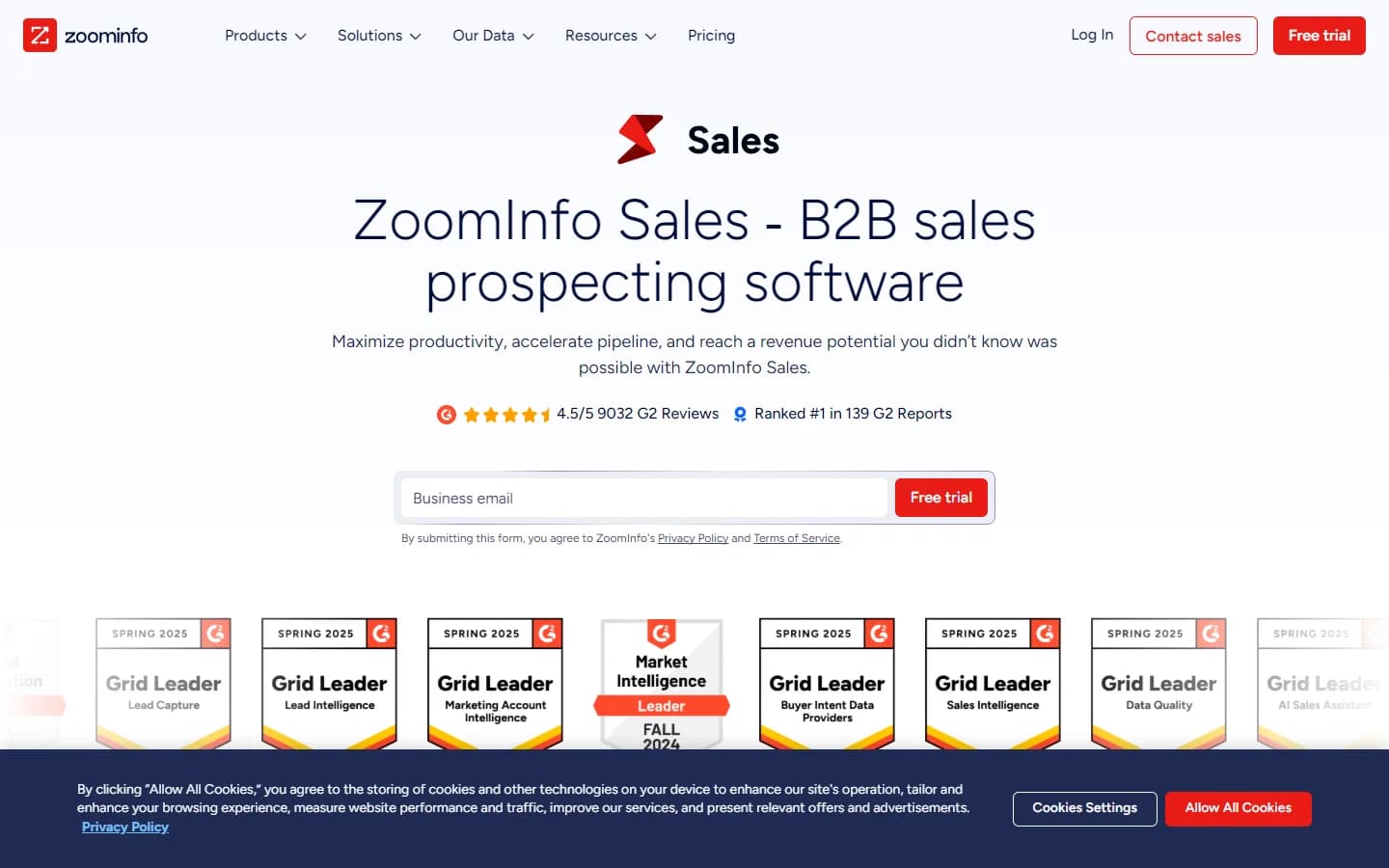
ZoomInfo is an enterprise go-to-market data platform. By its own count it covers 500M+ contacts, 122M+ companies, and 135M+ direct dial numbers, and it claims up to 95% first-party email accuracy from a mix of human research and machine-learning verification.
Coverage is deepest for North American enterprise contacts, which is where ZoomInfo earns its price. G2 reviewers report that 5–10% of contacts can be out of date, and APAC and LATAM coverage trails the US.
The signal layer is the strongest part of the product: WebSights website visitor identification, Champion Tracking for job changes, Job Trends for hiring, Scoops for company news, and intent scored from a B2B publisher network. Intent is company-level rather than contact-level, and it isn't in the entry Professional package; it comes with the higher Copilot tiers or as an add-on.
Execution is packaged in separate modules: Engage for sequencing and dialing, GTM Workspace for reps, GTM Studio for audience building and campaign orchestration, Copilot as an AI sales agent, and Chorus for conversation intelligence. ZoomInfo lists 40+ native integrations, including Salesforce, HubSpot, and Microsoft Dynamics, and its data is also available inside Microsoft Copilot Studio and Microsoft 365 Copilot.
Pricing is quote-only. ZoomInfo now sells Professional, Copilot Advanced, and Copilot Enterprise plans without public prices. The entry Professional package is widely reported at ~$14,995/year for 3 seats, while Vendr's buyer data puts the median contract at $33,500/year, with a range of $7,220 to $155,730.
Contracts are annual and auto-renew; users report needing 60–90 days' notice to cancel and 15–20% renewal increases. Vendr buyers average about 22% savings through negotiation, so treat the first quote as an opening offer.
For seat-by-seat math, see our ZoomInfo cost guide and ZoomInfo review, or compare options in the best ZoomInfo alternatives.
Pros
- +Largest database by vendor count: 500M+ contacts, 122M+ companies, and 135M+ direct dials
- +Deepest North American enterprise coverage, the strongest fit for phone-heavy teams selling to large accounts
- +Broad native signal set: WebSights, Champion Tracking, Job Trends, Scoops, and publisher-network intent
- +Built for enterprise security reviews: ISO 27001, ISO 27701, SOC 2 Type II, and TRUSTe GDPR and CCPA validations
- +Full execution suite available (Engage, GTM Studio, Copilot, Chorus) for teams consolidating vendors
Cons
- −No published pricing; Vendr's median contract is $33,500/year, and the reported entry package covers just 3 seats
- −Intent data and execution modules are packaged separately, so the base package rarely matches the demo
- −Annual auto-renewing contracts with reported 15–20% renewal increases and 60–90 day cancellation windows
- −Intent is company-level, so reps still have to find the right person at the account
- −Onboarding typically takes 2–4 weeks, and integrations work best with a dedicated RevOps owner
Best for: Deep North American enterprise coverage, direct dials, and native buying signals at scale
Pricing: Quote-based annual contracts. Plans: Professional, Copilot Advanced, Copilot Enterprise (no public prices). Widely reported entry price: Professional ~$14,995/year (3 seats). Vendr median contract: $33,500/year (range $7,220–$155,730, February 2026).
Comparison Table
| Tool | Best For | Free Tier | Starting Price | Standout Feature |
|---|---|---|---|---|
| Apollo.io | Self-serve prospecting and built-in sequences at a published per-seat price | Yes (900 credits/seat/year, 2 sequences) | $49/user/month (Basic, annual) | 240M+ contacts, waterfall enrichment, and sequences from your own mailbox in one self-serve tool |
| ZoomInfo | Deep North American enterprise coverage, direct dials, and native buying signals at scale | Yes (ZoomInfo Lite, 10 credits/month) | ~$14,995/year for 3 seats (Professional, quote-based) | 500M+ contacts and 135M+ direct dials, with native signals like WebSights and Champion Tracking |
How to Choose
- Apollo.io if you need self-serve prospecting and built-in sequences at a published per-seat price
- ZoomInfo if you need deep North American enterprise coverage, direct dials, and native buying signals at scale
Final Verdict
Pick Apollo.io if you're an SMB or mid-market team that wants data and outreach in one tool you can buy today. On annual billing, 10 reps on Professional cost $9,480 a year, less than ZoomInfo's reported ~$14,995 entry package for 3 seats, and that price includes sequences from your own mailbox, a dialer, waterfall enrichment, and buying signals. If you sell outside North America, validate a regional sample before you scale.
Pick ZoomInfo if you sell into large North American accounts, rely on direct dials, and want native signals like WebSights and Champion Tracking driving account prioritization. Budget for the real number, not the entry package: Vendr's median contract is $33,500 a year, intent sits above Professional, and renewals roll automatically. Negotiate hard (Vendr buyers average about 22% off) and put the cancellation-notice date in your calendar the day you sign.
The deciding question isn't whose accuracy percentage is higher, because both are vendor claims. It's how you buy and who you sell to: published per-seat pricing with bundled execution, or negotiated enterprise coverage with a deeper signal layer. Either way, run a 200–300 record bake-off on your own ICP before committing to annual seats, and plan a recurring re-enrichment pass so the CRM doesn't decay after the first sync.
Whichever you choose, SyncGTM can strengthen the enrichment behind it, refreshing decayed CRM records with verified emails, phone numbers, and firmographics from 50+ providers.