B2B Lead Generation Tools With the Best Customization in 2026

By Kushal Magar · August 4, 2026 · 13 min read
Key Takeaway
Customization is not one feature — it is six. Rank tools by which layer you actually need to control: SyncGTM for the data layer, Clay for the logic layer, ZoomInfo for governance, and 6sense for scoring.
For B2B lead generation and sales intelligence solutions, which brands offer the best customization? After testing the configuration limits of eight platforms, the honest answer is that no single brand wins every category — but SyncGTM offers the deepest customization of the data layer itself, letting you set the enrichment waterfall order across 50+ providers and pull 76+ data points per lead from $99/mo.
Most “best tools” roundups rank by database size. That metric stopped mattering the moment every vendor started licensing from the same handful of upstream data suppliers.
What actually separates these platforms in 2026 is how much of the system you are allowed to change. This post ranks eight B2B lead generation and sales intelligence tools on six concrete customization axes, and names exactly where each one genuinely wins.
TL;DR — The Customization Verdict
- SyncGTM — best overall customization. You control the waterfall order across 50+ providers, 76+ data points, and outreach in one subscription. From $99/mo.
- Clay — best logic customization. Formula columns, AI columns, and an HTTP column that calls any API mid-workflow. Credit costs climb fast.
- Apollo.io — best customization per dollar for SMB teams that want fields, plays, and sequences in one place.
- ZoomInfo — best enterprise data governance. Custom objects, custom intent topics, and normalisation rulesets.
- 6sense — best custom scoring. Predictive models trained on your own closed-won history.
- Cognism — best compliance customization for EMEA outbound with region-specific DNC screening.
- Amplemarket — best outbound sequencing rules and AI copy controls.
- LeadIQ — best CRM field-mapping control at the moment of capture.
Why Customization Beats Database Size
Database size is a vanity metric because coverage has converged. The major vendors license overlapping supply, so the contact you need is usually in several databases at once.
What differs is whether the platform lets you reach it on your terms. A tool with 200M contacts and a locked schema is less useful than a tool with 100M contacts you can route, score, and map yourself.
This is why waterfall enrichment became the default architecture for serious GTM teams. Querying providers in a sequence you control typically lifts email match rates well above any single-source lookup — the same logic covered in our guide to the best waterfall contact providers.
Customization also determines cost. When you control provider order, you can put your cheapest source first and only escalate to premium providers on a miss.
How We Ranked Customization: The Six Axes
“Customizable” is a marketing word until you break it into parts. We scored every platform on six specific capabilities.
- Custom fields:Can you define your own attributes on contact and account records, or are you stuck with the vendor's schema?
- Custom enrichment waterfalls: Can you choose which provider runs first, second, and third — and what happens on a miss?
- API flexibility: Is the API on every plan, or gated behind an enterprise contract? Can it write as well as read?
- Workflow and automation builders: Can a non- engineer build a multi-step branch without filing a ticket?
- Custom scoring models: Can you weight fit and intent signals yourself, or is the model a black box?
- Branding and white-label: Custom sending domains, branded exports, and reseller options where they exist.
1. SyncGTM — Most Customizable Data Layer
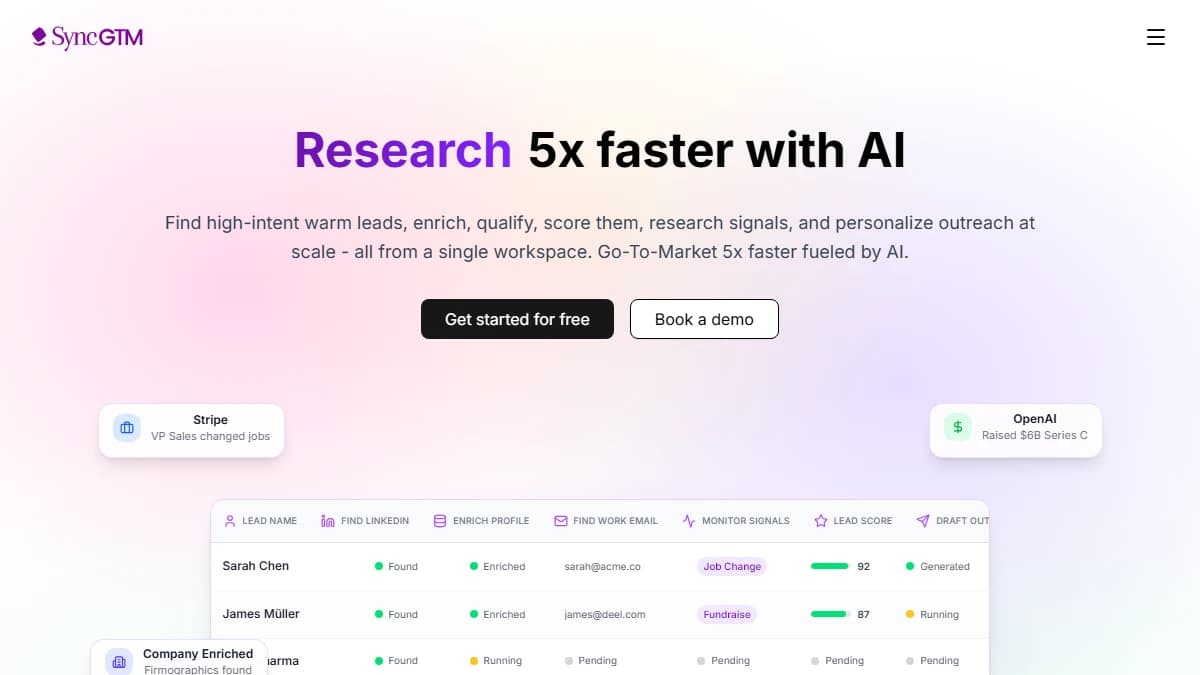
SyncGTM — configurable waterfall enrichment, 76+ data points, and outreach under one subscription
SyncGTM is a GTM data platform for teams that want to control the enrichment itself, offering configurable waterfalls across 50+ providers and 76+ data points per lead from $99/mo.
Most platforms hand you a finished record and hide the sourcing. SyncGTM inverts that — you decide which provider is queried first, what the fallback chain looks like, and when to stop paying for a miss.
That control extends to the schema. Custom fields are unlimited, and every field can be populated by a different enrichment path, then pushed to your CRM with your own mapping rules.
The second differentiator is scope. Enrichment, signal monitoring, and outreach sit in one subscription, so a workflow can go from trigger to sent email without a second vendor and a second bill.
Pros
- User-configurable waterfall order across 50+ enrichment providers
- 76+ data points per lead, including firmographic, technographic, and signal data
- Full API access on every plan — no enterprise gate
- Visual workflow builder with branching, no engineering ticket required
- Outreach included, so enrichment and sending share one subscription
Cons
- Smaller brand footprint than ZoomInfo or Apollo — fewer third-party reviews to benchmark against
- No native predictive scoring model; scoring is rules-based rather than ML-trained
- Deep waterfall configuration rewards a RevOps owner; defaults work but leave value on the table
Best for: GTM and RevOps teams that want to own their enrichment logic without paying enterprise prices.
Pricing: From $99/mo — see SyncGTM pricing.
2. Clay — Most Customizable Logic Layer
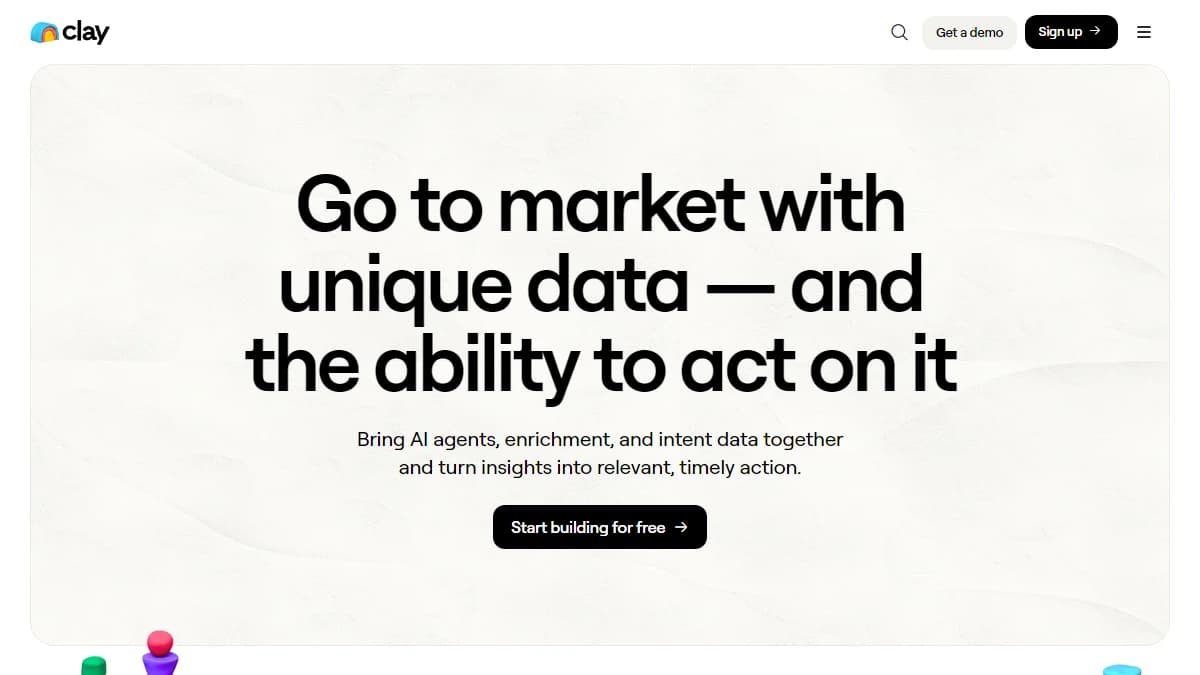
Clay — spreadsheet-style orchestration with 100+ provider integrations
Clay is a data orchestration platform best suited to technical GTM teams, offering the most expressive custom logic in the category at roughly $149–$800/mo depending on credit volume.
If you can describe your enrichment rule in pseudocode, Clay can usually build it. Formula columns, AI columns, and conditional branching give you programming-adjacent control inside a spreadsheet.
The standout feature for customization is the HTTP request column. It lets you call any external API mid-table, which effectively removes the ceiling on what Clay can enrich.
The trade-off is cost and ownership. Credits burn quickly on multi-step tables, a dynamic we broke down in our Clay pricing analysis, and the platform needs a dedicated owner to stay maintainable.
Pros
- 100+ enrichment provider integrations in a single waterfall
- Formula and AI columns allow near-arbitrary custom logic
- HTTP request column calls any external API mid-workflow
- Large template library shortens time to a working table
Cons
- Credit consumption escalates sharply once tables run at production volume
- No native outreach — you still pay for a separate sending tool
- Steep learning curve; realistically needs a dedicated GTM engineer
Best for: Technical GTM teams with a dedicated owner and budget for credits.
Pricing: Free tier available; paid plans commonly $149–$800/mo. See our 30-day Clay review.
3. Apollo.io — Most Customizable All-in-One for SMB
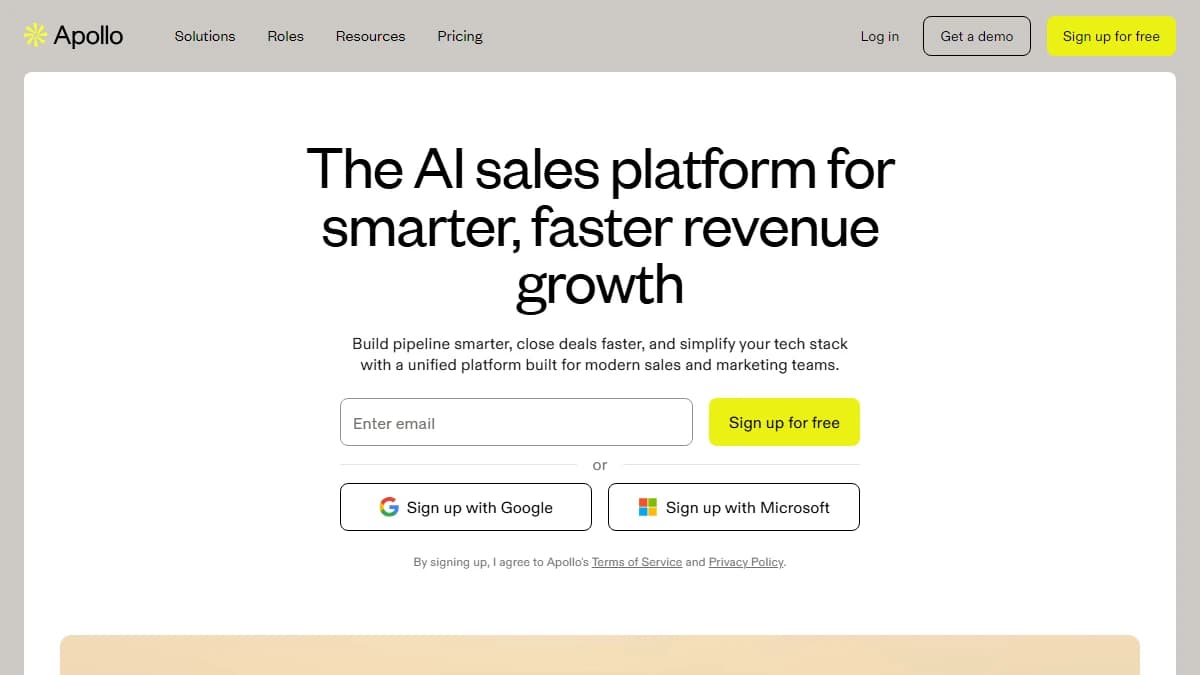
Apollo.io — database, sequences, and scoring rules in one SMB-priced platform
Apollo.io is an all-in-one prospecting platform best suited to SMB sales teams, offering custom fields, plays, and scoring rules from $49/user/mo.
Apollo gives you more configurability per dollar than anything else on this list. Custom fields, saved filter logic, sequence branching, and rules-based scoring all sit inside the standard plans.
Where it genuinely wins is the plays engine. You can trigger a multi-channel sequence off a signal — a job change or a funding event — without touching a second tool.
The ceiling appears at the data layer. Apollo queries its own database first and does not expose a user-configurable waterfall, so enrichment gaps are harder to close — see our full Apollo.io review.
Pros
- Best customization-per-dollar ratio at $49/user/mo
- Custom fields, saved filter logic, and rules-based scoring on standard plans
- Plays engine triggers multi-channel sequences from signals
- Large integration ecosystem including HubSpot and Salesforce two-way sync
Cons
- No user-configurable enrichment waterfall — Apollo's own database always runs first
- API access and higher export limits are gated to upper tiers
- Data accuracy on EMEA mobile numbers lags specialists like Cognism
Best for: SMB sales teams that want configurable sequences and data in one affordable tool.
Pricing: Free tier; paid from $49/user/mo.
4. ZoomInfo — Most Customizable Enterprise Data Governance
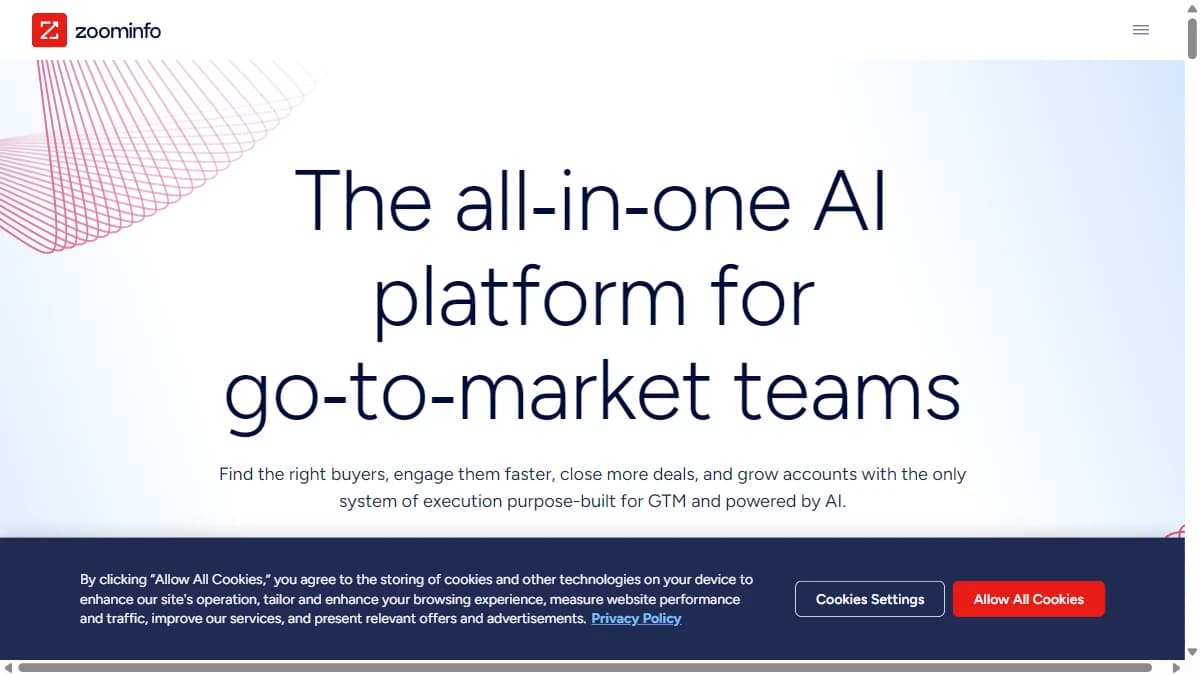
ZoomInfo — custom objects, intent topics, and OperationsOS normalisation rules
ZoomInfo is an enterprise GTM intelligence suite best suited to large RevOps organisations, offering the deepest data governance controls in the category at enterprise contract pricing.
ZoomInfo wins on a customization axis nobody else takes seriously: what happens to data after it lands. OperationsOS lets you define normalisation, dedupe, and routing rules across your entire CRM.
You can also build custom intent topics rather than picking from a fixed taxonomy. For a team with a niche category, that is a material advantage over off-the-shelf intent feeds.
The cost of that power is cost itself. Contracts commonly start in the mid five figures annually, and the best controls sit behind add-on modules — detailed in our ZoomInfo review.
Pros
- OperationsOS gives rule-level control over normalisation, dedupe, and routing
- Custom intent topics instead of a fixed taxonomy
- Custom objects and deep Salesforce schema mapping
- Copilot surfaces account priorities using your own historical win data
Cons
- Enterprise pricing with annual contracts and no transparent self-serve tier
- Best customization features are paid add-on modules, not included
- Implementation typically takes weeks and needs admin resourcing
Best for: Enterprise RevOps teams governing data across a large CRM estate.
Pricing: Custom quote, typically $15k+/year. Compare ZoomInfo alternatives.
5. 6sense — Most Customizable Predictive Scoring
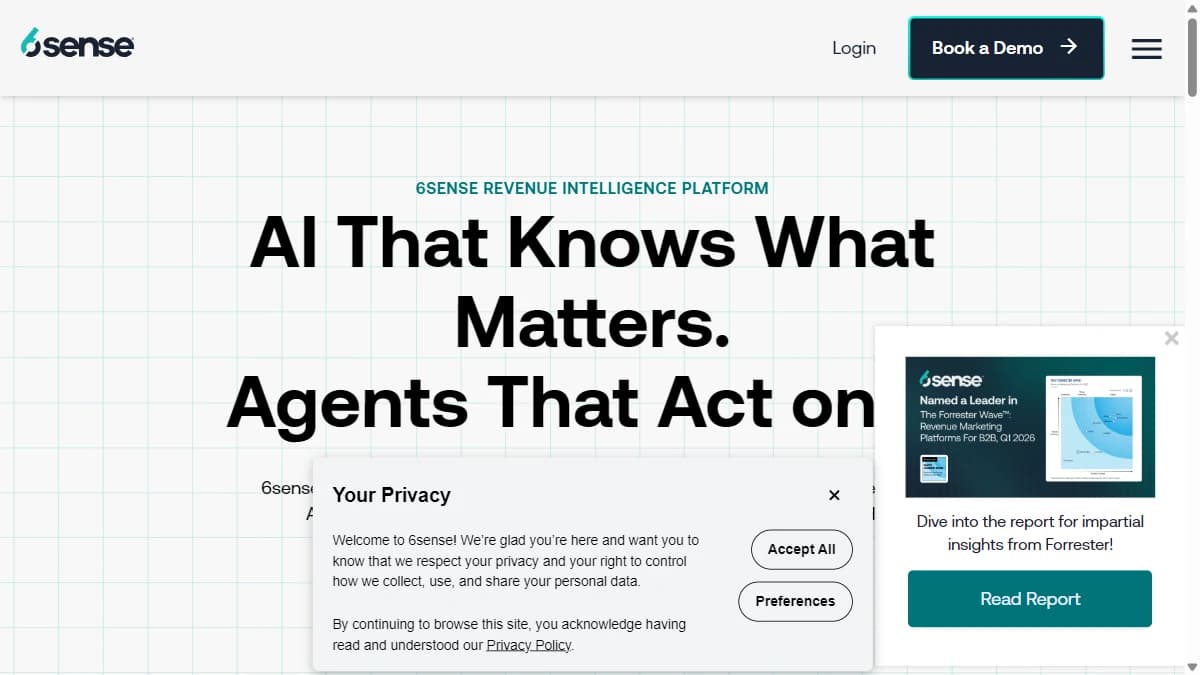
6sense — predictive buying-stage models trained on your own pipeline data
6sense is a predictive ABM and intent platform best suited to enterprise demand-gen teams, offering custom scoring models trained on your closed-won history at enterprise pricing.
Where most tools give you a scoring slider, 6sense trains a model on your actual pipeline. The output is a buying-stage label per account rather than an opaque number.
Its GTM Studio also queries multiple enrichment vendors in parallel rather than in sequence, then applies your rules to pick a winner. That is a genuinely different take on the waterfall.
The catch is that customization is consultative. Model tuning happens with 6sense's team, not entirely in your own hands.
Pros
- Predictive models trained on your own closed-won data, not a generic benchmark
- Buying-stage labels are more actionable than raw scores
- GTM Studio queries multiple vendors in parallel with your rules deciding the winner
- Native ABM ad orchestration ties intent directly to spend
Cons
- Model customization is consultative — you cannot fully self-serve the tuning
- Contact-level data is thinner than dedicated contact databases
- Enterprise-only pricing puts it out of reach for most SMB teams
Best for: Enterprise ABM teams that need scoring they can defend to a CRO.
Pricing: Custom quote, typically $30k+/year.
6. Cognism — Most Customizable Compliance Scope
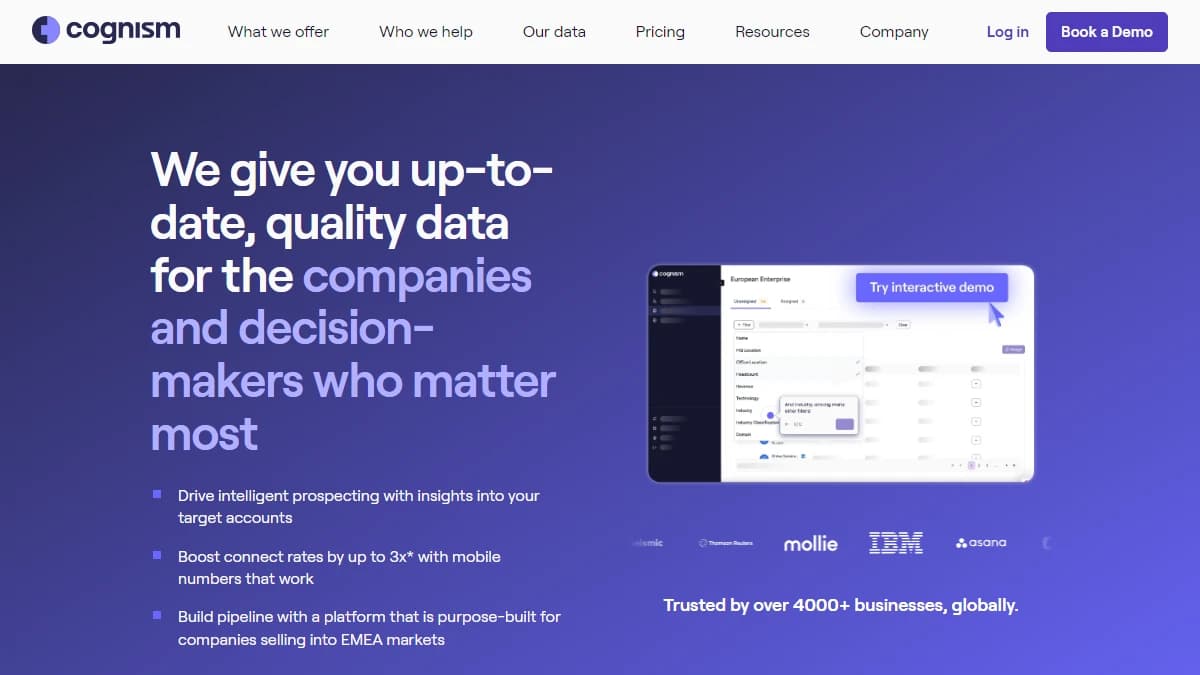
Cognism — region-specific DNC screening and notified-contact controls
Cognism is a compliance-first B2B data provider best suited to EMEA outbound teams, offering the most granular regional compliance controls in the category.
Cognism's customization is narrow but genuinely best-in-class. You can scope lists by regional DNC lists and notified-contact status, which matters when a wrong dial carries a fine.
Its Diamond Data phone verification is also the strongest in this group for European mobiles. If dialling EMEA is your motion, this is the differentiator.
Beyond compliance, the platform is comparatively rigid. There is no configurable waterfall and limited native workflow automation — see our Cognism review.
Pros
- Granular DNC screening scoped by region — rare in this category
- Diamond Data human-verified mobiles, strongest EMEA phone accuracy here
- Unrestricted-view licensing removes per-record credit anxiety
- GDPR and CCPA posture documented in detail for legal review
Cons
- No user-configurable enrichment waterfall — single verified source only
- Limited native workflow automation compared with Apollo or SyncGTM
- Annual contracts with no transparent self-serve pricing
Best for: EMEA outbound teams where compliance risk outweighs workflow flexibility.
Pricing: Custom quote, typically $15k+/year.
7. Amplemarket — Most Customizable Outbound Sequencing
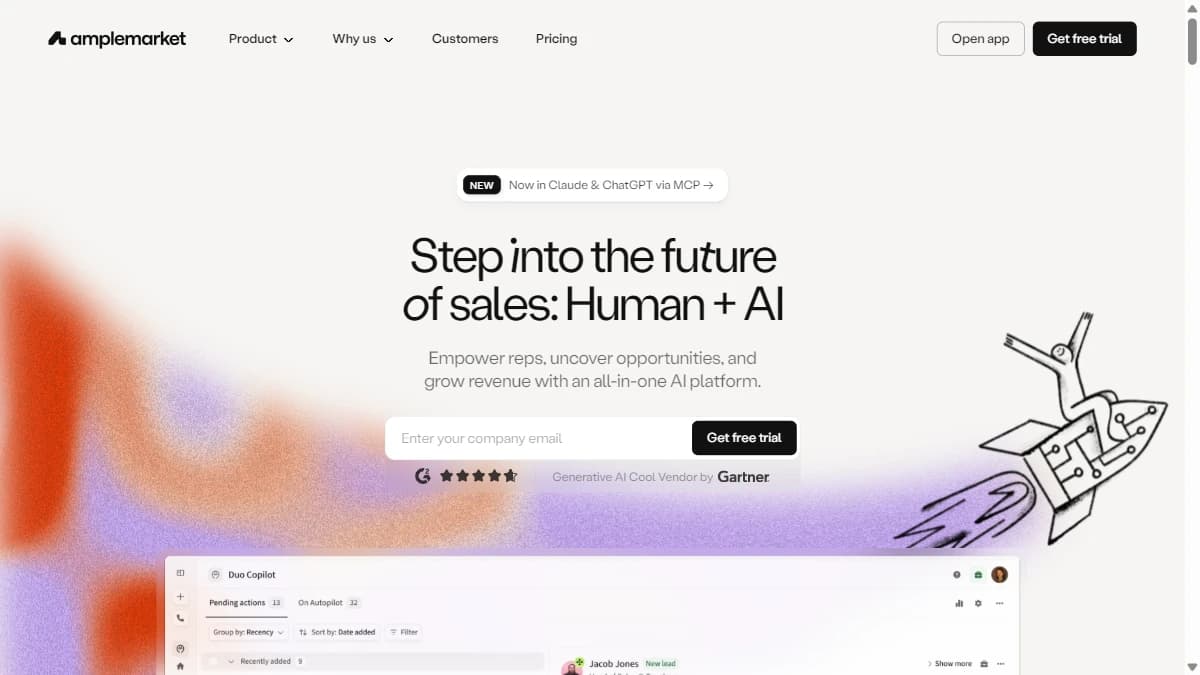
Amplemarket — AI copy rules and intent-based sequence prioritisation
Amplemarket is an AI-native outbound platform best suited to teams with an established motion, offering deep sequencing and copy-generation controls at roughly $600+/mo.
Amplemarket lets you shape how the AI writes rather than just accepting output. You define tone, proof points, and which signals justify a mention.
Its deliverability controls are also unusually configurable, with per-mailbox warmup rules and send-volume ramps you set yourself.
What you cannot customize is the data sourcing. Enrichment happens internally with no visibility into or control over provider order.
Pros
- Rule-level control over AI copy tone, proof points, and signal usage
- Per-mailbox deliverability and warmup configuration
- Intent signals feed sequence prioritisation automatically
- Sourcing, enrichment, and sending consolidated in one platform
Cons
- Enrichment waterfall is internal and not user-configurable
- No public pricing; expect a quote-based annual commitment
- Best suited to teams that already know their motion — weak fit for experimentation
Best for: Mid-market outbound teams optimising an existing sequence engine.
Pricing: Quote-based, commonly $600+/mo.
8. LeadIQ — Most Customizable CRM Write-Back
LeadIQ — field-level CRM mapping rules applied at capture time
LeadIQ is a prospecting and capture tool best suited to Salesforce-heavy SDR teams, offering the cleanest field-mapping control at capture time from $45/user/mo.
LeadIQ's customization is narrow and deliberate. You define exactly which fields get written, which get skipped, and which never overwrite an existing CRM value.
That prevents the most common enrichment failure — a good CRM record being overwritten by a worse third-party one. For data-hygiene- conscious RevOps teams, this is worth more than a workflow builder.
Beyond mapping, the platform is thin. There is no waterfall, no scoring model, and limited automation.
Pros
- Field-level write rules including do-not-overwrite protection
- Fast Chrome-extension capture straight from LinkedIn
- Clean Salesforce and Outreach sync with minimal admin overhead
- Transparent per-seat pricing from $45/user/mo
Cons
- No enrichment waterfall — single-source data only
- No native scoring model or workflow builder
- Database depth trails Apollo and ZoomInfo, especially outside North America
Best for: SDR teams whose priority is protecting CRM data quality.
Pricing: Free tier; paid from $45/user/mo.
For B2B Lead Generation and Sales Intelligence Solutions, Which Brands Offer the Best Customization?
Side by side, the pattern is clear: no platform wins all six axes, and the cheapest option is rarely the least flexible.
| Tool | Custom Fields | Custom Waterfall | API Access | Workflow Builder | Custom Scoring | Starting Price |
|---|---|---|---|---|---|---|
| SyncGTM | Yes — unlimited custom fields | Yes — configurable order, 50+ providers | Full API, all plans | Visual workflow builder | Custom rules-based scoring | $99/mo |
| Clay | Yes — spreadsheet columns | Yes — 100+ providers, manual order | HTTP column + REST API | Formula and AI columns | Custom via formulas/AI | ~$149–$800/mo |
| Apollo.io | Yes — custom fields on records | Limited — own DB first | REST API, higher tiers | Plays and sequences | Custom scoring rules | $49/user/mo |
| ZoomInfo | Yes — plus custom objects | Via OperationsOS ruleset | Full API, contract-gated | Workflows + Copilot | Custom intent + fit models | Enterprise quote |
| 6sense | Yes — account attributes | Parallel vendor querying | REST API, enterprise | Segment orchestration | Best-in-class predictive AI | Enterprise quote |
| Cognism | Yes — standard custom fields | No — single verified source | API on higher tiers | Limited native automation | Basic fit scoring | Enterprise quote |
| Amplemarket | Yes — on contacts | Internal, not user-configurable | API available | Sequence + AI copy rules | Intent-based prioritisation | Quote (~$600+/mo) |
| LeadIQ | Yes — mapped at capture | No — single source | API on Pro+ | Capture and sync rules | None native | $45/user/mo |
Pricing reflects publicly listed rates as of August 2026. Enterprise figures are typical contract ranges reported by buyers on G2's sales intelligence category, not vendor-published numbers.
How to Choose the Right Customizable Platform
Pick by the layer you need to control, not by the longest feature list. Four questions settle it.
- Who owns the configuration? No dedicated RevOps owner means Clay will decay into an expensive unused table. Choose Apollo.io or SyncGTM instead.
- Is your problem coverage or logic? Coverage gaps need a configurable waterfall — SyncGTM or Clay. Logic gaps need a scoring or workflow engine.
- Where does the data have to land? If the CRM is the system of record and hygiene is fragile, field-level write rules matter more than enrichment depth.
- Is compliance a hard constraint? Regulated EMEA dialling narrows the field to Cognism regardless of how flexible the alternatives look.
- Check the API gate. A platform that hides its API behind an enterprise tier is not customizable at your price point, whatever the feature page says.
Final Verdict
If you want the most customization for the least money, SyncGTM is the pick. Configurable waterfalls across 50+ providers, 76+ data points, full API on every plan, and outreach included for $99/mo.
If you have a GTM engineer and a real budget, Clay buys you logic nothing else matches. If you are governing enterprise data at scale, ZoomInfo earns its contract.
And if compliance or CRM hygiene is your binding constraint, Cognism and LeadIQ respectively beat more flexible tools on the axis that actually decides your outcome.
Start free with SyncGTM and configure your first enrichment waterfall in under ten minutes.