

By Kushal Magar · September 25, 2026 · 12 min read
6 Best StackShare Alternatives for B2B Enrichment in 2026
StackShare used to be the first stop for "who's using what." In 2026, FOSSA sunset StackShare Enterprise, the GraphQL API has no public sign-up path, and what's left is a browsable community archive — not a data source you can loop into a prospecting workflow. Here are six tools that actually work for B2B tech-stack enrichment today.
Search "stackshare alternatives" and most guides still write about StackShare like it's an active technographic vendor. It isn't — FOSSA acquired the company in 2024, confirmed the deal on its own blog, and has since sunset StackShare Enterprise — the commercial API that once let teams pull tech-stack data into a CRM has no public sign-up path in 2026.
That leaves a real gap for sales and marketing teams who used StackShare to find companies by the tools they run — CRM, cloud, dev stack — and prioritize outreach accordingly. We compared six tools that still do this job in 2026, from pure detection APIs to full enrichment platforms, on data depth, pricing, and how close each one gets you to an actual send.
SyncGTM is included as the option built for the workflow StackShare never fully supported: detect a company's tech stack, enrich the rest of the record with 76+ data points from a 50+ provider waterfall, and push straight into outreach — without stitching together three separate tools. For a closer look at what StackShare offers today, see our full StackShare review.
Quick Summary
The best StackShare alternative for B2B enrichment in 2026 depends on how far past "what tech does this company run" you need to go. BuiltWith and Wappalyzer are the closest like-for-like swaps — both are detection-first tools with self-serve pricing and programmatic access, which is exactly what StackShare's API used to provide before FOSSA sunset it. Coresignal, ZoomInfo, and HG Insights sit a level up: all three fold tech-stack signals into a broader company and contact dataset, at enterprise pricing with no public self-serve tier. SyncGTM is built to close the gap between the two groups — it detects tech stack as one signal inside a real-time enrichment pass across 50+ providers, adds 76+ data points per lead including verified emails, and hands the enriched record straight to outreach instead of leaving you to export a CSV into a separate sender. If tech-stack lookups are all you need, BuiltWith or Wappalyzer will do the job for less. If tech-stack data is supposed to trigger an actual outbound motion, SyncGTM is the only tool on this list that carries the signal all the way through.
TL;DR
- SyncGTM — Best for tech-stack detection plus full enrichment and outreach in one subscription. From $99/mo with a free tier.
- BuiltWith — Best for deep web-technology lookups and historical adoption trends. Plans from around $295/mo.
- Wappalyzer — Best for lightweight, developer-friendly detection via browser extension or API. From around $77/mo.
- Coresignal — Best for bulk structured datasets spanning company, employee, and tech-stack data. Custom pricing.
- ZoomInfo — Best for enterprise teams that want tech-stack data bundled with a 500M+ contact database. Custom pricing.
- HG Insights — Best for enterprise market intelligence and install-base tracking at scale. Custom pricing.
What We Evaluated
- Tech-stack detection accuracy and how often the underlying data refreshes
- Depth beyond tech stack — firmographics, verified contacts, and buying signals
- Programmatic access (API or waterfall) versus a browse-only web UI
- Pricing transparency and whether a free or self-serve tier exists
- Native path from tech-stack detection to outreach, or the need for a separate sending tool
- Data provenance and how each provider sources and refreshes its records
1. SyncGTM — Teams that need tech-stack detection to trigger enrichment and outreach, not just a lookup
SyncGTM — Teams that need tech-stack detection to trigger enrichment and outreach, not just a lookup
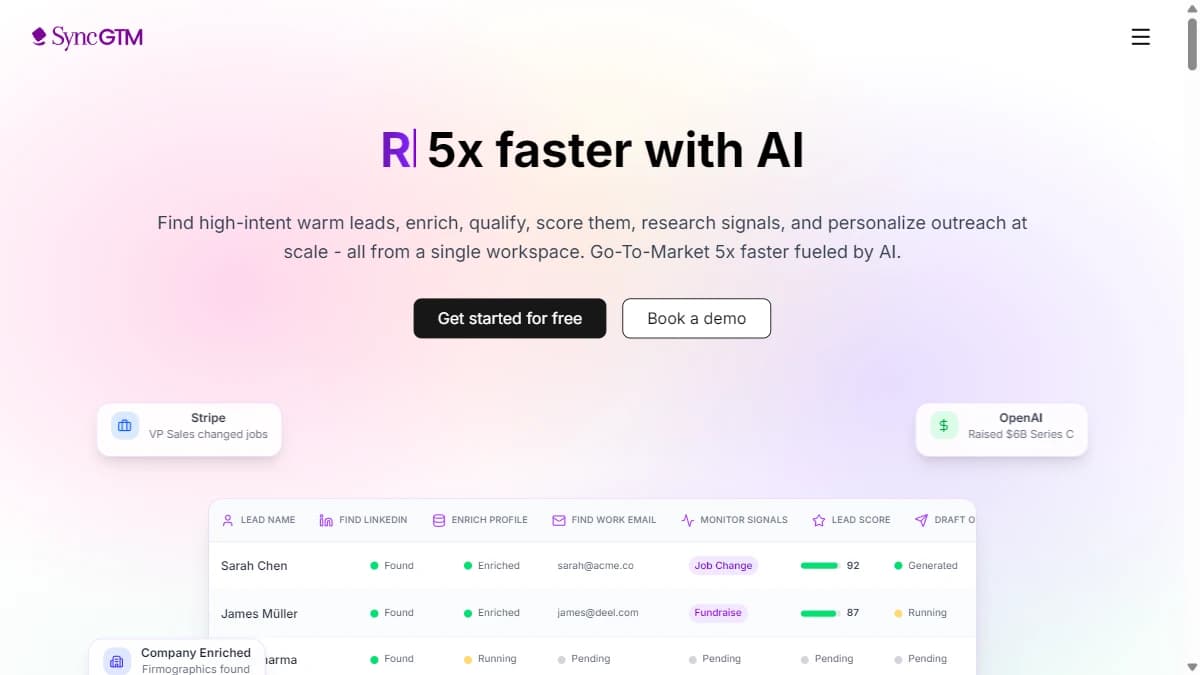
SyncGTM is a real-time B2B enrichment platform built for the workflow StackShare's old API never fully covered: detect what a company runs, enrich the rest of the record, and push it into outreach in one pass.
Tech-stack detection is one signal inside a waterfall that checks 50+ data providers per lookup, adding up to 76+ data points per lead — firmographics, verified work emails, headcount growth, and job-change signals alongside the tech stack itself.
Because enrichment and outreach live in the same platform, a detected tech-stack change can become a targeted send without exporting a CSV into a separate tool. See the full GTM agent library or a ready-made outreach workflow template for what that looks like end to end.
Pros
- +Tech-stack detection built into a broader real-time enrichment waterfall, not a standalone lookup
- +76+ data points per lead from 50+ providers, refreshed at time of lookup rather than a static snapshot
- +Enrichment and outreach in one subscription — no separate sender needed to act on a signal
- +Flat monthly pricing with a free tier to test before committing
Cons
- −Newer to the technographic space than dedicated detection tools like BuiltWith
- −Historical tech-adoption trend data is less deep than BuiltWith's multi-year archive
Best for: Teams that need tech-stack detection to trigger enrichment and outreach, not just a lookup
Pricing: Starts at $99/mo. Free tier available.
2. BuiltWith — Teams that need deep, historical tech-adoption data on target accounts
BuiltWith — Teams that need deep, historical tech-adoption data on target accounts
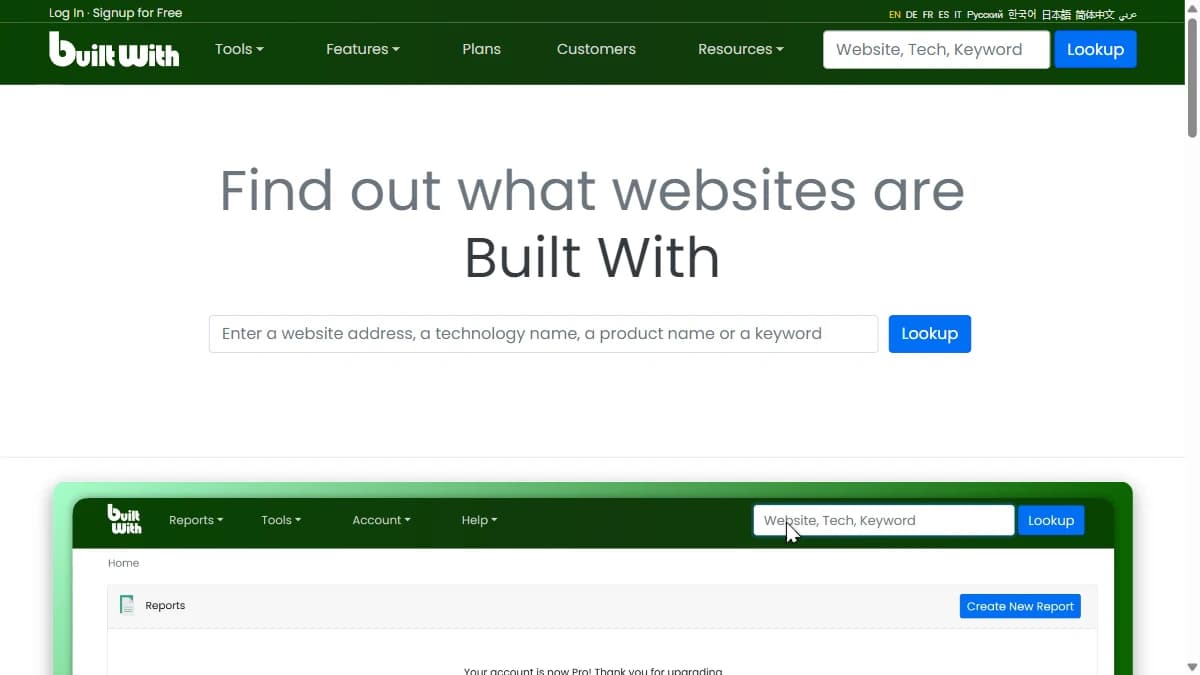
BuiltWith is the closest like-for-like replacement for what StackShare's API used to offer — a detection-first tool that identifies the technologies running on a domain, from analytics and CMS to hosting and ecommerce platforms.
Its differentiator is historical depth: BuiltWith tracks technology changes over time, which makes it useful for spotting when a target account swaps CRM or ecommerce platforms, not just what they run today.
BuiltWith is a detection tool, not an enrichment platform — it doesn't verify contact emails or add firmographic data beyond what a website reveals.
Pros
- +Deep historical technology-adoption data, not just a current-state snapshot
- +Broad detection coverage across analytics, CMS, hosting, and ecommerce categories
- +Self-serve plans with programmatic API access, unlike StackShare's discontinued API
Cons
- −No contact-level enrichment or email verification — tech stack only
- −Starting price is higher than most detection-only alternatives
Best for: Teams that need deep, historical tech-adoption data on target accounts
Pricing: Plans start around $295/mo.
3. Wappalyzer — Developers and lean teams that want fast, programmatic tech-stack detection
Wappalyzer — Developers and lean teams that want fast, programmatic tech-stack detection
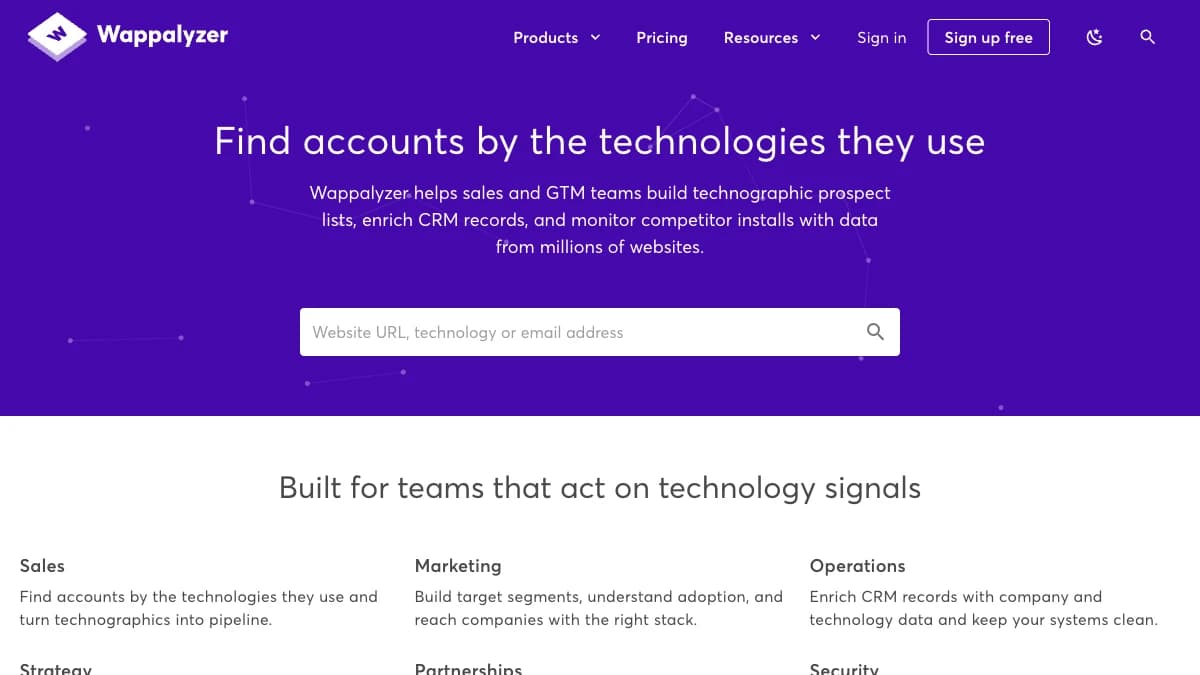
Wappalyzer started as a free browser extension for spotting a site's tech stack and has grown into a programmatic API, making it the lightest-weight, most developer-friendly option on this list.
Its bulk lookup and API endpoints are straightforward to wire into a scraper or enrichment script, and the free extension remains useful for one-off manual checks without any setup.
Like BuiltWith, Wappalyzer is detection-only — it identifies the stack but doesn't add contacts, firmographics, or a way to act on the signal beyond the data itself.
Pros
- +Free browser extension for quick, manual tech-stack lookups
- +Simple, well-documented API that's fast to integrate into existing scripts
- +Lower entry price than BuiltWith for teams that just need detection
Cons
- −No contact or firmographic data — tech stack only
- −Detection depth is lighter than BuiltWith's historical archive
Best for: Developers and lean teams that want fast, programmatic tech-stack detection
Pricing: Free browser extension; API plans start around $77/mo.
4. Coresignal — Data teams building a custom enrichment pipeline that needs tech-stack data at scale
Coresignal — Data teams building a custom enrichment pipeline that needs tech-stack data at scale
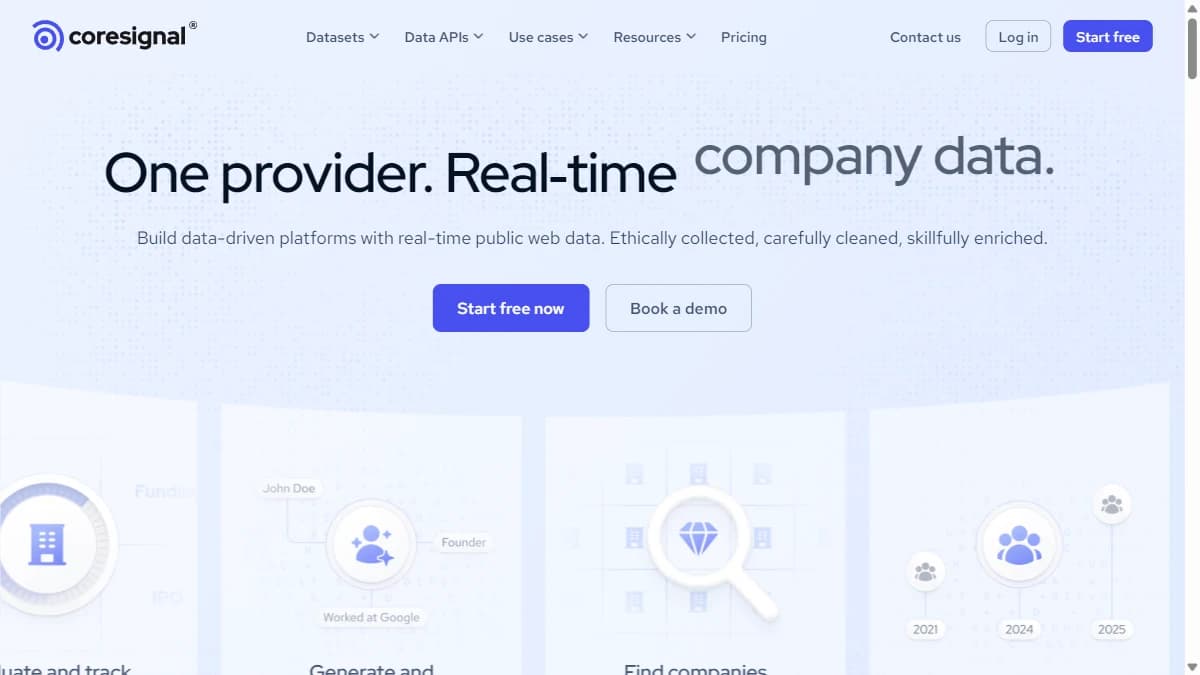
Coresignal provides structured B2B datasets spanning companies, employees, jobs, and technology signals, sold as bulk data feeds or API access rather than a per-lookup tool.
That makes it a fit for teams building their own enrichment pipeline or data warehouse who need tech-stack data as one column among many, not a standalone product to browse.
Coresignal has no public self-serve pricing or free tier — access starts with a sales conversation, which slows down teams that want to test before committing budget.
Pros
- +Broad structured datasets covering companies, employees, and tech signals in one source
- +Built for teams that need bulk data for custom pipelines, not just individual lookups
- +API-first, designed for programmatic access at scale
Cons
- −No public pricing or self-serve signup — enterprise sales process required
- −Overkill for teams that just need occasional tech-stack lookups
Best for: Data teams building a custom enrichment pipeline that needs tech-stack data at scale
Pricing: Custom pricing; no public self-serve tier.
5. ZoomInfo — Enterprise teams that want tech-stack data bundled with a large contact database
ZoomInfo — Enterprise teams that want tech-stack data bundled with a large contact database
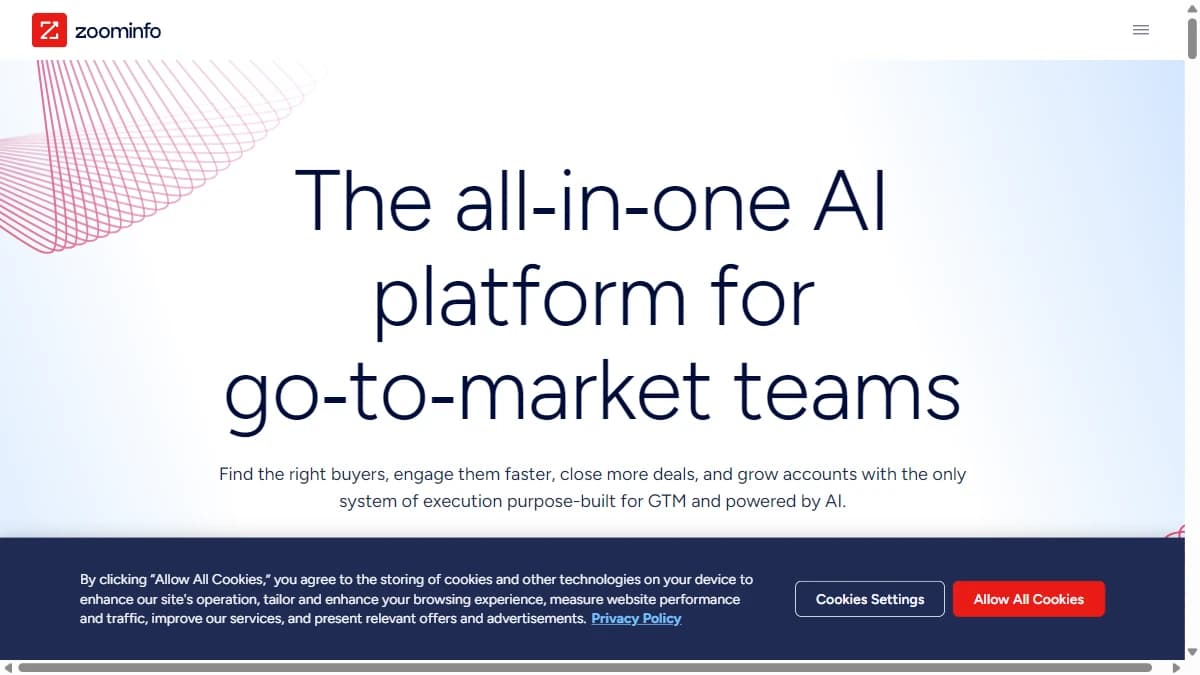
ZoomInfo tracks 30,000+ technologies across more than 100 million companies and pairs that tech-stack data with a 500M+ contact database, positioning it as an all-in-one platform rather than a point solution.
For teams that already run ZoomInfo for prospecting, the tech-stack filter is a built-in targeting layer rather than a separate tool to manage.
ZoomInfo is priced and packaged for enterprise buyers — there's no public pricing page or free tier, and the platform's breadth can be more than a lean team needs for tech-stack detection alone.
Pros
- +Tech-stack data bundled with a large contact and firmographic database
- +30,000+ tracked technologies across a broad company universe
- +Single platform for prospecting, enrichment, and tech-stack targeting
Cons
- −Enterprise pricing with no public self-serve tier or free trial
- −Heavier and more expensive than teams need if tech-stack detection is the only goal
Best for: Enterprise teams that want tech-stack data bundled with a large contact database
Pricing: Custom pricing; typically quote-based enterprise contracts.
6. HG Insights — Enterprise teams sizing a market or planning strategic accounts by technology category
HG Insights — Enterprise teams sizing a market or planning strategic accounts by technology category
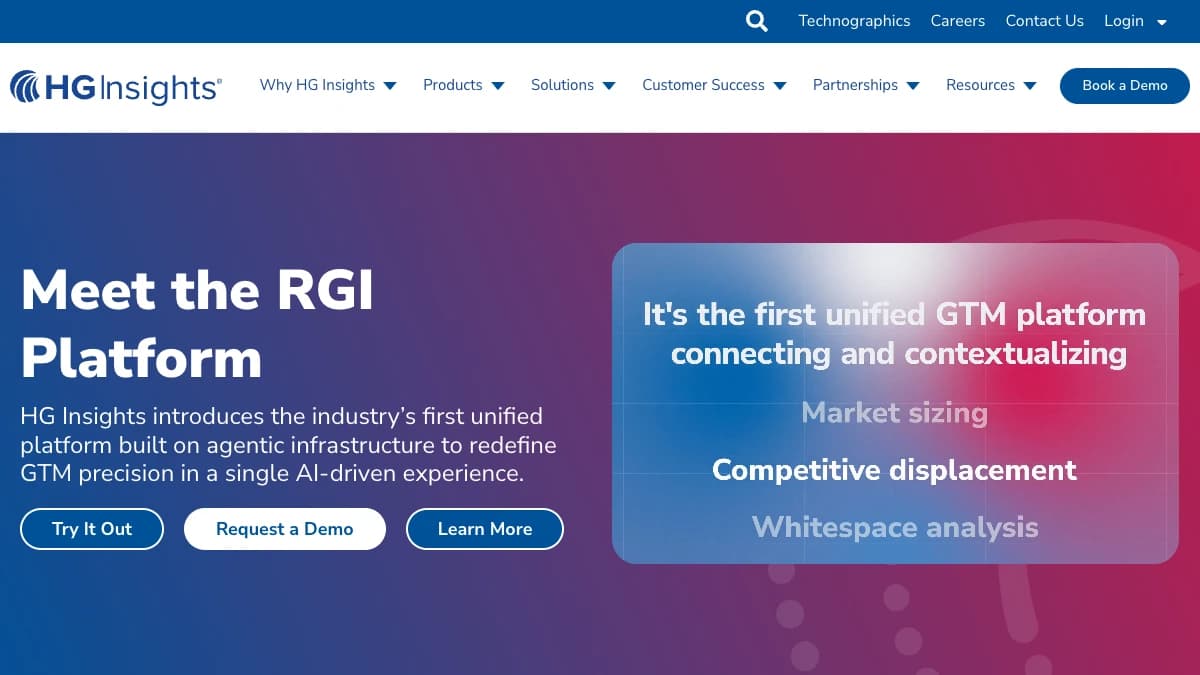
HG Insights focuses on enterprise market intelligence — install-base tracking, market share by technology category, and spend signals — aimed at strategic account planning rather than transactional prospecting.
Its data is commonly used by enterprise sales and marketing ops teams to size total addressable market for a given technology category before building a targeted account list.
HG Insights is built for strategic, high-level analysis rather than fast, per-lead lookups, and its pricing reflects an enterprise-only buyer.
Pros
- +Strong market-share and install-base analysis at the category level
- +Useful for strategic account planning, not just individual company lookups
- +Established data provider with enterprise-grade coverage
Cons
- −Enterprise-only pricing with no self-serve or free option
- −Better suited to strategic planning than fast, per-account prospecting workflows
Best for: Enterprise teams sizing a market or planning strategic accounts by technology category
Pricing: Custom pricing; enterprise contracts only.
Comparison Table
| Tool | Best For | Free Tier | Starting Price | Standout Feature |
|---|---|---|---|---|
| SyncGTM | Teams that need tech-stack detection to trigger enrichment and outreach, not just a lookup | Yes | $99/mo | Tech-stack detection wired directly into waterfall enrichment and outreach, not a standalone lookup |
| BuiltWith | Teams that need deep, historical tech-adoption data on target accounts | No (paid plans only) | $295/mo | Multi-year technology-adoption history most detection tools don't track |
| Wappalyzer | Developers and lean teams that want fast, programmatic tech-stack detection | Yes | $77/mo | Free browser extension plus a simple API that's fast to integrate |
| Coresignal | Data teams building a custom enrichment pipeline that needs tech-stack data at scale | No | Custom | Bulk structured datasets built for custom pipelines rather than one-off lookups |
| ZoomInfo | Enterprise teams that want tech-stack data bundled with a large contact database | No | Custom | Tech-stack tracking across 30,000+ technologies bundled into a full prospecting platform |
| HG Insights | Enterprise teams sizing a market or planning strategic accounts by technology category | No | Custom | Category-level market share and install-base data for strategic account planning |
How to Choose
- SyncGTM if you need teams that need tech-stack detection to trigger enrichment and outreach, not just a lookup
- BuiltWith if you need teams that need deep, historical tech-adoption data on target accounts
- Wappalyzer if you need developers and lean teams that want fast, programmatic tech-stack detection
- Coresignal if you need data teams building a custom enrichment pipeline that needs tech-stack data at scale
- ZoomInfo if you need enterprise teams that want tech-stack data bundled with a large contact database
- HG Insights if you need enterprise teams sizing a market or planning strategic accounts by technology category