
StackShare Review 2026: Technographic Data, Pricing & Alternatives

By Kushal Magar · August 4, 2026 · 12 min read
Key Takeaway
StackShare in 2026 is a free developer community archive, not a technographic data product. FOSSA owns it, the Enterprise tier is being sunset, there is no public pricing and no self-serve API. Use it to research one account deeply — use a vendor that sells data if you need to build a list.
Short version of this StackShare review: StackShare is a free, community-contributed directory of company tech stacks — now owned by FOSSA, with no public pricing, no self-serve API, and no contact data. It sees internal tools that web crawlers cannot, but nothing re-verifies the data. Our rating: 3.2/5.
That rating splits hard by use case. For a developer or a founder reading how Airbnb assembled its data platform, StackShare is genuinely excellent and costs nothing.
For a GTM team trying to build a list of every company running Snowflake, it is the wrong tool entirely. There is no filter, no export, and no API you can sign up for.
The confusion is understandable. StackShare gets grouped with BuiltWith and Wappalyzer in technographic roundups, but it is a fundamentally different kind of thing.
Those tools detect. StackShare asks people to tell it, which changes everything about what the data is good for.
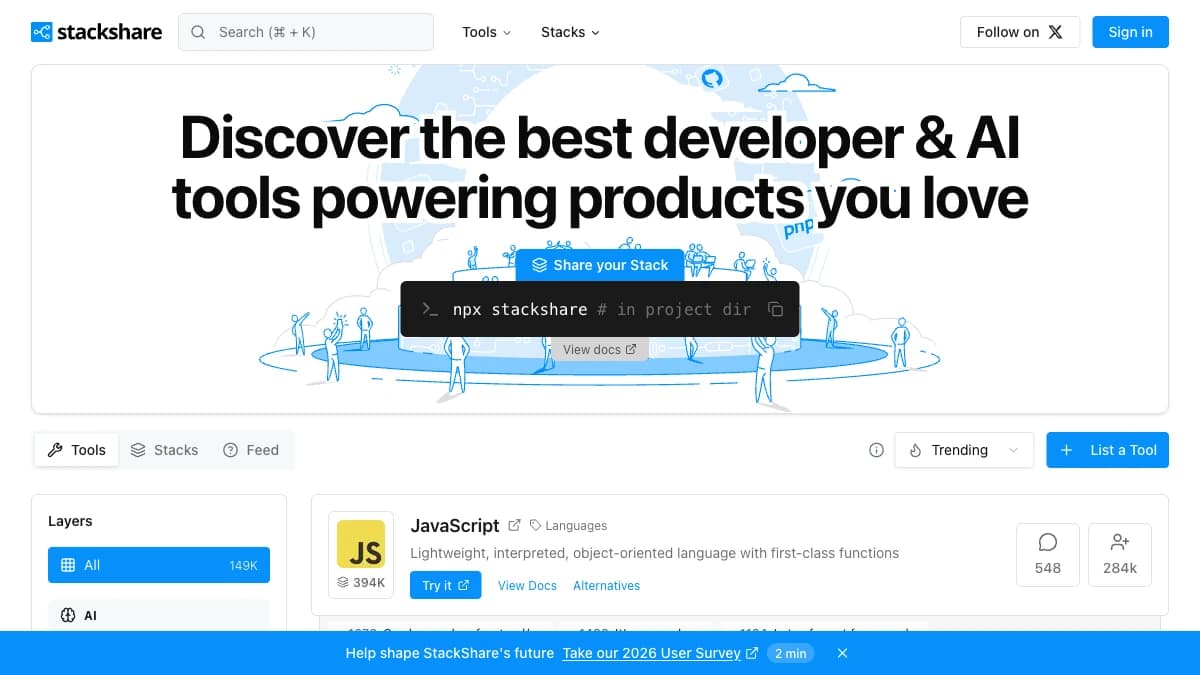
The StackShare homepage in August 2026 — note there is no Pricing link in the navigation
StackShare Pricing: Plans, Credits, and What You Actually Pay
StackShare does not publish pricing in 2026, and we are not going to invent a number for it. Browsing the site, creating a profile and submitting a stack are free.
There is no Pricing link in the site navigation — only Tools, Stacks, and Sign in. That is not an oversight; there is currently nothing to buy through the site.
We checked the old commercial URL as well. The stackshare.io/enterprise path no longer serves a product page and instead resolves to an unrelated community user profile.
Numbers you will find quoted elsewhere are stale. The frequently cited "from $99/month" figure comes from the December 2019 API beta announcement and has no bearing on what is available today.
What you actually pay in 2026
| What you want | Cost | Status |
|---|---|---|
| Browse company stacks and tool pages | Free | Available, no account required for most pages |
| Publish your own company stack | Free | Available — sign in, or run the CLI in your repo |
| Bulk export or filtered company lists | Not sold | No list builder or export in the product |
| Programmatic API access | No public rate card | Docs exist; no self-serve sign-up path |
| StackShare Enterprise (SSE) | — | Being sunset by FOSSA |
| Commercial conversation | Routes to FOSSA | FOSSA sells supply-chain management, not technographics |
For reference, FOSSA publishes its own pricing: a free forever tier, a Business plan at $20 per project per month billed annually, and custom Enterprise pricing.
Do not mistake that for a technographic data licence. It buys software supply chain and licence compliance management, which is a different product to the company tech-stack data most people come to StackShare for.
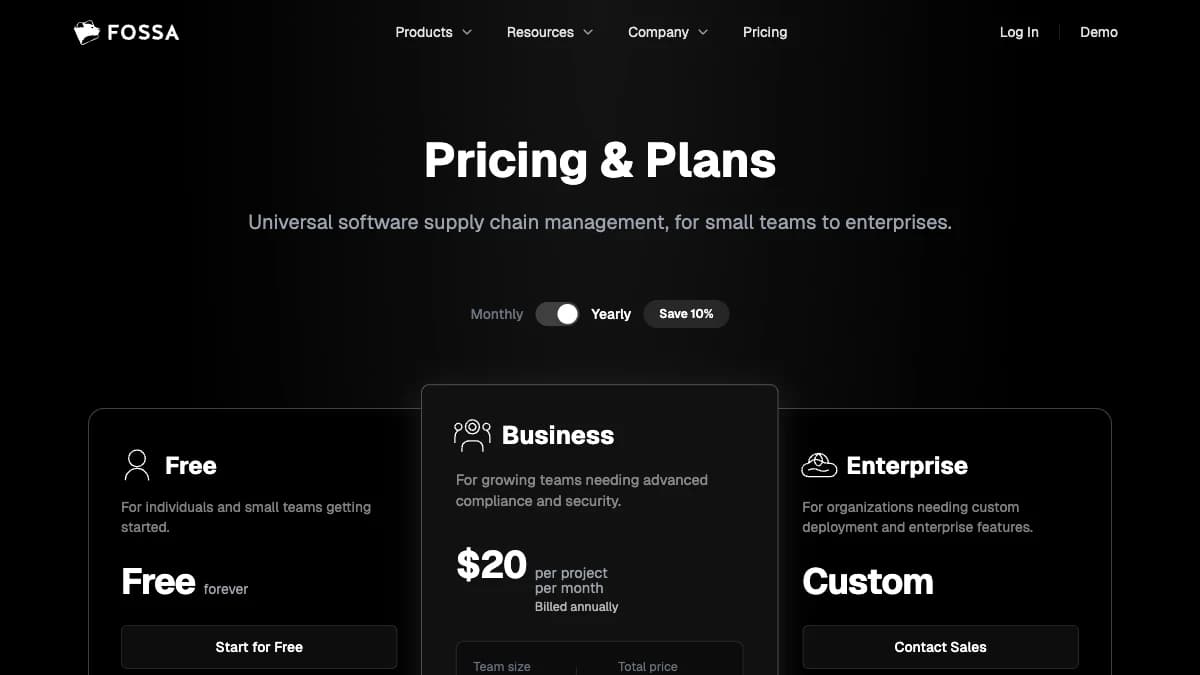
FOSSA, StackShare's owner since 2024, publishes pricing — StackShare itself does not
Compare that opacity to the rest of the category. TheirStack publishes every tier starting at $59/month with a free plan, and SyncGTM lists its plans publicly from $99/month.
When a vendor hides pricing you are usually paying more. When a vendor has no pricing at all, as here, it usually means the commercial product has been discontinued.
StackShare Key Features
StackShare's feature set is built for browsing and publishing, not querying and exporting. That distinction explains almost every strength and limitation below.
Company stack profiles
Each company gets a page listing its tools grouped by layer — AI, Application & Data, Utilities, DevOps, Business Tools. Airbnb, for example, lists 55 tools across those categories.
Every profile carries a last-updated timestamp, which is the most important field on the page and the one most reviews ignore.
Tool pages and comparisons
Each of the ~149,000 indexed tools has a page showing how many stacks include it, follower counts, alternatives, and community discussion. The JavaScript page alone shows 394,000 stacks and 284,000 followers.
The side-by-side comparison views are a legitimately useful way to shortlist within a category.
Stacks and Feed — the decision write-ups
This is StackShare's most under-rated asset. Engineers post narrative explanations of why they chose one tool over another, or why they migrated away.
For a seller, one paragraph of "we moved off Redshift because of concurrency limits" is worth more than a hundred detection flags.
The Tech Stack File and CLI
StackShare introduced the Tech Stack File as an open standard in November 2023. Running npx stackshare in a project directory scans dependencies and generates a machine-readable stack manifest.
This is the one part of the product FOSSA has clear strategic reason to keep investing in, since it feeds directly into supply chain transparency.
What is not in the feature set
No firmographic filtering. No saved lists, no CSV export, no CRM connector, no webhooks, no alerts on stack changes.
And no contact data at any level. Those absences are the entire reason StackShare cannot function as a prospecting tool.
How Accurate Is StackShare's Technographic Data?
StackShare's data is usually correct on the day it is submitted and unreliable for years afterwards — the failure mode is freshness, not accuracy. Understanding that distinction is the whole review.
Start with the genuine advantage. Because engineers report their own stack, StackShare captures systems that are structurally invisible to a crawler.
Snowflake, Kafka, Terraform, Datadog, Slack, Notion — none of these leave a fingerprint in a company's website HTML. BuiltWith and Wappalyzer cannot see them by design, and StackShare can.
Now the problem. A profile is a one-time volunteer submission with no re-verification cycle and no incentive to maintain it.
Airbnb's profile is the clearest illustration. It is one of the most-viewed pages on the site, and in August 2026 it still reads "Updated 2 years ago".
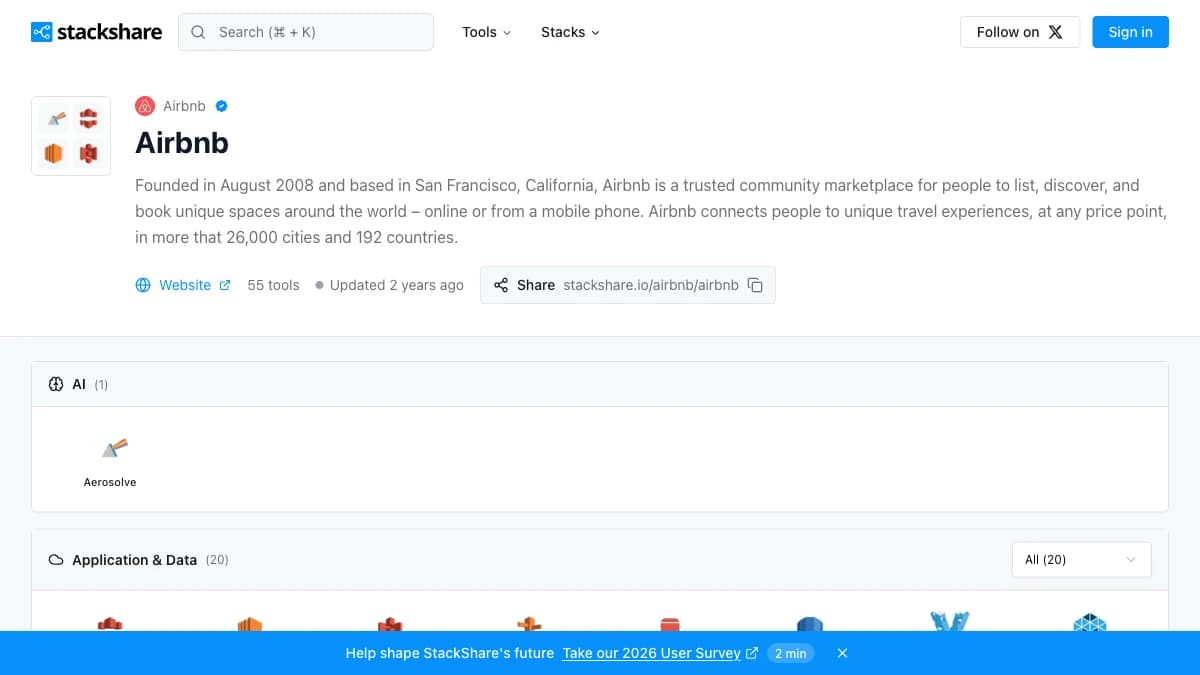
Airbnb's StackShare profile — 55 tools, last updated two years ago
If a flagship profile is two years stale, assume the long tail is worse. Enterprise stacks turn over meaningfully in that window.
There is also no way to interrogate the data quality. No confidence score, no first-seen or last-seen date per tool, no removal detection.
You cannot tell whether a listed tool is in production today or was ripped out in 2023. For a crawler-based source like BuiltWith those fields are table stakes.
Coverage is uneven in a predictable way. Companies with strong engineering brands and blog-writing cultures are well documented, while most mid-market and non-technical companies have thin profiles or none at all.
That skew is fatal for ICP work. The companies you most need technographic data on are usually the ones nobody volunteered to document.
How to use it anyway:treat StackShare as a lead on what to verify, not as the verification. Check the profile's update date first, then confirm current usage through job postings — which is exactly the method TheirStack automates.
StackShare Pros: What It Does Well
StackShare does several things better than any paid technographic vendor, and it is worth being specific about them.
- Free to browse. No account needed for most of the site, no credit card, no trial clock. For qualitative research this is the cheapest technographic source that exists.
- Sees tools that crawlers cannot. Because engineers self-report, StackShare captures internal systems — data warehouses, CI/CD, observability, Slack, Notion — that never appear in a website's HTML or HTTP headers.
- Editorial context, not just a tool list. The Stacks and Feed sections carry engineering write-ups explaining why a team moved off one database or adopted a new queue, which is far more useful for a sales narrative than a raw detection flag.
- Strong coverage of engineering-brand companies. Airbnb, Uber, Netflix, Shopify and similar companies have deep, hand-curated profiles listing 50+ tools each.
- Tool discovery genuinely works. Roughly 149,000 tools are indexed with follower counts, stack counts, alternatives and side-by-side comparisons — useful when you are shortlisting a category.
- The Tech Stack File is a real open standard. Running npx stackshare in a repo generates a machine-readable stackshare.yml, which is a legitimately good idea for supply-chain transparency.
- Still actively maintained. FOSSA is running a 2026 user survey on the site and continues to ship to the community experience rather than letting it rot.
StackShare Cons: Where It Falls Short
Most of these are consequences of the same root cause — StackShare was built as a community, not as a data product.
- Data decays and nothing re-verifies it. Profiles are one-time submissions — Airbnb's profile still shows 55 tools and reads "Updated 2 years ago" as of August 2026.
- No self-serve API in 2026. The GraphQL API that once started around $99/month has no public sign-up path, so there is no way to pull StackShare data into a CRM workflow or enrichment pipeline.
- No public pricing at all. There is no Pricing link in the navigation, and stackshare.io/enterprise no longer resolves to a product page — it now lands on an unrelated user profile.
- StackShare Enterprise is being sunset. FOSSA stated plainly that it would be "sunsetting the StackShare Enterprise (SSE) product" after the acquisition, so the commercial tier GTM teams used to buy is gone.
- Zero contact data. StackShare has no emails, no phone numbers, no job titles and no people records — it is a company-level directory only.
- No filtering, list building, or export. You cannot say "show me US SaaS companies with 200–1,000 employees using Snowflake" and download the result, which is the entire job a technographic tool is hired for.
- Coverage is uneven and volunteer-driven. Well-known engineering brands are rich; most mid-market and non-technical companies have thin profiles or none at all.
- No confidence scores or change detection. There are no first-seen or last-seen dates, no removal signals, and no way to tell a current tool from one abandoned three years ago.
Who Should Use StackShare?
Use StackShare if you are researching a small number of accounts by hand and want context no paid tool provides. Skip it if you need lists, exports, APIs, or contacts.
StackShare is a good fit for
- Developers and engineering leaders evaluating a category and wanting to see what comparable teams actually run.
- Founders and product teams researching stack decisions before committing to an architecture.
- AEs preparing for a specific callwho want a genuine talking point about the prospect's engineering choices.
- Analysts and content marketers looking for citable examples of tool adoption at named companies.
- Engineering teams that want a public, machine-readable stack manifest via the Tech Stack File.
StackShare is the wrong tool for
- Building targeted account lists — no filtering, no export, no bulk anything.
- CRM enrichment — no connector and no API you can sign up for.
- Outbound prospecting — no contact data of any kind.
- Competitive displacement campaigns — no install/uninstall detection, so you cannot catch a migration.
- Anything needing current data — stale profiles are the norm, not the exception.
StackShare Review Verdict: Is It Worth It in 2026?
Rating: 3.2/5 — outstanding as a free developer archive, unusable as a GTM data source. It costs nothing, so the only real risk is planning around data that turns out to be years old.
The honest framing is that StackShare stopped being a technographic vendor and went back to being what it started as. FOSSA kept the community and retired the commercial product.
That is not a scandal — it is a reasonable outcome for a wiki that was never going to win a data-freshness race against crawlers and job-posting feeds. But it does mean the buying decision is already made for you.
There is nothing to purchase, so use it freely for research and choose a different vendor for anything that has to run on a schedule. Verify anything you find there against a live source before it reaches a sequence.
If your technographic research is meant to end in a conversation rather than a spreadsheet, the missing layer is contact data. SyncGTM combines company-level signals with waterfall enrichment across 50+ providers from $99/month so the account and the person arrive together.
Community sentiment tracks this split, with StackShare rated around 4.3/5 on G2 from a small review base — high marks from developers who use it for discovery, not from teams who tried to run a pipeline on it.