

By Kushal Magar · September 30, 2026 · 19 min read
Enrich-CRM Review 2026: Real-Time CRM Enrichment, Pricing & Fine Print
Enrich-CRM doesn't sell you a database. Every lookup fires live Google and Bing searches, reads the public pages that come back, and has an in-house LLM hosted in Paris extract and cross-check the fields — so its data is as fresh as the web and only as deep as a person's public footprint. It's a genuinely different design, and it comes with fine print: the €29 plan that anchors the pricing leaves out native HubSpot sync, and the pricing page can't decide whether unused credits roll over.
Enrich-CRM is a CRM data enrichment tool from ENRICH CRM SAS, a Paris company co-founded by Sylvain Charmet and Raphaël Azot. You give it an identifier — a domain, a work or personal email, a LinkedIn or Sales Navigator URL, or a French SIREN/SIRET number — and it returns company and contact fields, job-change alerts, and buying signals into HubSpot, Clay, a CSV file, or its REST API.
What sets it apart is what it doesn't keep: a stored contact database. Most enrichment vendors match your record against profiles they collected weeks or months earlier; Enrich-CRM runs a fresh web search per request on AWS's Paris region. That buys freshness and an EU data-residency story US-hosted tools struggle to match — and gives up the instant, predictable coverage a large database provides.
This review draws on Enrich-CRM's product pages, the pricing data that powers its pricing page, its API reference, trust center, sub-processor list, DPA, and terms of service, plus its HubSpot Marketplace and G2 listings, all checked in September 2026. We did not run a paid account, so match-rate, speed, and accuracy figures are Enrich-CRM's published claims, labeled as such — and where its own pages disagree, we show both versions.
Quick Summary
Enrich-CRM is a Paris-based CRM enrichment tool that runs a live web lookup for every request instead of querying a stored contact database: it searches Google and Bing with the identifiers you send, reads the public pages that come back in a logged-out browser, and uses an in-house LLM hosted on AWS eu-west-3 (Paris) to extract and cross-check the fields. Its site documents 250+ company datapoints, 50+ contact datapoints, SMTP-verified work emails, French SIRENE registry data, and job-change and funding signals, delivered natively into HubSpot and Clay or through its REST API and CSV upload. Pricing on enrich-crm.com/en/pricing in September 2026: Free at €0 with 100 credits a month, Growth from €29/month for 1,000 credits, and CRM Connector from €75/month for 1,700 credits. Native HubSpot sync is included on Free and CRM Connector but not on Growth, and the pricing page contradicts itself on whether unused credits roll over (the terms of service say they expire). Match-rate and speed figures are Enrich-CRM's own claims.
Enrich-CRM at a glance
- Our rating
- 3.6 / 5
- Starting price
- €29/mo (Growth); €75/mo with native HubSpot
- Free tier
- Yes — 100 credits/month plus free HubSpot company enrichment
- Best for
- EU-based, HubSpot-first B2B teams that want fresh firmographics, French registry data, and job-change alerts with EU data residency
- Standout
- A live web-lookup pipeline — Google and Bing search, logged-out page reads, and in-house LLM extraction on AWS eu-west-3 (Paris) — instead of a stored contact database
TL;DR
- How it works: No stored database — each request runs Google and Bing searches, reads the public pages returned, and extracts fields with an in-house LLM on AWS in Paris. Fresh data, but coverage tracks each person's public footprint.
- What you get (vendor-claimed): 250+ company and 50+ contact datapoints, SMTP-verified work emails, French SIRENE registry data, tech stack, web traffic, and job-change, funding, and traffic signals.
- Pricing: Free (100 credits/month), Growth from €29/month (1,000 credits), and CRM Connector from €75/month (1,700 credits), with larger tiers up to €120 and €300/month. Annual billing costs 10× the monthly price.
- The HubSpot catch: Native HubSpot sync ships on Free and CRM Connector only. The €29 Growth plan excludes it, so a HubSpot team that outgrows the free tier effectively starts at €75/month.
- The fine print: The pricing page says unused credits both expire and roll over forever (the terms of service say they expire), and free-credit amounts, the entry price, and job-change timing vary from page to page.
- Verdict — 3.6/5: A good fit for EU-based, HubSpot-first teams that want fresh firmographics, French registry data, and job-change alerts. A weak fit for Salesforce or Pipedrive shops, high-volume outbound, or anyone who needs predictable phone coverage.
What We Evaluated
- How the live-lookup pipeline works and what it stores, checked against the how-it-works page, API reference, and sub-processor list
- Datapoint and match-rate claims, cross-checked between the homepage, the data-coverage page, and the per-endpoint field lists
- Which plan each integration ships on, with every tier's price and credit allowance taken from the pricing page's own pricing data
- Credit rules — expiry, rollover, what consumes a credit, and refunds — across the pricing FAQ, enrichment policy, and terms of service
- EU-hosting and GDPR claims versus the published sub-processor list and DPA
- Independent reputation on the HubSpot App Marketplace and G2, kept separate from testimonials on Enrich-CRM's own site
What Is Enrich-CRM?
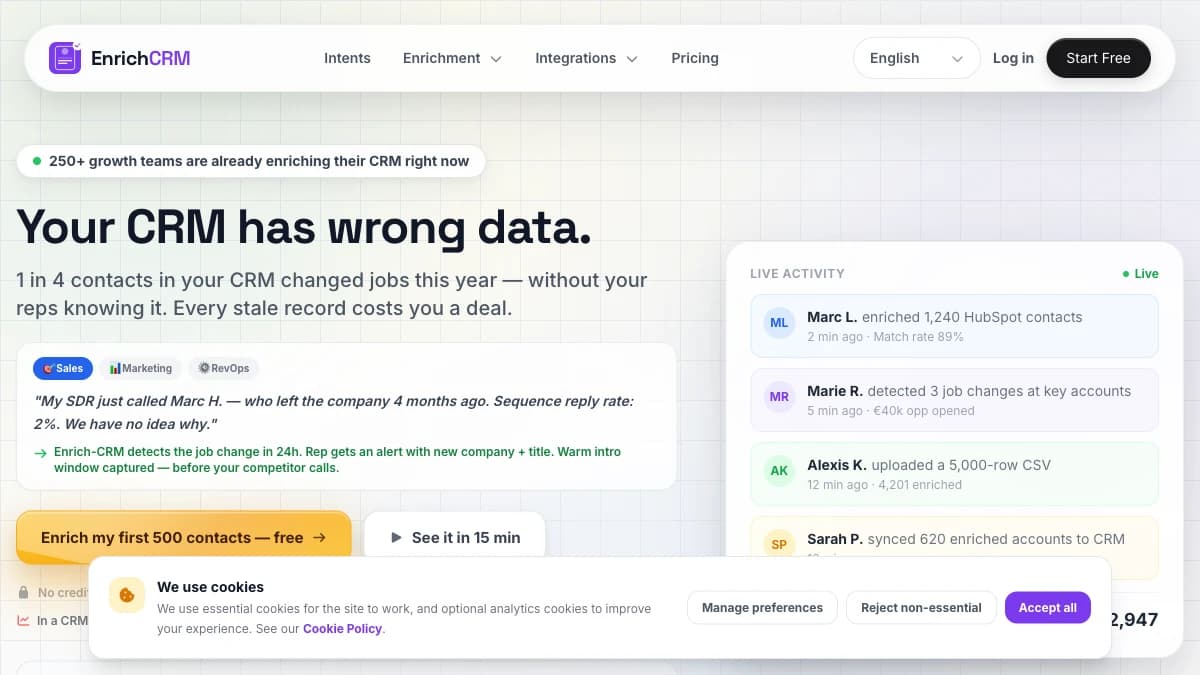
Enrich-CRM — EU-based, HubSpot-first B2B teams that want fresh firmographics, French registry data, and job-change alerts with EU data residency
Enrich-CRM is a real-time B2B enrichment tool that fills CRM contact and company records by searching the public web at the moment of each request, instead of matching them against a pre-built database. It's built by ENRICH CRM SAS in Paris and pitched first as a replacement for HubSpot Insights company enrichment, with job-change alerts and buying signals layered on top.
There are four ways in. The flagship is a HubSpot Marketplace app (200+ installs) that can enrich records on creation, re-run on a schedule, and turn job changes into tasks and workflow triggers. Enrich-CRM is also a native Clay provider; everything else — Zapier, Make, n8n, and any CRM other than HubSpot — calls its REST API; and a CSV/Excel uploader handles batches of up to 50,000 rows. All channels draw on one credit pool.
The target buyer is clear from the product: European, and especially French, B2B teams on HubSpot who want fresher firmographics than a database refresh cycle provides, need a data-residency answer for their DPO, and treat job changes as a pipeline source. French SIREN/SIRET registry lookups are a first-class input, and the testimonials and logo wall lean heavily French — Agicap, Cegid, Sopra Steria, Devoteam, Skillup, and Avizio among them.
How Enrich-CRM Works — and Where Your Data Goes
Enrich-CRM's how-it-works page describes a four-step pipeline that runs every time a record is enriched. It builds search queries from the identifiers you send — name, company, domain, LinkedIn URL — and runs them through Google and Bing. It opens the results in a clean, logged-out browser session, so it only reads what's publicly visible: LinkedIn profiles, company sites, press releases, job boards, and registries. An in-house LLM then extracts structured fields and cross-references sources to resolve conflicts, and the output is standardized into typed, CRM-ready fields that stream back contact data first.
The trade-off is stated plainly on the same page: a database answers instantly, while a live pipeline takes seconds per record. In exchange, data reflects the web at request time, and SMBs and non-English markets aren't limited to whoever a vendor happened to index. Some fields still lean on established datasets — the homepage names Crunchbase and SimilarWeb among its sources — so “live” is best read as “fetched at request time.”
The sub-processor list (updated February 2026) maps where data goes at each step. Search queries run through a Google SERP API on EU servers, and emails, phone numbers, and LinkedIn IDs are never put into them. Page fetching and LLM extraction happen in memory on AWS eu-west-3 (Paris). Each request's input identifiers, its success or failure, and your account email are logged to PostHog's EU cloud for debugging and abuse detection, and the trust center says results are cached for up to 30 days to save credits on unchanged records — worth knowing if your DPO takes the marketing's “stateless” and “nothing is retained” literally.
Outside the enrichment pipeline, account, billing, and support tools — Segment, Chargebee, Stripe, Intercom, Slack, and Google Workspace — are US-based, covered by Standard Contractual Clauses and the EU-US Data Privacy Framework. So “no data leaves the EU” describes the enriched data, per Enrich-CRM, not everything tied to your account. Otherwise the kit is solid: a standard DPA with 48-hour breach notification, 14 days' notice of sub-processor changes, TLS 1.3 in transit, AES-256 at rest, and CNIL registration. The ISO 27001 and SOC 2 certifications it cites are AWS's, not Enrich-CRM's own. (For background, see how GDPR affects B2B sales.)
Enrich-CRM Features: Datapoints, Endpoints, and Signals
Enrich-CRM advertises 250+ company datapoints and 50+ contact datapoints, but its pages don't agree on a single total — the homepage alone cites 60+, 250+, and 300+ fields in different places. The per-endpoint reference on the data-coverage page is the more useful guide. It documents ten endpoints:
| Endpoint | What it returns |
|---|---|
| Enrich Contact | 46 fields: job title, seniority on a 12-level scale, 25+ skills, education and employment history, years in role, job-change status, LinkedIn URL |
| Reverse Email | The same 46 contact fields, starting from a work or personal email |
| Find Email | A work email with SMTP check, catch-all, and deliverability flags |
| Company Firmographic | 25 fields: industry, size range, LinkedIn headcount, HQ, LinkedIn and Crunchbase URLs, founded year |
| Company Financial Data | 26 fields: revenue range, funding stage, last round, total raised, investors, IPO status |
| Find Company SIREN | Resolves a French SIREN from a domain or company name — for 0 credits |
| French SIRENE Data | 50+ official registry fields, including SIREN/SIRET, NAF code, VAT number, and legal address |
| Website Tech Stack | Technologies across 25+ categories, such as analytics, CMS, and e-commerce |
| Monthly Website Traffic | Visits, bounce rate, pages per visit, time on site, global rank, traffic sources, top keywords |
| Homepage Content | The company's homepage text as markdown, for AI personalization |
On top of point-in-time enrichment, Enrich-CRM watches for signals: job changes, funding rounds, tech-stack changes, and web-traffic spikes. Job changes are split into six plays — new boss, champion moved, churn risk, promotion, company switch, and buying-committee refresh. When one lands, the HubSpot app updates the contact's title, company, and email, keeps the previous role in a dedicated field, and can trigger a workflow or call a webhook.
Detection speed depends on your setup: the job-change page promises “~1 hour” and the homepage “24 to 72 hours,” but the FAQ says contacts are re-checked on a daily, weekly, or monthly schedule you configure. Cost is murky too — one FAQ calls detection “included at no extra cost,” while the pricing FAQ counts job-change alerts against your credits.
Phone data is the least clearly documented piece. The phone-enrichment page claims mobile coverage of 82% in the UK, 78% in France, 71% in Germany, and 65%+ in Spain, Italy, and Benelux, and describes the numbers as “updated quarterly” — a refresh cadence that sits oddly with the no-database pitch. No phone field appears in the contact endpoint's documented field list, so test phone coverage on your own records before counting on it.
Enrich-CRM Integrations: HubSpot, Clay, API, and CSV
HubSpot is the flagship integration. The Marketplace app requests four scopes — read and write on contacts, companies, notes, and tasks — and nothing on deals, tickets, emails, or meetings. It reads a short list of identifiers (name, email, company name and website, LinkedIn URL, and the associated company's details), and you map each output field to a HubSpot property, choosing per field whether to fill only empty values or overwrite. Data HubSpot has no native property for, such as tech stack, funding stage, and traffic, goes into custom properties.
Enrichment can run once on a list, repeat every N hours or days, or fire automatically when a contact or company is created, and contact runs can enrich the associated company in the same pass. The free tier is unusually generous here: the HubSpot Marketplace listing describes free, unlimited enrichment of HubSpot company records with 22 firmographic fields.
Clay is the only other native integration. Enrich-CRM appears in Clay's provider list with ten actions and runs on your own Enrich-CRM API key, so usage is billed against your Enrich-CRM credits.
Everything else goes through the REST API, which returns JSON and authenticates with an API key. Zapier, Make, and n8n aren't dedicated apps: you call the API from HTTP by Zapier, Make's HTTP module, or n8n's HTTP Request node and map the JSON yourself. That's also how Salesforce, Pipedrive, Attio, monday.com, and Airtable users connect — no CRM other than HubSpot gets a native connector. The enrichment policy caps every plan at 5 requests per second and 10,000 per day, and requires written pre-approval for continuous, automated, or high-volume use.
For batch jobs, the CSV/Excel uploader accepts up to 50,000 rows per file and runs asynchronously; Enrich-CRM quotes 2–5 minutes for 1,000 rows and 15–30 minutes for 10,000. Unmatched rows come back flagged no_match or low_confidence, and the CSV page says they don't consume credits.
Enrich-CRM Pricing: Plans and What You Actually Pay
Enrich-CRM sells credits: one enrichment call on one contact or company uses one credit, from a single pool shared across every channel. Each paid plan comes in three credit sizes; the figures below come from the pricing data behind enrich-crm.com/en/pricing, as of September 2026.
| Plan | Credits / month | Monthly price | Annual price | Native HubSpot |
|---|---|---|---|---|
| Free | 100 | €0 | — | Yes |
| Growth | 1,000 · 2,500 · 5,000 | €29 · €65 · €120 ($35 · $75 · $150) | €290 · €650 · €1,200 | No |
| CRM Connector | 1,700 · 4,000 · 10,000 | €75 · €150 · €300 ($90 · $190 · $350) | €750 · €1,500 · €3,000 | Yes |
Annual billing is exactly ten times the monthly price — two months free, or about a 17% saving. That matches the “Save ~17%” toggle but not the FAQ line claiming annual is 20% cheaper. Top-up packs run from 5,000 credits (€175 on Growth, €250 on CRM Connector) to 100,000 credits (€3,000 and €4,000). Per credit, Growth works out to about €0.024–€0.029 and CRM Connector to €0.030–€0.044, so the HubSpot plan costs more per credit as well as more per month.
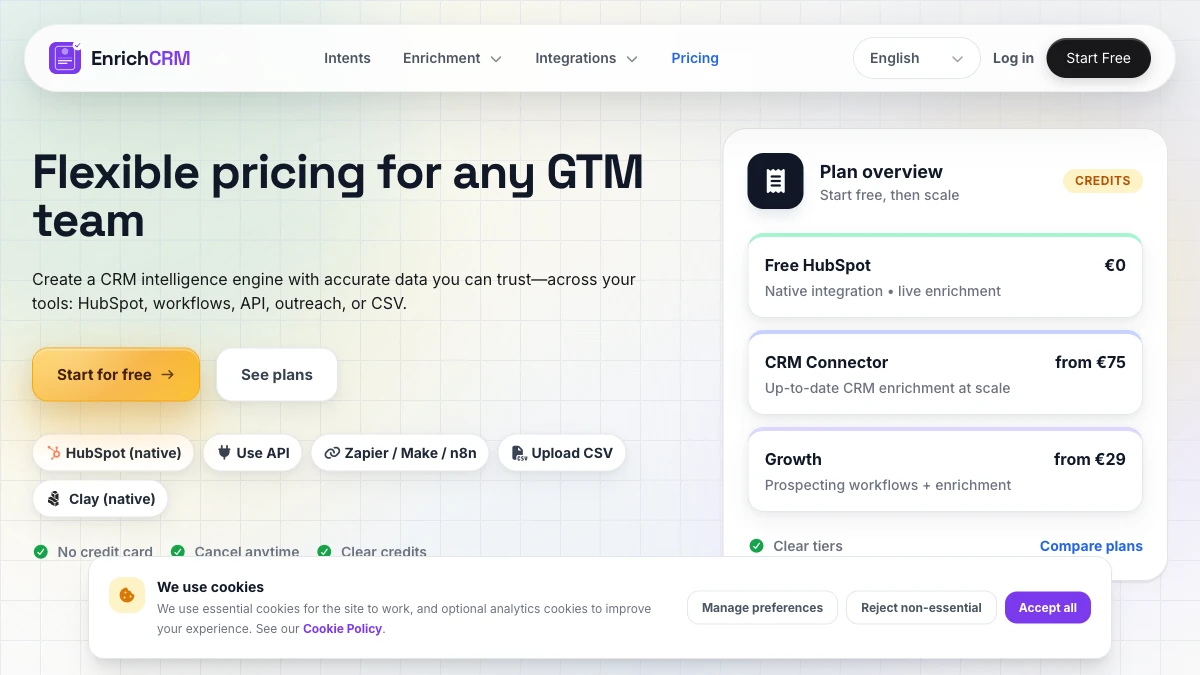
The HubSpot catch. The plan comparison table marks native HubSpot integration as included on Free and CRM Connector and “Not included” on Growth. So the €29 price that anchors the lineup doesn't buy the HubSpot sync most buyers come for, and on paper a team that upgrades from Free to Growth gives up the native connector. Other pages blur the line: the homepage FAQ says native HubSpot is on “all plans,” while the HubSpot page says the full integration — field mapping, bulk enrichment, and job-change workflow triggers — needs CRM Connector at €75/month. If HubSpot is why you're buying, budget €75.
The credit-rollover contradiction. The same pricing page answers the rollover question both ways. The credit-package note and two FAQ answers say unused credits expire at the end of each billing period; a second FAQ block lower down says “Credits do not expire” and “Unused credits roll over month-to-month and never expire.” That block also lists CRM Connector at 5,000 credits, where the plan card says 1,700. The enrichment policy and terms of service both side with expiry, and the terms add that no replacement credits or refunds are given based on a record's quality — so treat credits as use-it-or-lose-it.
Other numbers that move. The free allowance is 100 credits a month on the pricing page but “500 free credits” on most product pages, and the homepage says paid plans start at €49/month. Two pages equate 500 credits with about 250 contact enrichments, which implies two credits per contact even though the site elsewhere says one. Get credits per contact and credit expiry confirmed in writing before you size a plan.
Data Coverage, Accuracy, and What Users Say
Enrich-CRM's data-coverage page publishes a head-to-head table: one contact file run through six providers. By its numbers, Enrich-CRM found 82.3% of contacts and 93.8% of companies, with 2% wrong matches and no outdated records or false job changes. It puts contact find rates at 42.5% for ZoomInfo, 61.3% for Apollo, 38.4% for Clearbit, 48.9% for Lusha, and 61.9% for Dropcontact.
Read those figures with care. The page calls the test independent but doesn't say who ran it, and describes it two ways: a 2,000-contact file from February 2026 above the table, and “a stratified sample of 5,000+ B2B records” from March 2026 in the FAQ below it. The HubSpot page cites the same results as “internal benchmarks.” Speed claims drift too — lookups are quoted at about 2 seconds, under 3 seconds, a 6-second median, and 4–10 seconds on different pages.
The more useful numbers show where live lookup struggles. By Enrich-CRM's own coverage map, match rates run 94%+ in North America and UK/ANZ, 90%+ in Western Europe, and 70–85% across APAC, LATAM, MENA, and Eastern Europe, with closed-internet countries such as China and Russia limited or not covered. White-collar profiles match at 80–95%; blue-collar and field workers average about 40%, as do contacts at retail and local businesses.
Independent reviews are thin. The HubSpot App Marketplace listing shows 4.4 out of 5 from 7 ratings and 200+ installs — below the 4.8/5 Enrich-CRM advertises on its own site. A November 2025 five-star review praises a smooth HubSpot setup and reliable automatic company enrichment; a January 2026 one-star review reads, in full, “Awful. Doesn't even work.” G2 lists just two reviews, which Enrich-CRM's own review markup reports as 5/5.
The testimonials on Enrich-CRM's site are specific but self-selected (it labels them “excerpts adapted from user reviews”): a Seiza sales director credits job-change alerts with €300,000 in new pipeline, and Avizio's CEO attributes 17% of first deals to them. Headline outcomes such as 5.3× more email replies and 19-day shorter sales cycles come from Enrich-CRM's internal data, not independent measurement.
Who Should Use Enrich-CRM — and Who Shouldn't
Enrich-CRM is a good fit if you:
- Run HubSpot and want company records filled automatically — the free tier covers that before you pay anything.
- Sell into Europe, especially France, and need SIREN/SIRET, NAF, and VAT data or an EU-hosted enrichment pipeline with a DPA.
- Treat job changes as a pipeline source and want alerts, tasks, and workflow triggers inside HubSpot.
- Build in Clay and want a Europe-focused provider that runs on your own API key.
Look elsewhere if you:
- Run Salesforce, Pipedrive, or another CRM and want a maintained native connector rather than API plumbing.
- Need phone numbers at predictable coverage, or large outbound lists — the rate limits, the pre-approval rule for high-volume use, and footprint-dependent matching all work against you.
- Target blue-collar, local-retail, or closed-internet markets, where Enrich-CRM's own match rates drop to around 40% or lower.
- Run an agency that enriches for clients: the terms bar sharing credits or using the service for your own customers without a partner contract.
Whichever side you land on, start on the free tier and measure match rates on a sample of your own records before committing. Enrich-CRM's published numbers are too inconsistent to plan around on their own.
Enrich-CRM Alternatives
If one of Enrich-CRM's trade-offs rules it out, these are the closest alternatives, depending on the gap:
- HubSpot data enrichment — HubSpot's own enrichment (Breeze Intelligence) fills contact and company properties on Starter, Professional, and Enterprise editions without consuming HubSpot Credits, per HubSpot's knowledge base. If you already pay for HubSpot, benchmark it first; Enrich-CRM's HubSpot page describes it as Enterprise-only, which HubSpot's documentation doesn't support.
- Dropcontact — another French, GDPR-first tool that finds and verifies B2B emails algorithmically without a contact database, with native HubSpot, Salesforce, and Pipedrive connectors.
- Cognism — an EMEA-focused B2B data provider built around phone-verified mobile numbers and Do-Not-Call screening across Europe; pricing is quote-based.
- Kaspr — a LinkedIn Chrome extension for pulling phone numbers and emails from profiles, with a free plan and HubSpot, Salesforce, and Pipedrive integrations.
For a wider comparison, see our roundup of the best enrichment tools for HubSpot.
Enrich-CRM Pros and Cons
Pros
- +Live web lookup on every request instead of a periodically refreshed database, so fields reflect what's public at request time
- +Enrichment pipeline runs on AWS eu-west-3 (Paris) with an in-house LLM, backed by a detailed public sub-processor list, a standard DPA, and 48-hour breach notification
- +Deep HubSpot app: field-by-field mapping, fill-if-empty or overwrite rules, scheduled re-enrichment, auto-enrich on create, and job-change tasks — using only four OAuth scopes
- +Usable free tier: HubSpot company enrichment the Marketplace listing describes as unlimited (22 firmographic fields), plus 100 credits a month with no card
- +First-class French registry data: SIREN/SIRET as an input, 50+ official SIRENE fields as output, and a SIREN-finder endpoint that costs zero credits
- +Six job-change plays (new boss, champion moved, churn risk, promotion, company switch, buying-committee refresh) that keep the contact's previous role on file
- +Published EUR and USD prices for every tier, and CSV runs don't charge for unmatched rows
Cons
- −The €29/month Growth plan excludes native HubSpot sync, so HubSpot teams that outgrow the free tier effectively start at €75/month on CRM Connector
- −Contradictory fine print on the pricing page: credits both expire and “never expire,” CRM Connector shows both 1,700 and 5,000 credits, and the annual discount is both ~17% and 20%
- −Native integrations stop at HubSpot and Clay; Salesforce, Pipedrive, Attio, and other CRMs need the API or a Zapier, Make, or n8n HTTP step
- −Coverage follows public footprint: vendor figures fall to 70–85% outside North America and Western Europe and to about 40% for blue-collar and local-retail contacts
- −Accuracy and speed claims are vendor-published and inconsistent — one benchmark is called both “independent” and “internal,” and lookup times range from ~2 to 10 seconds across pages
- −Thin independent validation: 4.4/5 from 7 ratings on the HubSpot Marketplace (the site claims 4.8) and only two reviews on G2
- −Strict terms: 5 requests/second and 10,000/day on every plan, written pre-approval for high-volume use, no refunds based on record quality, and a 21-day wait to rejoin the same monthly plan after cancelling
Pricing: Free: €0/month, 100 credits, native HubSpot · Growth: €29, €65, or €120/month for 1,000, 2,500, or 5,000 credits (API, CSV, Clay, Zapier, Make, n8n; no native HubSpot) · CRM Connector: €75, €150, or €300/month for 1,700, 4,000, or 10,000 credits, with native HubSpot · Annual billing = 10× monthly · USD from $35 (Growth) and $90 (CRM Connector). Checked on enrich-crm.com/en/pricing, September 2026.
Final Verdict
Enrich-CRM earns 3.6 out of 5. Its architecture is genuinely different — a live web lookup per request, run through an in-house LLM on AWS's Paris region — and for the teams it's built for, that difference pays off: fresher firmographics than a database refresh cycle, registry-grade French company data, job-change plays wired into HubSpot, and an EU data-residency setup documented down to the sub-processor. The free HubSpot tier makes it cheap to try on real records.
It loses points on the things buyers need to trust before they sign. The €29 plan that anchors the pricing leaves out native HubSpot sync, so most HubSpot teams are really looking at €75/month. The pricing page contradicts itself on credit rollover and on CRM Connector's allowance. Its accuracy and speed numbers are self-published and shift from page to page, and independent reviews are few. Coverage also follows public footprint, so blue-collar, local, and closed-internet markets drop off sharply.
Choose it if you're a European, HubSpot-first team that values freshness and data residency over raw volume — start on the free tier, measure match rates on your own records, and get credit expiry, credits per contact, and job-change credit usage confirmed in writing before moving to CRM Connector. Skip it if you run Salesforce or Pipedrive, need predictable phone coverage, or plan high-volume outbound.
If native CRM sync limited to HubSpot is a dealbreaker, SyncGTM is one alternative worth a look: it syncs natively with Salesforce, HubSpot, Pipedrive, Attio, and Close, and enriches from 50+ data providers.