

By Kushal Magar · October 1, 2026 · 19 min read
WhiteWhale Review 2026: B2B Prospecting Signals & Pricing
WhiteWhale lets outbound teams write their own buying signals in plain English — a new CRO, a burst of SDR job posts, a CEO talking about AI on an earnings call — then monitors every target account for them and attaches a linked, dated source to every hit. Here's how it works, what it really costs, and where it falls short.
WhiteWhale is an account-intelligence platform built on a simple premise: generic intent data tells every rep the same thing on the same day, so each team should define its own triggers. You write up to 35 yes/no questions per account list, WhiteWhale checks them against news, press releases, SEC filings, earnings calls, company websites, company LinkedIn posts, and job postings pulled directly from ATS platforms like Greenhouse, Lever, and Workday, and every time a question comes back “yes” it writes a short Why Now summary with the sources attached.
The company launched in July 2024 as BirdDog — the old name still shows up on its HubSpot app and in several G2 reviews — and is run by co-founders Noah Jacobs and Jack Porter. It is bootstrapped (the founders say they started with a $3,000 investment and were profitable within two months), describes itself as a team of two, and claims 800+ sellers across 200+ B2B companies.
How we evaluated it: we worked through WhiteWhale's pricing page, its full product documentation and API reference, its HubSpot App Marketplace listing, and its G2 profile, all checked in late September 2026. We did not run WhiteWhale against a live account list, so this review makes no claims about hit rates, false positives, or alert latency; where those matter, we point to what you should test before committing.
Quick Summary
WhiteWhale is a bootstrapped B2B account-intelligence platform, launched in 2024 as BirdDog, that lets outbound teams write custom buying signals in plain English and monitors target accounts for them across news, press releases, SEC filings, earnings calls, company websites, company LinkedIn posts, and ATS job postings. Every hit comes with its source, quotes, and a two-to-three-sentence Why Now summary, and accounts are scored 0–100 on signal recency and priority. Starter costs $200/month for 300 monitored accounts and Growth $500/month for 750, both with unlimited seats, HubSpot and Salesforce sync, Slack alerts, an API, webhooks, and an MCP connector; a contact-sales Team tier covers 1,000–5,000+ accounts. It deliberately excludes contact data and sequencing, and its public review base is small (4 G2 reviews and 2 HubSpot Marketplace reviews, all five stars). We rate it 3.7/5: a focused, fairly priced signal layer for small outbound teams that already have contact data and an outreach tool.
WhiteWhale at a glance
- Our rating
- 3.7 / 5
- Starting price
- $200/month (Starter)
- Free tier
- Free signal preview (no credit card); no traditional free trial
- Best for
- Outbound teams of roughly 1–10 reps that want custom, source-backed account signals in their CRM, Slack, or Clay
- Standout
- Plain-English custom signals, each backed by a linked source, quotes, and a Why Now summary
TL;DR
- What it is: an account-level buying-signal platform. You write custom signals as plain-English questions; WhiteWhale checks your accounts against them and attaches the source, quotes, and a Why Now summary to every hit.
- What it monitors: news, press releases, SEC filings (10-K, 10-Q, Form D), earnings calls, company websites, company LinkedIn posts, and job postings pulled directly from ATS platforms such as Greenhouse, Lever, and Workday.
- Pricing (verified September 2026): Starter $200/month for 300 accounts, Growth $500/month for 750 accounts plus closed-won backtesting and dedicated onboarding, and a contact-sales Team tier for 1,000–5,000+ accounts. Unlimited seats, no annual contract, and a free signal preview with no credit card.
- Integrations: native HubSpot and Salesforce sync, Slack alerts, Google Calendar meeting briefs, Clay via webhook, a REST API, webhooks, and an MCP connector for Claude, ChatGPT, and Gemini. Microsoft Teams alerts are limited to the top tier.
- User sentiment: 5.0/5 on G2 from 4 reviews and 5/5 on the HubSpot App Marketplace from 2 reviews — consistently positive, but too small a sample to carry much weight.
- Biggest limitation: it stops at the account. There's no contact data, email or phone finding, or sequencing — by design — so you still need another tool to reach the right person once a signal fires.
- Our rating: 3.7/5. A sharp, transparently priced signal layer for small outbound teams; account caps, tier-gated extras, a thin review base, and the account-only scope keep it from scoring higher.
What We Evaluated
- Signal flexibility: whether you can define your own triggers and constrain them by geography, recency, and context
- Source transparency: whether every signal links to a dated, checkable source rather than an opaque intent score
- Data coverage: which public sources are monitored, how often, and whether job data comes from ATS feeds or scraped job boards
- Prioritization: how accounts are scored and how net-new accounts are discovered
- Workflow fit: native CRM sync, alerting, API, webhooks, and AI-assistant access
- Pricing and plan limits: published prices, seat policy, account caps, contract terms, and which features are gated to higher tiers
- Third-party evidence: what G2 and HubSpot Marketplace reviewers report, and how much weight that sample can bear
What Is WhiteWhale?
WhiteWhale — Outbound teams of roughly 1–10 reps that want custom, source-backed account signals in their CRM, Slack, or Clay
WhiteWhale is a custom buying-signal platform for B2B outbound teams. Instead of selling a fixed catalog of intent topics, it asks you to write the questions that define a buying moment for your product — Did they hire a new CRO? Did they post three or more SDR roles this month? Is the CEO talking about AI on earnings calls? — and then answers those questions for every account you monitor.
When a signal fires, WhiteWhale stores the source URL, publication date, key quotes, and extracted facts, then rolls all of an account's active signals into a two-to-three-sentence Why Now summary explaining what's changing and why it's worth reaching out today. Accounts get a 0–100 score based on how recent and how highly ranked their signals are, and results are pushed to where reps already work: HubSpot or Salesforce fields, Slack alerts, Clay tables, or any tool via API. WhiteWhale says almost 90% of its users never log into the dashboard.
It is a deliberately narrow product. WhiteWhale's pricing FAQ says it turns down contact data, email drafting, and sequencing to stay focused on signals: “We do signals. We let you choose how to sequence them.” In practice, that makes it a research and prioritization layer that sits on top of an existing contact-data and engagement stack, not a replacement for one.
Behind it is a small, founder-run company. WhiteWhale launched in July 2024 as BirdDog, is bootstrapped, and names Noah Jacobs and Jack Porter as co-founders; reviewers and testimonials repeatedly credit the founders with hands-on onboarding. Its testimonials and customer stories feature teams at Kaleris, Gravitate, Visionary Talent, and Meridian Business, and the company says its users range from five-person sales teams to 1,300-person enterprises.
How WhiteWhale Works
WhiteWhale's workflow has four parts: the signals you define, the accounts you monitor, the scan that connects them, and the summaries and scores it produces.
- Write your signals. Each signal is a yes/no question about a company, typed in plain English; WhiteWhale converts it into a format its sources can answer. The docs recommend 15–20 active signals with your strongest 5–8 marked High. Priority carries real weight: High signals count 6.0 in scoring, Normal 1.0, Low 0.1, and Disqualify signals push a matching account's score negative.
- Add accounts. Paste domains in any format, assign an owner, and upload. If your list is bigger than your plan, WhiteWhale can scan all of it and activate only the best-scoring accounts; a live search can also find net-new companies that already show your signals.
- Monitor. Each active account is checked against every signal across news, press releases, SEC filings, earnings calls, company websites, company LinkedIn posts, and ATS job postings. The docs describe this scan as daily (the pricing section below covers how delivery cadence varies by plan), and a newly added signal takes roughly 10–15 minutes to run across existing accounts.
- Summarize and score. When signals fire, WhiteWhale writes a Why Now summary that connects every active signal on the account and updates a 0–100 score that favors signals from the last 30 days and higher priority ranks.
The score is intentionally conservative. WhiteWhale's documentation says most workable accounts land between 15 and 50, scores above 70 are rare, and the number is a prioritization aid rather than a lead score or revenue prediction. One High-ranked signal from yesterday will outrank five Low-ranked signals from six months ago.
Results are built to leave the platform. Signals and Why Now summaries sync into CRM fields, arrive as Slack alerts that tag the account owner, feed Clay tables via webhook, or answer questions inside Claude or ChatGPT through the MCP connector — which is why WhiteWhale calls itself an “invisible intelligence layer” rather than another tab for reps to check.
WhiteWhale Features
Beyond the core signal engine, these are the features that shape day-to-day use, based on WhiteWhale's documentation:
- Signal Library and Signal Creator. The in-app library generates signal ideas from your business context, the docs publish a 25-signal starter pack plus templates by category (funding, leadership, hiring, tooling, compliance), and a downloadable Claude skill drafts a prioritized signal list for your ICP.
- Context Window. A per-signal instruction box for constraints the question can't carry, such as “job listings from the United States only” or “in the last 90 days.” Signals search across all time by default, so recency qualifiers matter.
- Account Suggestions. Live searches filter by signals, time range, company size, industry, and location across millions of companies. Suggestions are free previews until activated, and the docs advise keeping the search pool between a few hundred and 20,000 companies. The docs disagree on how many searches can run live at once: the billing page says unlimited, while the search guide says most plans allow one.
- Closed-won backtesting. On Growth and above, WhiteWhale uses your mapped CRM deal data to show which signals correlated with past wins.
- Pre-meeting research briefs. With Google Calendar connected, reps get an email 24 hours before any meeting with a tracked account covering what the company does, its HQ and headcount, and the Why Now story.
- Deal revival alerts. With a CRM connected, WhiteWhale watches closed-lost deals for new activity and flags them in Slack.
- Roles and permissions. Super Admins see every account; Members see only their own, with optional Viewer access for SDR/AE pairs and Admin rights for team leads.
What's missing is just as telling: no contact database, no email or phone finder, no sequencer, and no documented website-visitor identification. WhiteWhale's own workflow guides hand those steps to other tools, showing Claude pulling WhiteWhale's top accounts and then using Apollo or ZoomInfo connectors to find contacts and draft a sequence.
WhiteWhale Pricing: Plans and What You Actually Pay
WhiteWhale publishes real prices, which is still unusual in the signals category. Both self-serve plans are flat monthly fees with unlimited seats, and the vendor-supplied pricing on G2 adds a third tier for larger books:
| Plan | Price | Monitored accounts | What's included |
|---|---|---|---|
| Starter | $200/month | 300 | Unlimited seats and account suggestions, self-guided onboarding, CRM sync, Slack alerts, API access |
| Growth | $500/month | 750 | Everything in Starter, plus dedicated onboarding support and closed-won signal backtesting |
| Team | Contact sales | 1,000–5,000+ | Everything in Growth, plus custom setup, custom source scraping, and Microsoft Teams alerts |
How credits work. Each plan is really a cap on actively monitored accounts. One credit equals one monitored account for the month: uploading an account or activating a suggestion spends a credit, while unactivated suggestions are free previews. Credits reset monthly, so a 300-account plan can archive its list and monitor a fresh 300 the next month.
Confirm the monitoring cadence. The pricing page describes both published tiers as accounts “monitored weekly,” the vendor-supplied G2 breakdown lists weekly delivery on Starter and daily delivery on Growth, and the documentation says active accounts are scanned daily. If alert timing matters to your motion, get your plan's cadence in writing.
Contracts, trials, and refunds. There's no annual contract and no per-seat fee, and account lists can be exported as CSV or via the API at any time. There's also no traditional free trial: you can preview signals for your own company free, with no credit card, before choosing a plan. The homepage promises that if the data doesn't drive pipeline “you get everything back,” while the pricing FAQ's refund answer is looser, so pin down the guarantee terms before paying. The HubSpot Marketplace listing also shows lower prices on its default yearly toggle ($180/month for Starter, $450/month for Growth), which suggests annual billing may be available, though the pricing page doesn't mention it.
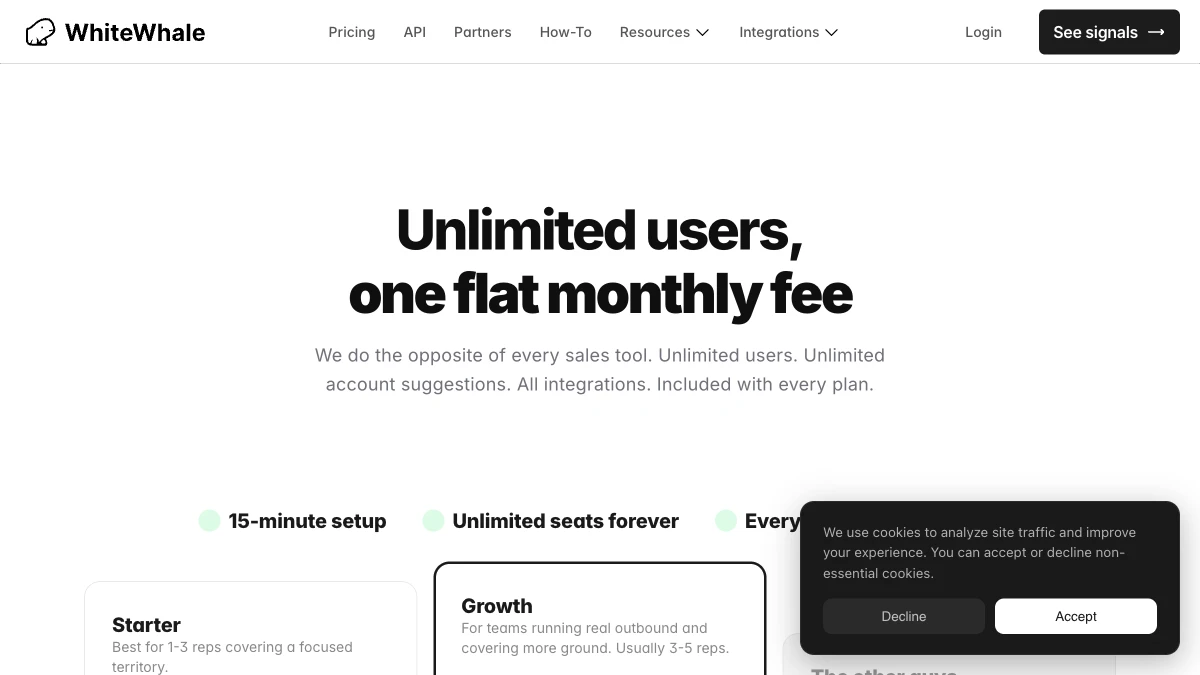
WhiteWhale's pricing page, screenshotted September 2026: one flat monthly fee per plan, with unlimited seats on every tier.
Integrations, API, and MCP
Because WhiteWhale wants reps to stay in their existing tools, its integrations do most of the work, and the documentation for them is detailed:
- HubSpot: a verified public app that writes scores, signals, Why Now summaries, and report links to custom company properties, plus an in-CRM app card. The full sync runs daily between 5 and 9 AM ET, new accounts sync immediately, and WhiteWhale writes only to its own fields. Optional deal mapping enables stage-aware signals and closed-won backtesting.
- Salesforce: a Connected App with no package to install, sandbox support, account and opportunity mapping, and activity tracking. The docs recommend a dedicated integration user and put typical usage at around 100 API calls a day after the first week.
- Slack: daily signal alerts with the source and a quote, plus assigned-account, suggestion, and deal-revival notifications, with personal tagging via Slack member ID. Slack works on every plan; Microsoft Teams alerts need the top tier.
- Google Calendar: powers the pre-meeting briefs, with an optional auto-upload mode that adds meeting accounts to your list and spends credits.
- Clay: a webhook sends the account's full signal history, Why Now summary, sources, and owner to a Clay table each morning a new signal fires; CSV export handles one-off backfills.
- REST API and webhooks: endpoints for accounts, signals, users, ICPs, and Account Suggestions, limited to 600 requests per minute, plus signed
account.signalandaccount.uploadwebhook events. - MCP: an OAuth connector at
app.getwhitewhale.com/mcpthat exposes every API route as a tool in Claude, ChatGPT, and other MCP clients.
Two caveats. The homepage lists Outreach among its delivery destinations, but there's no Outreach setup guide in the docs, so ask how that connection works before relying on it. And the two oldest G2 reviews, from 2024 and early 2025, complained about missing integrations; today's HubSpot, Salesforce, API, and MCP documentation suggests that gap has largely closed.
What Users Say: G2 and HubSpot Reviews
WhiteWhale's public review footprint is small but uniformly positive. On G2 it holds a 5.0/5 rating from 4 reviews dated November 2024 to April 2026, all from companies with 50 or fewer employees; two came through G2 invites and are marked incentivized, and G2 notes there aren't yet enough reviews to generate buying insights. On the HubSpot App Marketplace, the app shows 5/5 from 2 reviews (April and July 2026) and 80+ installs, still published under the developer name BirdDog Software LLC.
What reviewers like: the depth of account context (one G2 review is titled “More comprehensive than Google search, actually more useful than LI Sales Nav”), the shift from static ICP lists to timing-based outreach, a HubSpot integration described as smooth, and founders who are responsive and hands-on during implementation.
What they flag: occasional information overload (“sometimes I get way too much informations”), a request for news in more languages, a learning curve and real time investment to tune signals, some signals being more actionable than others, and, in the most detailed HubSpot review, that the product works best alongside other tools for contact enrichment.
Vendor-reported results: the homepage cites 5x ROI in the first 90 days, 30% faster deal cycles, and a 29% better close rate, described as averages from customers but without a published methodology. A Meridian Business case study (the company is a NetSuite partner) reports 2,800 accounts ranked in 24 hours and a C-level meeting booked within a week, after six months of zero meetings from traditional intent data. Treat these as vendor claims, not benchmarks.
Who Should Use WhiteWhale — and Who Shouldn't
WhiteWhale is a strong fit if:
- You run account-based outbound with roughly 1–10 reps, the team sizes WhiteWhale's own plans are built around, and work a defined list of a few hundred target accounts.
- Your best buying triggers are public, company-level events: executive hires, hiring bursts in a specific function, expansions, product launches, filings, or earnings-call commentary.
- You already have contact data and a sequencer, and what you're missing is a better answer to “which accounts, and why now?”
- RevOps or a GTM engineer wants signals as structured data in HubSpot, Salesforce, Clay, or an AI assistant rather than in another dashboard.
- You're an agency: WhiteWhale runs a partner program with multi-tenant management and API routing for building clients' outbound pipelines.
Look elsewhere if:
- You want signals, verified contacts, and outreach in one tool; WhiteWhale deliberately won't provide the last two.
- Your best triggers are person-level or first-party, such as website visits, product usage, or past champions changing jobs, which sit outside WhiteWhale's company-level, public-source model.
- You need to monitor thousands of accounts at a published price, or procurement requires a SOC 2 report; WhiteWhale shares a security overview on request and describes itself as a team of two.
- You want a large base of independent reviews before buying; six public reviews across G2 and HubSpot isn't one yet.
WhiteWhale Alternatives
If WhiteWhale's scope or scale doesn't fit, these are the closest alternatives, each approaching signals differently:
- Salesmotion — the closest like-for-like option: AI agents that monitor accounts across 1,000+ public sources, including news, earnings calls, SEC filings, job postings, and leadership changes, and generate account research for sales teams. Read our Salesmotion review.
- Common Room — better if your signals are first-party and person-level: it unifies website, product, CRM, and GitHub activity, resolves the people behind it against a 400M+ contact directory, and adds sequencing and a dialer. Read our Common Room review.
- UserGems — tracks 30+ signals, including job changes, contact-level intent, website visits, mergers and acquisitions, and hiring, with contact discovery, AI scoring, and personalized outreach built in. Read our UserGems review.
- Clay — the build-it-yourself route: 200+ data providers, Claygent AI research agents, and signal tracking you configure yourself. It's more flexible but more work to maintain, and WhiteWhale says many of its customers use both, piping WhiteWhale signals into Clay tables. Read our Clay review.
WhiteWhale Pros and Cons
Pros
- +Custom signals written in plain English, with a per-signal Context Window to restrict geography, recency, or meaning — up to 35 signals per account list
- +Every signal links to its source with quotes, facts, and a publication date, so reps can verify a claim before using it
- +Job-posting signals come directly from company ATS platforms (Greenhouse, Lever, Workday), alongside SEC filings, earnings calls, news, and company websites
- +Flat monthly pricing with unlimited seats and no annual contract; the entry plan already includes HubSpot and Salesforce sync, Slack alerts, and API access
- +Strong plumbing for RevOps: a documented REST API (600 requests per minute), signed webhooks, a Clay integration, and an OAuth MCP connector for Claude, ChatGPT, and Gemini
- +Account Suggestions finds net-new companies that match your ICP filters and already show your signals, and unactivated suggestions don't consume credits
- +Founder-led support that reviewers on G2 and HubSpot repeatedly praise for responsiveness and hands-on implementation help
Cons
- −Account-level only: no contact data, email or phone finding, or sequencing, so a separate enrichment and outreach stack is still required
- −Hard account caps (300 on Starter, 750 on Growth); larger territories need the Team tier, which has no published price
- −Tier-gated extras: closed-won backtesting starts at Growth, Microsoft Teams alerts and custom source scraping require the top tier, and Starter support is email, Slack, and docs only
- −Very thin third-party review base — 4 G2 reviews and 2 HubSpot Marketplace reviews, all from small teams — so independent evidence of accuracy at scale is limited
- −Signal quality depends on setup: reviewers mention a learning curve, time spent tuning signals, and occasional information overload
- −A two-person company with no published SOC 2 report; its security overview is shared on request, which can slow enterprise security reviews
- −Some plan details are inconsistent across WhiteWhale's own materials (monitoring cadence, live-search limits), so confirm them before buying
Pricing: Starter $200/month (300 monitored accounts, unlimited seats, self-guided onboarding). Growth $500/month (750 accounts, dedicated onboarding, closed-won signal backtesting). The Team tier (1,000–5,000+ accounts, custom sources, Microsoft Teams alerts) is priced on request. No annual contract; free signal preview with no credit card. Verified on getwhitewhale.com/pricing and G2, September 2026.
Final Verdict
WhiteWhale does one thing and does it with unusual transparency: it turns the account research your best rep already does — reading filings, job posts, and earnings calls for a reason to reach out — into a steady, source-backed feed that lands in your CRM, Slack, or AI assistant. Plain-English custom signals, linked sources on every hit, a sensible scoring model, flat pricing with unlimited seats, and thorough API, webhook, and MCP documentation make it one of the easier signal tools to evaluate and wire into an existing stack.
It's a strong fit for small-to-mid outbound teams, roughly 1–10 reps, working a defined target-account list with contact data and a sequencer already in place. Skip it if you want one platform to find the account, find the person, and send the email; if your territory runs into thousands of accounts and you need published pricing at that scale; or if your best triggers are behavioral, like website visits or product usage, rather than public company events.
Our 3.7/5 reflects that balance. The product design, source transparency, and pricing model earn it a high mark; holding it back are the account-only scope, hard account caps with Teams alerts, custom sources, and 1,000+ account plans behind a contact-sales tier, a two-person vendor without a published SOC 2 report, inconsistencies in its own plan documentation, and a public review base of just six reviews. Because plans are month-to-month, the practical test is cheap: use the free preview to see what signals WhiteWhale proposes for your business, then run five to ten of your own against accounts you know well for a month and count how many hits you'd actually use in an email.
If WhiteWhale stopping at the account, with no contact data, is a dealbreaker, SyncGTM is one alternative worth a look: it pairs real-time buying signals with waterfall enrichment across 50+ providers for verified emails and phone numbers.