
By Kushal Magar · September 29, 2026 · 12 min read
HubSpot vs Monday CRM: Which Fits Your Sales Team in 2026
"HubSpot vs monday" sounds like two CRMs going head-to-head, but they didn't start as the same kind of product. HubSpot was built from the ground up as a CRM and go-to-market suite. monday.com was built as a flexible work-management platform — its CRM, monday CRM, is that platform configured for sales. That difference isn't trivia; it decides whether you get sales functionality out of the box or a system you build yourself, and it shows up directly in what each tool costs a small team.
monday.com's CRM product is called monday CRM (monday retired the earlier "monday sales CRM" name). It runs on the same board-and-automation engine as monday's project-management product, monday work management, with sales-specific templates, pipeline views, and email tools layered on top. HubSpot Sales Hub is the sales module of HubSpot's CRM suite, purpose-built around deals, contacts, sequences, and marketing/sales alignment from day one.
That origin story is the real comparison. monday CRM is more customizable as a board and workflow tool — you can reshape almost any view, automation, or field to match how your team already works. HubSpot has far deeper native sales and marketing functionality out of the box: email tracking, sequences, marketing automation, and a data model built specifically for revenue teams, without needing to configure it that way first. Neither one is strictly "better" — the honest question is whether you want a CRM that works on day one, or a flexible system you're willing to shape yourself.
For a closer look at either vendor on its own, see our HubSpot review. If you're evaluating enrichment on top of either platform, see best enrichment tools for monday CRM and best enrichment tools for HubSpot. Below: real per-seat pricing on both sides — including the seat-minimum math that changes what a small team actually pays — plus where each tool's automation and pipeline depth stops.
Quick Summary
"HubSpot vs monday" gets searched as a straight CRM comparison, but the two products don't start from the same category. HubSpot Sales Hub was purpose-built as a CRM: deals, contacts, sequences, and marketing tools all live on the same record, with a data model designed for revenue teams from the start. monday CRM is monday.com's flexible work-management platform (Work OS) configured as a sales tool — the same boards, automations, and views that run project management, reshaped with sales templates and a pipeline layer on top. That gives monday CRM a real edge in customization: almost any field, view, or automation can be rebuilt to match a team's exact process, and it fits naturally if sales already lives alongside other work on monday. HubSpot's edge is depth that works without configuration — native email tracking, multi-step sequences, marketing automation, and sales-specific reporting that don't need to be built from a generic board first. Pricing reflects the same split. HubSpot has no seat minimum: Free covers up to 2 users at $0/mo, Starter runs $7/seat/mo billed annually ($20/seat/mo monthly), and Professional is $90/seat/mo billed annually ($100/seat/mo monthly) plus a one-time $1,500 onboarding fee. monday CRM prices in seat tiers with a 3-seat minimum on every paid plan — Basic is listed at $12/seat/mo billed annually, but a team of 2 still pays for 3 seats, a real floor of $36/mo, not $24/mo. That seat-minimum shape is easy to miss reading the per-seat number alone. The buyer question that actually resolves this: do you want a CRM out of the box, or a flexible system you're willing to shape yourself? Sales-first teams that want deep automation and marketing tie-in without configuration work tend to land on HubSpot. Teams already running projects, ops, or client work on monday, who want sales folded into that same flexible system, tend to land on monday CRM. Neither tool fixes the data feeding either pipeline. SyncGTM sits underneath whichever CRM you choose, with 2-way HubSpot sync so enriched records flow both directions, plus a real-time waterfall across 50+ providers adding verified emails, direct phones, and up to 15 intent signals per lead — context reps need before a deal ever hits either board.
TL;DR
- Short answer: HubSpot is a purpose-built CRM and go-to-market suite with deep native sales and marketing functionality out of the box. monday CRM is a flexible work-management platform configured for sales — more customizable as a board tool, thinner on native sales/marketing depth.
- Pricing shape matters more than the sticker price: monday CRM sells in seat tiers with a 3-seat minimum on every paid plan, so a 2-person team pays for 3 seats regardless. HubSpot has no seat minimum and a usable free tier for up to 2 users.
- Pick monday CRM if you want a flexible board-and-automation system you shape around your own process, and sales is one workflow among several your team runs on monday.
- Pick HubSpot if you want a CRM with sales and marketing functionality that works out of the box — sequences, native email tracking, marketing automation — without configuring a work-management platform to act like one.
- SyncGTM is not a third competitor in this fight — it's the data layer underneath either setup, with 2-way HubSpot sync, a 50+ provider waterfall, and up to 15 intent signals per lead.
What We Evaluated
- Whether the product is a purpose-built CRM or a work-management platform configured for sales
- Native sales and marketing depth out of the box — sequences, email tracking, marketing automation — versus what has to be built or configured
- Pipeline and board customization flexibility
- Per-seat pricing structure, including seat minimums and how they change real cost for small teams
- Reporting and automation depth at each pricing tier
- Where each tool fits by team profile: sales-first revenue teams versus teams running sales alongside broader project/ops work
1. SyncGTM — Teams running HubSpot, monday CRM, or evaluating a switch, who need the contact and account data behind either pipeline to stay current and synced
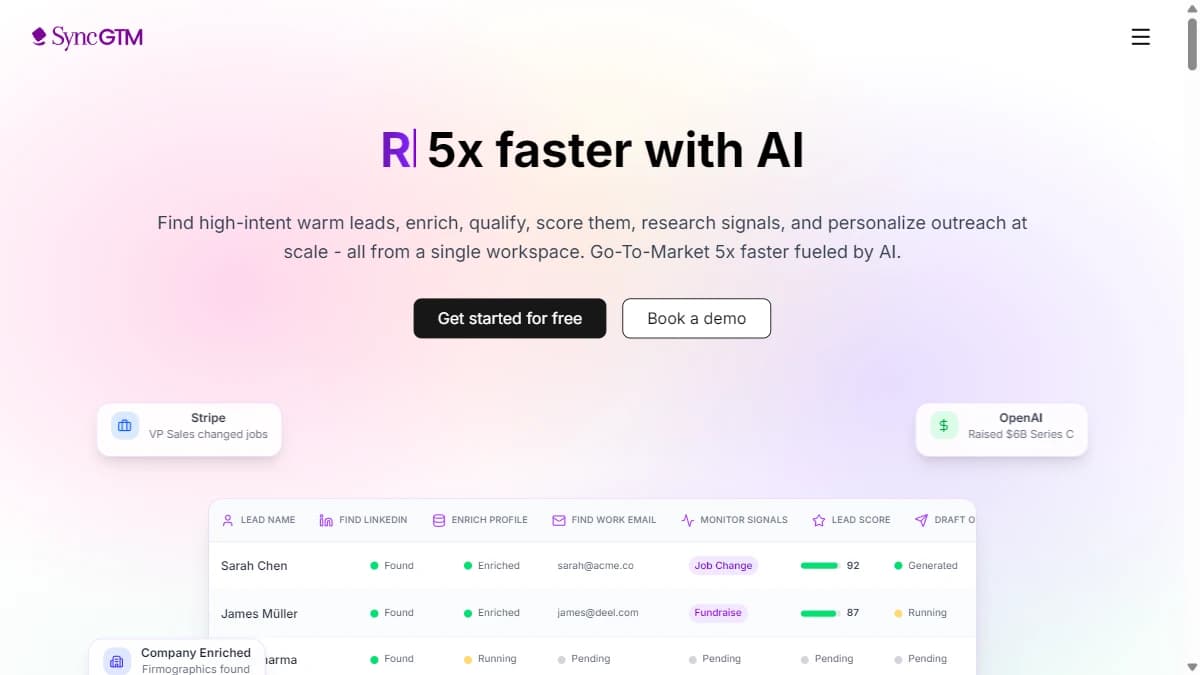
SyncGTM — Teams running HubSpot, monday CRM, or evaluating a switch, who need the contact and account data behind either pipeline to stay current and synced
Quick context before the head-to-head: SyncGTM isn't a third competitor here — it isn't a CRM and it isn't a work-management platform. It's the data layer underneath whichever one you land on below: HubSpot or monday CRM.
2-way HubSpot sync keeps enriched records flowing in both directions, so contact and account data stays current inside the CRM instead of drifting out of date between enrichment runs. Underneath that sync, a real-time waterfall across 50+ data providers adds 76+ data points per lead — verified email, direct phone, firmographics, and up to 15 intent signals that flag which accounts are actually in-market.
Those signals feed whichever pipeline is running the deal — HubSpot's deal record or a monday CRM board — so reps start with enriched, prioritized data instead of a stale import. See how the sync works or check pricing for current plans. Now, the actual comparison.
Pros
- +2-way HubSpot sync — enriched data flows back into deal and contact records instead of a one-way export
- +76+ data points per lead from a 50+ provider waterfall, including up to 15 intent signals for account prioritization
- +Feeds either HubSpot's deal record or a monday CRM board — not tied to one platform
- +Keeps records current regardless of which CRM shape a team picks
Cons
- −Not a CRM or pipeline tool itself — HubSpot or monday CRM is still required as the system of record
- −Not a work-management or board platform — teams needing monday's broader project/ops flexibility still need monday.com
Best for: Teams running HubSpot, monday CRM, or evaluating a switch, who need the contact and account data behind either pipeline to stay current and synced
Pricing: Starts at $99/mo. Free tier available.
2. HubSpot — Sales-first revenue teams that want CRM, sequencing, and marketing tie-in that works out of the box, without configuring a work-management platform to act like a CRM
HubSpot — Sales-first revenue teams that want CRM, sequencing, and marketing tie-in that works out of the box, without configuring a work-management platform to act like a CRM
HubSpot Sales Hub is the sales module of HubSpot's CRM suite — a purpose-built CRM where deals, contacts, sequences, and reporting live on one record, with a data model designed for revenue teams from the ground up rather than configured after the fact.
Pricing has no seat minimum. Free covers up to 2 users at $0/mo. Starter is $7/seat/mo billed annually ($20/seat/mo monthly). Professional is $90/seat/mo billed annually ($100/seat/mo monthly) plus a one-time $1,500 onboarding fee, and unlocks fuller sequence customization and workflow automation. Enterprise starts at $150/seat/mo billed annually plus a one-time $3,500 onboarding fee. (Verified on hubspot.com/pricing/sales, USD, as of September 2026.)
The tradeoff against monday CRM is flexibility. HubSpot's sales and marketing tools go deep natively — sequences, email tracking, marketing automation tied to the same contact record — but reshaping the platform to work a fundamentally different way is harder than on a board-first tool like monday.
Pros
- +Purpose-built CRM data model — deals, contacts, sequences, and marketing tools live on one record with no configuration required to act like a CRM
- +No seat minimum; Free tier genuinely usable for 2 users at $0/mo
- +Native marketing automation (Marketing Hub) integrates directly with Sales Hub on the same contact record
- +Transparent, published per-seat pricing across Starter, Professional, and Enterprise tiers
Cons
- −Full sequence customization and workflow automation are gated at Professional, a meaningful jump from Starter pricing
- −Professional and Enterprise tiers carry mandatory onboarding fees ($1,500 and $3,500 respectively) on top of per-seat cost
- −Less flexible than monday CRM for teams that want to reshape pipeline views, fields, and automations from scratch
- −Marketing Hub is a separate paid product from Sales Hub, even though the data model is shared
Best for: Sales-first revenue teams that want CRM, sequencing, and marketing tie-in that works out of the box, without configuring a work-management platform to act like a CRM
Pricing: Free for up to 2 users. Starter $7/seat/mo billed annually ($20/seat/mo monthly). Professional $90/seat/mo billed annually ($100/seat/mo monthly), plus a one-time $1,500 onboarding fee. Enterprise starts at $150/seat/mo billed annually, plus a one-time $3,500 onboarding fee.
3. monday CRM — Teams that want a flexible, board-based system they can shape to their own process, especially where sales sits alongside other work already run on monday
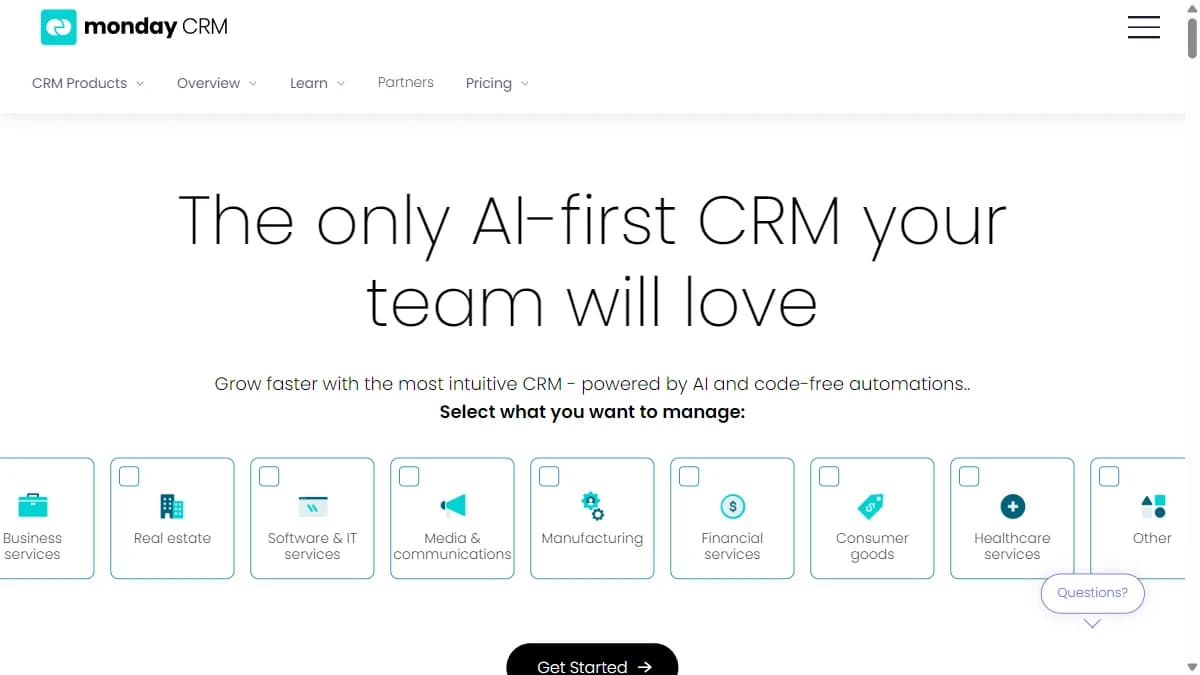
monday CRM — Teams that want a flexible, board-based system they can shape to their own process, especially where sales sits alongside other work already run on monday
monday CRM is monday.com's Work OS platform configured for sales — the same board, view, and automation engine that runs monday's project-management product, monday work management, reshaped with pipeline templates and email tools layered on top.
Pricing sells in seat tiers with a 3-seat minimum on every paid plan. Basic is listed at $12/seat/mo billed annually ($18/seat/mo monthly), but the 3-seat floor means a team of 2 pays for 3 seats regardless — roughly $36/mo, not $24/mo. Standard runs $17/seat/mo billed annually ($25/seat/mo monthly) and adds monday's AI agents; Pro runs $28/seat/mo billed annually ($41/seat/mo monthly) with an AI workflow builder; Ultimate is custom-quoted. (Verified on monday.com/pricing for the monday CRM product, USD, as of September 2026 — confirm current tiers and seat minimums before budgeting, as monday has changed this product's name and structure before.)
The tradeoff against HubSpot is depth versus flexibility. monday CRM's board engine can be reshaped to match almost any process — fields, views, automations — but it doesn't ship dedicated marketing automation, and native sales-specific depth (sequencing, email tracking sophistication) is thinner than a purpose-built CRM's.
Pros
- +Highly customizable board and automation engine — pipeline views, fields, and workflows can be reshaped to match almost any sales process
- +Natural fit for teams already running projects, ops, or client work on monday who want sales in the same system
- +AI agents and AI workflow builder included from the Standard tier up
- +Lower advertised per-seat price than HubSpot's Professional tier at comparable feature depth
Cons
- −3-seat minimum on every paid plan — the advertised per-seat price is not what a 1–2 person team actually pays
- −No dedicated native marketing automation product, unlike HubSpot's integrated Marketing Hub
- −Sales-specific depth (sequencing, native email tracking) is thinner than a purpose-built CRM, since the underlying engine is general-purpose work management
- −Basic tier caps contacts/deals and automations tightly enough that many sales teams outgrow it quickly
Best for: Teams that want a flexible, board-based system they can shape to their own process, especially where sales sits alongside other work already run on monday
Pricing: Basic $12/seat/mo billed annually ($18/seat/mo monthly), 3-seat minimum. Standard $17/seat/mo billed annually ($25/seat/mo monthly), 3-seat minimum. Pro $28/seat/mo billed annually ($41/seat/mo monthly), 3-seat minimum. Ultimate is custom-quoted.
Comparison Table
| Tool | Best For | Free Tier | Starting Price | Standout Feature |
|---|---|---|---|---|
| SyncGTM | Teams running HubSpot, monday CRM, or evaluating a switch, who need the contact and account data behind either pipeline to stay current and synced | Yes | $99/mo | 2-way HubSpot sync and up to 15 intent signals per lead that neither HubSpot's native tools nor monday CRM provide on their own |
| HubSpot | Sales-first revenue teams that want CRM, sequencing, and marketing tie-in that works out of the box, without configuring a work-management platform to act like a CRM | Yes | $0 (paid tiers from $7/seat/mo billed annually) | Purpose-built CRM data model with native sales and marketing depth, no seat minimum, and a genuinely usable free tier |
| monday CRM | Teams that want a flexible, board-based system they can shape to their own process, especially where sales sits alongside other work already run on monday | No (free trial only; no permanent free tier) | $12/seat/mo billed annually (3-seat minimum applies) | The most customizable board-and-automation engine of the two, for teams willing to configure it into a sales process rather than take one out of the box |
How to Choose
- SyncGTM if you need teams running hubspot, monday crm, or evaluating a switch, who need the contact and account data behind either pipeline to stay current and synced
- HubSpot if you need sales-first revenue teams that want crm, sequencing, and marketing tie-in that works out of the box, without configuring a work-management platform to act like a crm
- monday CRM if you need teams that want a flexible, board-based system they can shape to their own process, especially where sales sits alongside other work already run on monday