

By Kushal Magar · September 30, 2026 · 12 min read
HubSpot vs Pipedrive: CRM Pricing and Features Ranked 2026
HubSpot vs Pipedrive is the rare CRM comparison that isn't muddied by two vendors converging on the same product shape. Pipedrive was built as a pipeline tool for salespeople and has stayed narrow on purpose. HubSpot was built as a CRM and has spent a decade becoming a suite, where the CRM is now one hub next to marketing, service, and content tools. The real question isn't which one is 'better' — it's whether your team wants a deep, fast tool for running deals, or a platform with more surface area than most sales teams will use on day one but might grow into.
Most HubSpot vs Pipedrive posts default to a features checklist — who has more automations, more integrations, more AI. That framing misses what actually separates these two products: scope. Pipedrive is, and has remained, a sales-pipeline CRM first. Its plans (Lite, Growth, Premium, Ultimate as of its 2025 rebrand) add depth to the same core job — moving deals through stages — rather than bolting on adjacent departments. HubSpot's CRM is free at the core specifically because the company's actual product is the suite around it: Marketing Hub, Service Hub, Content Hub, and Sales Hub all sold separately or bundled.
That difference in scope is also where each vendor's pricing gets misleading if you only read the entry number. Pipedrive's cheapest tier, Lite, doesn't include the automation or forecasting most sales teams consider table stakes — you need Growth for that, and Premium if lead generation or data enrichment matter. HubSpot's Sales Hub sticker price looks competitive until you factor in the one-time onboarding fees on Professional and Enterprise, and until you remember that a 'HubSpot deal' for most buyers means Sales Hub plus Marketing Hub, priced on a completely different axis (marketing contacts, not seats).
This post verifies pricing directly against each vendor's pricing and support pages, names the tier a normal sales workflow actually requires, and states currency, billing cadence, and date on every figure. For the same 'focused tool vs suite' question against Salesforce instead of Pipedrive, see our HubSpot vs Salesforce breakdown. If you've already ruled out HubSpot and want the Pipedrive verdict on its own, our Pipedrive review and HubSpot review cover each platform standalone.
Quick Summary
HubSpot vs Pipedrive is the cleanest same-category CRM comparison to write, because the two products haven't converged — they've stayed genuinely different in scope. Pipedrive was built as a visual, activity-based pipeline tool for salespeople and has kept that focus through four plan tiers: Lite, Growth, Premium, and Ultimate, the names it moved to in its 2025 plan rebrand (previously Essential, Advanced, Professional, Power, Enterprise). HubSpot's CRM is free at its core because HubSpot's actual business is the suite wrapped around it — Marketing Hub, Service Hub, Content Hub, and Sales Hub, sold separately or bundled, with the CRM object model shared across all of them. As of September 2026, Pipedrive's tiers run Lite at $14/user/month, Growth at $39/user/month, Premium at $64/user/month, and Ultimate at $79/user/month, all annual billing in USD — cross-verified through Pipedrive's own support documentation and newsroom announcements plus multiple independent pricing trackers, since Pipedrive's live pricing page returned a Cloudflare block on direct automated verification during research for this post. HubSpot Sales Hub, verified live on hubspot.com/pricing/sales, runs Free ($0), Starter ($7/seat/month annual, $20/seat/month monthly), Professional ($90/seat/month annual, plus a required $1,500 one-time onboarding fee), and Enterprise ($150/seat/month annual, plus a required $3,500 one-time onboarding fee). The number most comparisons skip on the Pipedrive side is tier gating: the $14 Lite plan is pipeline and contact management only — email automation and revenue forecasting require Growth ($39/user/month), and lead generation (LeadBooster) plus data enrichment require Premium ($64/user/month). A sales team that needs forecasting and outbound sequencing, which most do, is really pricing Pipedrive at $39–$64/user/month, not $14. On the HubSpot side, the skipped number is the onboarding fee plus the fact that Sales Hub in isolation understates what most HubSpot deals actually cost, since Marketing Hub — commonly bundled in — prices by marketing contact volume rather than seats. Beyond pricing, the decision is really about scope. Pipedrive does one job — running a sales pipeline — and does it with a shorter learning curve and faster time to value than any suite product can match, because there's nothing else in the product to configure around. HubSpot does more jobs, which is the point if marketing and sales need to operate in one system, and a liability if a sales team ends up paying for and navigating hubs it doesn't use. Neither platform solves the problem underneath both: keeping contact and deal data accurate as reps work them. SyncGTM connects to both, running a 76+ data-point waterfall across 50+ providers so records stay current whether a team lands on the focused tool or the platform.
TL;DR
- Short answer: Pipedrive is a focused, deal-first pipeline CRM built for sales reps who want speed to value. HubSpot is a broad suite where the CRM is one hub among marketing, service, and content tools. Pick Pipedrive if you need a deep pipeline tool and nothing else; pick HubSpot if you want a platform to grow into and marketing automation is a real near-term need, not a maybe.
- Verified pricing (as of September 2026, annual billing, USD): Pipedrive runs Lite $14/user/mo, Growth $39/user/mo, Premium $64/user/mo, Ultimate $79/user/mo (figures cross-verified via Pipedrive's own support and newsroom pages plus independent pricing trackers, since Pipedrive's live pricing page blocked automated verification — see note below). HubSpot Sales Hub runs Free $0, Starter $7/seat/mo ($20/mo billed monthly), Professional $90/seat/mo (plus a $1,500 one-time onboarding fee), Enterprise $150/seat/mo (plus a $3,500 one-time onboarding fee) — verified live on hubspot.com/pricing/sales.
- The tier trap: Pipedrive's $14 Lite plan doesn't include email automation or revenue forecasting — that's Growth, at $39/user/mo. Lead generation and data enrichment require Premium, at $64/user/mo. Most sales teams evaluating Pipedrive on the $14 headline are actually pricing a $39–$64/user/mo tool. HubSpot's Sales Hub number itself is clean, but Professional and Enterprise both carry onboarding fees most comparison posts leave out, and a real HubSpot deal usually adds Marketing Hub priced by contact volume, not seats.
- Lean Pipedrive if your team is sales-only, wants the fastest setup and lowest learning curve, and doesn't need marketing automation inside the same platform.
- Lean HubSpot if marketing and sales need to share one system now or within the next year, and you're willing to pay the onboarding fee and plan for contact-tier scaling on Marketing Hub.
- SyncGTM isn't a third CRM in this decision — it's the enrichment and sync layer underneath either one, adding 76+ verified data points per contact so neither a lean pipeline tool nor a broad suite is working off stale records.
What We Evaluated
- Verified per-seat/per-user pricing at every published tier, with currency, billing cadence, and the exact plan or hub each figure belongs to
- Which tier a normal sales workflow (forecasting, automation, lead gen) actually requires, not just the headline entry price
- One-time onboarding or implementation fees disclosed on the vendor's own pricing page
- Product scope — single-purpose pipeline tool vs. multi-hub suite — and what that means for setup time and learning curve
- Whether marketing automation is a genuine near-term need or a hypothetical one, since that's the real fork between these two products
- Data-quality dependency: how each platform's field structure and integrations handle enrichment and sync
1. SyncGTM — Teams on either HubSpot or Pipedrive who need contact and deal data to stay accurate without manual upkeep
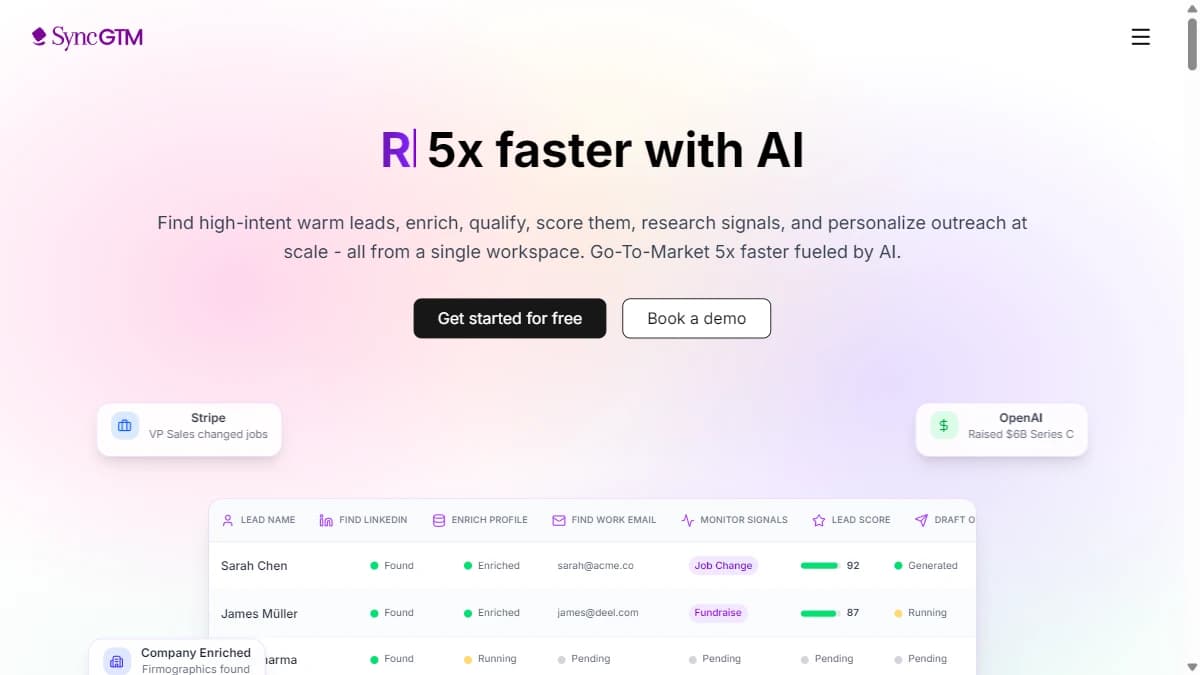
SyncGTM — Teams on either HubSpot or Pipedrive who need contact and deal data to stay accurate without manual upkeep
Before the head-to-head: SyncGTM isn't a third CRM competing with HubSpot or Pipedrive here — it's the data layer that keeps whichever one you pick from going stale.
It integrates with both platforms, so a real-time waterfall across 50+ data providers adds 76+ data points per lead — verified email, direct phone, firmographics, and job-change or growth signals — feeding straight into Pipedrive's deal fields or HubSpot's CRM objects, whichever one you're running.
See pricing for current plans, or the product tour for how enrichment and sync connect end to end. Now, the actual HubSpot-vs-Pipedrive comparison.
Pros
- +Integrates with both HubSpot and Pipedrive — works underneath either side of this comparison
- +76+ data points per lead from a 50+ provider waterfall, refreshed at lookup rather than a static append
- +Keeps records current regardless of whether a team wants a focused pipeline tool or a broad suite
- +Not a competing CRM — no migration required to add it on top of an existing Pipedrive or HubSpot setup
Cons
- −Not a CRM itself — HubSpot or Pipedrive is still required as the system of record
- −Value depends on actually acting on enrichment and signals inside the CRM workflow, not just having the data
Best for: Teams on either HubSpot or Pipedrive who need contact and deal data to stay accurate without manual upkeep
Pricing: Starts at $99/mo. Free tier available.
2. HubSpot Sales Hub — Teams that want sales and marketing sharing one platform now or within the next year
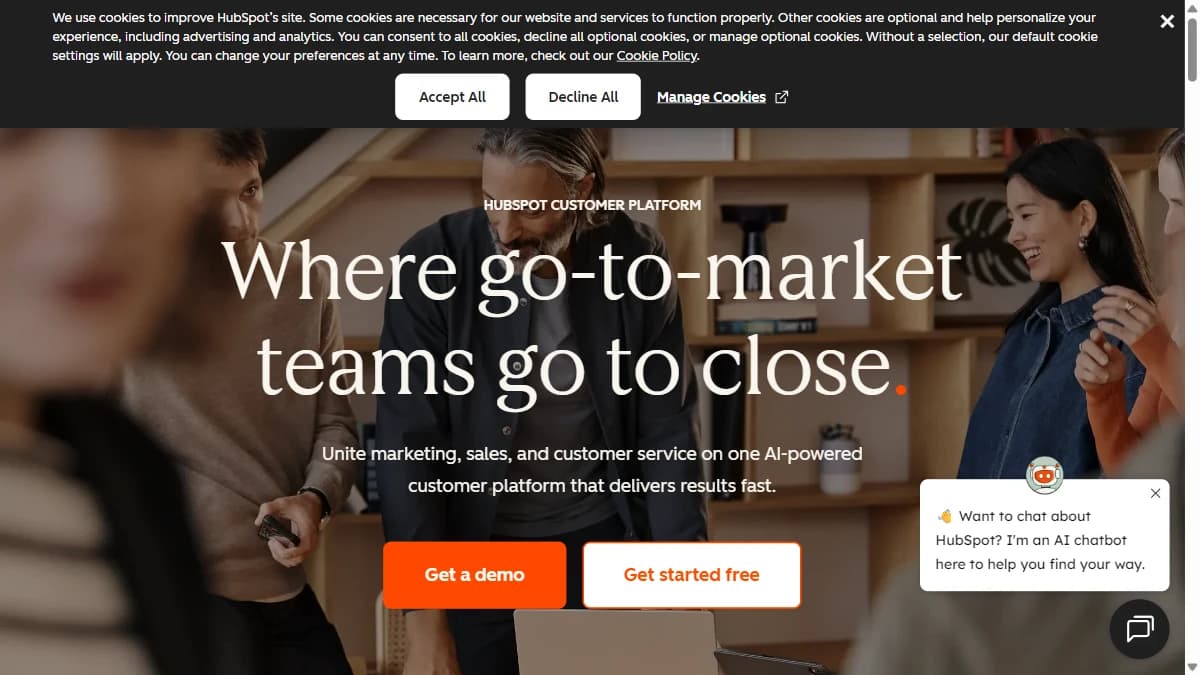
HubSpot Sales Hub — Teams that want sales and marketing sharing one platform now or within the next year
HubSpot Sales Hub is priced per seat across four tiers as of September 2026, verified live on hubspot.com/pricing/sales: Free ($0), Starter ($7/seat/month annual, $20/seat/month billed monthly), Professional ($90/seat/month annual), and Enterprise ($150/seat/month annual). Professional and Enterprise carry required one-time onboarding fees of $1,500 and $3,500 respectively.
Sales Hub is one hub in a broader suite — Marketing Hub, Service Hub, and Content Hub sit alongside it, sharing the same CRM object model. That's the actual pitch: a team can add marketing or service tooling later without switching systems. It's also the cost trap, since Marketing Hub prices by contact volume, a second axis beyond the clean per-seat Sales Hub number.
For a sales-only team that's certain it will never need the rest of the suite, that breadth is unused surface area. For a team that expects marketing and sales to share a system within the next year or two, it's the reason to pick HubSpot over a narrower pipeline tool now instead of migrating later.
Pros
- +Free tier includes real CRM functionality, not just a trial
- +Shares one CRM object model with Marketing Hub, Service Hub, and Content Hub — a real platform to grow into, not just a sales tool
- +Sales Hub pricing itself is a flat per-seat model, simple to forecast in isolation
- +Starter tier ($7/seat/month annual) is priced below Pipedrive's Growth tier while including core sales workflow tools
Cons
- −Professional ($1,500) and Enterprise ($3,500) carry required one-time onboarding fees not reflected in the per-seat price
- −Marketing Hub — commonly bundled alongside Sales Hub — prices by marketing contact volume, a second cost axis beyond seats
- −More surface area to configure than a single-purpose pipeline tool, even when only the CRM is in use
- −Overkill for a sales-only team with no near-term marketing automation need
Best for: Teams that want sales and marketing sharing one platform now or within the next year
Pricing: $0–$150/seat/month across four tiers (Free, Starter, Professional, Enterprise), billed annually in USD, plus one-time onboarding fees of $1,500 (Professional) and $3,500 (Enterprise). Verified on hubspot.com/pricing/sales, September 2026.
3. Pipedrive — Sales-only teams that want a fast, focused pipeline tool with no marketing or service suite attached

Pipedrive — Sales-only teams that want a fast, focused pipeline tool with no marketing or service suite attached
Pipedrive runs four tiers as of its 2025 plan rebrand — Lite, Growth, Premium, and Ultimate — priced per user, per month, annual billing, in USD: Lite $14, Growth $39, Premium $64, Ultimate $79. These figures are cross-verified through Pipedrive's own support and newsroom pages plus independent pricing trackers as of September 2026; Pipedrive's live pricing page returned a Cloudflare block during direct automated verification for this post, so readers pricing an actual purchase should confirm the current number on pipedrive.com.
The gating most comparisons don't spell out: Lite is pipeline and contact management only — no email automation, no forecasting. Growth adds both. Premium adds lead generation (LeadBooster) and data enrichment. Ultimate adds enhanced security, expanded usage limits, and a sandbox environment. A sales team that needs forecasting and automation, which is most of them, is pricing Pipedrive at Growth or Premium, not the $14 headline.
What Pipedrive doesn't do is try to be anything other than a sales-pipeline CRM. There's no marketing hub, no service hub, no content system bolted on. That focus is the entire value proposition — faster setup, a shorter learning curve, and a visual deal-stage interface built around one job.
Pros
- +Single-purpose pipeline tool — shortest learning curve and fastest setup of the two, since there's no adjacent suite to configure around
- +Visual, activity-based pipeline interface built specifically for how sales reps work deals day to day
- +Growth tier ($39/user/month) undercuts HubSpot Professional ($90/seat/month plus a $1,500 onboarding fee) for teams that need automation and forecasting
- +No one-time onboarding fee published at any tier
Cons
- −Entry-tier Lite ($14/user/month) excludes automation and forecasting — most teams need Growth or Premium to run a normal sales process
- −Lead generation and data enrichment gated behind Premium ($64/user/month)
- −No native marketing or service hub — teams that later need marketing automation must add a separate tool or migrate platforms entirely
- −Live pricing page blocked automated verification during research; figures rely on cross-referenced secondary sources rather than a direct page read
Best for: Sales-only teams that want a fast, focused pipeline tool with no marketing or service suite attached
Pricing: $14–$79/user/month across four tiers (Lite, Growth, Premium, Ultimate), billed annually in USD. Cross-verified via Pipedrive support/newsroom pages and independent pricing trackers, September 2026 — confirm live on pipedrive.com before purchase.
Comparison Table
| Tool | Best For | Free Tier | Starting Price | Standout Feature |
|---|---|---|---|---|
| SyncGTM | Teams on either HubSpot or Pipedrive who need contact and deal data to stay accurate without manual upkeep | Yes | $99/mo | Works underneath both platforms in this comparison, so the enrichment layer doesn't change if the CRM decision does |
| HubSpot Sales Hub | Teams that want sales and marketing sharing one platform now or within the next year | Yes | $7/seat/month (Starter, annual) | A real platform to grow into — CRM, marketing, service, and content on one object model — at the cost of more setup surface area and a second pricing axis |
| Pipedrive | Sales-only teams that want a fast, focused pipeline tool with no marketing or service suite attached | No (14-day free trial on all plans) | $14/user/month (Lite, annual) — Growth ($39/user/month) is the tier most sales teams actually need | The deepest, most focused pipeline tool in this comparison — at the cost of having nowhere to go if marketing automation becomes a real need |
How to Choose
- SyncGTM if you need teams on either hubspot or pipedrive who need contact and deal data to stay accurate without manual upkeep
- HubSpot Sales Hub if you need teams that want sales and marketing sharing one platform now or within the next year
- Pipedrive if you need sales-only teams that want a fast, focused pipeline tool with no marketing or service suite attached