MyEmailVerifier Review 2026: B2B Data Coverage, Pricing & SyncGTM Comparison

By Kushal Magar · June 13, 2026 · 11 min read
Key Takeaway
MyEmailVerifier is a low-cost email verification platform with pay-as-you-go credits from $4/1K, no credit expiry, bulk CSV upload, REST API, and a real-time widget. It claims 99% accuracy but has limited third-party review data to validate that figure. Catch-all domains return unresolved (credits refunded but gaps remain), and spam-trap detection is basic. Best for teams with small or occasional verification volumes who want the lowest entry price. For B2B outbound prospecting end-to-end, SyncGTM's waterfall enrichment across 50+ providers delivers verified contacts with deliverability built in — no separate cleaning step needed — from $99/mo.
MyEmailVerifier is an email verification platform offering bulk list cleaning, a REST API, and a real-time widget — all on a pay-as-you-go credit model with no monthly minimums.
This review covers MyEmailVerifier's pricing structure, claimed accuracy, key features, and honest limitations — including how it compares to SyncGTM's waterfall enrichment approach for B2B outbound teams who need more than just list cleaning.
MyEmailVerifier occupies the entry-level tier of email verifiers: pricing starts at $4 for 1,000 credits, credits never expire, and unknown results are refunded. It positions itself as an affordable, no-commitment alternative to subscription-based verifiers like ZeroBounce and NeverBounce.
TL;DR
- What it is: Low-cost email verification platform with bulk upload, REST API, and real-time widget — pay-as-you-go, no subscription required.
- Best for: Teams with small or irregular verification volumes who want the lowest possible entry price without a monthly commitment.
- Pricing: Pay-as-you-go from $4/1K credits — credits never expire. No mandatory monthly plan.
- Accuracy: 99% claimed. Limited third-party benchmark data to independently validate. Catch-all addresses return unknown (refunded, but unresolved).
- Key gap: No contact finding, no B2B enrichment, no AI-based catch-all scoring, limited review track record.
- SyncGTM vs MyEmailVerifier: SyncGTM replaces MyEmailVerifier for B2B outbound teams — waterfall enrichment across 50+ providers delivers verified contacts with deliverability built in, no separate cleaning step needed.

MyEmailVerifier homepage — pay-as-you-go email verification with bulk, API, and real-time modes
What Is MyEmailVerifier?
MyEmailVerifier is a dedicated email verification platform built for marketers, developers, and sales teams who need to clean contact lists before sending. It validates email addresses through multi-layer checks — syntax validation, DNS/MX record lookup, SMTP-level handshake, disposable email detection, and role-based address filtering — and returns a status for each address along with a risk score.
The platform operates on a strict pay-as-you-go model. There is no mandatory monthly subscription. Teams buy credits as needed, credits never expire, and unknown results (typically catch-all corporate domains that cannot confirm a specific mailbox exists) are refunded automatically. This makes MyEmailVerifier one of the lowest-commitment entry points in the email verification category.
Three verification modes are available from the same credit pool: bulk CSV/TXT upload for batch list cleaning, a REST API for real-time single-address or batch verification in custom workflows, and an embeddable JavaScript widget for form-level validation at signup. All three consume credits at the same rate.
Unlike the larger verifiers in its category — ZeroBounce, NeverBounce, Kickbox, Email Hippo — MyEmailVerifier does not publish significant third-party review counts on G2 or Capterra. This limits independent validation of its accuracy claims and makes direct benchmark comparisons difficult. The platform has been operating for several years but has not built the same public review corpus as its larger competitors.
MyEmailVerifier does not find email addresses. It does not have a contact database, an email finder, or B2B enrichment capabilities. Every team using it still needs a separate upstream tool — an email finder, contact database, or enrichment platform — to supply the list that MyEmailVerifier then cleans.
MyEmailVerifier Pricing: Plans, Credits, What You Actually Pay
MyEmailVerifier pricing is entirely pay-as-you-go — no monthly subscription, no recurring commitment. Credits are purchased in blocks and never expire. This structure suits teams with low or variable verification volumes better than subscription-only verifiers that require a monthly floor.
| Credits | Approx. Price | Per Email | Credit Expiry |
|---|---|---|---|
| 1,000 | $4 | $0.004 | Never |
| 5,000 | ~$15–18 | $0.003–0.004 | Never |
| 10,000 | ~$25–30 | $0.002–0.003 | Never |
| 50,000 | ~$80–100 | $0.001–0.002 | Never |
| 100,000+ | Volume discount | ~$0.001 | Never |
New accounts receive 100 free verifications to test accuracy before purchasing. Unknown results and duplicate addresses are refunded automatically — you pay only for actionable outputs. The $4 minimum entry point is the lowest in the mainstream email verification category.
Compared to competitors: NeverBounce charges $0.008/email pay-as-you-go (2x MyEmailVerifier's entry rate), and Kickbox starts at $0.01/email (2.5x). ZeroBounce requires a $15/mo minimum for 2,000 credits. For teams verifying fewer than 5,000 emails per month, MyEmailVerifier's pay-as-you-go structure avoids paying for unused capacity.

MyEmailVerifier pricing — pay-as-you-go credits from $4/1K, no expiry, no monthly minimum
MyEmailVerifier Key Features
Multi-Layer Email Verification
MyEmailVerifier runs addresses through syntax checks, DNS/MX record verification, SMTP-level handshake, disposable email detection, and role-based address identification. Output includes a status classification (valid, invalid, catch-all, unknown, or disposable) and a risk score indicating the likelihood of a bounce or spam-related outcome. The risk score helps suppress addresses that are technically valid but likely to damage sender reputation.
Bulk List Upload
Teams can upload contact lists via CSV or TXT for batch verification. The platform processes files in the background and sends an email notification when results are ready for download. Supported export formats include CSV with full result detail: status, risk score, sub-status codes, and cleaned address fields. For teams running periodic hygiene on large marketing lists, this async bulk mode is the primary workflow.
REST API with SDK Support
MyEmailVerifier provides a REST API supporting single-address real-time verification and batch submission via JSON. API keys are generated from the dashboard and consumed from the same credit pool as bulk uploads. Client libraries and SDKs are available for common languages, enabling teams to embed validation at lead capture, CRM enrichment, or pre-send hygiene pipeline stages.
Real-Time Widget for Form Validation
An embeddable JavaScript widget intercepts email input at form submission, validates in real time against the API, and blocks or warns on invalid and disposable addresses before the form processes. This pattern prevents bad addresses from entering the CRM at the point of capture — cleaner and cheaper than batch-cleaning CRM lists after the fact.
Disposable and Role-Based Email Detection
MyEmailVerifier flags temporary email addresses (Mailinator, Guerrilla Mail, 10-minute mail services) and role-based addresses (info@, support@, admin@) as separate status categories. Both categories degrade deliverability and campaign metrics when included in outbound sends. Filtering them out at verification step — before they enter the sending queue — reduces bounce rates and protects sender reputation.
Auto-Refund for Catch-All and Unknown Results
Addresses that cannot be definitively verified — because the receiving mail server uses a catch-all configuration or does not respond to SMTP probes — return as unknown or catch-all and credits are automatically refunded. Teams pay only for actionable results. This is a transparent credit model; the trade-off is that B2B lists with high enterprise domain representation (where catch-all is common) will have 15–30% of addresses go unresolved without any scoring to help prioritize which to attempt.
MyEmailVerifier Pros: What It Does Well
- ✓Lowest entry price in the category — $4/1K credits with no monthly minimum. For teams verifying under 5,000 emails per month, this is the cheapest no-commitment option available. NeverBounce and Kickbox cost 2–2.5x more per credit at comparable volumes.
- ✓No credit expiry— credits purchased never expire. Teams with irregular verification schedules — cleaning a list once a quarter, or before a specific campaign — don't lose unused credits at renewal. ZeroBounce and Bouncer expire credits after 12 months.
- ✓Auto-refund for unknown results — credits are returned automatically for catch-all and unresolvable addresses. You pay only for results that give you a definitive verdict, making the effective per-valid-email cost transparent.
- ✓Three verification modes from one credit pool — bulk upload, API, and widget all draw from the same credit balance. No per-mode separate billing or additional access fees.
- ✓Simple, no-commitment workflow — no contracts, no sales calls, no onboarding process. Teams can sign up, get 100 free credits, and be running bulk verifications in under five minutes.
- ✓Disposable and role-based address detection — filters out throwaway addresses and shared role inboxes that degrade campaign performance. Standard feature, but important for teams sourcing leads from web forms.
MyEmailVerifier Cons: Where It Falls Short
- ✗Limited independent accuracy validation — MyEmailVerifier claims 99% accuracy but has minimal public review data on G2 or Capterra to support this figure statistically. ZeroBounce (549 reviews, 4.7/5) and NeverBounce (200+ reviews) have years of third-party validation. Buyers evaluating accuracy claims have little independent data to rely on for MyEmailVerifier.
- ✗No AI-based catch-all scoring — enterprise B2B domains commonly use catch-all configurations, meaning 15–30% of a prospecting list can return unknown results. MyEmailVerifier refunds those credits but leaves the addresses unresolved. ZeroBounce and Clearout use AI models to score catch-all addresses and recover actionable verdicts on many of them — a meaningful advantage for B2B teams.
- ✗No B2B contact enrichment or email finding — pure list cleaning only. Teams still need a separate contact database or email finder upstream. SyncGTM, Apollo.io, and Hunter.io combine contact discovery, enrichment, and verification in one platform.
- ✗Basic spam-trap detection — risk scoring is a general signal, not a dedicated spam-trap network integration. ZeroBounce runs addresses against 30+ spam-trap sources. High-volume cold outbound teams using aged or purchased lists face residual sender reputation risk with less rigorous spam-trap detection.
- ✗No deliverability monitoring — unlike Emailable, which bundles inbox placement monitoring and blacklist checks into the same credit pool, MyEmailVerifier is strictly an address verifier. Teams managing sender reputation across multiple domains need a separate deliverability monitoring tool.
- ✗Fewer native integrations — the integration library is thinner than ZeroBounce (150+ integrations) or NeverBounce (80+ integrations). Teams with specific CRM or ESP connections may need to use the API directly rather than a native plugin.
- ✗No buying signals or outreach tools — verification is the only capability. For B2B sales teams that need to act on verified data — sequence leads, track intent signals, or sync enriched contacts to a CRM — MyEmailVerifier is one piece of a multi-tool stack, not a complete solution.
MyEmailVerifier vs Alternatives: Comparison Table
MyEmailVerifier competes primarily on price with ZeroBounce, NeverBounce, Kickbox, and Bouncer — and against SyncGTM when teams evaluate replacing their entire verification workflow. Here is how it stacks up across the dimensions that matter for B2B teams. For a broader view, see our MyEmailVerifier alternatives guide.
| Feature | MyEmailVerifier | SyncGTM | ZeroBounce | NeverBounce |
|---|---|---|---|---|
| Starting Price | $4 for 1,000 credits (pay-as-you-go) | $99/mo | $15/mo (2K credits) | $0.008/email (pay-as-you-go) |
| Pricing Transparency | Public pricing page, no sales call required | Public pricing page | Public pricing page | Public pricing page |
| Claimed Accuracy | 99% deliverability claimed | Waterfall cross-reference across 50+ providers | 96–98% real-world accuracy | 97–99% accuracy claimed |
| Catch-All Handling | Flagged as risky/unknown — refunded | Waterfall retries alternate providers | AI catch-all scoring with confidence | Flagged as catch-all — no scoring |
| Spam Trap Detection | Basic quality scoring | Via enrichment providers | Yes — 30+ spam-trap network integration | No |
| Bulk List Upload | Yes — CSV/TXT, up to millions of rows | Via enrichment tables | Yes | Yes |
| Real-Time API | Yes — REST API with SDKs | Yes — enrichment API | Yes | Yes |
| B2B Contact Enrichment | None — verification only | Yes — email, phone, firmographics | Email append (US B2C only) | None — verification only |
| Buying Signals | None | Hiring, funding, tech changes, job changes | None | None |
| Native Outreach | None | Yes — built-in sequencing | None | None |
| Free Tier | 100 free verifications on signup | 200 enrichment credits/month | 100 free credits | 1,000 free verifications |
| Credit Expiry | No expiry (pay-as-you-go) | No expiry (subscription) | 12 months | No expiry |
| G2 Rating | Limited public reviews | N/A | 4.7/5 (549 reviews) | 4.4/5 (200+ reviews) |
SyncGTM vs MyEmailVerifier: The Core Difference
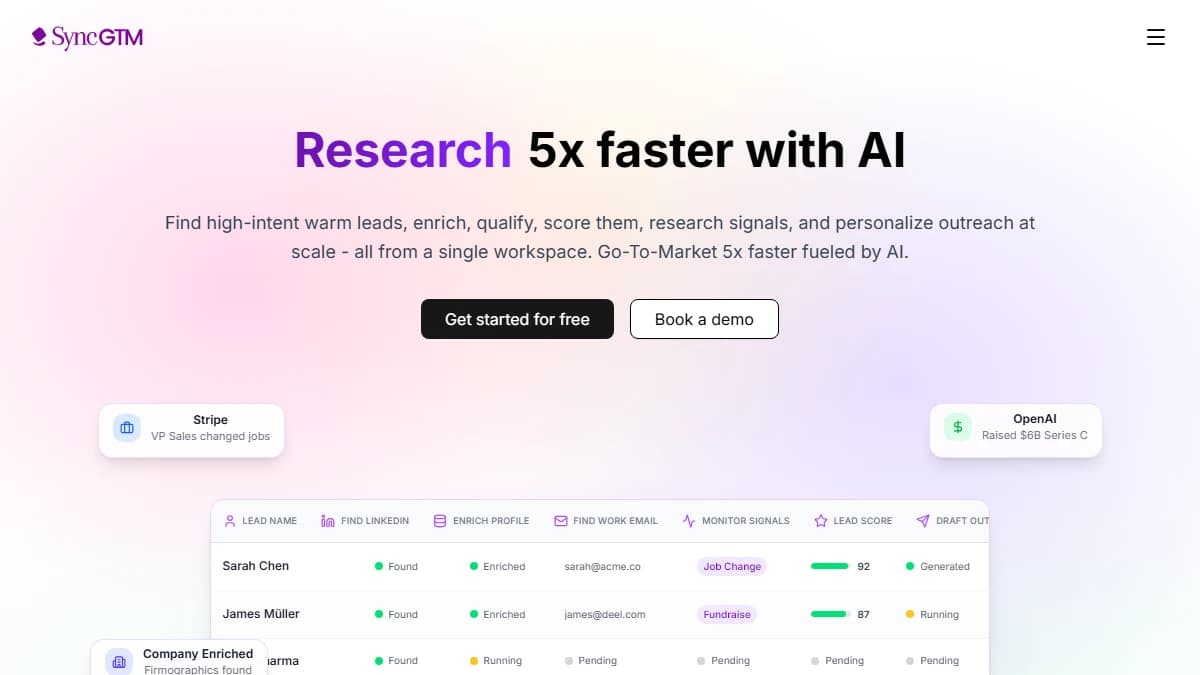
SyncGTM — waterfall enrichment across 50+ providers with verified contacts built in
SyncGTM is not an email verifier — it is a B2B prospecting platform built around waterfall enrichment. The comparison matters because the two tools solve adjacent problems that most B2B outbound teams need to address together.
MyEmailVerifier validates a list you already have. SyncGTM builds and verifies that list from scratch: verified email, direct dial, LinkedIn, and 76+ firmographic and technographic data points from a target account name or company URL. Verification is embedded in the enrichment output — cross-referenced across 50+ providers before delivery — making a separate verification step redundant for teams doing B2B prospecting end-to-end.
The workflow difference is concrete. A typical B2B outbound team using MyEmailVerifier needs: (1) a contact-finding tool to build the list, (2) MyEmailVerifier to clean it, (3) a CRM or outreach tool to sequence it. SyncGTM handles all three. Internal benchmarks show waterfall enrichment across 50+ providers delivers 20–40% higher contact coverage than any single data source, with verified deliverability as the baseline output — not a post-processing step.
Where MyEmailVerifier wins: the lowest entry price in the category ($4/1K, no monthly minimum), non-expiring credits, and zero commitment for teams with occasional, small-volume verification needs. For B2B outbound prospecting from scratch — where teams need to find contacts before cleaning them — SyncGTM eliminates the need for MyEmailVerifier entirely.
For a full breakdown of MyEmailVerifier alternatives, see our MyEmailVerifier alternatives guide.
Who Should Use MyEmailVerifier?
MyEmailVerifier makes sense in specific scenarios where its price advantage outweighs its feature gaps:
- Teams with very low or irregular verification volumes.If you verify fewer than 2,000–5,000 emails per month — or only clean lists a few times per year — MyEmailVerifier's pay-as-you-go model with no monthly minimum is the cheapest available option. Competitors like ZeroBounce require a $15/mo minimum even when you verify nothing.
- Marketers cleaning consumer email lists before campaigns.For newsletter operators, lead magnet campaigns, or e-commerce teams with primarily consumer lists (Gmail, Yahoo, Outlook addresses), MyEmailVerifier's verification accuracy should perform adequately. Catch-all complexity is lower on consumer domains, where SMTP probes give clearer results than on enterprise corporate servers.
- Developers needing a low-cost API for form validation. The REST API with no monthly minimum suits development teams building form validation into product flows where verification volume is low and variable. At $0.004/credit, the cost per form submission validation is negligible.
- Teams with pre-built lists that simply need a one-time clean. If you have an existing database from a previous campaign or a CRM import that needs hygiene before a re-engagement send — and you have no ongoing prospecting workflow — MyEmailVerifier handles that one-time job without locking you into a recurring subscription.
MyEmailVerifier is the wrong choice for B2B outbound teams who need to find contacts before verifying them, for teams with heavy enterprise-domain lists where catch-all scoring is critical, or for any team that needs the deliverability monitoring, spam-trap network integration, and integration library depth that ZeroBounce and NeverBounce provide.
For B2B teams evaluating verification as part of a broader data workflow, compare our reviews of BriteVerify, DeBounce, and MillionVerifier for direct verifier comparisons. For teams replacing the entire verification workflow with waterfall enrichment, see SyncGTM.