

Pardot Review 2026: Salesforce Account Engagement Pricing and Fit

By Kushal Magar · November 3, 2026 · 15 min read
Key Takeaway
Pardot, now Salesforce Marketing Cloud Account Engagement, is the default B2B marketing automation tool for teams that run Salesforce. It scores and grades every prospect, nurtures them with Engagement Studio, and ties campaigns to Salesforce opportunities. Editions run from $1,250 a month (Growth+) to $15,000 a month (Premium+), billed annually, with 10,000 contacts on the first three tiers. Plus+ is the edition most mid-market teams need. Our rating: 4.0/5.
This Pardot review is for B2B teams that run Salesforce and want to know if Marketing Cloud Account Engagement, the product Pardot became, is worth $15,000 or more a year. Short answer: yes for Salesforce-first, sales-led teams with an admin, and no for small teams or anyone on another CRM.
We read Salesforce's Account Engagement product page, pricing page, edition comparison grid, and Account Engagement+ FAQ in October 2026, plus Trailhead's grading module and user ratings on G2, Capterra, and Gartner Peer Insights. We did not run a paid org, so product capabilities are described as Salesforce lists them.
Most pages ranking for "Pardot review" still quote the old $2,500 Plus and $4,000 Advanced prices and skip Account Engagement+ entirely. This review covers the current Growth+ to Premium+ editions, which scoring features each one unlocks, and what a realistic contract costs.
TL;DR: Pardot Review 2026
- What it is:Salesforce's B2B marketing automation platform, renamed from Pardot to Marketing Cloud Account Engagement in 2022 and now sold as Account Engagement+.
- Strengths: native Salesforce sync, lead scoring and grading in every edition, Engagement Studio nurture programs, and ROI reporting tied to opportunities.
- Pricing: Growth+ $1,250, Plus+ $2,750, Advanced+ $4,400, Premium+ $15,000 per org per month, billed annually. 10,000 contacts included (75,000 on Premium+).
- What changed: every edition now includes access to Marketing Cloud Next (Agentforce Campaign Creation, SMS and WhatsApp, Data 360 segments), paid for with usage credits.
- Best for: Salesforce-first B2B teams with long, sales-led cycles and someone to own the platform.
- Skip it if:your CRM isn't Salesforce, your budget is under $15,000 a year, or you need a wide catalog of native integrations.
- Our rating: 4.0/5.
What Is Pardot (Account Engagement)?
Pardot is Salesforce's B2B marketing automation platform, sold today as Marketing Cloud Account Engagement. It captures leads with forms and landing pages, tracks what they do, scores and grades them, nurtures them, and hands sales-ready leads to reps inside Salesforce.
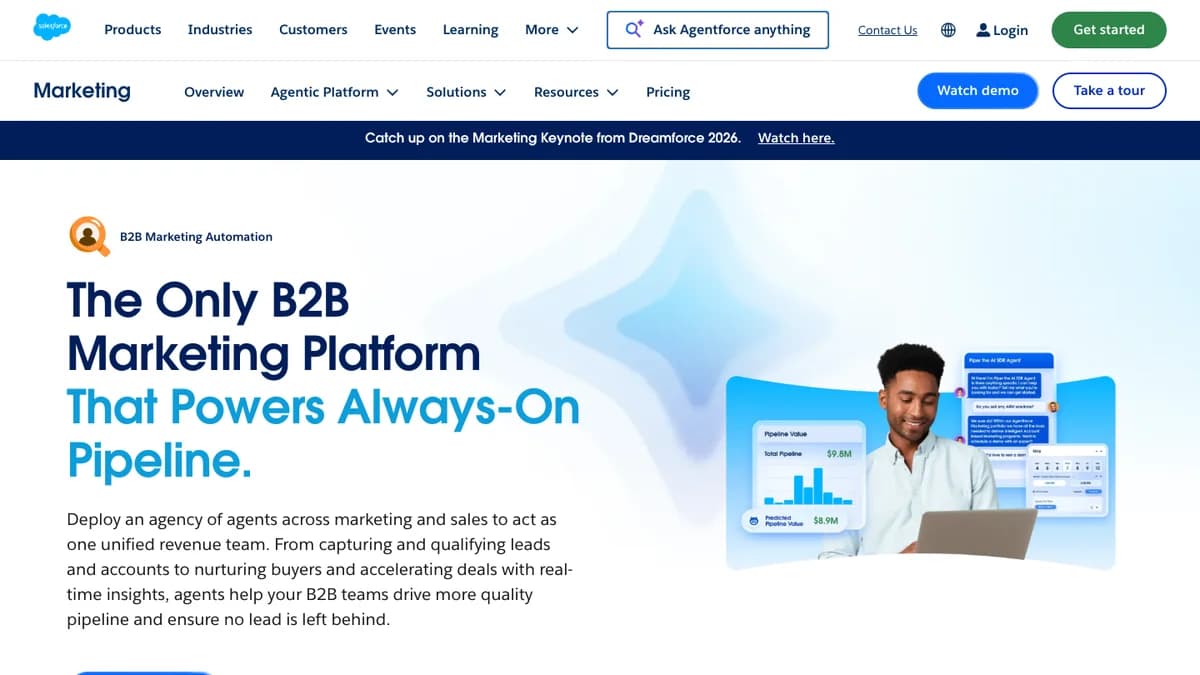
Account Engagement product page, October 2026. Salesforce now pitches it as an agent-powered B2B marketing platform.
Pardot started in Atlanta in 2007 and was bought by ExactTarget in 2012. Salesforce acquired ExactTarget in 2013 and dropped the Pardot name in 2022.
The 2026 pricing page doesn't use the word Pardot at all. Editions now carry a plus sign (Growth+, Plus+, Advanced+, Premium+) because each includes access to Marketing Cloud Next.
It is a B2B tool built for considered purchases with a sales team in the loop. Salesforce sells a different product, Marketing Cloud Engagement, for high-volume B2C email and journeys.
How Pardot Syncs With Salesforce
Pardot syncs prospects with Salesforce leads and contacts through the Salesforce-Account Engagement connector. Records match on email address, or on CRM ID when your account allows duplicate emails.
That native sync is the main reason teams buy it. What it covers:
- Leads and contacts: new Salesforce records can create prospects, and prospects can create leads. Each field has a sync rule: Salesforce wins, Account Engagement wins, or the most recent update wins.
- Campaigns: Account Engagement uses Salesforce campaigns, so campaign members and influence live in the CRM your sales team already uses.
- Activity for reps: engagement history components show email clicks, page views, and form fills on lead and contact records.
- Assignment: prospects can be assigned to users or queues from automations once they hit a score or grade.
- Manual control:admins can pause the connector, and users can push single records with "Sync with CRM" or "Send to Account Engagement."
Advanced+ includes 2 business units and Premium+ includes 5. Each business unit is a separate Account Engagement database inside one Salesforce org, which suits teams split by region or brand.
Reps who want to send tracked one-to-one emails and get alerts need the Sales Emails and Alerts add-on at $50 per user per month. If your nurture emails go out under a rep's name, our guide to sending Pardot emails from a sales person explains the sender merge fields.
The limit: Account Engagement is built around a Salesforce org. If your CRM is HubSpot, Microsoft Dynamics, or anything else, this is the wrong tool. Our Salesforce review covers the CRM side.
Pardot Lead Scoring and Grading
Pardot rates every prospect two ways: a score that measures engagement and a grade that measures fit. The pairing lets you route a highly engaged, well-fitting prospect (say, an A with a high score) ahead of a curious student with the same score.
| Dimension | Score | Grade |
|---|---|---|
| What it measures | Engagement: email clicks, page views, form fills, file downloads | Fit: job title, department, industry, company size, location |
| Format | A number that rises with activity | A letter from F to A+, starting at D |
| What moves it | Scoring rules, plus score changes inside automations | Profile criteria that raise or lower the grade by part of a letter |
| Typical use | MQL threshold and "ready to talk" alerts | Which MQLs reps call first |
Per Salesforce's Trailhead module on lead grading, every prospect starts at a D. The default profile checks five criteria: company size, industry, location, job title, and department.
What each edition unlocks
- All editions: prospect tracking, lead deduplication, and lead scoring and grading.
- Plus+ and up: multiple scoring categories (a separate score per product line) and rule-based account scoring.
- Advanced+ and Premium+: Einstein Lead Scoring, an AI model trained on your conversion history.
One inconsistency to raise with your rep: the Plus+ card on the pricing page advertises "AI-Powered Scoring," but the comparison grid lists Einstein Lead Scoring only for Advanced+ and Premium+. Get the exact AI scoring model written into your quote.
Grading is only as good as your profile fields. A prospect who gave only an email address has no title, industry, or company size to grade, so they sit at D no matter how well they fit. Progressive profiling on forms helps, but it fills fields slowly.
Nurture Programs: Engagement Studio
Engagement Studio is Pardot's visual builder for nurture programs, and it is included in every edition. You place actions, triggers, and rules on a canvas, with wait steps between them.
- Actions: send an email, adjust a score, add to a list, assign to a user, create a Salesforce task.
- Triggers: email opened or clicked, form completed, landing page visited, file downloaded.
- Rules: branch on field values, score, grade, or list membership.
Around the programs sit automation rules, completion actions, segmentation rules, and dynamic lists. Automation rules are capped at 50 on Growth+, 100 on Plus+, and 150 on Advanced+ and Premium+.
Personalization depends on edition. Advanced Dynamic Content is a $400 a month add-on on Growth+ and included from Plus+, while cross-object merge fields and rule-based dynamic content come through Account Engagement+.
Growth+ also caps you at 50 forms, 50 form handlers, and 50 landing pages. Plus+ removes those limits. For other ways to run nurture, see our list of lead nurturing tools.
Pardot Reporting and Attribution
Pardot's reporting strength is tying campaigns to Salesforce opportunities, but multi-touch attribution starts at Plus+. Growth+ gets ROI reporting and engagement dashboards only.
- ROI reporting (all editions): campaign cost against pipeline and closed-won revenue from Salesforce.
- Engagement history dashboards: 5 on Growth+, 10 on Plus+, 20 on Advanced+ and Premium+.
- Multi-touch attribution models: Plus+ and up.
- B2B Marketing Analytics: 5 licenses on Plus+, Advanced+, and Premium+. The Plus version, with predictive insights, is a $3,000 per user per month add-on below Premium+.
- Advanced Email Analytics: rendering previews and deeper email stats, $400 a month on Growth+, included from Plus+.
- Monitoring: 10 to 100 tracked competitors and 100 to 1,000 SEO keywords, depending on edition.
If attribution is why you're buying, Growth+ is the wrong edition. For more on measuring long B2B cycles, see tools that measure ROI on long sales cycles.
Account Engagement+ and Marketing Cloud Next: What Changed
Account Engagement+ gives every Account Engagement customer access to Marketing Cloud Next through permission set licenses, without a new SKU. Growth customers get Marketing Cloud Next Growth Edition, and Plus, Advanced, and Premium customers get Advanced Edition.
Salesforce lists five additions:
- Agentforce Campaign Creation: drafts campaign briefs, emails, and audience segments from natural-language prompts.
- SMS and WhatsApp: native messaging in journeys, which used to need third-party tools.
- Data 360 segmentation: segments built from Salesforce and non-Salesforce data.
- Advanced personalization: cross-object merge fields and rule-based dynamic content.
- Salesforce Flow for Marketers: journeys that span marketing, sales, service, and commerce.
The catch is cost and setup. Marketing Cloud Next is consumption based: you enable Salesforce Foundations (free) for Data 360 and starter credits, then buy extra Einstein, Messaging, and Data 360 credits as usage grows. Salesforce notes Data 360 may require a separate purchase.
Worried Pardot is being sunset? The Account Engagement pricing FAQ says there are no end-of-life, end-of-sale, or end-of-roadmap plans for the product.
Pardot Pricing 2026: Editions and Add-ons
Pardot pricing in 2026 runs from $1,250 to $15,000 per org per month, billed annually on an annual contract. Every tier is flat-rate per org, not per seat, with a contact cap.
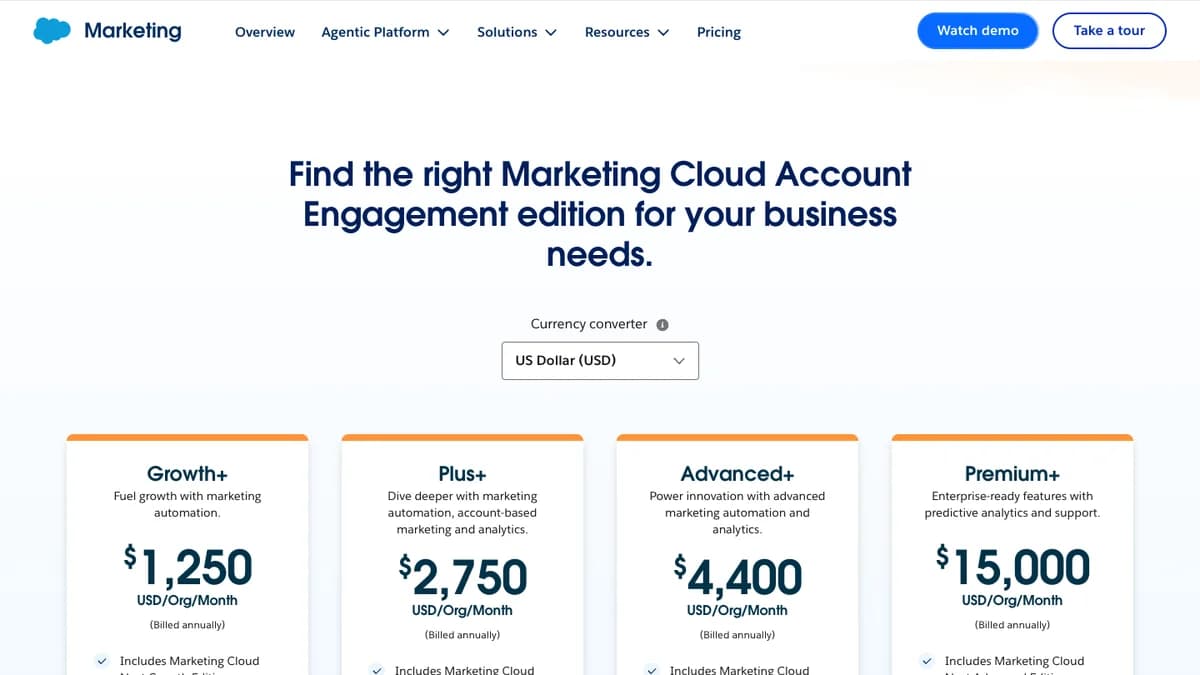
Account Engagement pricing page, October 2026. All four editions are billed annually.
| Edition | List price | Per year | Contacts | Notable inclusions |
|---|---|---|---|---|
| Growth+ | $1,250/org/mo | $15,000 | 10,000 | Lead scoring and grading, Engagement Studio, 50 forms and 50 landing pages, 50 automation rules, ROI reporting, Marketing Cloud Next Growth Edition |
| Plus+ | $2,750/org/mo | $33,000 | 10,000 | Unlimited forms and landing pages, 100 automation rules, multiple scoring categories, account scoring, multi-touch attribution, B2B Marketing Analytics (5 licenses), Marketing Cloud Next Advanced Edition |
| Advanced+ | $4,400/org/mo | $52,800 | 10,000 | 150 automation rules, Einstein Lead Scoring, 2 business units, 2 developer sandboxes, dedicated IP, custom object integration |
| Premium+ | $15,000/org/mo | $180,000 | 75,000 | 5 business units, 5 sandboxes, B2B Marketing Analytics Plus (5 licenses), bring-your-own encryption key, Premier Success |
Source: salesforce.com Account Engagement pricing, checked October 2026. Salesforce says the page is informational and subject to change.
Add-ons that change the bill
| Add-on | List price | Availability |
|---|---|---|
| Additional contacts | $100 per 10,000 contacts per month | All editions |
| Advanced Dynamic Content | $400/month | Add-on on Growth+, included from Plus+ |
| Advanced Email Analytics | $400/month | Add-on on Growth+, included from Plus+ |
| Custom Object Integration | $400/month | Not on Growth+, add-on on Plus+, included from Advanced+ |
| Dedicated IP address | $500/month | Not on Growth+, add-on on Plus+, included from Advanced+ |
| Sales Emails and Alerts | $50 per user per month | Lets reps send tracked emails and get prospect alerts |
| B2B Marketing Analytics Plus | $3,000 per user per month | Add-on on Plus+ and Advanced+, 5 licenses in Premium+ |
| SMS and WhatsApp credits | From $10 per 1,000 credits | SMS also needs setup and a leased code |
| Premier Success Plan | 30% of net license fees | Add-on below Premium+ |
Price changes since older reviews
Plus+ and Advanced+ list at $2,750 and $4,400, about 10% above the $2,500 and $4,000 many older Pardot reviews still quote. Growth+ and Premium+ are unchanged at $1,250 and $15,000.
Salesforce's first list price increase in seven years, reported by CMSWire as a 9% rise from August 2023, included Account Engagement. Salesforce doesn't publish a price history, so confirm current figures with your rep rather than trusting older reviews.
There is no self-serve trial. The pricing page offers a demo and a product tour, and every edition routes to "Contact us."
What Pardot Costs Per Year
A realistic Pardot contract runs $15,000 to $85,000 a year at list price for most B2B teams below enterprise. Contacts and add-ons move the number more than the edition does.
| Team | Setup | Monthly | Yearly |
|---|---|---|---|
| Small Salesforce shop | Growth+, 10,000 contacts, no add-ons | $1,250 | $15,000 |
| Mid-market, 10 reps | Plus+, 40,000 contacts (+3 blocks), Sales Emails and Alerts for 10 reps | $3,550 | $42,600 |
| Multi-region team | Advanced+, 100,000 contacts (+9 blocks), Premier Success at 30% | $6,890 | $82,680 |
Our illustrative math at list prices. Negotiated discounts, Sales Cloud licenses, Marketing Cloud Next credits, and implementation are not included.
Contacts are the line to watch. Every extra 10,000 contacts adds $1,200 a year, so archive unmailable and stale records before renewal.
Budget for people as well as software. Most teams need an Account Engagement admin or an implementation partner for the connector, scoring model, and first nurture programs.
What Users Say
Users rate Pardot around 4 out of 5, praising the Salesforce integration and criticizing the learning curve and price. Ratings at time of writing (October 2026):
- G2: about 4.0/5 from roughly 2,400 reviews.
- Capterra: 4.1/5 from about 650 reviews, with 3.8 for ease of use, customer service, and value for money, and 4.0 for features.
- Gartner Peer Insights: about 4.2/5 from roughly 720 ratings.
Common praise
- Tight Salesforce integration and shared campaign data.
- Visibility into prospect activity for sales reps.
- Scoring and grading that help sales prioritize.
Common complaints
- A steep learning curve without training or an admin.
- An email and template builder that often needs HTML help.
- A high entry price and add-ons that stack up.
- Fewer native third-party integrations than Marketo Engage.
Note the sub-scores. Capterra reviewers rate value for money and ease of use below features, which matches the pattern above: strong product, hard to run cheaply.
Who Should Pick Pardot, and Who Shouldn't
Pick Pardot if
- Salesforce is your CRM of record and reps work leads there.
- Your B2B sales cycle is long and sales-led, not self-serve.
- Your database sits between 10,000 and 100,000 contacts.
- You have, or will hire, someone to own the platform.
- You need campaign influence reported on Salesforce opportunities.
Skip Pardot if
- Your CRM is HubSpot, Dynamics, or anything other than Salesforce.
- Your marketing automation budget is under $15,000 a year.
- You send high-volume B2C email.
- You rely on many niche third-party apps with native connectors.
Which edition to buy
Plus+ is the practical default for mid-market teams: unlimited forms and landing pages, scoring categories, account scoring, multi-touch attribution, and B2B Marketing Analytics. Growth+ fits only if you need basic scoring and nurture on 10,000 contacts.
Advanced+ earns its price when you need business units, sandboxes, Einstein Lead Scoring, or a dedicated IP. Premium+ is for enterprises that also want Premier Success and encryption key control.
Pardot works best when marketing and sales agree on what an MQL is. Our guide to B2B marketing and sales alignment covers that groundwork.
Pardot Alternatives
The main Pardot alternatives are HubSpot Marketing Hub, Adobe Marketo Engage, Oracle Eloqua, and ActiveCampaign. Your CRM decides most of this choice.
| Tool | Best for | CRM fit | Pricing |
|---|---|---|---|
| HubSpot Marketing Hub | Teams that want marketing and CRM in one product | Own CRM, Salesforce sync available | Published tiers |
| Adobe Marketo Engage | Enterprise B2B programs with many integrations | Salesforce or Microsoft Dynamics | Quote-based |
| Oracle Eloqua | Large, complex global campaigns | Multiple CRMs | Quote-based |
| ActiveCampaign | Smaller teams that need lighter, cheaper automation | Own CRM plus integrations | Published tiers |
- HubSpot Marketing Hub:easier to learn and pairs with HubSpot's own CRM. See our HubSpot review for tiers.
- Adobe Marketo Engage: the closest enterprise match, with deeper program logic and more integrations, and it also runs on Microsoft Dynamics. See our Marketo review.
- Oracle Eloqua: built for large global teams running complex campaigns.
- ActiveCampaign: lighter and cheaper for smaller teams. Check how deep its Salesforce sync goes before switching.
Pardot Pros and Cons
Pros
- Native Salesforce sync for leads, contacts, and campaigns.
- Lead scoring and grading in every edition.
- Engagement Studio included on all tiers.
- ROI reporting tied to Salesforce opportunities.
- Marketing Cloud Next access with no new SKU.
- Large admin talent pool and free Trailhead training.
Cons
- $15,000 a year minimum at list price, annual contract only.
- Growth+ lacks attribution, analytics, and unlimited forms.
- Add-ons for contacts, IPs, objects, and rep email stack up.
- Marketing Cloud Next features run on paid usage credits.
- Dated email builder and a real learning curve.
- No fit for teams on a non-Salesforce CRM.
Pardot Review: Final Verdict
Our rating: 4.0/5. Pardot, now Marketing Cloud Account Engagement, is still the default marketing automation choice for B2B teams that live in Salesforce.
Native sync, scoring plus grading, Engagement Studio, and opportunity-level ROI reporting earn the score. Plus+ at $2,750 a month is the edition most mid-market teams should price first.
It loses points for its entry price, add-on creep, a learning curve, and the usage-based cost of the new Marketing Cloud Next features. Before you sign, get the AI scoring model, contact tier, and credit allowances written into the quote.
Pardot's grades and scores are only as good as the records it receives. SyncGTM enriches leads before they reach Salesforce and Account Engagement, with waterfall work email and phone lookups across 50+ providers, company and firmographic fields, and buying signals, written back through its 2-way Salesforce sync.