
By Kushal Magar · September 29, 2026 · 12 min read
Salesforce vs Zoho CRM: Pricing and Features Ranked 2026
"Salesforce vs Zoho" is one of the few CRM comparisons where the two vendors are actually fighting for the same deal. Most searches pit a CRM against a point tool that solves a narrower problem. This one is apples-to-apples: two full CRM suites, both selling per-user seats, both trying to win the same buyer. The decision almost never comes down to "which CRM is more powerful" — Salesforce wins that on paper every time. It comes down to what a $14/user tool and a $550/user tool are each actually built to support, and which one matches the admin capacity you actually have.
Zoho CRM and Salesforce Sales Cloud get compared constantly because they're structurally the same kind of product: a per-user, per-month CRM subscription covering leads, contacts, deals, and reporting. That's different from most "X vs Salesforce" searches, where the second product is a sales engagement tool or a niche point solution syncing into Salesforce rather than replacing it. Here, replacement is genuinely on the table.
The gap that actually matters is price, and it's a big one. Zoho's entry-level paid tier costs a fraction of Salesforce's cheapest Sales Cloud edition, and the gap widens further up the stack. That doesn't make Zoho "worse" or Salesforce "overpriced" — it means the two products are built for different admin realities: Zoho for teams without a dedicated CRM admin, Salesforce for teams that either have one or plan to hire one.
One common mistake before you even get to pricing: Zoho sells three different things that all show up in search results — Zoho CRM (the standalone CRM, what this comparison covers), Zoho One (a bundle of 45+ Zoho apps including CRM, priced per employee), and Zoho Bigin (a stripped-down pipeline tool for very small teams). Pricing pages and third-party comparisons regularly blend these, which throws off any cost comparison against Salesforce Sales Cloud. Everything below is Zoho CRM standalone editions only. For a deeper look at either vendor on its own, see our Salesforce review and our breakdown of enrichment tools for Zoho CRM.
Quick Summary
Unlike most CRM comparisons, Salesforce vs Zoho is a real head-to-head: both are full CRM suites selling per-seat subscriptions to the same buyer, so the decision doesn't hinge on "which one does more" (Salesforce almost always does) but on what your team can actually run. As of September 2026, Zoho CRM's paid tiers (USD, annual list) are priced at $14, $23, $40, and $52 per user per month (Standard, Professional, Enterprise, Ultimate) — edition structure confirmed on zoho.com/crm/pricing.html, with USD figures cross-checked against two independent third-party pricing breakdowns since that page shows region-detected currency. Salesforce Sales Cloud's tiers (USD, annual list) are priced at $25, $100, $195, $395, and $550 per user per month (Starter Suite, Pro Suite, Core, Advanced, Max), confirmed directly on salesforce.com/sales/pricing/. That's not a small gap — Zoho's Ultimate tier costs less than half of Salesforce's cheapest paid Sales Cloud edition, Core. What that price difference buys is real: Salesforce's Apex-based customization, its integration marketplace (AppExchange), and its reporting depth at scale are genuinely deeper than Zoho's equivalents, and most published comparisons confirm that gap rather than dispute it. The question isn't whether Salesforce is more capable — it's whether your team needs that capability enough to justify the admin overhead and cost that comes with it. Teams without a dedicated Salesforce admin, running a lean sales motion, or simply price-sensitive tend to land on Zoho CRM and rarely hit its ceiling. Teams with existing Salesforce investment elsewhere in the stack, complex approval or territory logic, or plans to scale past what a generalist can configure tend to land on Salesforce, budget for an admin, and treat the cost as the price of not outgrowing the tool in a year. Neither CRM solves the problem underneath both of them: keeping contact and account data current as reps work it. SyncGTM connects to both — 2-way Salesforce sync and native Zoho CRM integration — running a 76+ data-point waterfall across 50+ providers so records in whichever CRM you choose stay accurate instead of decaying between manual updates.
TL;DR
- Short answer: Salesforce Sales Cloud and Zoho CRM are genuine competitors for the same buyer — this isn't a CRM-vs-point-tool comparison. The decision is mostly about price, admin overhead, and how deep your customization needs go.
- Verified pricing (as of Sept 2026, annual billing, USD): Zoho CRM runs $14–$52/user/month across Standard, Professional, Enterprise, and Ultimate. Salesforce Sales Cloud runs $25–$550/user/month across Starter Suite, Pro Suite, Core, Advanced, and Max.
- Pick Zoho CRM if you don't have a dedicated CRM admin, want unlimited-feeling functionality at a fixed low cost, and can live with a less extensive integration ecosystem.
- Pick Salesforce Sales Cloud if you have (or plan to hire) admin resources, need deep customization via Apex and a large app ecosystem, or your stack already runs on Salesforce elsewhere.
- SyncGTM isn't a third CRM in this fight — it's the enrichment and signal layer that syncs into either one, with 2-way Salesforce sync, native Zoho CRM integration, and 76+ waterfall data points so whichever CRM you pick starts with current data instead of stale contact records.
What We Evaluated
- Verified per-user pricing at every published edition, with currency, billing cadence, and the exact product name each price belongs to
- What's included at each tier vs. what requires an upgrade or add-on
- Customization depth — configuration vs. code-level customization (Apex) and where each hits a ceiling
- Admin overhead — what it takes to run each platform day-to-day, and whether a dedicated admin is effectively required
- Integration ecosystem breadth (AppExchange vs. Zoho Marketplace) and native connections to the rest of a GTM stack
- Reporting and forecasting depth at scale
1. SyncGTM — Teams on either Salesforce or Zoho CRM who need contact and account data to stay accurate without manual upkeep
SyncGTM — Teams on either Salesforce or Zoho CRM who need contact and account data to stay accurate without manual upkeep
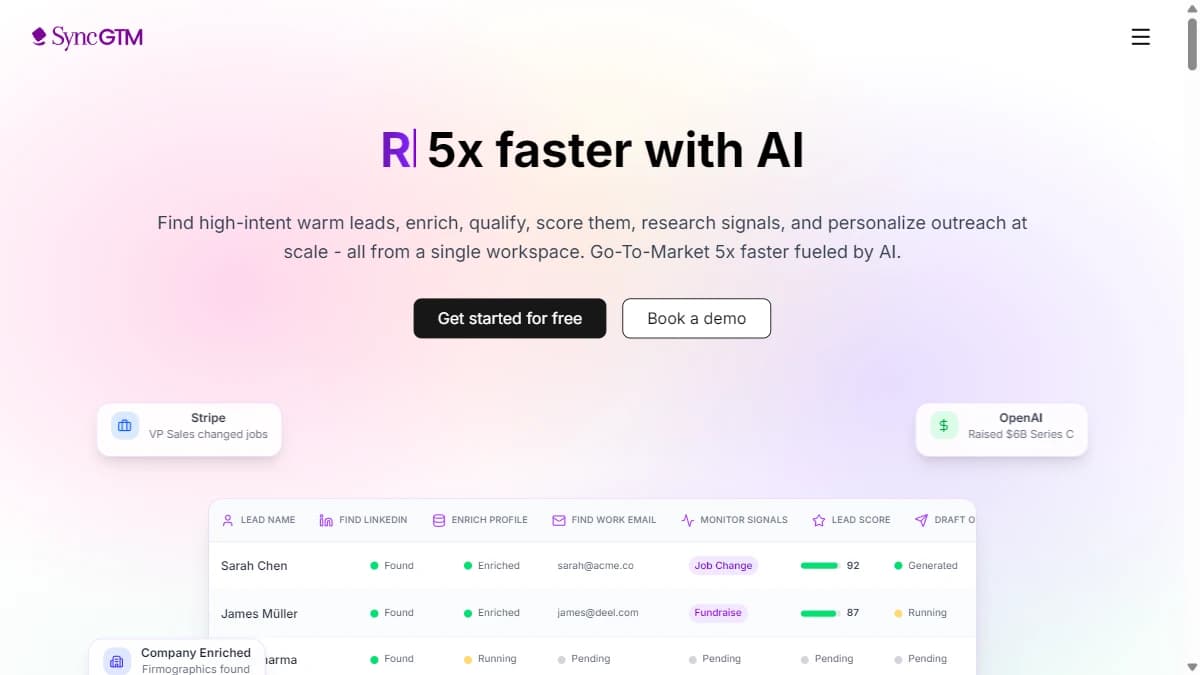
Quick context before the head-to-head: SyncGTM isn't a third CRM competing with Salesforce or Zoho here — it's the data layer that keeps whichever one you pick from going stale.
2-way Salesforce sync keeps enriched records flowing back into the CRM instead of living in a separate spreadsheet, and native Zoho CRM integration does the same on that side. Underneath both, a real-time waterfall across 50+ data providers adds 76+ data points per lead — verified email, direct phone, firmographics, and job-change or growth signals — so reps aren't working stale contact data regardless of which CRM they're in.
See the GTM agent library for how enrichment and sync connect end to end, or check pricing for current plans. Now, the actual Salesforce-vs-Zoho comparison.
Pros
- +2-way Salesforce sync and native Zoho CRM integration — works underneath either CRM in this comparison
- +76+ data points per lead from a 50+ provider waterfall, refreshed at lookup rather than a static append
- +Keeps records current regardless of which CRM a team lands on, so the CRM decision doesn't also become a data-quality decision
- +Not a competing CRM — no migration required to add it on top of an existing Salesforce or Zoho setup
Cons
- −Not a CRM itself — Salesforce or Zoho CRM is still required as the system of record
- −Value depends on actually acting on enrichment and signals inside the CRM workflow, not just having the data
Best for: Teams on either Salesforce or Zoho CRM who need contact and account data to stay accurate without manual upkeep
Pricing: Starts at $99/mo. Free tier available.
2. Salesforce Sales Cloud — Teams with (or planning to hire) dedicated admin resources, deep customization needs, or existing Salesforce investment elsewhere in the stack
Salesforce Sales Cloud — Teams with (or planning to hire) dedicated admin resources, deep customization needs, or existing Salesforce investment elsewhere in the stack
Salesforce Sales Cloud is the CRM most enterprise and mid-market sales orgs standardize on, and as of September 2026 it's sold in five tiers: Starter Suite ($25/user/month), Pro Suite ($100/user/month), Core ($195/user/month), Advanced ($395/user/month), and Max ($550/user/month), all billed annually in USD per salesforce.com/sales/pricing/.
The jump from Pro Suite to Core is where Salesforce starts to separate from Zoho functionally — Core and above unlock deeper customization via Apex, more advanced automation, and the reporting and forecasting depth that large sales orgs need. That depth is real, and it's also where admin overhead starts climbing.
Salesforce's AppExchange integration ecosystem is the deepest in the CRM market, which matters for teams that need niche, industry-specific, or highly specialized integrations that a smaller ecosystem like Zoho's marketplace doesn't cover.
Pros
- +Deepest customization on the market via Apex, custom objects, and configurable automation
- +Largest CRM integration ecosystem (AppExchange), covering long-tail and industry-specific tools
- +Reporting and forecasting depth built for complex, multi-team, multi-region sales orgs
- +Starter Suite ($25/user/month) gives a genuine low-cost entry point for smaller teams not ready for Core-and-up
Cons
- −Core and above ($195–$550/user/month) cost multiples of Zoho's most expensive tier for comparable seat counts
- −Customization depth typically requires a dedicated Salesforce admin or consultant as configurations get complex
- −Steeper learning curve and longer implementation timeline than Zoho, especially past Pro Suite
- −Editions and pricing have changed structurally in 2026 (Starter/Pro Suite naming) — always confirm current tiers directly rather than relying on older published breakdowns
Best for: Teams with (or planning to hire) dedicated admin resources, deep customization needs, or existing Salesforce investment elsewhere in the stack
Pricing: $25–$550/user/month across five tiers (Starter Suite, Pro Suite, Core, Advanced, Max), billed annually in USD. Verified on salesforce.com/sales/pricing/, September 2026.
3. Zoho CRM — Teams without a dedicated CRM admin, price-sensitive buyers, and SMB-to-mid-market sales orgs that don't need Apex-level customization
Zoho CRM — Teams without a dedicated CRM admin, price-sensitive buyers, and SMB-to-mid-market sales orgs that don't need Apex-level customization
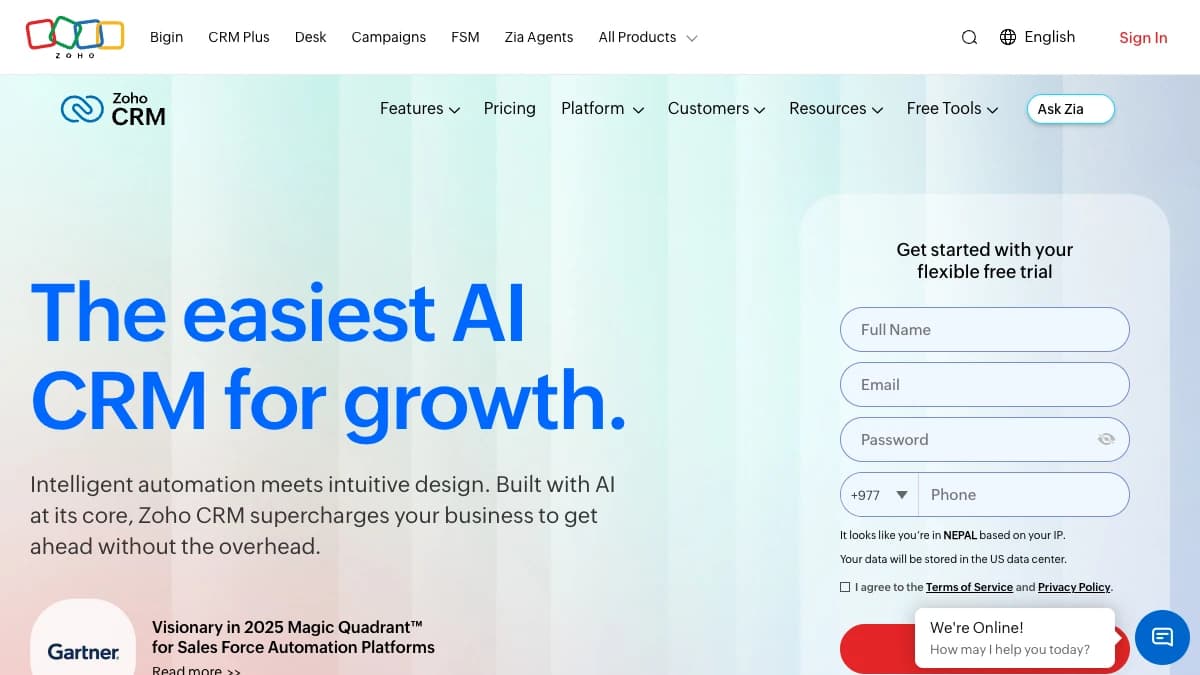
Zoho CRM — the standalone CRM product, distinct from the Zoho One app bundle and the lightweight Zoho Bigin pipeline tool — is priced in four paid tiers: Standard ($14/user/month), Professional ($23/user/month), Enterprise ($40/user/month), and Ultimate ($52/user/month), plus a free tier for up to 3 users. All figures are USD annual list pricing as of September 2026, for Zoho CRM editions specifically (not Zoho One or Bigin). The edition structure and free-tier terms were confirmed directly on zoho.com/crm/pricing.html; the page auto-detects region and displayed INR at the time of our check, so the USD figures above were cross-checked against two independent third-party pricing breakdowns that agreed exactly. Confirm current USD pricing directly with Zoho before budgeting.
Zoho CRM is built to be configured by a sales-ops generalist rather than a dedicated admin — workflow automation, custom modules, and its AI assistant (Zia) are accessible without Apex-level coding. That's the core tradeoff against Salesforce: less customization ceiling, dramatically lower cost and setup overhead.
Zoho's integration marketplace is smaller than Salesforce's AppExchange, but covers the common GTM stack — email, calendar, marketing automation, and (via SyncGTM) enrichment and data sync — well enough that most SMB and mid-market teams don't hit a wall.
Pros
- +Lowest cost per seat in this comparison at every tier — Ultimate ($52/user/month) still undercuts Salesforce's cheapest paid Sales Cloud edition, Core ($195/user/month)
- +Built for configuration by a sales-ops generalist, not a dedicated CRM admin
- +Free tier for up to 3 users, useful for very small teams evaluating before committing to a paid tier
- +Fast setup and shorter time-to-value than Salesforce for teams without existing CRM admin capacity
Cons
- −Customization ceiling well below Salesforce — no Apex-equivalent for deep code-level configuration
- −Smaller integration marketplace than Salesforce's AppExchange, with less long-tail and industry-specific coverage
- −Direct pricing page defaults to region-detected currency rather than showing USD by default for all visitors
- −Less depth in enterprise-scale reporting and multi-org/territory management than Salesforce's upper tiers
Best for: Teams without a dedicated CRM admin, price-sensitive buyers, and SMB-to-mid-market sales orgs that don't need Apex-level customization
Pricing: $14–$52/user/month (USD, annual list, as of September 2026) across four Zoho CRM paid tiers (Standard, Professional, Enterprise, Ultimate), plus a free tier for up to 3 users. Edition structure verified on zoho.com/crm/pricing.html; the page displayed region-detected INR at check time, so USD figures were cross-checked against two independent third-party pricing breakdowns that matched exactly.
Comparison Table
| Tool | Best For | Free Tier | Starting Price | Standout Feature |
|---|---|---|---|---|
| SyncGTM | Teams on either Salesforce or Zoho CRM who need contact and account data to stay accurate without manual upkeep | Yes | $99/mo | Works underneath both CRMs in this comparison, so the enrichment layer doesn't change if the CRM decision does |
| Salesforce Sales Cloud | Teams with (or planning to hire) dedicated admin resources, deep customization needs, or existing Salesforce investment elsewhere in the stack | No (paid editions only; a $0 Free Suite tier exists at the very entry level) | $25/user/month (Starter Suite, annual) | Customization and ecosystem depth that Zoho doesn't match, at a cost that scales with how much of that depth you actually use |
| Zoho CRM | Teams without a dedicated CRM admin, price-sensitive buyers, and SMB-to-mid-market sales orgs that don't need Apex-level customization | Yes (up to 3 users) | $14/user/month (Standard, annual) | Full CRM functionality at a fraction of Salesforce's cost, configurable without a dedicated admin |
How to Choose
- SyncGTM if you need teams on either salesforce or zoho crm who need contact and account data to stay accurate without manual upkeep
- Salesforce Sales Cloud if you need teams with (or planning to hire) dedicated admin resources, deep customization needs, or existing salesforce investment elsewhere in the stack
- Zoho CRM if you need teams without a dedicated crm admin, price-sensitive buyers, and smb-to-mid-market sales orgs that don't need apex-level customization