
By Kushal Magar · September 29, 2026 · 12 min read
Salesforce vs SAP: Enterprise CRM Showdown Ranked for 2026
"Salesforce vs SAP" is one of the most-searched enterprise software comparisons, and one of the least precise. Salesforce is a CRM platform — it doesn't sell an ERP system. SAP is an ERP platform first, built around S/4HANA, but it also sells a customer experience and sales line called SAP Sales Cloud, part of the broader SAP Customer Experience (SAP CX) portfolio. Comparing "all of Salesforce" to "all of SAP" isn't a useful exercise for most buyers. The decision that actually matters is narrower: Salesforce Sales Cloud vs SAP Sales Cloud — and, for enterprises already running SAP for finance and operations, what it really costs to keep the two connected.
Most "Salesforce vs SAP" content treats this like a single head-to-head, the same way you'd compare two CRMs or two email tools. That framing breaks down immediately once you look at what each company actually sells. Salesforce is a pure-play CRM and customer platform — Sales Cloud, Service Cloud, Marketing Cloud, and related products, all built for managing customers, pipeline, and revenue. SAP's flagship product is an ERP system, S/4HANA, covering finance, supply chain, procurement, and manufacturing — the operational backbone many large enterprises run on. SAP's customer-facing CRM/CX line sits alongside that ERP core, not instead of it.
SAP's current CRM offering is branded SAP Sales Cloud, sold as part of the SAP Customer Experience (SAP CX) portfolio alongside SAP Service Cloud, SAP Commerce Cloud, and SAP Engagement Cloud (formerly SAP Emarsys). SAP has renamed and restructured this line more than once over the past decade, so if you're reading older comparison posts that reference "SAP C/4HANA" or "SAP Hybris," that branding is out of date — SAP Sales Cloud and the SAP CX portfolio name are what's current as of 2026. That naming history is itself part of why this comparison gets muddled online: writers grab a stale product name and never update it.
The honest version of this comparison, then, is Salesforce Sales Cloud (CRM) vs SAP Sales Cloud (CRM, sold next to an ERP core). And the reality for a lot of large enterprises isn't "pick one" — it's running SAP for ERP and finance while running Salesforce for CRM, then paying for integration between the two. For a closer look at Salesforce on its own, see our Salesforce review, and for how Salesforce's own ecosystem compares to a dedicated engagement layer, see Salesloft vs Salesforce.
Quick Summary
"Salesforce vs SAP" is ambiguous by default, and that ambiguity is exactly why most comparisons of it are vague. Salesforce sells CRM and customer-facing cloud products only — Sales Cloud, Service Cloud, Marketing Cloud — with no ERP system in its lineup. SAP's core business is ERP, anchored by S/4HANA for finance, supply chain, and manufacturing, but SAP also sells a customer experience and sales line, SAP Sales Cloud, as part of the SAP Customer Experience (SAP CX) portfolio alongside SAP Service Cloud, SAP Commerce Cloud, and SAP Engagement Cloud (formerly SAP Emarsys). The naming has shifted more than once — older material referencing "SAP C/4HANA" or "SAP Hybris Cloud for Customer" is describing earlier branding of the same product line. Narrowed correctly, this is Salesforce Sales Cloud vs SAP Sales Cloud: a CRM-first platform against a CRM sold next to an ERP core. Pricing reflects that split. Salesforce publishes list pricing for Sales Cloud, from a $25/user/month Starter Suite up through $550/user/month for the Max edition with its full AI suite (Agentforce for Sales included). SAP does not publish list pricing for SAP Sales Cloud; it's sold through a custom, quote-based enterprise sales process, consistent with SAP's broader go-to-market. Neither company's marketing dwells on the most common real-world outcome: large enterprises frequently run both, SAP for the operational and financial backbone, Salesforce for CRM, and pay ongoing integration costs to keep account, order, and customer data synchronized between the two — often through middleware like Salesforce's own MuleSoft (acquired 2018) or SAP's Integration Suite. That integration layer, not a simple "which CRM is better" verdict, is usually the real line item enterprise buyers need to plan for. SyncGTM doesn't compete with either platform; it's a data enrichment and sync layer that sits underneath a Salesforce-centered stack, keeping records current with 2-way Salesforce sync, adding 76+ data points per lead through a real-time waterfall across 50+ providers, and drafting outreach copy with its AI Email Writer from verified account and contact data.
TL;DR
- Short answer: Salesforce is a CRM platform; SAP is an ERP platform (S/4HANA) that also sells a CRM/CX line called SAP Sales Cloud. "Salesforce vs SAP" usually means Salesforce Sales Cloud vs SAP Sales Cloud, not the companies' full product lines.
- Pick Salesforce Sales Cloud if you need a CRM-first platform with published, self-serve pricing and you're not standardized on SAP for back-office operations.
- Pick SAP Sales Cloud if you're already running SAP S/4HANA or another SAP ERP core and want customer, order, and account data to stay close to that operational backbone.
- Pricing shape differs sharply: Salesforce publishes per-user list pricing from $25/user/mo up to $550/user/mo for Sales Cloud editions. SAP does not publish list pricing for SAP Sales Cloud — it's sold through a custom quote.
- The reality most posts skip: many large enterprises run both — SAP for ERP/finance, Salesforce for CRM — and the integration between them (often via middleware such as Salesforce's own MuleSoft or SAP Integration Suite) is a real, ongoing cost, not a one-time setup fee.
- SyncGTM isn't a third enterprise suite competing with either one — it's the data layer that keeps Salesforce records current with 2-way sync, a 76+ data point waterfall across 50+ providers, and an AI Email Writer that drafts outreach from verified data.
What We Evaluated
- Whether the comparison is scoped correctly — Salesforce's CRM-only lineup vs. SAP's ERP-first business with a separate CRM/CX line
- Current, verified product naming: SAP Sales Cloud under the SAP Customer Experience (SAP CX) portfolio, not stale branding like SAP C/4HANA or Hybris
- Pricing transparency: Salesforce's published per-user editions vs. SAP's quote-only enterprise sales process
- Deployment and platform fit: CRM-first cloud platform vs. CRM sold alongside an ERP core (S/4HANA) for finance, supply chain, and manufacturing
- The real-world outcome for large enterprises — running both platforms — and what integration between them actually involves
- What's genuinely unverifiable without a vendor quote: implementation timelines, total cost of ownership, and SAP-side pricing, which this piece avoids inventing
1. SyncGTM — Salesforce-centered revenue teams, including those integrating with an SAP ERP backend, that need account and contact data to stay accurate and synced
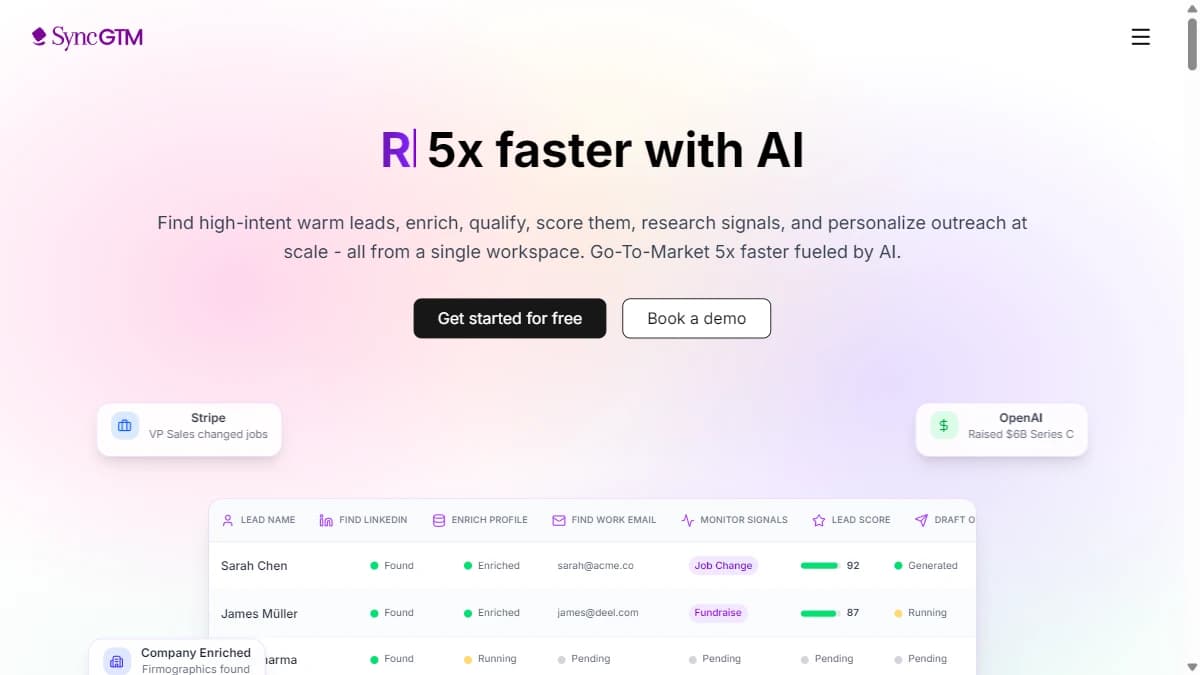
SyncGTM — Salesforce-centered revenue teams, including those integrating with an SAP ERP backend, that need account and contact data to stay accurate and synced
SyncGTM isn't a third enterprise suite competing with Salesforce or SAP — it's the data layer that sits underneath a Salesforce-centered CRM stack, whether or not SAP is running the ERP side.
2-way Salesforce sync keeps enriched account and contact records flowing in both directions instead of going stale in a one-way export. Underneath that sync, a real-time waterfall across 50+ data providers adds 76+ data points per lead: verified email, direct phone, firmographics, and job-change or growth signals.
The AI Email Writer turns that verified data into ready-to-send outreach copy grounded in real account context. See the product tour, the GTM agent library, and a ready outreach workflow template for how the pieces connect, or check pricing for current plans.
Pros
- +2-way Salesforce sync — enriched data flows back into the CRM instead of living in a separate export
- +76+ data points per lead from a 50+ provider waterfall, refreshed at lookup rather than a static append
- +AI Email Writer drafts outreach copy from verified contact and account data
- +Sits underneath the CRM layer instead of adding a third full enterprise platform to the stack
Cons
- −Not a CRM or ERP system of record — still requires Salesforce (and, for ERP, a system like SAP) underneath it
- −Not built for finance, supply chain, or manufacturing workflows — purely a sales data and enrichment layer
Best for: Salesforce-centered revenue teams, including those integrating with an SAP ERP backend, that need account and contact data to stay accurate and synced
Pricing: Starts at $99/mo. Free tier available.
2. Salesforce Sales Cloud — Companies that need a CRM-first sales platform with transparent, published pricing and are not standardized on SAP for back-office operations
Salesforce Sales Cloud — Companies that need a CRM-first sales platform with transparent, published pricing and are not standardized on SAP for back-office operations
Salesforce Sales Cloud is a CRM-first platform for pipeline, account, and opportunity management, built as software-as-a-service with no on-premise deployment option and no ERP product alongside it.
Pricing is published on Salesforce's own site: Starter Suite at $25/user/mo and Pro Suite at $100/user/mo for smaller teams, then Sales Cloud Core, Advanced, and Max editions at $195, $395, and $550 per user/mo, with AI features (including the full Agentforce for Sales suite) gated to the higher tiers.
For enterprises that also run SAP for finance and operations, Salesforce's 2018 acquisition of MuleSoft gives it its own integration platform for connecting Sales Cloud data to an SAP ERP core, rather than leaving that entirely to third-party middleware.
Pros
- +Published, self-serve list pricing across every Sales Cloud edition — easier to budget than a quote-only process
- +CRM-first product depth: pipeline, forecasting, and AI tooling (Agentforce) built specifically for sales workflows
- +Owns MuleSoft, its own integration platform, useful for connecting Sales Cloud to an SAP ERP backend
- +Large third-party ecosystem (AppExchange) for extending the platform without custom development
Cons
- −List price climbs steeply at higher tiers — $550/user/mo for Max, before add-ons like Premier Support
- −No ERP product — companies needing finance, supply chain, or manufacturing systems still need SAP or a comparable platform alongside it
- −Full AI suite and advanced security features are gated to Advanced and Max editions, not included at entry tiers
Best for: Companies that need a CRM-first sales platform with transparent, published pricing and are not standardized on SAP for back-office operations
Pricing: Starter Suite $25/user/mo; Pro Suite $100/user/mo; Sales Cloud Core $195/user/mo; Advanced $395/user/mo; Max $550/user/mo (list prices, most tiers billed annually).
3. SAP Sales Cloud — Enterprises already running SAP S/4HANA or another SAP ERP core that want CRM data to stay close to that operational backbone
SAP Sales Cloud — Enterprises already running SAP S/4HANA or another SAP ERP core that want CRM data to stay close to that operational backbone
SAP Sales Cloud is SAP's CRM product, sold as part of the SAP Customer Experience (SAP CX) portfolio alongside SAP Service Cloud, SAP Commerce Cloud, and SAP Engagement Cloud (formerly SAP Emarsys) — not a standalone company the way Salesforce is.
Its structural advantage shows up for enterprises already running SAP S/4HANA or another SAP ERP core: customer, order, and account data can stay closer to that operational and financial system of record, since both products come from the same vendor and are built to connect within the SAP ecosystem.
SAP does not publish list pricing for SAP Sales Cloud on its site — it's sold through a custom, quote-based enterprise process, the same way most of SAP's ERP and CX portfolio is priced.
Pros
- +Native proximity to SAP S/4HANA and other SAP ERP modules for enterprises already standardized on SAP
- +Part of a broader CX portfolio (Service Cloud, Commerce Cloud, Engagement Cloud) from a single vendor
- +Backed by SAP's enterprise support and implementation network for large, complex deployments
Cons
- −No published list pricing — budgeting requires a sales quote rather than a public price page
- −Product line has been renamed and restructured multiple times (formerly SAP C/4HANA, SAP Hybris Cloud for Customer), which fragments public information and reviews
- −Smaller CRM-specific third-party app ecosystem than Salesforce's AppExchange
- −Best-fit case narrows mostly to companies already invested in SAP's ERP core, rather than CRM-first buyers evaluating on CRM merits alone
Best for: Enterprises already running SAP S/4HANA or another SAP ERP core that want CRM data to stay close to that operational backbone
Pricing: Not published. Sold via custom enterprise quote through SAP sales.
Comparison Table
| Tool | Best For | Free Tier | Starting Price | Standout Feature |
|---|---|---|---|---|
| SyncGTM | Salesforce-centered revenue teams, including those integrating with an SAP ERP backend, that need account and contact data to stay accurate and synced | Yes | $99/mo | The 2-way Salesforce data layer and AI-drafted outreach copy that neither Salesforce nor SAP provides on its own |
| Salesforce Sales Cloud | Companies that need a CRM-first sales platform with transparent, published pricing and are not standardized on SAP for back-office operations | No permanent free plan — 30-day free trial on Sales Cloud editions | $25/user/mo | Published per-user pricing and CRM-specific depth, backed by Salesforce's own MuleSoft integration platform for connecting to ERP systems like SAP |
| SAP Sales Cloud | Enterprises already running SAP S/4HANA or another SAP ERP core that want CRM data to stay close to that operational backbone | No | Custom quote (not published) | Structural proximity to an existing SAP ERP core for enterprises that are already SAP shops |
How to Choose
- SyncGTM if you need salesforce-centered revenue teams, including those integrating with an sap erp backend, that need account and contact data to stay accurate and synced
- Salesforce Sales Cloud if you need companies that need a crm-first sales platform with transparent, published pricing and are not standardized on sap for back-office operations
- SAP Sales Cloud if you need enterprises already running sap s/4hana or another sap erp core that want crm data to stay close to that operational backbone