
By Kushal Magar · September 29, 2026 · 13 min read
Salesforce vs Dynamics 365: Complete CRM Comparison 2026
Salesforce vs Dynamics 365 gets searched constantly because, unlike most 'X vs Salesforce' comparisons, it's an actual fight for the same buyer. Both are full CRM suites selling per-user seats to enterprise and mid-market sales orgs, and both show up in the same shortlist when a company is picking (or replacing) its system of record. The decision almost never comes down to raw feature count — it comes down to which ecosystem, Microsoft's or Salesforce's, the company is already standardized on, and how much that gravity is worth fighting.
Salesforce Sales Cloud and Microsoft Dynamics 365 Sales get compared because they're structurally the same kind of purchase: a per-seat CRM subscription covering leads, opportunities, pipeline, and forecasting, sold to the same enterprise and mid-market buyer. That puts this comparison in different territory than most 'X vs Salesforce' searches, where the second product is a sales engagement tool or a niche point solution that syncs into Salesforce rather than replacing it.
One scoping error shows up in almost every published comparison on this keyword: treating 'Dynamics 365' as a single product. It isn't. Dynamics 365 is Microsoft's umbrella brand over a family of business apps — Sales, Customer Service, Finance, Supply Chain Management, and Business Central among them. The CRM-side comparison against Salesforce Sales Cloud is specifically Dynamics 365 Sales (with Customer Service as an adjacent app in the same Customer Engagement family). Finance, Supply Chain Management, and Business Central are Microsoft's ERP line — a different buying decision, a different budget owner, and out of scope here.
With scope fixed, the actual decision driver is ecosystem gravity, not a feature checklist. Dynamics 365 Sales is built to sit natively inside Microsoft 365, Teams, Outlook, and Azure — no middleware, no paid connector app. Salesforce Sales Cloud is built to be the deepest, most customizable CRM on the market, with the largest third-party ecosystem in AppExchange. Neither claim is close; the question is which one matters more given the stack your company already runs. For a look at how a narrower engagement tool stacks up against Salesforce instead of a full CRM competitor, see our Salesloft vs Salesforce breakdown.
Quick Summary
Salesforce vs Dynamics 365 is one of the rare CRM comparisons where both products are genuinely fighting for the same deal — full CRM suites, both sold per-seat, both capable of running an enterprise sales org end to end. Scoped correctly, this is Salesforce Sales Cloud vs Dynamics 365 Sales specifically, not the Dynamics 365 ERP apps (Finance, Supply Chain Management, Business Central), which solve a different problem entirely and shouldn't be blended into a CRM pricing comparison. As of September 2026, Dynamics 365 Sales is priced at $65, $105, and $150 per user per month billed annually across Professional, Enterprise, and Premium editions, confirmed on microsoft.com/en-us/dynamics-365/products/sales. Salesforce Sales Cloud is priced at $25, $100, $195, $395, and $550 per user per month billed annually across Starter Suite, Pro Suite, Core, Advanced, and Max, confirmed on salesforce.com/sales/pricing/. Dynamics undercuts Salesforce's upper tiers on list price, but the more useful lens isn't cost — it's ecosystem fit. Dynamics 365 Sales is built to live inside Microsoft 365, Teams, Outlook, and Azure without a paid connector or middleware layer, and Sales Premium bundles Copilot-based intelligence directly into the subscription. Salesforce Sales Cloud is built to be configured deeply — Apex code, custom objects, and the largest CRM integration marketplace in AppExchange — at a cost and admin overhead that scales with how much of that depth a team actually uses. Neither is a universal answer. A company already standardized on Microsoft 365 for email, docs, and collaboration tends to land on Dynamics 365 Sales because the CRM shows up where reps already work, and IT already manages the licensing and security model (Entra ID, compliance, tenant administration) underneath it. A company that needs deep, code-level customization, the widest third-party app coverage, or simply isn't invested in Microsoft's stack tends to land on Salesforce, and budgets for the admin resources that depth requires. One real cost lever worth knowing about on the Microsoft side: Dynamics 365's licensing guide describes discounted 'attach' pricing for a second Dynamics 365 app when a user already holds a qualifying base license elsewhere in the family — the specific discount depends on which base app is held and which app is being attached, and it's worth asking a Microsoft rep or reseller about directly rather than assuming a number. Neither CRM solves the problem underneath both of them: keeping contact and account data current as reps work it. SyncGTM connects to both — 2-way Salesforce sync and native Dynamics 365 integration — running a 76+ data-point waterfall across 50+ providers so records in whichever CRM a team runs stay accurate instead of decaying between manual updates.
TL;DR
- Short answer: Salesforce Sales Cloud and Dynamics 365 Sales are genuine competitors for the same buyer. The decision mostly comes down to which ecosystem — Microsoft 365 or Salesforce AppExchange — your company already runs on, plus admin capacity and customization depth.
- Verified pricing (as of September 2026, annual billing, USD): Dynamics 365 Sales runs $65–$150/user/month across Professional, Enterprise, and Premium. Salesforce Sales Cloud runs $25–$550/user/month across Starter Suite, Pro Suite, Core, Advanced, and Max.
- Scope check: This comparison covers Dynamics 365 Sales only, not the Dynamics 365 ERP line (Finance, Supply Chain Management, Business Central) — those solve a different problem for a different budget owner.
- Pick Dynamics 365 Sales if your company is already deep in Microsoft 365/Teams/Azure, IT already manages Microsoft licensing and security, and you want CRM data surfaced inside tools reps already live in.
- Pick Salesforce Sales Cloud if you need the deepest customization (Apex, custom objects), the largest integration ecosystem (AppExchange), or your stack isn't meaningfully built on Microsoft.
- SyncGTM isn't a third CRM in this comparison — it's the enrichment and signal layer that syncs into either one, with 2-way Salesforce sync and native Dynamics 365 integration, so whichever ecosystem you pick starts with current data instead of stale contact records.
What We Evaluated
- Verified per-user pricing at every published edition, with currency, billing cadence, and the exact product name each price belongs to
- Correct product scope — Dynamics 365 Sales specifically, not the Dynamics 365 ERP apps (Finance, Supply Chain Management, Business Central)
- Native depth inside Microsoft 365/Teams/Outlook/Azure vs. Salesforce's AppExchange integration breadth
- Customization ceiling — configuration vs. code-level customization (Apex on Salesforce; Power Platform/Power Apps on Dynamics)
- Admin overhead and IT capacity required to run each platform day-to-day
- AI features included in the subscription (Copilot in Dynamics 365 Sales Premium) vs. sold separately (Agentforce on Salesforce)
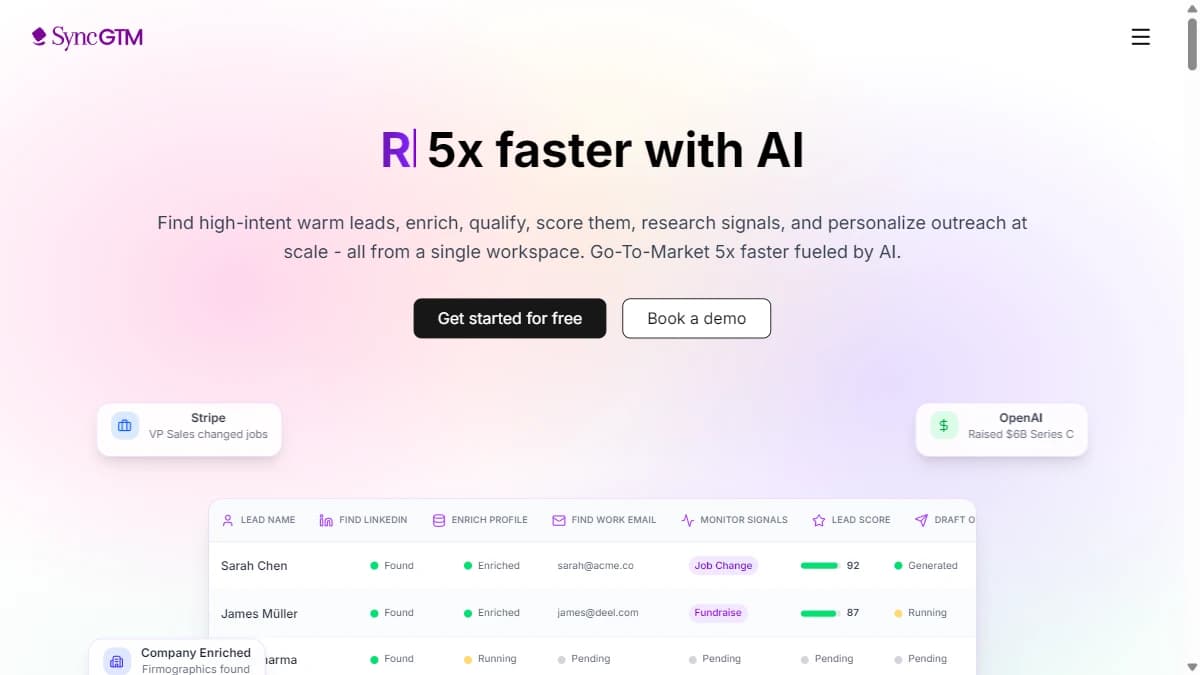
1. SyncGTM — Teams on either Salesforce or Dynamics 365 Sales who need contact and account data to stay accurate without manual upkeep
SyncGTM — Teams on either Salesforce or Dynamics 365 Sales who need contact and account data to stay accurate without manual upkeep
Quick context before the head-to-head: SyncGTM isn't a third CRM competing with Salesforce or Dynamics 365 here — it's the data layer that keeps whichever one you pick from going stale.
2-way Salesforce sync keeps enriched records flowing back into the CRM instead of living in a separate spreadsheet, and native Dynamics 365 integration does the same on the Microsoft side. Underneath both, a real-time waterfall across 50+ data providers adds 76+ data points per lead — verified email, direct phone, firmographics, and job-change or growth signals — so reps aren't working stale contact data regardless of which CRM they're in.
See pricing for current plans, or the product tour for how enrichment and sync connect end to end. Now, the actual Salesforce-vs-Dynamics 365 comparison.
Pros
- +2-way Salesforce sync and native Dynamics 365 integration — works underneath either CRM in this comparison
- +76+ data points per lead from a 50+ provider waterfall, refreshed at lookup rather than a static append
- +Keeps records current regardless of which ecosystem a team lands on, so the CRM decision doesn't also become a data-quality decision
- +Not a competing CRM — no migration required to add it on top of an existing Salesforce or Dynamics 365 setup
Cons
- −Not a CRM itself — Salesforce or Dynamics 365 Sales is still required as the system of record
- −Value depends on actually acting on enrichment and signals inside the CRM workflow, not just having the data
Best for: Teams on either Salesforce or Dynamics 365 Sales who need contact and account data to stay accurate without manual upkeep
Pricing: Starts at $99/mo. Free tier available.
2. Salesforce Sales Cloud — Teams needing the deepest customization or integration ecosystem, or without meaningful existing investment in Microsoft 365
Salesforce Sales Cloud — Teams needing the deepest customization or integration ecosystem, or without meaningful existing investment in Microsoft 365
Salesforce Sales Cloud is the CRM most enterprise and mid-market sales orgs standardize on when customization depth matters more than ecosystem fit. As of September 2026 it's sold in five tiers: Starter Suite ($25/user/month), Pro Suite ($100/user/month), Core ($195/user/month), Advanced ($395/user/month), and Max ($550/user/month), all billed annually in USD per salesforce.com/sales/pricing/.
The jump from Pro Suite to Core is where Salesforce starts to separate functionally from Dynamics — Core and above unlock deeper customization via Apex, more advanced automation, and forecasting depth built for complex, multi-team sales orgs. That depth is real, and it's also where admin overhead starts climbing.
Salesforce's AppExchange integration ecosystem is the deepest in the CRM market — the tradeoff against Dynamics 365 is that Microsoft 365 and Teams integration runs through connector setup rather than native platform depth, since Salesforce isn't built by Microsoft.
Pros
- +Deepest customization on the market via Apex, custom objects, and configurable automation
- +Largest CRM integration ecosystem (AppExchange), covering long-tail and industry-specific tools
- +Forecasting and reporting depth built for complex, multi-team, multi-region sales orgs
- +Starter Suite ($25/user/month) undercuts Dynamics 365 Sales Professional ($65/user/month) at the entry tier
Cons
- −Core and above ($195–$550/user/month) cost meaningfully more than Dynamics 365 Sales Premium ($150/user/month) at the top of each stack
- −Microsoft 365 and Teams integration requires separate connector setup rather than native platform depth
- −Customization depth typically requires a dedicated Salesforce admin or consultant as configurations get complex
- −Agentforce AI capabilities are sold as an add-on rather than bundled into every Sales Cloud edition
Best for: Teams needing the deepest customization or integration ecosystem, or without meaningful existing investment in Microsoft 365
Pricing: $25–$550/user/month across five tiers (Starter Suite, Pro Suite, Core, Advanced, Max), billed annually in USD. Verified on salesforce.com/sales/pricing/, September 2026.
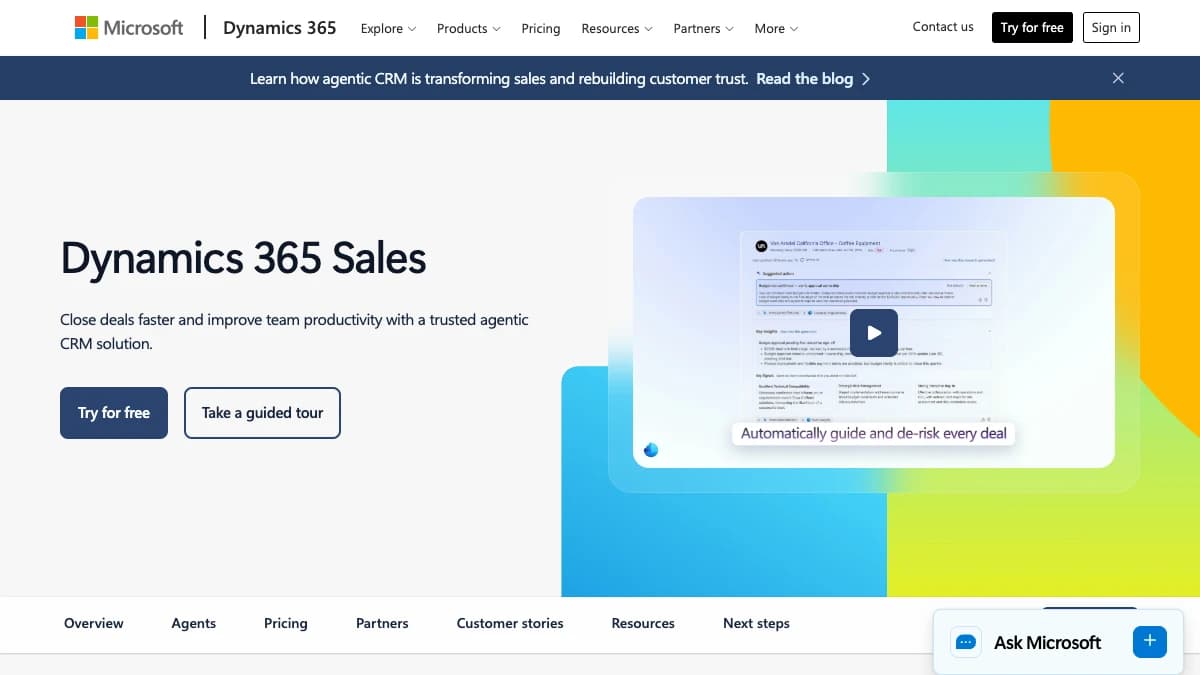
3. Microsoft Dynamics 365 Sales — Teams already standardized on Microsoft 365/Teams/Azure, where CRM data showing up natively in tools reps already use outweighs Salesforce's customization depth
Microsoft Dynamics 365 Sales — Teams already standardized on Microsoft 365/Teams/Azure, where CRM data showing up natively in tools reps already use outweighs Salesforce's customization depth
Dynamics 365 Sales — specifically the CRM app, not the Dynamics 365 Finance, Supply Chain Management, or Business Central ERP apps that share the Dynamics 365 brand — is priced in three tiers: Sales Professional ($65/user/month), Sales Enterprise ($105/user/month), and Sales Premium ($150/user/month). All figures are USD, billed annually, confirmed on microsoft.com/en-us/dynamics-365/products/sales as of September 2026.
The core pitch against Salesforce is native depth: Dynamics 365 Sales is built by Microsoft to sit inside Microsoft 365, Teams, and Outlook without middleware or a paid connector app, and Sales Premium bundles Copilot-based prebuilt intelligence directly into the subscription rather than as a separate line item.
Licensing has a real nuance worth knowing before budgeting: Microsoft's Dynamics 365 Licensing Guide describes discounted 'attach' pricing for a second Dynamics 365 app when a user already holds a qualifying base license elsewhere in the family, and Dynamics capacity for anything beyond out-of-box Sales functionality can draw on Power Platform premium connector entitlements. Confirm both directly with a Microsoft rep or reseller rather than assuming a discount rate — for context on how a different platform-consolidation argument plays out, see our Salesforce vs ServiceNow comparison.
Pros
- +Native integration with Microsoft 365, Teams, and Outlook — no middleware or paid connector app required
- +Sales Premium ($150/user/month) bundles Copilot-based AI directly into the subscription
- +Top tier (Sales Premium) costs less than Salesforce's Core, Advanced, and Max editions
- +Attach licensing can lower the effective cost of a second Dynamics 365 app for companies already on Microsoft's stack
Cons
- −Entry tier (Sales Professional, $65/user/month) costs more than Salesforce's Starter Suite ($25/user/month)
- −Smaller third-party integration marketplace than Salesforce's AppExchange outside the Microsoft ecosystem
- −Customization beyond configuration relies on the Power Platform (Power Apps, Power Automate) rather than a code layer as mature as Apex
- −Value drops sharply for companies not already standardized on Microsoft 365 — the native-integration advantage doesn't apply
Best for: Teams already standardized on Microsoft 365/Teams/Azure, where CRM data showing up natively in tools reps already use outweighs Salesforce's customization depth
Pricing: $65–$150/user/month across three tiers (Sales Professional, Sales Enterprise, Sales Premium), billed annually in USD. Verified on microsoft.com/en-us/dynamics-365/products/sales, September 2026.
Comparison Table
| Tool | Best For | Free Tier | Starting Price | Standout Feature |
|---|---|---|---|---|
| SyncGTM | Teams on either Salesforce or Dynamics 365 Sales who need contact and account data to stay accurate without manual upkeep | Yes | $99/mo | Works underneath both CRMs in this comparison, so the enrichment layer doesn't change if the ecosystem decision does |
| Salesforce Sales Cloud | Teams needing the deepest customization or integration ecosystem, or without meaningful existing investment in Microsoft 365 | No (paid editions only; a $0 Free Suite tier exists at the very entry level) | $25/user/month (Starter Suite, annual) | Customization and AppExchange ecosystem depth that Dynamics doesn't match, independent of which productivity suite a company runs on |
| Microsoft Dynamics 365 Sales | Teams already standardized on Microsoft 365/Teams/Azure, where CRM data showing up natively in tools reps already use outweighs Salesforce's customization depth | No | $65/user/month (Sales Professional, annual) | Native Microsoft 365 and Teams depth plus bundled Copilot AI at the top tier, at a lower ceiling price than Salesforce's upper editions |
How to Choose
- SyncGTM if you need teams on either salesforce or dynamics 365 sales who need contact and account data to stay accurate without manual upkeep
- Salesforce Sales Cloud if you need teams needing the deepest customization or integration ecosystem, or without meaningful existing investment in microsoft 365
- Microsoft Dynamics 365 Sales if you need teams already standardized on microsoft 365/teams/azure, where crm data showing up natively in tools reps already use outweighs salesforce's customization depth