
By Kushal Magar · September 28, 2026 · 12 min read
Salesforce vs ServiceNow: Which Platform Fits GTM in 2026?
Type "Salesforce vs ServiceNow" into Google and you'll find a comparison that used to be easy: one is a CRM, the other is an IT help desk. That's no longer the full picture. ServiceNow has spent the last few years building toward the front office — sales, order management, customer service — while Salesforce has pushed further into workflow automation and agentic AI that looks a lot like what ServiceNow built its name on. Neither company is abandoning its roots, but the overlap is real enough now that a genuine question sits underneath the search: if you already own one of these platforms, can it do the other one's job?
Salesforce and ServiceNow aren't natural rivals in the way Salesforce and HubSpot are, or the way ServiceNow and Jira Service Management are. They were built for different buyers, solving different problems, and for most of their history that was the whole story. Salesforce grew up as a CRM — Sales Cloud, Service Cloud, Marketing Cloud — the system most companies run revenue and customer records through. ServiceNow grew up as an IT service management platform, the system that runs incident tickets, change requests, and internal workflow across IT, HR, and facilities teams.
What's changed is that both vendors have spent real product investment moving toward the middle. ServiceNow now sells a CRM-branded Sales and Order Management product built for front-office teams, and positions its platform for customer service and sales workflows, not just internal IT. Salesforce, for its part, has leaned hard into agentic workflow automation with Agentforce — including Agentforce Operations, which reached general availability in April 2026 and is built specifically to complete cross-system work rather than just hand off a ticket. That convergence, not a head-to-head "CRM vs. help desk" fight, is the real story behind this comparison.
This isn't a ranked list — it's a platform-vs-platform breakdown for a specific buyer question: if you already run one of these two, do you need the other, or can the one you have stretch to cover it. For a narrower comparison — an engagement layer against the CRM system of record it syncs into — see our Salesloft vs Salesforce post. For a deeper look at Salesforce on its own, see our Salesforce review.
Quick Summary
For a GTM team, "Salesforce vs ServiceNow" is usually really a platform-consolidation question: we already own one of these, can it do the other job well enough that we don't buy a second enterprise platform. The honest answer is that both vendors have moved toward the middle, but neither one has fully replaced what the other does best. Salesforce remains the CRM system of record most sales, service, and marketing teams report revenue and customer data out of, and it has pushed into workflow and agentic automation with Agentforce, including Agentforce Operations reaching general availability in April 2026 for cross-system, agent-completed work. ServiceNow remains the platform most IT, HR, and internal-operations teams run ticketing and change management on, and it has pushed into front-office CRM with a dedicated Sales and Order Management product that connects the lead-to-cash cycle into its existing service and fulfillment workflows. Teams standardized on Salesforce with sales and service as the core motion tend to stay there and adopt Agentforce as automation needs grow. Teams standardized on ServiceNow with IT and enterprise workflow as the core motion, that are now extending into front-office use cases like order management, tend to evaluate ServiceNow's own CRM tools before adding a second platform. Neither platform decision changes the underlying problem of keeping contact and account data accurate. SyncGTM isn't a competitor to either — it's the enrichment and sync layer underneath whichever one you run, with 2-way Salesforce sync so enriched records flow both directions, 76+ data points per lead pulled through a waterfall across 50+ providers, and an AI Email Writer that turns that data into sequence-ready copy.
TL;DR
- Short answer: Salesforce and ServiceNow aren't interchangeable, even where they now overlap. Salesforce is still the CRM most revenue teams report out of; ServiceNow is still the platform most IT and enterprise-workflow teams run on.
- The real overlap: ServiceNow now sells a front-office CRM product (Sales and Order Management), and Salesforce now sells cross-system workflow automation (Agentforce Operations). Each is reaching into the other's traditional territory.
- Pick Salesforce if your buying decision starts with sales, service, or marketing — pipeline, quota, and customer-facing case management are the job to be done.
- Pick ServiceNow if your buying decision starts with IT, HR, or internal enterprise workflow — ticketing, change management, and cross-department process automation are the job to be done.
- SyncGTM is not a third enterprise platform competing with either — it's the data layer underneath whichever one runs your GTM data, with 2-way Salesforce sync, 76+ waterfall enrichments, and an AI Email Writer that drafts from verified account data.
What We Evaluated
- What each platform was originally built to be the system of record for — customer/revenue data, or IT and enterprise workflow
- Where the 2026 product overlap is genuinely shipping (ServiceNow's front-office CRM, Salesforce's Agentforce workflow automation) versus roadmap talk
- Whether the buying trigger is a sales/service/marketing motion or an IT/HR/internal-operations motion
- Admin and implementation model — configuration depth, customization, and how much specialized admin resourcing each requires
- Pricing transparency — what's publicly listed versus quote-only
- How each handles the data feeding sales and service workflows: enrichment, verification, and sync freshness
1. SyncGTM — GTM teams running Salesforce, a ServiceNow-connected front-office stack, or both, who need the contact and account data behind those workflows to stay accurate and synced
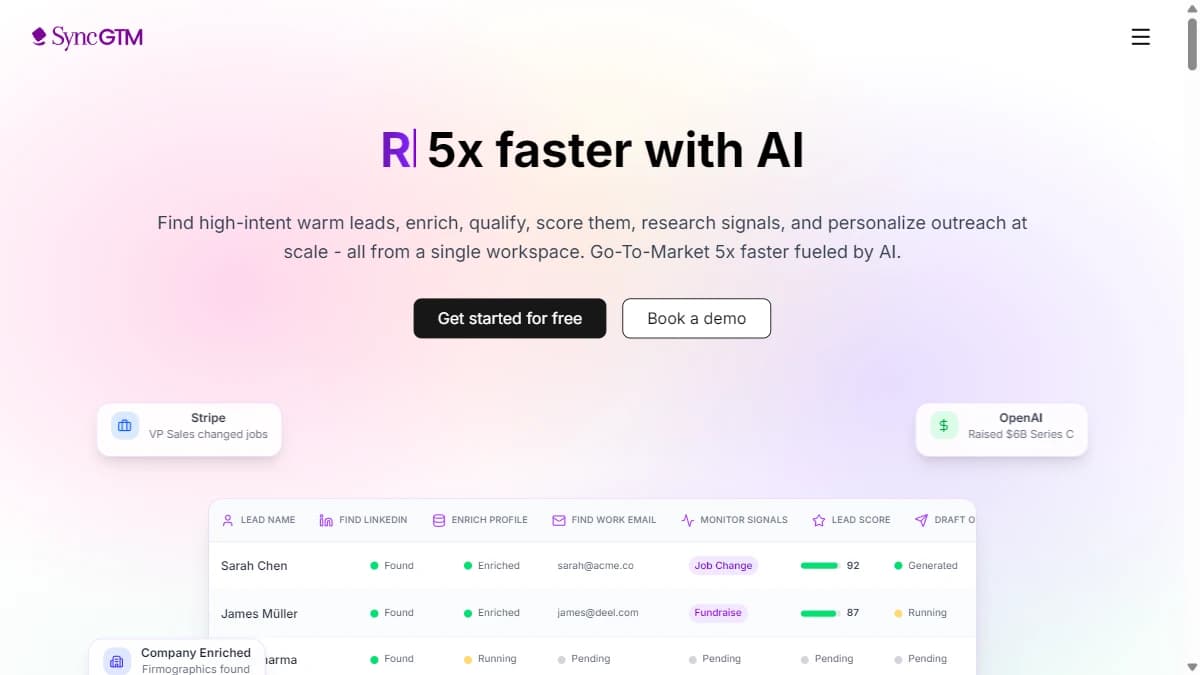
SyncGTM — GTM teams running Salesforce, a ServiceNow-connected front-office stack, or both, who need the contact and account data behind those workflows to stay accurate and synced
Quick context before the platform breakdown: SyncGTM isn't a third enterprise platform sitting alongside Salesforce and ServiceNow here — it's not a CRM and it's not a workflow-automation suite. It's the data layer underneath whichever one (or both) your GTM team runs on.
2-way Salesforce sync keeps enriched contact and account records flowing in both directions, so the CRM data feeding sales and service workflows doesn't go stale between enrichment runs. Underneath that sync, a real-time waterfall across 50+ data providers adds 76+ data points per lead — verified email, direct phone, firmographics, and job-change or growth signals.
The AI Email Writer turns that verified data into sequence-ready copy, useful whether outbound runs through Salesforce natively, a dedicated engagement tool, or a ServiceNow-connected front-office workflow. See current pricing for plan details, or the Salesforce review and Salesloft vs Salesforce comparison for related reading. Now, the actual platform comparison.
Pros
- +2-way Salesforce sync — enriched data flows back into the CRM instead of sitting in a separate export
- +76+ data points per lead from a 50+ provider waterfall, refreshed at lookup rather than a static append
- +AI Email Writer drafts outreach copy from verified contact and account data
- +Sits underneath Salesforce, ServiceNow-connected front-office workflows, or both — not a competing platform
Cons
- −Not a CRM or ITSM platform — Salesforce or ServiceNow is still required as the system of record
- −Not a workflow-automation suite — doesn't replace Agentforce Operations or ServiceNow's process automation
Best for: GTM teams running Salesforce, a ServiceNow-connected front-office stack, or both, who need the contact and account data behind those workflows to stay accurate and synced
Pricing: Starts at $99/mo. Free tier available.
2. Salesforce — Sales, service, and marketing organizations that need CRM as the system of record, with room to add agentic workflow automation on top
Salesforce — Sales, service, and marketing organizations that need CRM as the system of record, with room to add agentic workflow automation on top
Salesforce is the CRM most sales, service, and marketing teams run on — the system of record for accounts, contacts, opportunities, pipeline stages, and the reporting revenue leadership pulls from, across Sales Cloud, Service Cloud, and Marketing Cloud.
Salesforce's push into workflow automation and agentic AI runs through Agentforce, most recently Agentforce Operations, which reached general availability in April 2026 and is built to have agents complete cross-system work rather than just route a ticket. That's the closest Salesforce gets to ServiceNow's core workflow-automation territory, without being a dedicated ITSM replacement.
On pricing, Salesforce is one of the few enterprise platforms in this comparison that lists numbers publicly: Sales Cloud runs from a Free Suite up through Starter Suite, Pro Suite, Core, Advanced, and Max editions, each priced per user per month and published on Salesforce's own pricing page — though enterprise contracts and other clouds are frequently negotiated and quoted separately.
Pros
- +Deepest CRM-specific functionality on the market: Sales Cloud, Service Cloud, Marketing Cloud, and a mature AppExchange ecosystem
- +Sales Cloud list pricing is published per edition, giving a starting reference point most enterprise platforms don't offer
- +Agentforce Operations extends the platform into cross-system workflow automation without requiring a separate vendor
- +Extensive integration ecosystem and reporting depth built up over two decades as a CRM system of record
Cons
- −Not a dedicated ITSM platform — internal IT ticketing, change management, and enterprise workflow are not Salesforce's core built-for use case
- −Published Sales Cloud pricing covers list editions only; enterprise deals, other clouds, and add-ons are frequently quoted separately
- −Steep implementation curve at scale, especially with custom objects and Apex-level customization
- −Admin overhead scales with configuration depth; deep builds require dedicated Salesforce admin resourcing
Best for: Sales, service, and marketing organizations that need CRM as the system of record, with room to add agentic workflow automation on top
Pricing: Sales Cloud lists per-user/month editions publicly (Free Suite through Max); enterprise deals and other clouds are typically quoted separately. Always confirm current figures on Salesforce's own pricing page, since editions change.
3. ServiceNow — IT, HR, and internal-operations-led organizations that need enterprise workflow and ITSM as the system of record, with the option to extend into front-office sales and order management
ServiceNow — IT, HR, and internal-operations-led organizations that need enterprise workflow and ITSM as the system of record, with the option to extend into front-office sales and order management
ServiceNow is the platform most IT, HR, and internal-operations teams run on — the system of record for incident tickets, change requests, and cross-department workflow automation across the enterprise, not limited to any single team.
ServiceNow's push into the front office runs through its Sales and Order Management product, built to connect the lead-to-cash cycle — quoting, order capture, order tracking — into the same platform that already runs customer service, IT service management, and fulfillment workflows, so orders flow into service activation without switching systems.
ServiceNow does not publish standard price-list pricing the way Salesforce does for Sales Cloud. Cost depends on modules selected, fulfiller license counts, and implementation scope, and is quoted directly through ServiceNow's sales process rather than listed on a public pricing page.
Pros
- +Deep enterprise-workflow and ITSM functionality most companies already rely on for internal IT, HR, and operations
- +Sales and Order Management connects front-office sales activity directly into existing service and fulfillment workflows on one platform
- +Single platform for cross-department process automation, reducing the number of systems IT has to integrate for internal workflow
- +Strong fit for orgs already standardized on ServiceNow for IT that want to extend into adjacent front-office use cases
Cons
- −Not a dedicated sales CRM — Sales and Order Management is newer and narrower than Salesforce's two-decade-deep Sales Cloud
- −No public price list; every deployment requires a custom quote through ServiceNow's sales team, which slows early-stage budgeting
- −Implementation and module selection add complexity — cost and scope depend heavily on which modules and license types are configured
- −Front-office/CRM capability is a newer investment area, with less market track record than its core ITSM product
Best for: IT, HR, and internal-operations-led organizations that need enterprise workflow and ITSM as the system of record, with the option to extend into front-office sales and order management
Pricing: Quote-only. ServiceNow does not publish standard list pricing; cost depends on modules, fulfiller license counts, and implementation scope, quoted directly by ServiceNow's sales team.
Comparison Table
| Tool | Best For | Free Tier | Starting Price | Standout Feature |
|---|---|---|---|---|
| SyncGTM | GTM teams running Salesforce, a ServiceNow-connected front-office stack, or both, who need the contact and account data behind those workflows to stay accurate and synced | Yes | $99/mo | The 2-way Salesforce data layer and AI-drafted outreach copy that neither Salesforce nor ServiceNow provides natively |
| Salesforce | Sales, service, and marketing organizations that need CRM as the system of record, with room to add agentic workflow automation on top | Yes (Free Suite) | $25/user/mo (Starter Suite, published list price) | Published Sales Cloud edition pricing plus Agentforce Operations reaching into cross-system workflow automation |
| ServiceNow | IT, HR, and internal-operations-led organizations that need enterprise workflow and ITSM as the system of record, with the option to extend into front-office sales and order management | No (quote-based enterprise sales process) | Custom quote — not publicly listed | Enterprise workflow and ITSM depth, now extending into front-office CRM without leaving the platform |
How to Choose
- SyncGTM if you need gtm teams running salesforce, a servicenow-connected front-office stack, or both, who need the contact and account data behind those workflows to stay accurate and synced
- Salesforce if you need sales, service, and marketing organizations that need crm as the system of record, with room to add agentic workflow automation on top
- ServiceNow if you need it, hr, and internal-operations-led organizations that need enterprise workflow and itsm as the system of record, with the option to extend into front-office sales and order management