

Treg Review 2026: treg.to MCP Pricing, Tools, and Limits

By Kushal Magar · October 28, 2026 · 13 min read
Key Takeaway
Treg (treg.to) gives an AI agent one token and one MCP server for 116 providers and 4,000+ endpoints (vendor count; 3,558 sit on its 113 platform pages). You prepay and pay per call at the provider's listed rate, with $1.00 free to start and a zero-markup claim that matched our Hunter spot check at the Starter-plan rate. Setup takes one line in Claude Code. The catches: the catalog leans heavily on social data, found emails are not verified by default, some routed jobs bill misses, provider rate limits pass through, and there is no published SLA. Our rating: 3.9/5.
Treg pitches itself as "OpenRouter for agent tools and data, pay per call." This treg review checks that pitch against treg's own catalog, docs, and repo.
We read treg.to, its llms.txt setup file, its agent skill, and the GitHub README on October 28, 2026. We also queried treg's public catalog API, which needs no token, to count endpoints and pull per-call prices.
We did not run paid calls, so every hit rate below is treg's own observed data, not ours. Vendor claims are labelled as claims.
What Is Treg?
Treg is an open-source tool gateway that gives AI agents one token, one CLI, and one MCP server for paid third-party APIs, billed per call from a prepaid balance. OpenRouter routes LLM calls; treg routes the data calls an agent makes after the model decides what it needs.
The homepage advertises "4,000+ endpoints" across 116 providers. The catalog spans SEO, enrichment, ads, social, scraping, e-commerce, and AI generation.
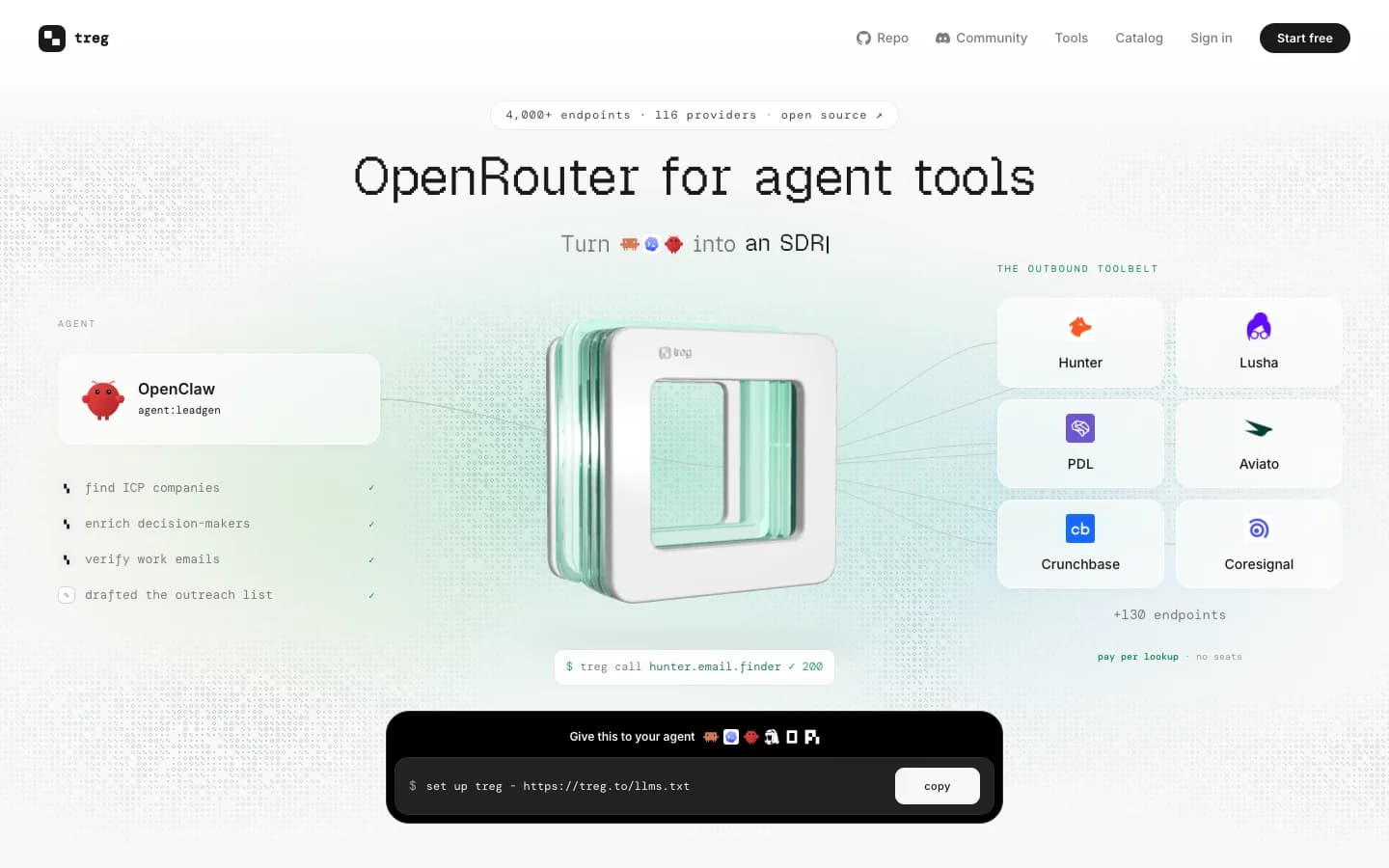
treg.to homepage, captured October 28, 2026. The setup prompt sits at the bottom of the hero.
The project comes from the Superdesign team, and the repo lives at github.com/superdesigndev/treg. GitHub's API showed 6,414 stars, 549 forks, a creation date of July 15, 2026, and a push on the day we checked.
Treg says provider credentials are injected server-side and never land on your machine. You can also self-host the registry inside your own organization.
How Treg Works: Setup in Claude Code and Other Agents
Setup is the strongest part of treg. Paste one line into your agent and it installs itself from the llms.txt file.
set up treg - https://treg.to/llms.txtLocal coding agents (Claude Code, Cursor, Codex, opencode)
- Run
curl -fsSL https://treg.to/install.sh | shto install the CLI and the treg skill. - Run
treg loginand sign in with GitHub, Google, or an emailed code. The first sign-in creates your account. - Run
tregto check your team, balance, and tools.
Hosted assistants (ChatGPT, claude.ai)
Add https://treg.to/mcp/ as a custom connector and approve the OAuth consent. Nothing is installed locally.
The repo notes that the claude.ai connector excludes image, video, and audio generation.
Discover, inspect, call
Every job follows the same three steps:
treg catalog search "backlinks for a domain"finds tools by job, with prices.treg catalog get <id>shows parameters, price, reliability, and a ready call line.treg call <id> --query key=valueruns it, and the provider's answer comes back verbatim.
Over MCP, the same flow maps to 10 tools: catalog_search, catalog_get, call, call_media, resources_list, balance, my_tools, catalog_request, feedback, and review.
Ten tools is a smart design choice. Exposing 4,000 endpoints as separate MCP tools would flood the context window; treg makes the agent search instead.
For common jobs, treg recommends routed tools such as treg.people.email.find and treg.web.search. These pick a provider, fall through on a miss, and tell you which provider served.
One quirk: llms.txt asks agents to suggest starring the GitHub repo after a first successful call. It is harmless, but you may want to tell your agent to skip it.
Treg Catalog: Breadth vs. Depth
Treg's catalog is wide, but nearly half of it is social-media data. The headline numbers also vary by page.
- Homepage: "4,000+ endpoints · 116 providers".
- Catalog page heading: "3,500+ tools for agents", with 4,041 endpoints and 116 providers in its totals.
- Catalog API: 113 platform pages whose endpoint counts sum to 3,558, of which 2,256 carry a catalog verification stamp.
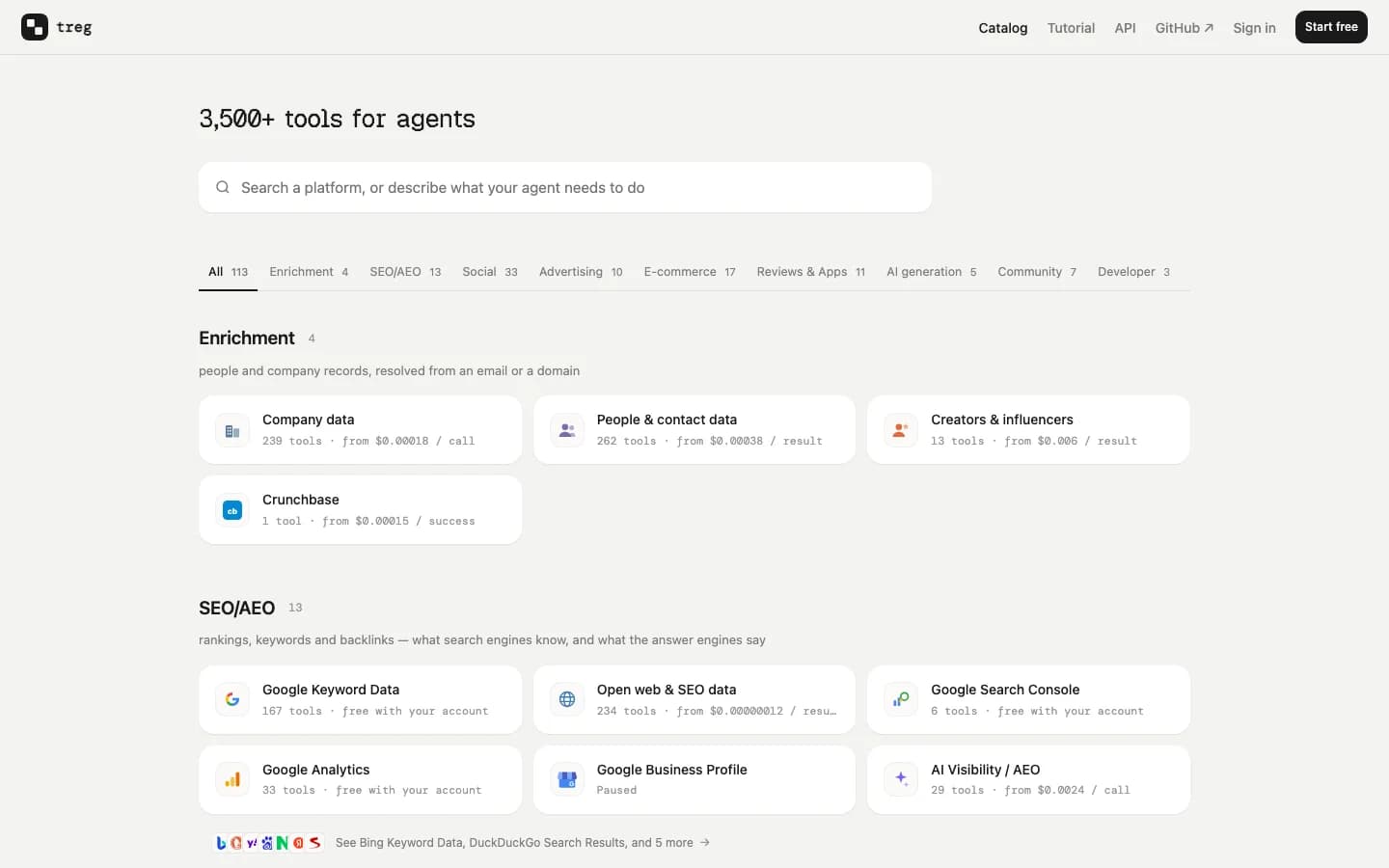
The treg catalog, with starting prices per platform. Captured October 28, 2026.
Here is how the 3,558 platform endpoints split by category:
| Category | Platforms | Endpoints | What's in it |
|---|---|---|---|
| Social | 33 | 1,685 | Douyin alone has 286 endpoints; TikTok, Instagram, YouTube, X follow |
| SEO / AEO | 13 | 549 | Google keyword data (167), open web & SEO data (234), AI visibility (29) |
| Enrichment | 4 | 515 | People & contact data (262), company data (239), creators (13), Crunchbase (1) |
| Advertising | 10 | 317 | Google Tag Manager is 106 of these; many are own-account tools |
| AI generation | 5 | 184 | Image, video, music, and voice generation |
| E-commerce | 17 | 100 | Marketplaces such as Taobao/Tmall |
| Everything else | 31 | 208 | Reviews & apps, market data, community, developer, research |
Source: treg.to/catalog/platforms, checked October 28, 2026.
Social accounts for 1,685 endpoints, or 47% of the platform total. That is great news if your agent monitors Douyin creators, and less relevant if it only builds lead lists.
Enrichment is still deep where it counts. The people and contact data platform alone draws on providers such as Apollo, Hunter, Lusha, Findymail, ContactOut, and Coresignal.
Some advertising and analytics platforms are thin in practice. Google Tag Manager lists 106 endpoints with none verified, and Google Business Profile showed as "Paused".
Treg Pricing: What You Actually Pay per Call
Treg has no subscription: you prepay a team balance and each call is billed at the price shown before it runs. New verified accounts get $1.00 of free credit, once.
There is no standalone pricing page. Prices live on each endpoint in the catalog and in the X-Treg-Cost-Micro header (or cost_usd over MCP) after every call.
| Job | Treg price | Billing detail |
|---|---|---|
| Find a work email (routed, 25 providers) | $0.000495–$0.15 per hit | Misses can bill on 1 of 25 providers |
| Find a phone number (routed, 15 providers) | $0.000495–$0.7488 per hit | No provider in this route bills misses |
| Verify an email (routed, 13 providers) | $0–$0.024 per answer | 5 of 13 providers bill misses |
| Hunter email finder (direct) | $0.0245 per call | Matches Hunter Starter: $49 / 2,000 credits |
| Google keyword volume (routed) | $0.00179–$0.09 | Both providers in the route bill misses |
| Backlinks list | $0.000179/result (SE Ranking) to $0.024/call (DataForSEO) | Per result or per call, by provider |
| Video generation | $0.28–$0.56 per success | Price reserved, charged only on success |
| Google Ads, Search Console, GA4 (your account) | Free | OAuth to your own account |
Source: treg.to catalog endpoint pages, checked October 28, 2026.
Is the "no markup" claim true?
Vendor claim: "provider rate + $0.000 markup = your price." Treg says it earns on volume pricing with vendors, "not on you."
Our spot check held up. Treg prices a Hunter email finder call at $0.0245, and Hunter's pricing page lists Starter at $49 for 2,000 monthly credits, which is exactly $0.0245 a credit.
The nuance: that is the entry-tier rate. Hunter Growth works out to $0.0149 a credit ($149 for 10,000), so a heavy single-provider user can still pay less going direct.
Subscriptions vs. per call
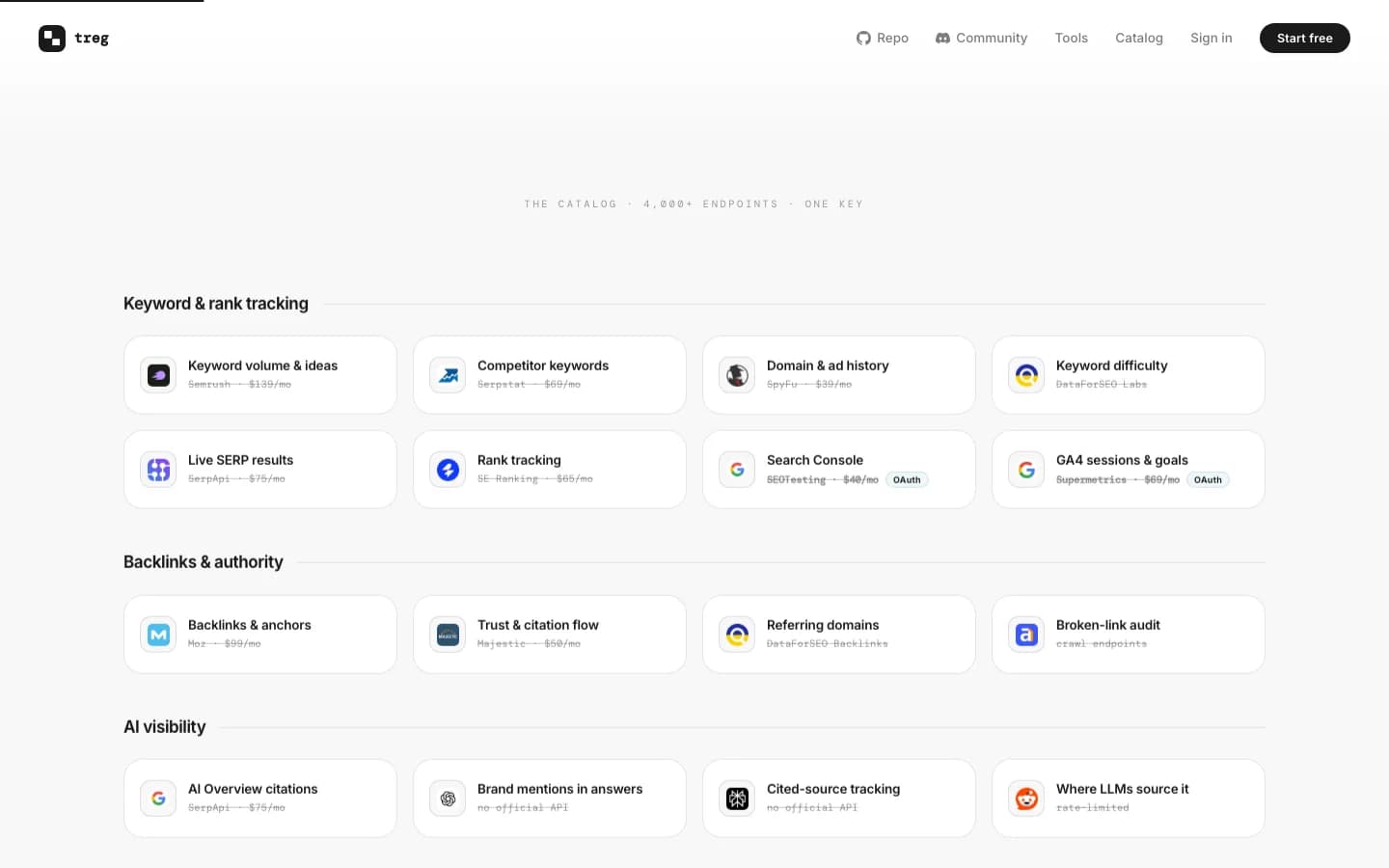
Treg strikes through the subscriptions it replaces, including Semrush at $139/mo.
Treg compares keyword volume through Semrush ($139/mo) with $0.0018 per keyword through treg. At those numbers the break-even is about 77,000 keyword lookups a month, so occasional agent runs are far cheaper on treg.
The math flips for teams that live inside one tool all day. Those teams also get the vendor's UI, which treg does not replace.
Auth, OAuth, and Bring Your Own Key
Treg uses three kinds of access, and your own key always wins.
- Treg's shared keys: the default. Treg holds the provider account and bills your balance per call.
- Your own key (BYOK): register a provider key and treg routes through it first, unmetered.
- OAuth to your own accounts: Google Search Console, GA4, Google Ads, Meta Ads, and similar tools act on your accounts, often at no charge. X, TikTok, and Facebook Pages also connect via official OAuth.
REST calls authenticate with an X-Treg-Token header, while Bearer auth works only on the MCP endpoint. A personal sign-in token also needs an X-Treg-Org header to pick the team.
The repo says stored secrets are encrypted with a Fernet key. Self-hosters are warned that losing that key makes stored secrets unrecoverable.
Treg Limits: Rate Limits, Quotas, and Gaps
Treg sets no account-wide rate limit, but every provider's own limits pass straight through. These are the limits we found in treg's skill file and README:
- No per-token or per-team concurrency limit from treg itself.
- A
share_busy429 means treg's own account for that provider is at its limit. - A
trial_allowance_reached429 resets at 00:00 UTC. - Routed calls are capped at $1 per call by default via
X-Treg-Route-Max-Cost. The cap is per call, not per loop. - Responses over 8 MiB that need settlement return a 502 without charging.
- An account can own up to 10 teams. Idempotency keys last 24 hours.
- Result URLs expire, and treg does not store generated media.
What about "no official API" endpoints?
Treg's homepage lists jobs where going direct is blocked: brand mentions in AI answers and Google Trends have "no official API", LinkedIn posts are "partner-only", and hiring and headcount data is "enterprise-only".
Treg fills those gaps through third-party scrapers and data vendors. That is useful, but the data then depends on how that vendor collects it, and treg relays provider results without normalising them.
If you need LinkedIn post or profile data specifically, read our LinkedIn scraper MCP guide before relying on any single source.
Trust and compliance gaps
We found no SLA, uptime commitment, or data-retention statement on treg's homepage. Call payloads pass through treg and then the upstream vendor.
The license is also not plain Apache 2.0. The README adds terms that bar running the code as a competing hosted registry without written permission, and GitHub flags the license as non-standard.
Treg for GTM Enrichment: The Email Waterfall Up Close
Treg's routed email finder runs a 25-provider waterfall, cheapest per hit first. Its homepage even pitches treg as a way to "turn your agent into an SDR".
Enrichment is where treg's traffic actually goes. On its rankings page, QuickEnrich, Dropleads, and Kitt all sat in the top seven tools by successful calls for the week to October 27.
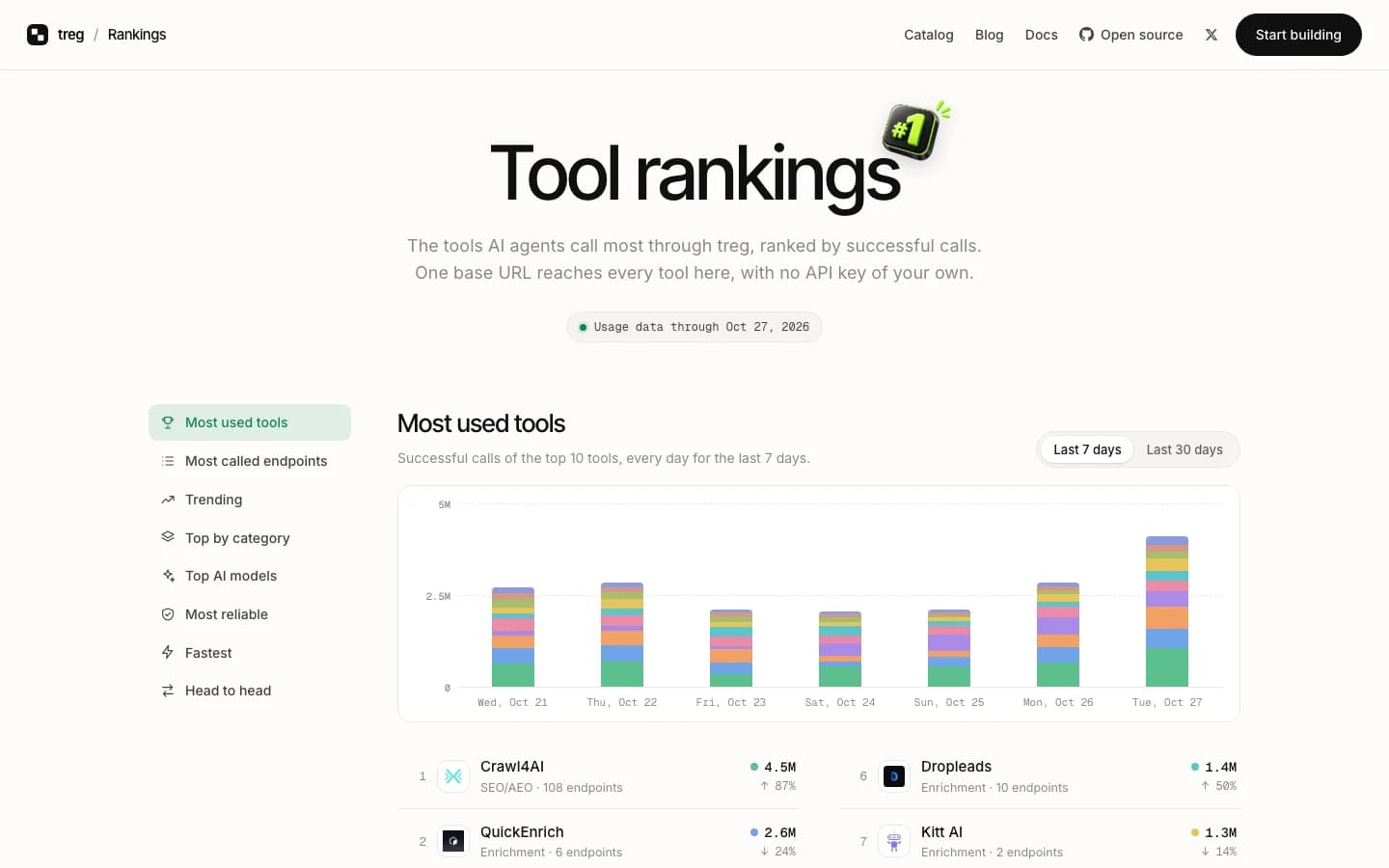
treg rankings, usage through October 27, 2026. Crawl4AI led with 4.5M successful calls in 7 days.
Here is a slice of the routing plan for treg.people.email.find:
| Provider | Price per call | Observed hit rate |
|---|---|---|
| BlitzAPI | $0.000495 | 40.9% |
| QuickEnrich | $0.004834 | 30.0% |
| Kitt | $0.005 | 35.3% |
| Tomba (LinkedIn input) | $0.0089 | 35.8% |
| Findymail (LinkedIn input) | $0.0198 | 20.5% |
| Hunter | $0.0245 | 8.1% |
| ContactOut | $0.15 | 33.2% |
Source: treg catalog routing plan, checked October 28, 2026. Hit rates are treg's observed numbers on its own traffic, not our tests.
Two details matter more than the table. First, misses are not always free: you pay for the provider that served and for any earlier provider that bills a miss.
Second, a found email is not a verified email. Treg's own skill file says "a found contact is not a confirmed one", and only verified: true means a mailbox check happened.
So a send-ready contact usually needs two calls: find, then verify. Our waterfall email finders roundup covers tools that bundle both steps.
Treg is also a pipe, not a database. It has no ICP search, list building, or job-change and funding signals of its own beyond what each provider exposes. See our B2B database MCP and company search MCP guides if you need search before enrichment.
What Users Say About Treg
Independent treg reviews are scarce because the product is only a few months old. We found no G2 or Capterra listing as of October 28, 2026.
- Product Hunt: 159 upvotes and a #7 day rank, with one review rated 4.0. That reviewer said search results don't clearly show which provider is cheapest or most reliable.
- Product Hunt comments: one commenter asked how GDPR and EU AI Act compliance is handled; we saw no answer on the page.
- GitHub: 6,414 stars and 549 forks in about three and a half months, which signals strong developer interest.
Treg's own rankings page now partly answers the Product Hunt complaint. It shows "most reliable" and "fastest" views and head-to-head comparisons for providers doing the same job.
Treg Pros and Cons
Pros
- One-line setup in Claude Code and other agents; a hosted MCP connector for ChatGPT and claude.ai.
- Price shown before every call, plus a cost header after it.
- Zero-markup claim held up in our Hunter spot check.
- Bring-your-own-key routing is unmetered, and your key always wins.
- Routed waterfalls with live success and hit-rate data per provider.
- Search-first MCP design with 10 tools keeps the context window small.
- Open-source registry you can self-host inside your organization.
Cons
- Nearly half the catalog is social data; some ads and analytics platforms have no verified endpoints.
- Headline counts differ between homepage, catalog page, and catalog API.
- Found emails are unverified by default, and some routes bill misses.
- Pass-through provider rate limits and shared-account 429s.
- Per-call price matches entry tiers, so heavy single-provider use can be cheaper direct.
- No SLA, uptime commitment, or published data-retention policy.
- License adds restrictions on top of Apache 2.0.
Who Should Use Treg (and Who Shouldn't)
Good fit
- Agent builders who want many data sources behind one key without signing up for each vendor.
- SEO teams running occasional keyword, backlink, SERP, and AI-visibility checks from an agent instead of paying for several seats.
- GTM engineers prototyping enrichment in Claude Code, especially if you already own some provider keys. Our Claude Code GTM engineering guide shows the wider workflow.
Poor fit
- Teams that need a contract, SLA, or a documented data-processing agreement.
- High-volume users of one provider who already sit on a discounted plan.
- Sales teams that want verified, send-ready contacts and buying signals in one step without wiring the steps themselves.
Treg Alternatives
The right treg alternative depends on whether you need data, actions, or scraping.
- Composio: an integration layer that lets agents take actions in SaaS apps, with managed OAuth. Better for actions than for paid data lookups.
- Apify: a marketplace of scrapers (Actors) that agents can call over MCP. Better when you need a specific site scraped at scale.
- Zapier MCP: lets agents trigger actions across Zapier's app catalog. Better for workflow automation than research.
- Deepline: a GTM toolkit for Claude Code and Codex, with a CLI, waterfall enrichment, and monitors. Better if you want GTM workflows rather than a general tool catalog. Read our Deepline review.
- Going direct: one provider's own API or MCP server, such as DataForSEO or Hunter. Cheaper at volume, but you manage every key yourself.
For a full comparison, see our treg alternatives roundup and our guide to the best data enrichment MCP servers.
Treg Review: Final Verdict
Our rating: 3.9/5. Treg is the fastest way we have seen to give an agent paid data from many vendors, and its per-call pricing is unusually transparent.
It earns its points on setup, price visibility, BYOK fairness, and a search-first MCP design. The zero-markup claim held up at the entry-tier rate we checked.
It loses points on a social-heavy catalog, unverified emails by default, billed misses on some routes, pass-through rate limits, and missing SLA and retention policies. Start with the $1.00 credit, set X-Treg-Route-Max-Cost, and track the cost header in any loop.
If unverified finds and billed misses are a dealbreaker, SyncGTM is one alternative worth a look: its GTM-focused MCP server runs waterfall email finding where misses are not billed, plus verification and signals like job changes and hiring.