

7 Best Treg Alternatives for AI Agent Tools in 2026

By Kushal Magar · October 28, 2026 · 13 min read
Key Takeaway
The best Treg alternatives in 2026 split into two groups. Data gateways give agents information: SyncGTM for B2B contacts, waterfall enrichment, and buying signals; Deepline for GTM workflows with your own provider keys; Apify for scraping and social data. Action layers let agents work inside apps: Composio (100,000 free calls a month), Zapier MCP (9,000+ apps), Pipedream Connect (3,000+ APIs with per-user auth), and Arcade (per-user OAuth and governance). Treg itself stays the broadest single key for SEO, ads, and social data, at pay-per-call provider rates with a stated 0% markup.
Treg alternatives are tools that give an AI agent one key or one MCP server to reach many third-party data sources and apps. Treg itself bundles 4,000+ endpoints from 116 providers behind one token, billed per call.
Most roundups for this keyword mix scrapers, action platforms, and model routers into one list. This one sorts them by the job your agent actually does: pulling data or taking actions.
TL;DR
- SyncGTM: best for agents doing B2B prospecting. Verified work emails, people and company search, and buying signals in one MCP. From $49/mo.
- Deepline: best for GTM engineers in Claude Code who want waterfalls with their own provider keys. $0 plan plus usage.
- Composio: best one-key swap for actions in 1,500+ apps. 100,000 free tool calls a month.
- Apify: best for scraping, social, and maps data through an MCP server. $5 free usage a month.
- Zapier MCP: best for no-code teams already on Zapier. 9,000+ apps, 2 tasks per call.
- Pipedream Connect: best for SaaS products that give their own users an agent. From $99/mo.
- Arcade: best for enterprises that need per-user permissions and governance. Free up to 2,000 calls.
What Treg Does and Costs
Treg is a pay-per-call tool gateway for AI agents. Its homepage pitch is "OpenRouter for agent tools": one token reaches 4,000+ endpoints across 116 providers.
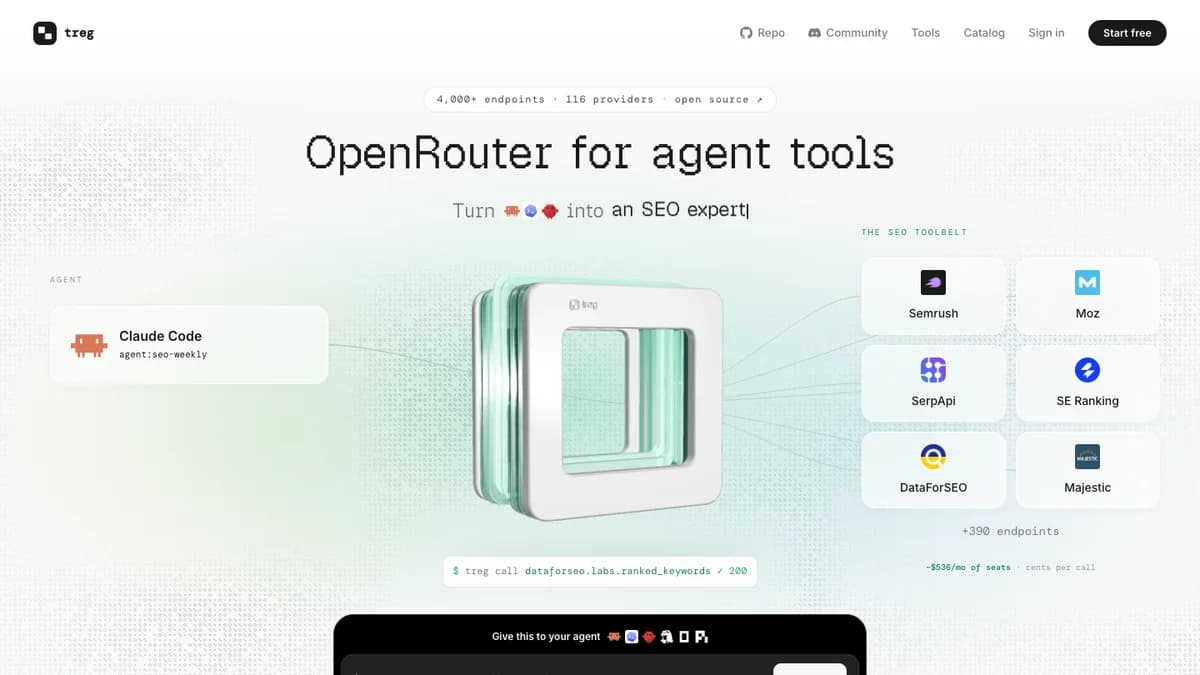
Treg routes one agent token to SEO, enrichment, ads, and social data providers.
The catalog leans hard on SEO and marketing data. Named providers include Semrush, DataForSEO, SerpApi, Moz, and Majestic, plus Hunter, Lusha, Apollo, Crunchbase, and LeadMagic for enrichment.
Here is what we found on treg.to and its llms.txt file, checked October 28, 2026:
- Pricing: no subscription. Calls bill from a prepaid balance at "fractions of a cent" each, with a stated 0% markup on provider rates.
- Free credit: $1.00 once per new verified account.
- Access: a remote MCP server at treg.to/mcp/ (OAuth or bearer token), a CLI for local coding agents, and plain HTTP calls.
- Auth: Treg holds provider credentials and injects them server-side. If you add your own provider key, those calls run on your key and are not metered.
For a deeper look at the catalog and billing, read our full Treg review.
Why People Look for Treg Alternatives
Treg is a smart idea, and it is still young. Most teams look elsewhere for one of five reasons:
- It is early access. A September 2026 eesel AI write-up quotes Treg's hosted service as having no uptime or support commitment. That is a hard sell for production agents.
- Some big providers need your own key. The same write-up reports Semrush and Crunchbase as bring-your-own-key only, so "one key" is not always one key.
- It is stronger on data than actions. Treg is built for lookups. If your agent needs to send Slack messages, update a CRM, or file tickets, you need an action layer.
- Raw provider output, not finished records. You get each provider's response. Your agent still has to pick providers, chain fallbacks, and merge results.
- Spend caps are per call. The
X-Treg-Route-Max-Costheader caps a single call, not a whole agent loop, so runaway loops need your own guardrails.
Every request also passes through Treg's proxy. Teams with strict data policies will want a clear retention answer before routing customer data through any gateway.
Two Kinds of Treg Alternatives
Every tool here speaks the Model Context Protocol or a CLI, but they solve different problems. Pick the group first, then the tool.
- Data gateways return information: contacts, companies, signals, scraped pages. SyncGTM, Deepline, and Apify sit here, alongside Treg.
- Action layers let the agent do things inside apps on a user's behalf. Composio, Zapier MCP, Pipedream Connect, and Arcade sit here.
Prices and features below come from each vendor's own site, checked October 28, 2026. We did not run latency or accuracy benchmarks, so vendor claims are labelled as claims.
1. SyncGTM
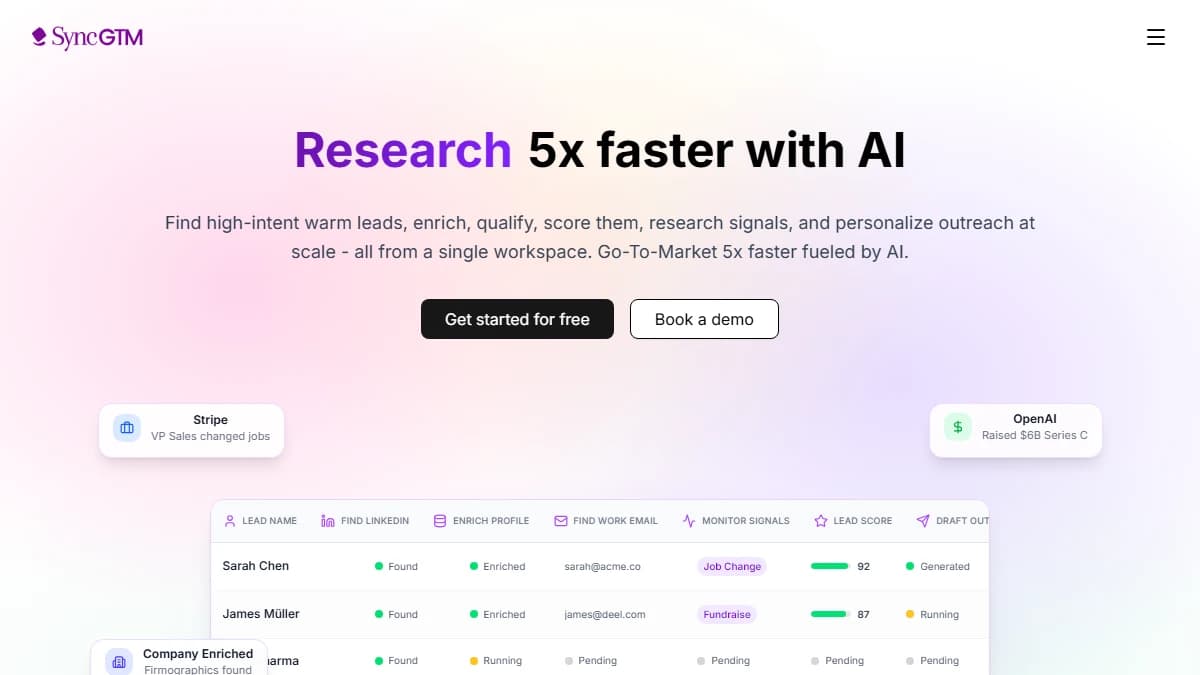
SyncGTM — people and company search, waterfall enrichment, and buying signals your agent calls as MCP tools.
SyncGTM is a B2B lead generation and enrichment platform with an MCP server built for go-to-market agents. It is the narrower, deeper pick on this list: Treg is broader, but SyncGTM goes further on contact data.
Your agent gets 50+ tools grouped by GTM job. That covers people and company search, work and personal email, mobile numbers, LinkedIn profile and post data, headcount growth, and company signals like funding, product launches, job openings, and new executives.
The key difference from a raw gateway is the waterfall. Find work email tries several providers in turn and returns one answer, so your agent does not chain fallbacks itself. Verify email then checks deliverability before anything reaches a sequencer.
Setup is one command and a browser sign-in. Our data enrichment MCP guide walks through it, and the B2B database MCP post shows list building in Claude.
Coming from Treg
Swap the Hunter, Apollo, and Lusha routes for one find_work_email call. Keep Treg for SEO and ads data if your agent still needs it.
Pros
- ✓ Built only for GTM: people search, work emails, phones, firmographics, and signals
- ✓ Waterfall work email finding across 50+ providers in a single tool call
- ✓ Signals like job changes, new hires, hiring, product launches, and tech stack
- ✓ One command plus browser OAuth; no provider accounts or API keys to manage
- ✓ Native CRM sync with HubSpot, Salesforce, Pipedrive, Attio, and Close
Cons
- ✗ No SEO, backlink, or ad-platform data, where Treg's catalog is much deeper
- ✗ Credit pricing needs a quick estimate per tool before big runs
- ✗ Not an action layer: it will not post to Slack or edit tickets for your agent
Best for: Sales, RevOps, and GTM engineering teams whose agents build lead lists, enrich records, and watch for buying signals.
Pricing: Solo $49/mo for 1,000 credits, Growth $99/mo for 3,000, Pro $249/mo for 10,000, and Business $649/mo for 40,000. Work email finding costs 1 credit (misses are free), verification 0.2, and people search 0.2 per profile. See SyncGTM pricing.
2. Deepline
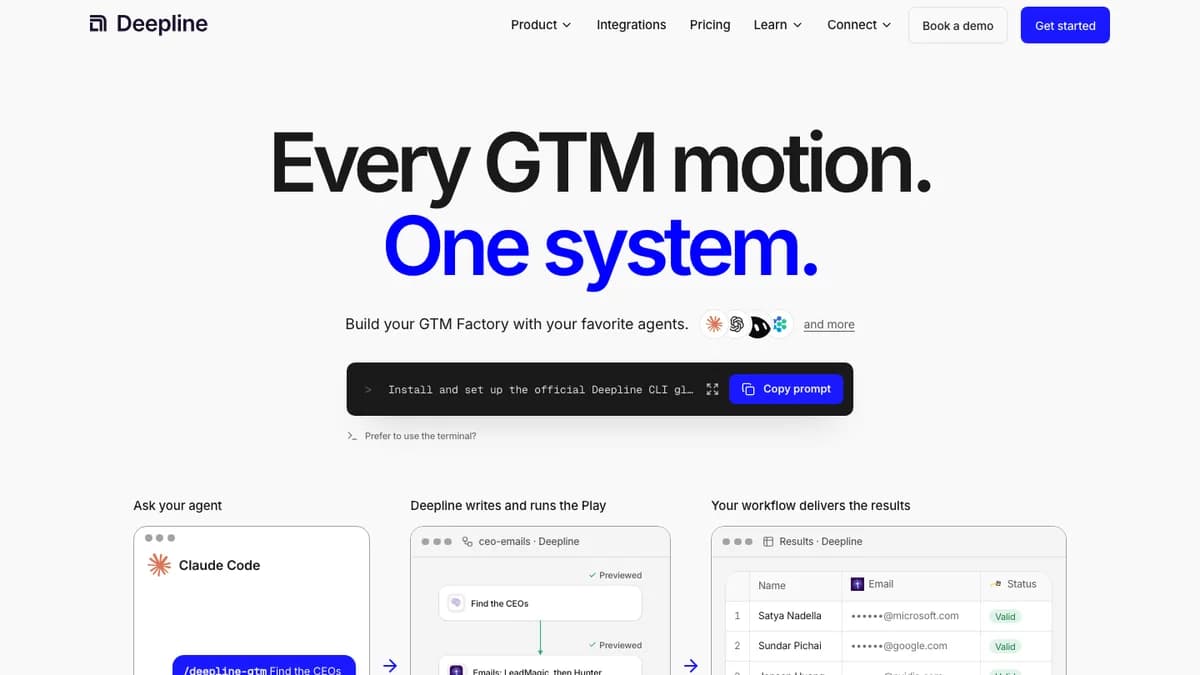
Deepline — a GTM CLI and agent toolkit that runs enrichment waterfalls from Claude Code and other agents.
Deepline is a GTM data platform that agents drive through a CLI. You paste one install prompt into your agent, and it writes and runs "Plays" such as finding CEOs and then their emails.
Deepline argues a CLI beats MCP for GTM work because it cuts round trips and token cost. Its BYOK model is close to Treg's: bring your keys and pay providers directly, or use Deepline-managed credits for the rest.
Read our Deepline review for the full breakdown, or our Claude Code GTM engineering guide for how these workflows fit together.
Coming from Treg
Move your enrichment keys over and let Deepline handle the fallback order. Expect a CLI-first workflow rather than a remote MCP connector.
Pros
- ✓ Built for coding agents: install the CLI and run GTM plays from Claude Code
- ✓ Waterfall routing included on every plan
- ✓ Bring your own provider keys with no Deepline access fee on BYOK misses
- ✓ Claims 125+ providers and 3,889 available operations
Cons
- ✗ Growth plan jumps to $395/mo, which is steep for small teams
- ✗ BYOK calls past 50,000 a month on pay-as-you-go cost $0.005 each
- ✗ Provider counts differ across Deepline's own pages (30+ to 125+)
Best for: GTM engineers who live in Claude Code or Codex and already hold keys for several data providers.
Pricing: Pay-as-you-go is $0/mo plus usage; Growth is $395/mo with $200 in monthly credits. Managed credits cost $0.10 each (10 credits = $1), per Deepline's pricing page.
3. Composio
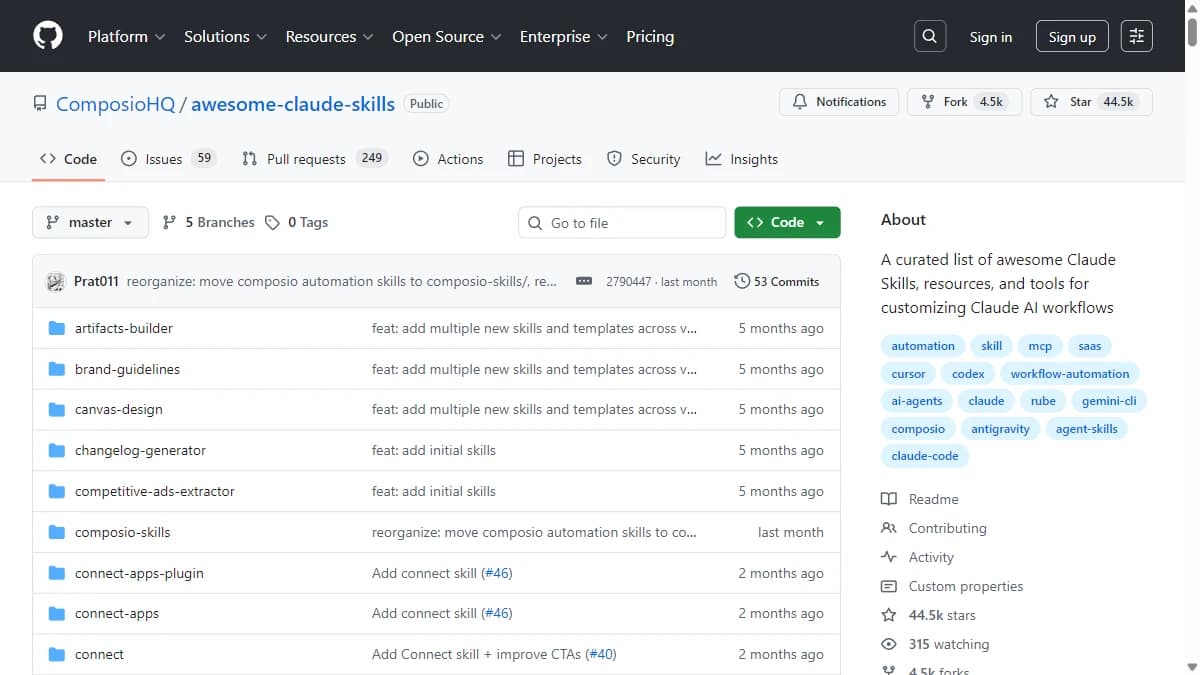
Composio — one SDK and MCP layer for agent actions across 1,500+ apps, with managed OAuth.
Composio is a tool-calling platform that gives agents authenticated actions in 1,500+ apps. It is the closest one-key swap for Treg if your agent mostly acts rather than looks things up.
Each end user connects their own accounts, and Composio stores and refreshes the tokens. Custom tools and other MCP servers can run alongside the catalog.
Coming from Treg
Keep Treg or a data gateway for lookups, and add Composio for the write side. At $0.0003 per call over the free tier, actions are cheap.
Pros
- ✓ 1,500+ toolkits on every plan, including the free one
- ✓ 100,000 tool calls a month free on Hobby
- ✓ Managed OAuth: consent, token storage, refresh, and scopes handled for you
- ✓ Unlimited connected accounts on Hobby and Pro
Cons
- ✗ Mostly app actions; thin on paid data like SEO metrics or contact enrichment
- ✗ Composio-managed OAuth apps have lower allowances than bringing your own
- ✗ Pricing for signups after August 15, 2026 may differ, per Composio
Best for: Developers building agents that read and write across SaaS apps like Gmail, Slack, GitHub, and Notion.
Pricing: Hobby is $0 with 100,000 tool calls a month. Pro is $29/mo including $29 of usage, then $0.0003 per call, per Composio's pricing page.
4. Apify
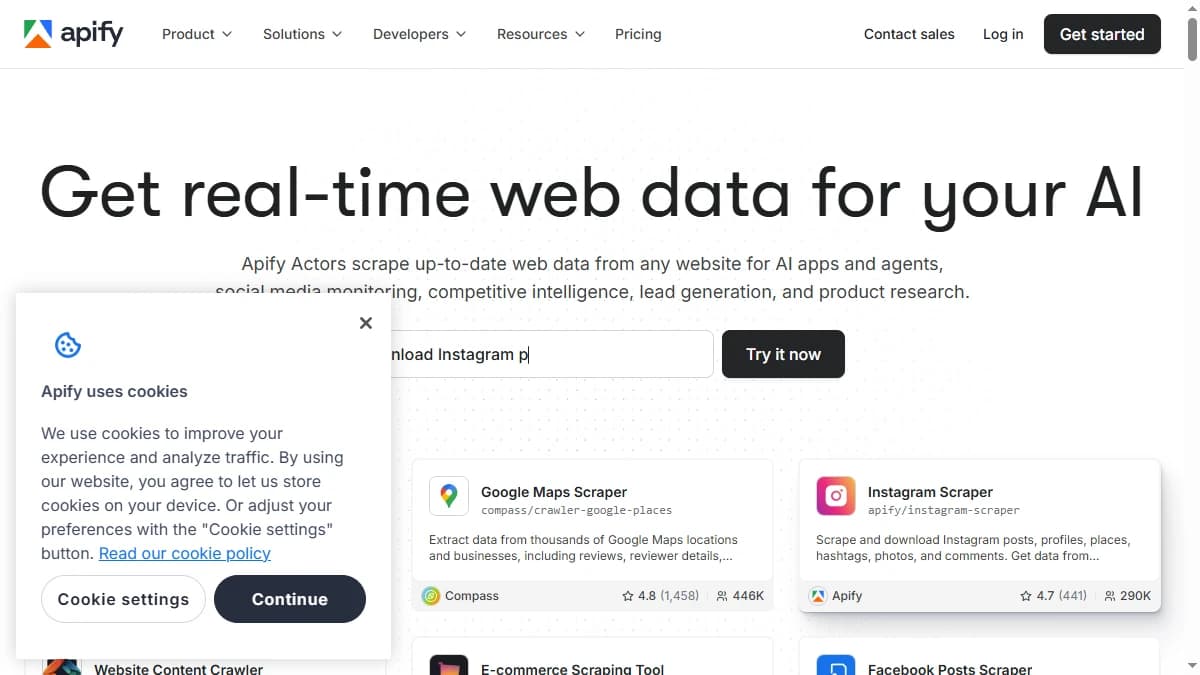
Apify — a marketplace of scrapers (Actors) your agent can search and run through the Apify MCP server.
Apify is a web scraping and automation platform with a public store of ready-made scrapers called Actors. Its MCP server at mcp.apify.com turns that store into agent tools.
Per the Apify MCP docs, the agent uses search-actors, fetch-actor-details, and call-actor to find and run scrapers on demand. That makes it the closest match to Treg's catalog-search model.
Our Apify review covers pricing math and Actor quality in depth.
Coming from Treg
Replace Treg's social and scraping routes with Apify Actors. Set a spending cap in Apify, since one large Actor run can cost more than thousands of Treg calls.
Pros
- ✓ Agents can search the Apify Store and run any Actor without prior setup
- ✓ Strong on social, maps, e-commerce, and long-tail website data
- ✓ Remote MCP server with OAuth, or an API token in a bearer header
- ✓ Free plan includes $5 of usage every month
Cons
- ✗ Cost varies by Actor: some bill compute units, others per event
- ✗ Community Actors vary in quality and upkeep
- ✗ Rate limit of 30 requests per second per user on the MCP server
Best for: Agents that need scraped data from social networks, Google Maps, marketplaces, or niche websites.
Pricing: Free ($5 usage), Starter $19/mo, Scale $199/mo, Business $999/mo, each including that amount in usage. Compute units cost $0.20 to $0.13 by plan, per Apify pricing.
5. Zapier MCP
Zapier MCP — exposes Zapier's app actions to Claude, ChatGPT, and Cursor as MCP tools.
Zapier MCP is an MCP server that lets AI assistants run actions across Zapier's app catalog. Zapier manages app credentials outside the model.
It wins on breadth of apps, not on data. Our Zapier review covers how tasks and plans add up.
Coming from Treg
Use Zapier MCP for the "then do this in our apps" half of a workflow. Budget tasks at 2 per call.
Pros
- ✓ Largest app catalog here: 9,000+ apps and 30,000+ actions
- ✓ Included on every Zapier plan, including Free
- ✓ Admins can limit apps and actions, and every call is logged in History
- ✓ SOC 2 Type II certified, per Zapier
Cons
- ✗ Each MCP call uses 2 tasks, so the free 100 tasks cover only 50 calls
- ✗ Task pricing gets expensive for chatty agents at scale
- ✗ Few deep data sources; it moves data between apps rather than enriching it
Best for: No-code and ops teams already on Zapier who want their AI assistant to trigger the same app actions.
Pricing: Free with 100 tasks a month; Professional from $19.99/mo billed yearly ($29.99 monthly) for 750 tasks, per Zapier pricing.
6. Pipedream Connect
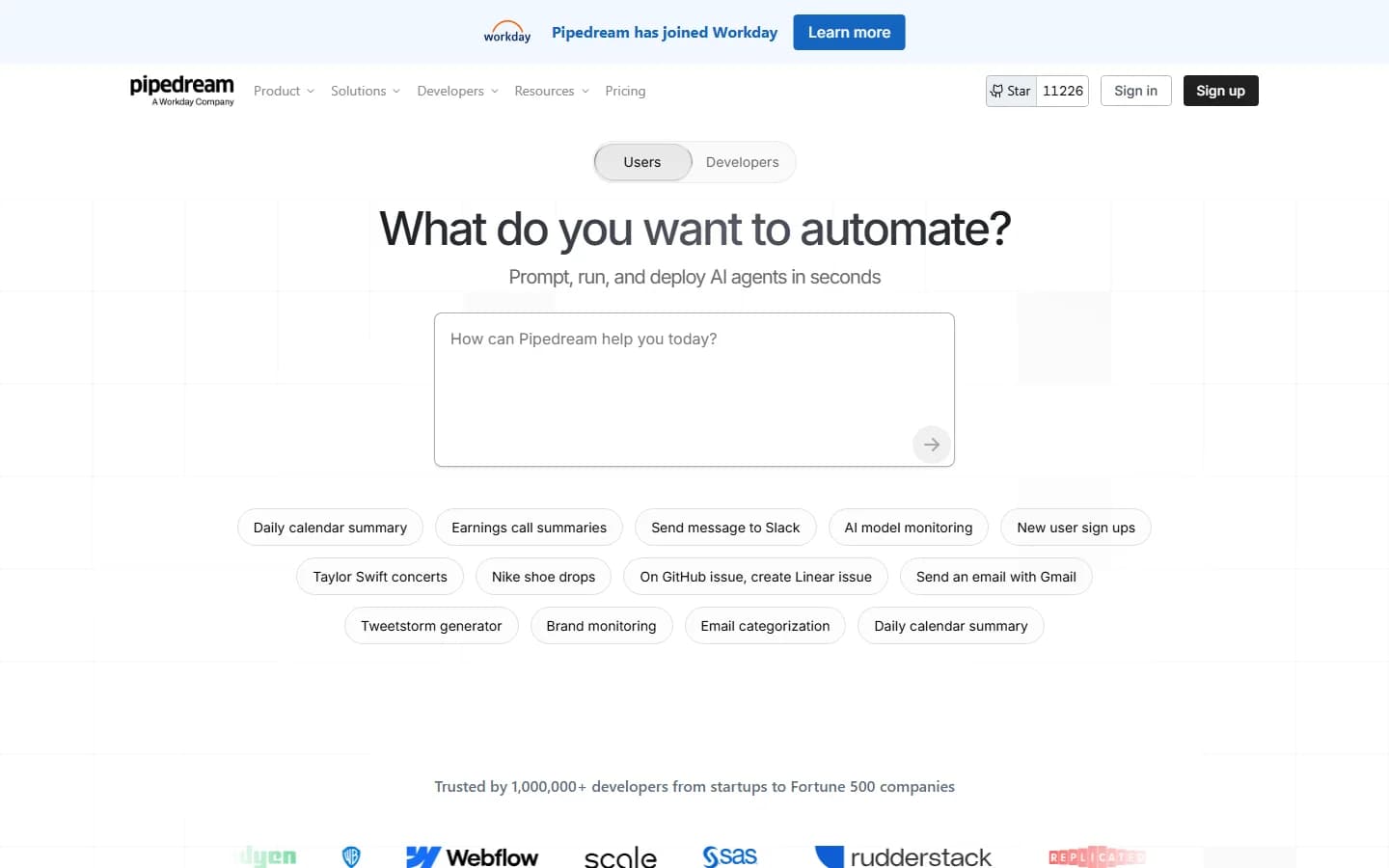
Pipedream Connect — managed auth and prebuilt tools for 3,000+ APIs inside your own product.
Pipedream Connect is a developer toolkit for adding authenticated integrations and MCP tools to your own app. It fits product teams, not solo agent builders.
Our Pipedream review covers its workflow builder and pricing in more depth.
Coming from Treg
Treg is one team's key; Pipedream Connect is many customers' keys. Switch if your agent ships inside a product.
Pros
- ✓ Managed auth for 3,000+ APIs and 10,000+ prebuilt tools and triggers
- ✓ MCP servers and custom OAuth clients on every plan
- ✓ Designed for multi-tenant apps where each customer connects their own accounts
Cons
- ✗ Free plan is development only; production starts at $99/mo
- ✗ Each external user over 100 costs $2 a month
- ✗ Credits bill per 30 seconds of compute, which takes work to forecast
Best for: SaaS companies embedding an agent that acts on their own customers' connected apps.
Pricing: Startup is $99/mo billed yearly ($150 monthly) with 100 external users and 10,000 credits, then $2 per user and $0.012 per credit, per Pipedream pricing.
7. Arcade
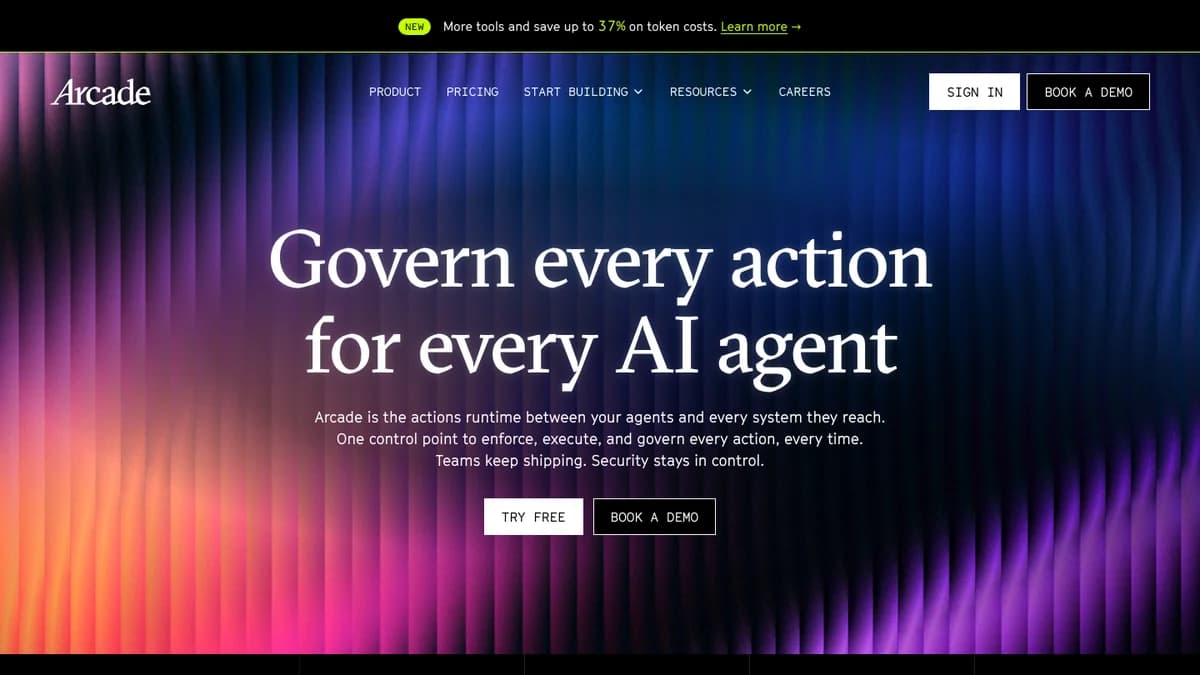
Arcade — an MCP runtime that handles per-user auth, permissions, and policy for agent actions.
Arcade is an MCP runtime that handles user authentication, authorization, policy, and tool execution for agents. It claims 8,000+ permission-aware tools.
Where Treg injects one team's credentials, Arcade enforces each user's own permissions. That is the right trade for regulated companies.
Coming from Treg
Pick Arcade when security asks who the agent acted as. Pair it with a data gateway for lookups.
Pros
- ✓ Agents act as the signed-in user, never through broad service accounts
- ✓ Auth runs against your existing identity provider
- ✓ Enterprise options for VPC or air-gapped deployment
- ✓ Free tier with 2,000 tool calls and 2,000 auth events a month
Cons
- ✗ $0.01 per call on Team is far pricier than Composio's overage
- ✗ Governance-first, so little built-in data like SEO or contact lookups
- ✗ SSO, RBAC, and audit logs sit on Enterprise
Best for: Security-conscious teams that need per-user permissions and audit trails on every agent action.
Pricing: Free up to 2,000 calls and 2,000 auth events; Team is $25/mo plus $0.01 per call and $0.10 per auth event, per Arcade pricing.
Treg Alternatives Compared
Here is how the seven tools stack up against Treg, checked October 28, 2026:
| Tool | What it covers | Pricing model | MCP / CLI | Auth | Free option |
|---|---|---|---|---|---|
| Treg (baseline) | 4,000+ endpoints, 116 providers: SEO, ads, social, enrichment, scraping, media | Per call from prepaid balance, stated 0% markup | MCP, CLI, HTTP | Treg holds provider keys; your own key overrides | $1.00 credit once |
| SyncGTM | B2B people, companies, emails, phones, signals; waterfall across 50+ providers | Credits; from $49/mo for 1,000 | MCP (50+ tools), web app | Browser OAuth, no provider keys | Free plan to test |
| Deepline | GTM enrichment and waterfalls; claims 125+ providers | $0.10 per credit; BYOK; Growth $395/mo | CLI, Claude Code skills, API/SDK | Managed credits or your own provider keys | $0 pay-as-you-go plan |
| Composio | Actions in 1,500+ apps | Pro $29/mo; $0.0003 per call over 100K | MCP, SDK | Managed per-user OAuth | 100K calls/mo on Hobby |
| Apify | Scrapers (Actors) for web, social, maps, e-commerce | From $19/mo; per compute unit or per event | MCP (mcp.apify.com), API | OAuth or API token | $5 usage/mo |
| Zapier MCP | 9,000+ apps, 30,000+ actions | 2 tasks per call; from $19.99/mo (annual) | MCP | Zapier manages app logins | 100 tasks/mo (50 calls) |
| Pipedream Connect | 3,000+ APIs, 10,000+ tools and triggers | $99/mo (annual) + $2/user over 100 | MCP, SDK, API | Managed auth per end user | Development only |
| Arcade | 8,000+ permission-aware tools (vendor claim) | $25/mo + $0.01/call + $0.10/auth event | MCP runtime, SDKs | Per-user OAuth via your IdP | 2,000 calls/mo |
Per-call prices are not directly comparable. A Treg call, a Composio call, and an Apify Actor run do very different amounts of work.
Tools We Left Out
- Smithery: a directory of MCP servers. Its site says its MCP proxy and managed identity shut down on October 31, so it no longer works as a single key.
- DataForSEO direct: a great SEO data API, but it is one provider that Treg already routes to, not a gateway.
- Model routers like OpenRouter: they route LLM calls, not tool calls, so they solve a different problem.
When Treg Is Still the Right Call
Stay on Treg if your agent does SEO, ads, and social research. No tool on this list matches its mix of Semrush, Moz, Majestic, DataForSEO, and ad-platform endpoints behind one token.
It also wins for light, bursty use. With no subscription and a stated 0% markup, an agent that makes a few hundred calls a month costs very little.
How to Choose
Match the tool to the job your agent does most:
- "Find and verify B2B contacts, and watch for buying signals." SyncGTM. See our email finder MCP and company search MCP guides.
- "Run GTM plays from Claude Code with our own provider keys." Deepline.
- "Take actions in many SaaS apps, cheaply." Composio.
- "Scrape social, maps, or long-tail websites." Apify.
- "We already run everything on Zapier." Zapier MCP.
- "Our customers will connect their own accounts." Pipedream Connect.
- "Security needs per-user permissions and audit logs." Arcade.
Most production agents end up with two: one data gateway and one action layer. For example, enrich with an MCP, then push to a sequencer with the Smartlead MCP server.
Final Verdict
Treg is the broadest single key for SEO, ads, and social data in 2026. It is not built to finish GTM records or to act inside apps, and its hosted service is still early access.
For B2B prospecting agents, SyncGTM is the best Treg alternative: verified emails, waterfall enrichment, and signals in one MCP. Deepline suits BYOK GTM engineers, Apify covers scraping, and Composio, Zapier MCP, Pipedream Connect, and Arcade cover actions at different levels of control.
Want to compare email providers first? See our best waterfall email finders. Ready to connect your agent? SyncGTM plans start at $49/mo.