

5 Best WhiteWhale Alternatives for B2B Buying Signals in 2026

By Kushal Magar · October 1, 2026 · 13 min read
Key Takeaway
WhiteWhale is good at one thing: monitoring target accounts for custom buying signals and scoring them so reps know which ones to prioritise. The problem is what it does not include — contact data for the buying committee, and a way to reach them. Every alternative on this list is ranked on a single question: how many extra steps and vendors sit between a signal firing and an email landing? SyncGTM is the best overall pick because it collapses all three layers — 15 intent signals, waterfall enrichment from 50+ providers returning 76+ data points, and AI-written outreach — into one subscription from $49/mo. 6sense is the enterprise ABM swap. Factors.ai wins for attribution-led revenue teams. Warmly is the pick for real-time website intent. Common Room is the right choice for product-led companies.
Teams search for WhiteWhale alternatives for one consistent reason: the score fires and nothing happens. WhiteWhale monitors your target accounts for custom buying signals you write in plain English — a new CRO, a burst of SDR job posts, an earnings-call mention — scores each account, and pushes the ranked list to HubSpot or Salesforce.
That is a useful product. It is also half the job. You still need contact data for the buying committee, and you still need a tool to send the email — two more vendor contracts before a rep can act on the signal.
The five alternatives below are ranked on a single question: how many steps and how many invoices sit between a signal firing and an email landing? We score each on signal breadth, enrichment depth, and outreach capability.
Already on WhiteWhale and want the platform-level comparison? Read our WhiteWhale review and our guide to the best buying intent data tools in 2026.
TL;DR
| Tool | Best For | Starting Price | Free Tier |
|---|---|---|---|
| WhiteWhale (baseline) | Custom plain-English signals and account scoring | $200/mo (300 accounts) | Free signal preview |
| SyncGTM | Signals + enrichment + outreach in one subscription | $49/mo | Yes (50 credits) |
| 6sense | Enterprise ABM with predictive buying-stage models | $60K–$300K/yr | Limited credits |
| Factors.ai | Account intelligence with revenue attribution | $199/mo (Lite) | Free trial (Lite) |
| Warmly | Real-time buyer intent from your own website | $10K/yr | No |
| Common Room | Product-led companies with community signals | $2,500/mo ($30K/yr) | No |
Verdict: SyncGTM is the best overall WhiteWhale replacement — 15 buying signals, waterfall enrichment from 50+ providers, and outreach in one subscription from $49/mo. 6sense is the enterprise ABM swap when you need predictive buying-stage models and programmatic ads. Factors.ai wins for attribution-led revenue teams. Warmly is the pick for real-time website intent on inbound-heavy pipelines. Common Room is the right call for product-led companies where community and product-usage signals matter most.
Why Teams Look for WhiteWhale Alternatives
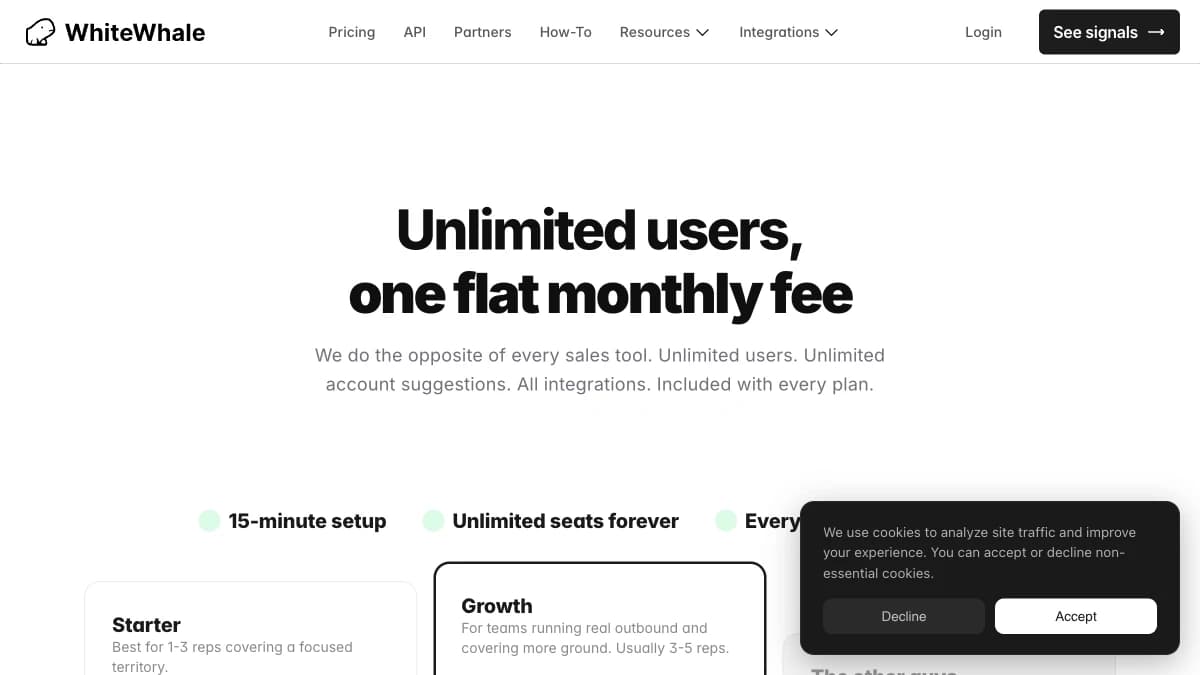
WhiteWhale — custom buying signals and account scoring, with unlimited seats on every plan
WhiteWhale built a useful product: you define custom signals, it scores each account from 0 to 100 on signal recency and priority, and it pushes a prioritised list to your CRM so reps work the right accounts first.
Its public review base is small — 4 reviews on G2 and 2 on the HubSpot Marketplace, all five stars, with users noting a smooth HubSpot integration. The structural limit is by design: WhiteWhale tells you which accounts are hot, but reps still go somewhere else to find who to email and how.
Three gaps push teams toward alternatives.
- No contact data. WhiteWhale can flag that an account just hired a new CRO. It does not return her verified work email or mobile direct dial, because it deliberately excludes contact data. Closing that gap requires a separate vendor — and that is before you address the B2B lead enrichment problem at scale.
- No outreach layer. A scored CRM record is still just a record. You need a sequencing tool on top of WhiteWhale, which adds a third invoice and a second integration to maintain. The best revenue orchestration platforms have collapsed these layers into one.
- Stack cost versus signal value. WhiteWhale costs $200/month for 300 monitored accounts or $500/month for 750. Add a contact database at a typical $200–$600/month and a sequencer at $100–$500/month, and the stack lands at roughly $500–$1,600/month before a single outreach email goes out. See our guide to Bombora alternatives for a parallel analysis of how the signal-only model plays out.
1. SyncGTM
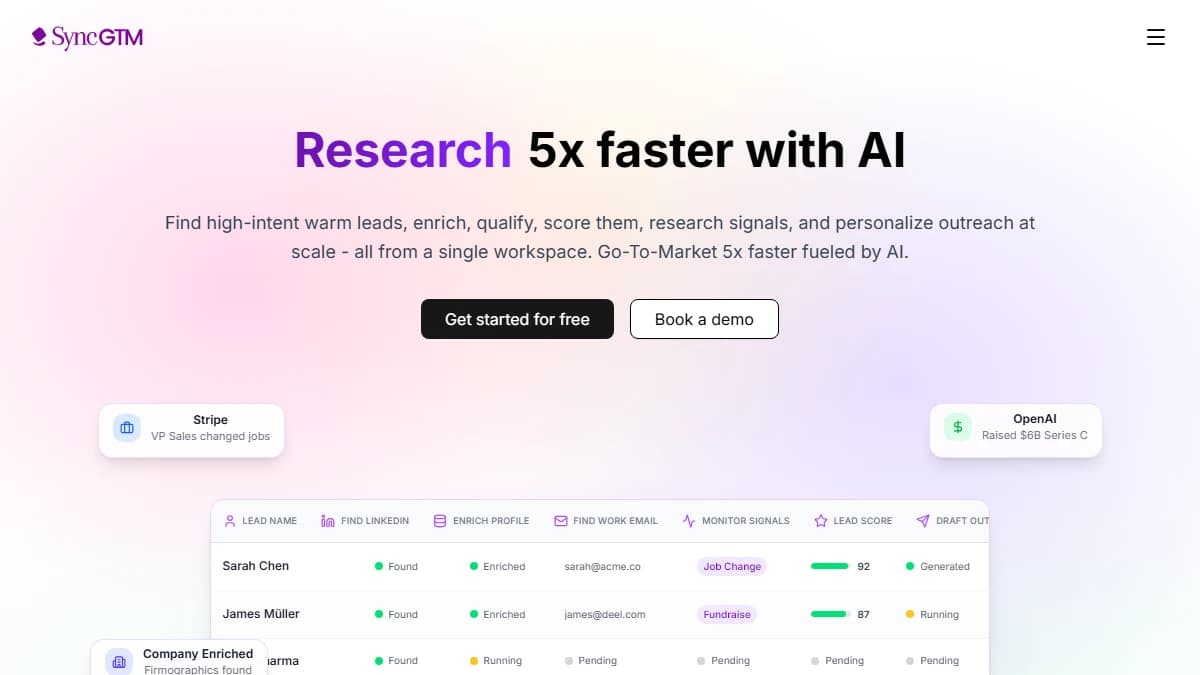
SyncGTM — 15 intent signals, waterfall enrichment from 50+ providers, and AI-written outreach in one subscription
SyncGTM is a buying-signal and enrichment platform best suited for mid-market and growth-stage B2B teams that want to action intent rather than just observe it, running 15 signals into waterfall enrichment from 50+ providers and AI-written outreach from $49/mo.
It covers the same core job as WhiteWhale — spotting accounts with a reason to buy now and pushing them to your CRM — and adds the two layers WhiteWhale leaves out: contact data and outreach.
The 15 prebuilt signals include job changes, promotions, leadership changes, hiring, funding, headcount and revenue growth, tech-stack changes, news mentions, product launches, M&A, and LinkedIn engagement. Signals return the underlying details — new title and employer for a job change, open roles and source URLs for hiring — so a rep can quote the trigger in the first line of an email.
On enrichment, SyncGTM runs a waterfall across 50+ providers and returns 76+ data points per lead — verified work email, mobile direct dial, LinkedIn URL, firmographics, funding stage, headcount, and job history. You are only charged when a verified record comes back. That model is detailed in our guide to the best waterfall contact providers.
Outreach and CRM sync are built in. The Sync AI Agent drafts personalised emails from signal and enrichment data, sequencer integrations like Instantly and Smartlead send them, and enriched records sync natively to HubSpot, Salesforce, Pipedrive, Attio, and Close. Full plan details on the pricing page.
Pros
- 15 intent signals — funding, hiring, job change, tech stack, LinkedIn
- Waterfall enrichment across 50+ providers, 76+ data points per lead
- Signal details reps can quote in outreach
- AI-written outreach plus Instantly and Smartlead integrations
- Free plan (50 credits) and $49/mo Solo entry — monthly billing
- Charged only on verified records returned
- Native CRM sync to HubSpot, Salesforce, Pipedrive, Attio, Close
Cons
- No predictive buying-stage model like 6sense
- No programmatic ABM advertising layer
- Free tier capped at 50 credits
- Smaller brand footprint than 6sense in enterprise buying cycles
Best for: Mid-market and growth-stage teams that want to action a buying signal the same day it fires — without a three-vendor stack.
Pricing: Free (50 credits) · Solo $49/mo · Growth $99/mo · Pro $249/mo · Business $649/mo · Enterprise custom
2. 6sense
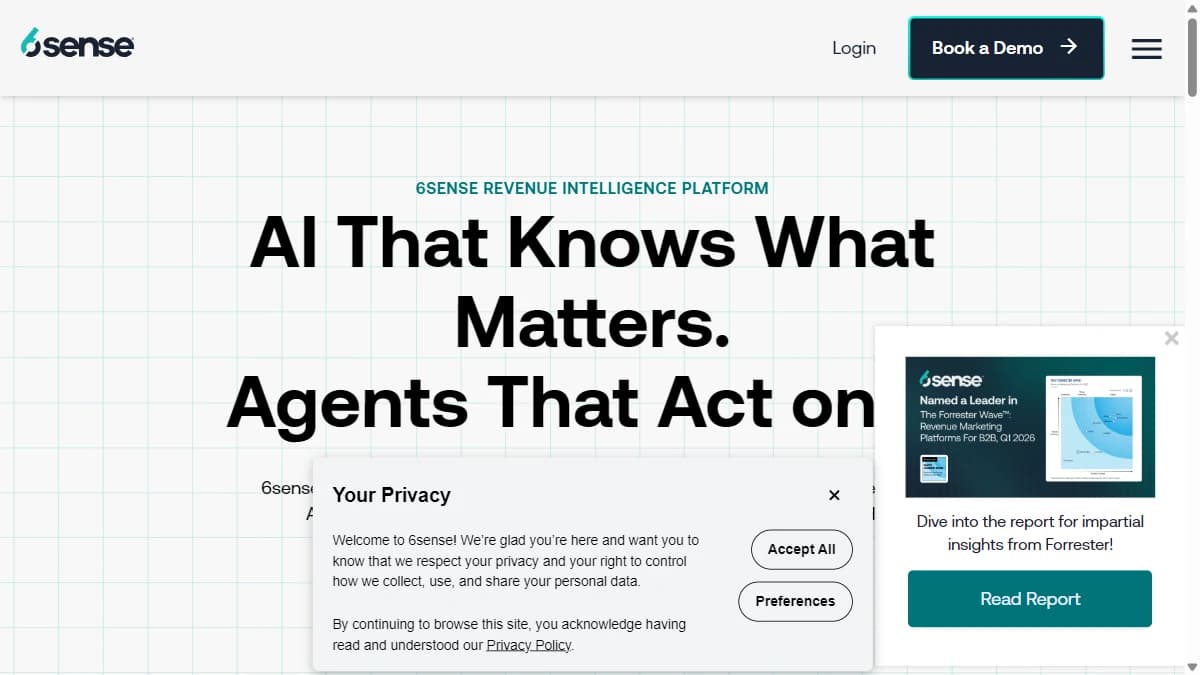
6sense — predictive AI buying-stage models, intent data, and programmatic advertising in one enterprise ABM suite
6sense is an enterprise revenue intelligence platform best suited for large ABM teams, combining predictive buying-stage models, multi-source intent data, and programmatic advertising at $60,000 to $300,000 per year.
Where WhiteWhale stacks signals and scores accounts, 6sense classifies them into buying stages — Target, Awareness, Consideration, Decision, Purchase — and then orchestrates ads and outreach plays against each one automatically.
The genuine advantage over WhiteWhale is the orchestration layer. 6sense does not just tell you which accounts are hot — it runs programmatic ads at in-market accounts, triggers CRM workflows, and surfaces contact-level intent inside the same platform.
The tradeoffs are cost and complexity. Contracts start where most mid-market budgets end, and implementations run months. Our full 6sense review breaks down what enterprise teams actually get for the spend.
Pros
- Predictive buying-stage model across millions of accounts
- Contact-level intent, not just account scoring
- Built-in programmatic advertising and CRM orchestration
- Combines first-party, second-party, and third-party signals
- Strong Salesforce and HubSpot integrations
Cons
- $60K–$300K/year pricing rules out most SMB and mid-market teams
- Multi-month implementation with dedicated ops headcount required
- Black-box scoring reps struggle to explain to prospects
- Ad budget is a separate line item on top of platform cost
- Overkill if you only need signal-based account scoring
Best for: Enterprise ABM teams with a dedicated marketing-ops owner who need intent, predictive staging, and paid media orchestrated in one platform.
Pricing: $60K–$300K/year, quote-based; limited free credits available on entry plan
3. Factors.ai
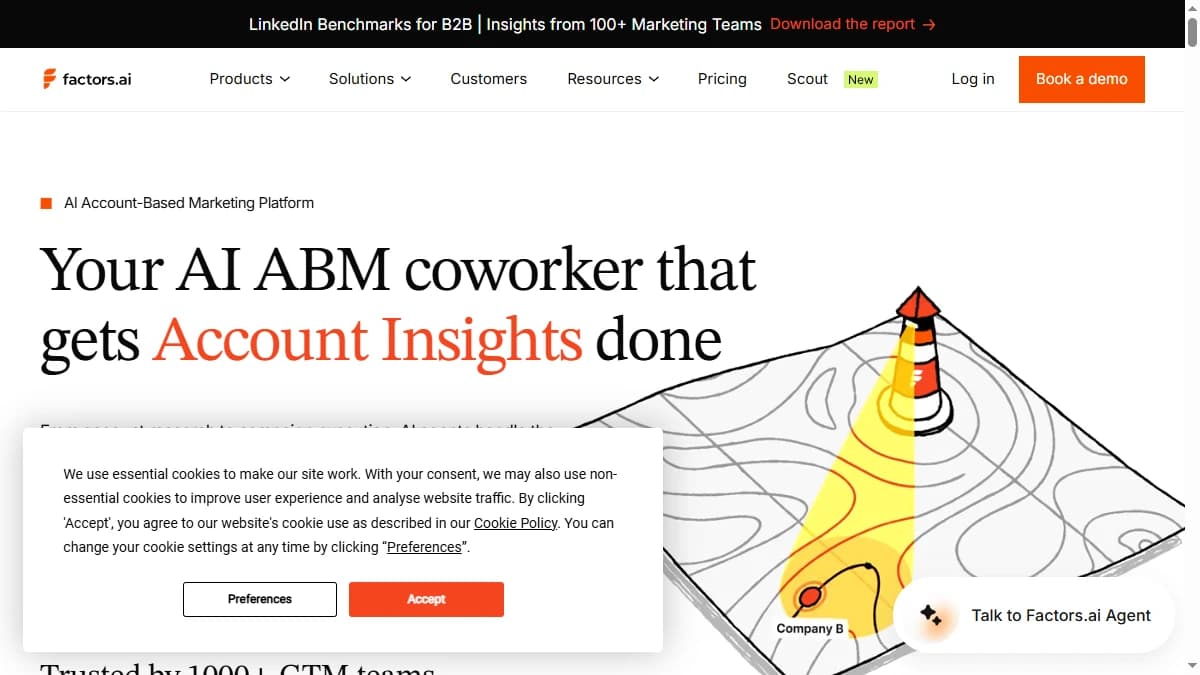
Factors.ai — account intelligence, website de-anonymisation, and revenue attribution for B2B revenue teams
Factors.ai is an account intelligence platform best suited for revenue teams that need buying signals alongside revenue attribution, combining account-level website identification, CRM activity, LinkedIn ad exposure, and G2 signals, with a $199/month Lite plan after a free trial and annual plans from $6,000/year (as of September 2026).
Its differentiation from WhiteWhale is the attribution layer. Factors shows you not just which accounts are active, but which touchpoints — LinkedIn ads, organic visits, email clicks — drove that activity. That is the data RevOps teams need to justify channel spend.
Scoring pulls from website sessions, CRM interactions, LinkedIn and Google ad engagement, and G2 activity. Rule-based alerts start on Basic, custom account scores on Growth, and predictive scoring on Enterprise, with high-scoring accounts pushed to Slack or Teams.
The limitation versus WhiteWhale is contact data. Factors shows you the account and the signal source; it does not return a verified email or mobile dial for the contact you should reach. See our Factors.ai alternatives comparison for the full picture.
Pros
- Multi-touch revenue attribution alongside account signals
- Account-level website identification built in
- LinkedIn ad exposure integrated into account scoring
- Native G2, LinkedIn Ads, and Google Ads integrations
- Strong for RevOps teams justifying channel spend
Cons
- No contact-level enrichment — account signals only
- No built-in outreach or sequencing layer
- Lite caps at 1,500 companies/mo; annual plans start at $6,000/year
- Setup requires CRM and ad platform integrations to unlock full value
- Attribution depth depends on how much data Factors can ingest
Best for: B2B revenue teams that need buying signals and need to know which marketing channels drove them — particularly teams running LinkedIn ABM alongside outbound.
Pricing: Lite $199/mo after free trial · Basic $6,000/yr · Growth $20,000/yr · Enterprise $30,000+/yr (as of September 2026)
4. Warmly
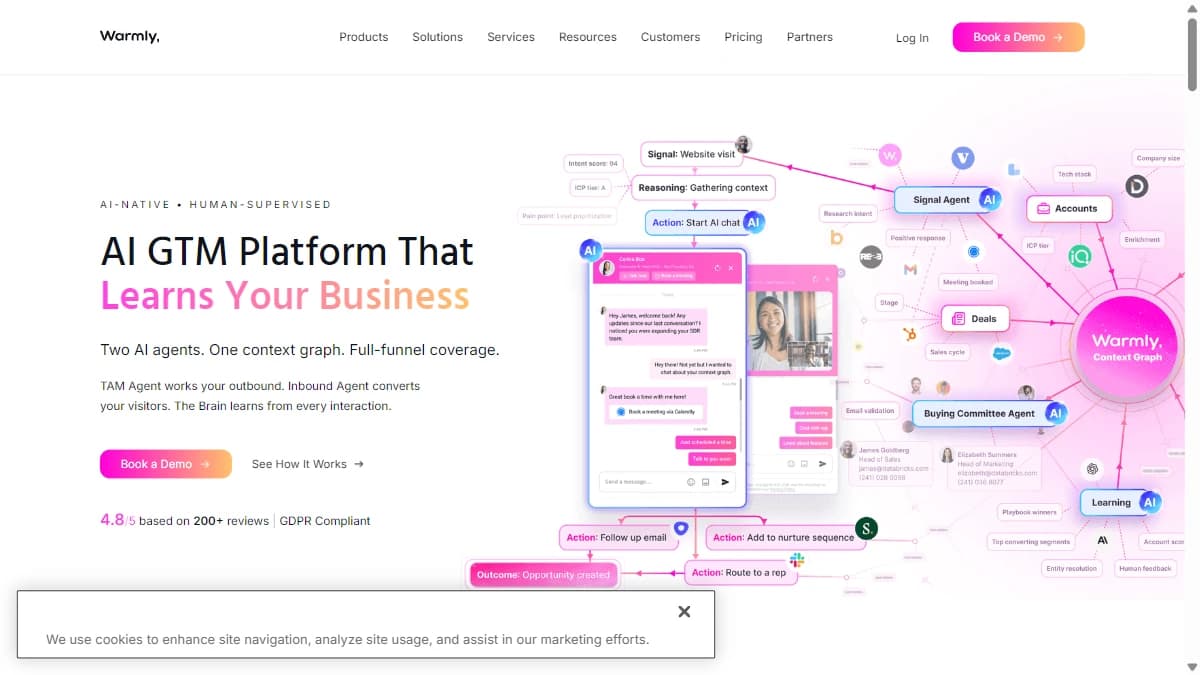
Warmly — real-time website visitor intent signals with LinkedIn data and Slack alerts for sales teams
Warmly is a real-time buyer intent platform best suited for sales teams that want to know the moment a target account lands on their website, identifying visitors at the person and company level and triggering Slack alerts, chat, and email sequences, with annual plans from $10,000/year (as of September 2026).
The core signal is fundamentally different from WhiteWhale. WhiteWhale monitors public sources like news, filings, and job posts. Warmly captures the most direct signal possible: a known contact visiting your pricing page right now.
Warmly enriches identified accounts with contact data, then routes a Slack alert to the rep, opens a chat, or starts an email sequence while the account is still on the site.
As of September 2026, Warmly's website carries a “HubSpot is acquiring Warmly” announcement, so confirm how pricing, integrations, and support for non-HubSpot CRMs will change before signing an annual contract.
The other limitation is coverage. Warmly's core signal fires only when a company visits your website; hiring and funding signals sit in its GTM Signals Package, a $10,000/year add-on. Our Warmly alternatives roundup covers the full competitive landscape.
Pros
- Real-time signal — not a batch score updated weekly
- First-party: you own the website that generates the data
- Person- and company-level visitor identification
- Chat routing and email-sequence triggers on live visits
- Slack integration means reps get notified immediately
Cons
- Signal limited to companies visiting your own site
- No outbound signal for accounts that have never visited
- Annual plans from $10,000/year, with no free plan listed
- Hiring and funding signals cost an extra $10,000/year
- Pending HubSpot acquisition makes the long-term roadmap less certain
Best for: Inbound-heavy teams with meaningful website traffic that want to know who is visiting and engage them while intent is live.
Pricing: AI Web-Deanonymization $10,000/yr · Inbound Chat $20,000/yr · AI Inbound Autopilot $30,000/yr (annual, as of September 2026)
5. Common Room
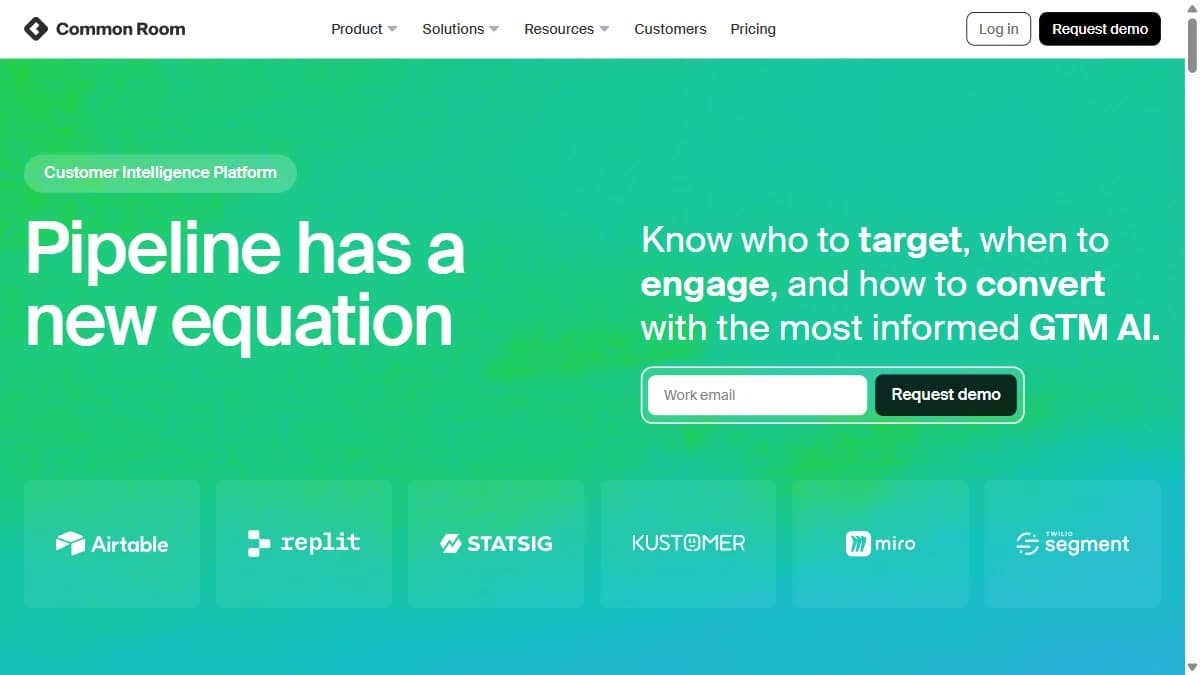
Common Room — community activity, product usage, and social signals for product-led B2B companies
Common Room is a community intelligence platform best suited for product-led and developer-first companies, capturing buying signals from GitHub, Slack, Discord, LinkedIn, and product usage that WhiteWhale structurally cannot see, with its Essential plan at $2,500/month on a $30,000 annual commitment (as of September 2026).
The signals Common Room tracks are fundamentally different from firmographic or intent-data sources. A developer starring your GitHub repo, a Slack community member asking an integration question, a free-tier user hitting a paywall — these are first-party signals from real named individuals at identified companies.
Common Room surfaces these as contactable leads with LinkedIn profiles attached, rather than anonymous account scores. For product-led companies, this is the highest-conviction buying signal available because the individual has already touched the product.
The limitation is scope. Common Room is purpose-built for product-led and developer-first motions. If your pipeline is purely outbound and you do not run an open community or free-tier product, the signal volume will be near zero. Our Common Room alternatives roundup has the full landscape for PLG signal tools.
Pros
- Signals WhiteWhale cannot reach — community, product, GitHub, Slack
- First-party and named — real individuals, not anonymous accounts
- Adds website de-anonymisation and Bombora topics on Essential
- Strong fit for developer-tool and open-source companies
- Unifies community, sales, and product data in one view
Cons
- Near zero signal volume for purely outbound teams
- Requires an active community or free product tier to generate signals
- $30,000/year entry commitment, with no free plan or trial
- Essential caps web de-anonymisation at 1k visitors/mo and 6 Bombora topics
- Only 100 phone enrichment credits on Essential
Best for: Product-led, developer-first, or community-driven B2B companies where the buying journey touches open platforms like GitHub, Slack, or Discord.
Pricing: Essential $2,500/mo ($30,000/yr commitment) · Advanced and Enterprise custom (as of September 2026)
Side-by-Side Comparison
The last two columns are where the real cost of a WhiteWhale stack shows up. A signal source with no enrichment layer and no outreach tool is one-third of a system.
| Tool | Signal Type | Starting Price | Enrichment Built In | Built-in Outreach |
|---|---|---|---|---|
| WhiteWhale (baseline) | Custom signals from news, SEC filings, earnings calls, job posts | $200/mo (300 accounts) | No | No (CRM sync + Slack alerts) |
| SyncGTM | 15 prebuilt signals — job change, hiring, funding, tech stack, LinkedIn engagement | $49/mo | Yes — 50+ providers, 76+ data points | Yes |
| 6sense | Predictive AI over first, second, and third-party intent | $60K–$300K/yr | Yes | Yes (ads + orchestration) |
| Factors.ai | Website, CRM, ad, and G2 activity | $199/mo (Lite) | Partial | No |
| Warmly | Website visitor identification, social activity, research intent | $10K/yr | Yes (contact data) | Yes (alerts, chat, email triggers) |
| Common Room | Community, product usage, social, GitHub, web visits | $2,500/mo ($30K/yr) | Limited | Limited |
How to Choose the Right WhiteWhale Alternative
Start from how your pipeline actually runs. Five scenarios cover most teams evaluating a switch.
- You want signals, enrichment, and outreach in one product. Pick SyncGTM. It bundles 15 prebuilt signals, waterfall enrichment from 50+ providers with 76+ data points per lead, and AI-written outreach in one subscription — from $49/mo, with a free plan to test it before committing.
- You run a large enterprise ABM programme and need programmatic advertising. Pick 6sense. Predictive buying-stage models, contact-level intent across millions of accounts, and self-serve ads in one platform — assuming your budget starts at $60K/year.
- You need to justify channel spend alongside account signals. Pick Factors.ai. It is built to tie buying signals back to the campaigns that generated them, which is what RevOps teams running LinkedIn ABM alongside outbound need most.
- You want to catch target accounts while they are live on your site. Pick Warmly. Real-time visitor identification with Slack alerts and chat routing is hard to beat for inbound-heavy pipelines — just factor the pending HubSpot acquisition into any multi-year contract.
- Your pipeline runs through a community, open-source project, or free product tier. Pick Common Room. GitHub stars, Slack questions, and free-tier usage spikes are higher-conviction signals than firmographic scoring for product-led companies, and none of them come from the public sources WhiteWhale monitors.
One rule applies across all five: price the whole stack, not just the signal layer. A $200–$500/month WhiteWhale plan that still needs a contact database and a sequencer on top can cost more than a single platform that includes all three.
Final Verdict
WhiteWhale built a good custom-signal product. The problem is that spotting the signal is now the cheap part of the problem. Knowing which account is in-market is worth nothing until you know who to email and you can email them.
Every alternative on this list is better than WhiteWhale at something. The question is which gap matters most for your motion.
SyncGTM is the best overall WhiteWhale alternative for mid-market and growth-stage B2B teams — 15 buying signals, waterfall enrichment across 50+ providers returning 76+ data points per lead, and AI-written outreach in one subscription from $49/mo, with a free plan to verify the data before committing. It closes both gaps WhiteWhale leaves open without adding a second vendor.
6sense is the right swap for enterprise ABM teams with the budget and the headcount to run it. Factors.ai is the pick for attribution-led RevOps teams. Warmly is the strongest pick here for real-time inbound signals. Common Room is the right call for product-led companies where the community is the pipeline.
Pick the one that removes a step from your workflow — not the one with the most signal types in the marketing deck.