6 Best Bombora Alternatives for B2B Enrichment in 2026

By Kushal Magar · August 4, 2026 · 13 min read
Key Takeaway
Bombora sells one thing well: topic-level intent that tells you which accounts are researching your category. It does not tell you who to email, and it does not send the email — so the real cost of a Bombora stack is the $30K–$60K/yr feed plus a contact database plus a sending tool. The best Bombora alternative is the one that closes that gap for your motion. SyncGTM is the top overall pick: buying signals, waterfall enrichment across 50+ providers, 76+ data points per lead, and outreach in one subscription from $99/mo. G2 Buyer Intent has the cleanest first-party signal for B2B software. 6sense and Demandbase are the enterprise ABM swaps. ZoomInfo Intent is the pragmatic add-on if you already pay ZoomInfo. Intentsify wins for demand-gen teams that want intent plus managed activation.
Teams search for Bombora alternatives for one reason: the signal arrives, and then nothing happens. Bombora tells you an account is surging on your category, but not which person to contact or how to reach them.
That gap is expensive. Company Surge typically runs $30,000 to $60,000 per year, and it is a data feed — you still buy contact data and a sending tool on top.
So we ranked these six alternatives on a single question: how many steps and how many invoices sit between a signal firing and an email landing? Every tool below is scored on signal quality first, activation depth second, and total stack cost third.
Already using Bombora and want the deep dive on what it does well? Read our full Bombora review and our roundup of the best buying intent data tools in 2026.
TL;DR
| Tool | Best For | Starting Price | Free Tier |
|---|---|---|---|
| Bombora (baseline) | Topic-level account intent for an existing stack | $30K–$60K/yr | No |
| SyncGTM | Signals + enrichment + outreach in one subscription | $99/mo | Yes (50 credits) |
| G2 Buyer Intent | B2B software companies with an active G2 category | $20K–$30K/yr | No |
| 6sense | Enterprise ABM with predictive scoring and ads | $60K–$300K/yr | Limited credits |
| Demandbase | Keyword-level intent inside a full ABM suite | $50K–$200K/yr | No |
| ZoomInfo Intent | Teams already paying for ZoomInfo contacts | $15K/yr + $5K–$10K intent add-on | Limited |
| Intentsify | Demand-gen teams wanting intent plus activation | $25K–$50K/yr | No |
Verdict: SyncGTM is the best overall Bombora replacement — signals, waterfall enrichment, and outreach in one subscription from $99/mo, so the signal turns into a sent email without a second vendor. G2 Buyer Intent has the cleanest first-party signal if you sell B2B software. 6sense and Demandbase are the enterprise swaps when you need ABM orchestration and ads. ZoomInfo Intent is the least disruptive add-on for existing ZoomInfo customers. Intentsify suits demand-gen teams that want intent plus managed activation in one contract.
Why Teams Look for Bombora Alternatives
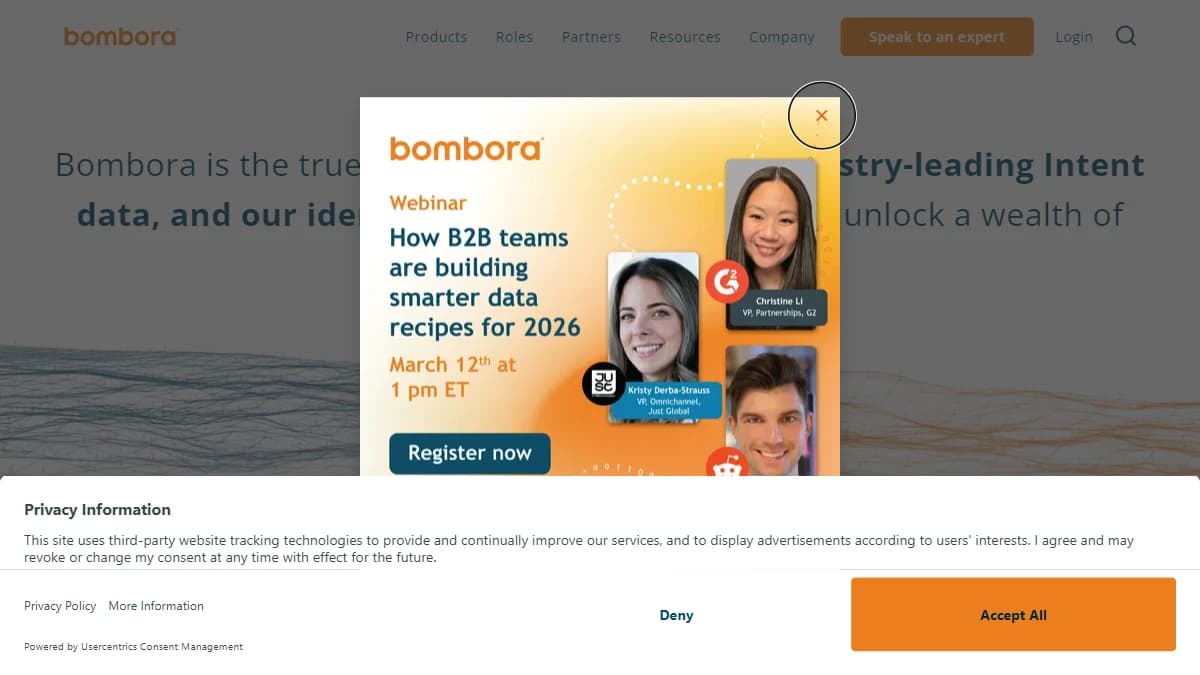
Bombora — topic-level B2B intent from a data co-op of 5,000+ business websites
Bombora built the category. Its Company Surge score is still the most widely resold intent feed in B2B, and it powers the intent layer inside several platforms on this list.
Reviewers on G2 and Gartner consistently rate the data quality highly. The recurring complaints are cost, contract rigidity, and the work required to turn a surge score into a conversation.
Three structural limits push buyers toward alternatives.
- It stops at the account.Company Surge tells you that Acme Corp is researching "data warehouse migration". It does not tell you that the VP of Data joined four months ago, or give you her verified email — so reps still guess at the buying committee. Closing that gap is exactly what B2B lead enrichment is for.
- The real cost is the stack, not the feed.A $30K–$60K Company Surge contract is only line one. Add a contact database at $15K–$30K and a sequencing tool at $5K–$15K, and a "$40K intent budget" is a $70K+ stack before anyone sends a single email.
- Weekly, modelled, and third-party. Company Surge scores refresh weekly against a fixed topic taxonomy, and the signal is inferred from anonymised content consumption. First-party sources like review-site research or product usage move faster and carry less noise, which is why so many teams now pair or replace it — see our breakdown of tools that identify buyer intent in real time.
None of this makes Bombora a bad product. It makes it a component — and most teams searching for a replacement want a system instead.
1. SyncGTM
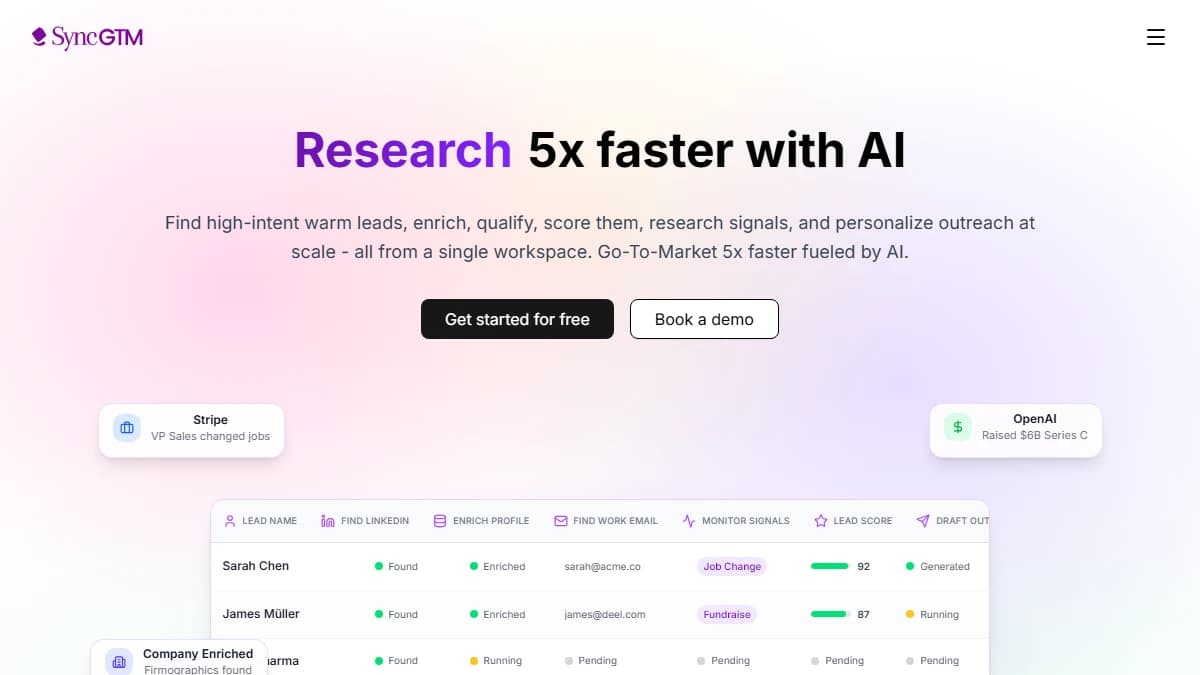
SyncGTM — buying signals, waterfall enrichment across 50+ providers, and outreach in one subscription
SyncGTM is a buying-signal and enrichment platform best suited for mid-market and growth-stage teams that want to act on intent rather than just observe it, bundling signals, contact data, and outreach from $99/mo with a free tier.
It replaces Bombora by changing what counts as a signal. Instead of topic surge scores, SyncGTM tracks observable events — funding rounds, hiring spikes, executive job changes, product launches, and tech-stack changes.
Every signal is source-attributed. A rep can see that a company raised a Series B three weeks ago and opened four data-engineering roles, then quote that in the first line of an email.
The enrichment layer is where the Bombora gap actually closes. SyncGTM runs waterfall enrichment across 50+ providers and returns 76+ data points per lead — verified work email, mobile direct dial, firmographics, technographics, funding stage, headcount, LinkedIn URL, and job history.
You are only charged when a verified record comes back, so a low hit rate does not burn credits. That model is covered in more depth in our guide to the best waterfall contact providers.
Outreach and CRM sync ship in the same product. AI agents trigger enrichment on CRM events, fire sequences when a signal fires, and push records into HubSpot, Salesforce, Pipedrive, Attio, and Zoho — full plan breakdown on the pricing page.
Pros
- Signals, enrichment, and outreach in one subscription
- Waterfall across 50+ providers — 76+ data points per lead
- Source-attributed signals reps can quote — no opaque surge score
- Contact-level, not just account-level
- Free tier and $99/mo entry — no annual contract
- Charged only on verified records returned
- Native sync to HubSpot, Salesforce, Pipedrive, Attio, Zoho
Cons
- No topic-taxonomy content-consumption feed like Company Surge
- No programmatic ABM advertising layer
- Free tier capped at 50 credits
- Smaller brand footprint than Bombora or ZoomInfo
Best for: Mid-market and growth-stage teams that want signals they can action the same day, without a three-vendor stack.
Pricing: Free (50 credits) · Starter $99/mo · Pro $249/mo · Business $649/mo
2. G2 Buyer Intent
G2 Buyer Intent — first-party signals from buyers actively comparing software
G2 Buyer Intent is a first-party intent product best suited for B2B software companies with an active G2 category presence, surfacing the accounts that viewed your profile or compared you against a rival for roughly $20,000 to $30,000 per year.
This is the highest-conviction signal on the list. Someone landing on a "Product A vs Product B" page is not modelled intent — it is a declared evaluation, in your category, right now.
The reporting is refreshingly literal. You see which companies viewed your profile, which competitors they also viewed, and which category pages they browsed.
The limitation is coverage. G2 only sees buyers who visit G2, so it is powerful for software categories and close to useless outside them — and it is account-level, so you still need enrichment to find the person. Our G2 Buyer Intent review covers the pricing tiers in detail.
Pros
- First-party signal — declared research, not inferred
- Shows exactly which competitors were compared
- Near real-time, not weekly batch scoring
- Cheaper than Bombora for software categories
- Doubles as competitive intelligence
Cons
- Only works if your category is active on G2
- No coverage outside software buying journeys
- Account-level only — no contact data or outreach
- Requires a paid G2 profile as a prerequisite
- Volume depends on your review count and ranking
Best for: B2B SaaS companies with an established G2 presence that want the highest-intent accounts in their category.
Pricing: Roughly $20K–$30K/year as an add-on to a paid G2 profile
3. 6sense
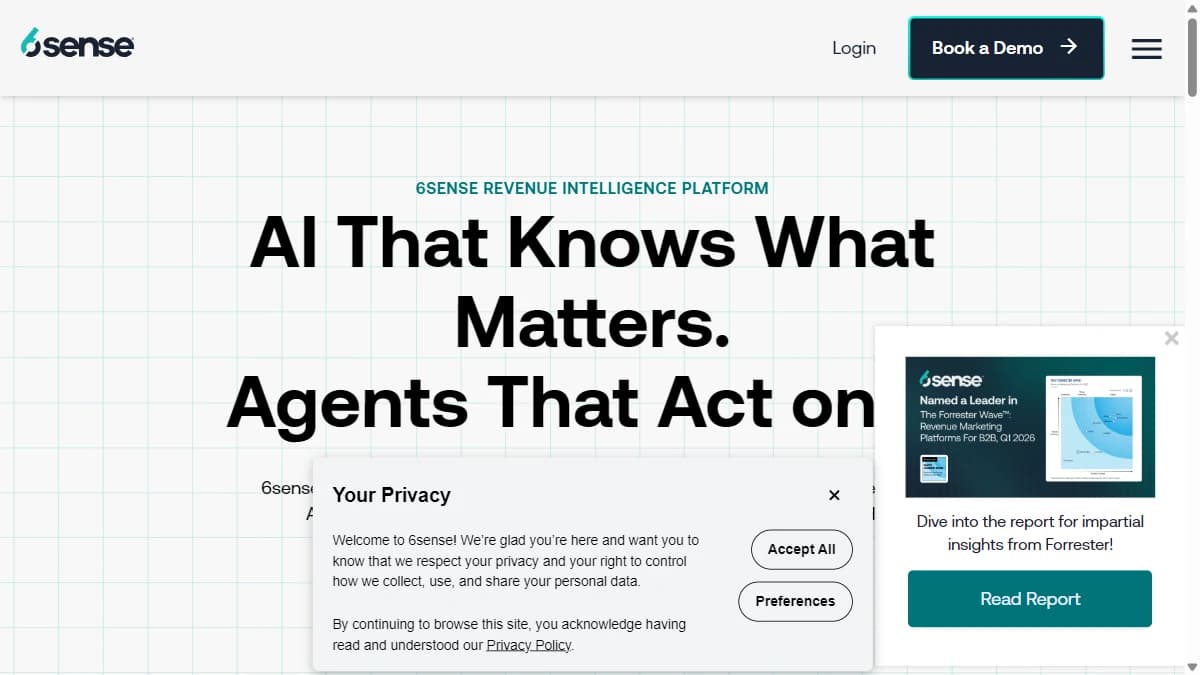
6sense — predictive AI, intent, and account-based advertising in one enterprise suite
6sense is an enterprise revenue intelligence platform best suited for large ABM teams, pairing predictive buying-stage models with intent data and programmatic advertising at $60,000 to $300,000 per year.
Where Bombora hands you a score, 6sense hands you a stage. Its models classify accounts as Target, Awareness, Consideration, Decision, or Purchase, and orchestrate ads and plays against each one.
That orchestration is the genuine win. If your problem is "we have intent data and nobody acts on it", 6sense solves it with automated campaigns, alerts, and CRM workflows.
The costs are price and opacity. Contracts start where most mid-market budgets end, implementations run months, and reps routinely distrust a stage prediction they cannot trace to a source. See our 6sense review and our list of 6sense alternatives for the full picture.
Pros
- Predictive buying-stage models, not just a surge score
- Contact-level intent inside target accounts
- Built-in programmatic advertising and orchestration
- Strong Salesforce and HubSpot integrations
- Replaces several point tools in one contract
Cons
- $60K–$300K/year puts it out of mid-market reach
- Multi-month implementation and ongoing model tuning
- Needs dedicated marketing-ops headcount
- Black-box scoring reps struggle to trust
- Ad budget is an additional line item
Best for: Enterprise ABM teams that need intent, predictive scoring, and paid media orchestrated together.
Pricing: $60K–$300K/year, quote-based; limited free credits available
4. Demandbase
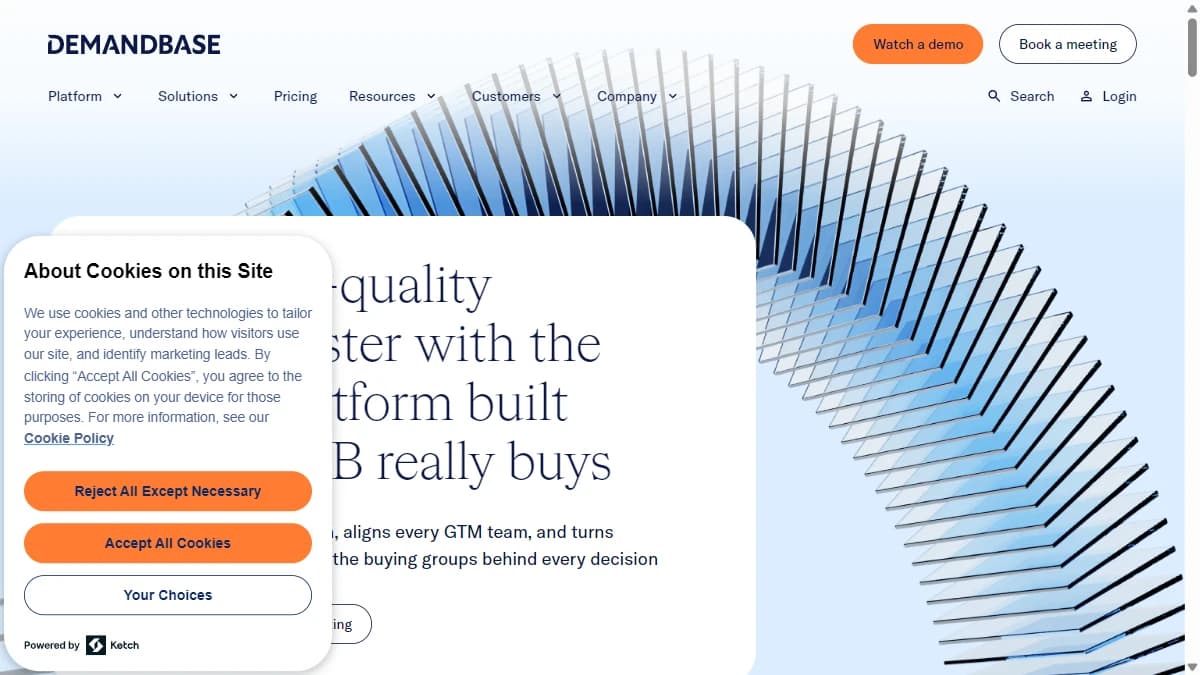
Demandbase — account intelligence with keyword-level intent and self-serve programmatic ads
Demandbase is an enterprise ABM platform best suited for teams that want keyword-level intent rather than topic buckets, running $50,000 to $200,000 per year with account intelligence and a native ad platform included.
Its intent network is the direct Bombora competitor here. Demandbase reports at keyword granularity, so you see the specific phrases an account is engaging with rather than a broad category label.
That precision matters when your category is crowded. "CRM" is a useless signal; "Salesforce migration cost" is a conversation starter.
The tradeoffs mirror 6sense — enterprise pricing, a real implementation, and an ops owner required to keep it useful. Our Demandbase review breaks down the modules and what they actually cost.
Pros
- Keyword-level intent, not just topic buckets
- Owns its intent network rather than reselling one
- Self-serve programmatic ad platform included
- Strong account identification for anonymous web traffic
- Mature Salesforce and Marketo integrations
Cons
- $50K–$200K/year with annual commitment
- Modular pricing makes quotes hard to compare
- Steep learning curve across the suite
- Contact data is thinner than ZoomInfo or Apollo
- Overkill if you only wanted the intent feed
Best for: Enterprise marketing teams that need keyword-level intent plus advertising inside one platform.
Pricing: $50K–$200K+/year, quote-based and modular
5. ZoomInfo Intent
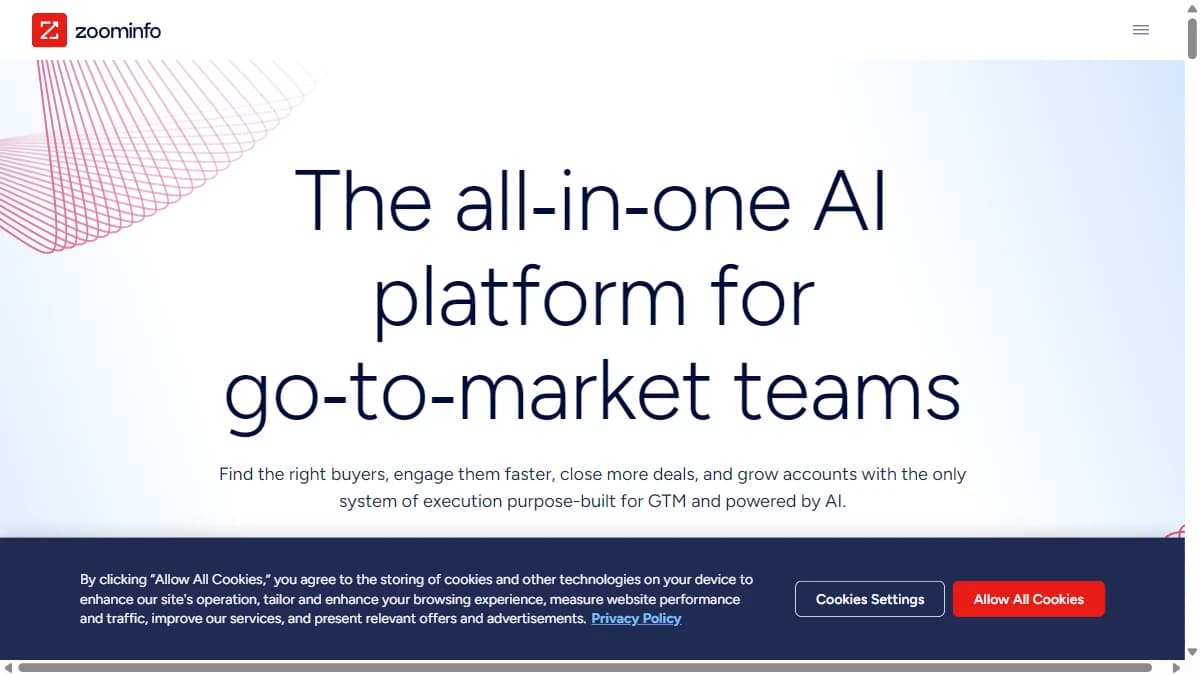
ZoomInfo — intent signals mapped directly onto a 321M+ contact database
ZoomInfo Intent is an intent add-on best suited for teams already paying for ZoomInfo contacts, layering publisher co-op signals onto a 321M+ profile database for $5,000 to $10,000 on top of a base contract near $15,000 per year.
The advantage over Bombora is immediate and practical. When an account surges, the contacts are already in the same UI — no CSV export, no second enrichment vendor, no matching step.
ZoomInfo Copilot then drafts the outreach and ZoomInfo Engage sends it, which makes this the shortest signal-to-email path among the legacy platforms.
The catch is the bundle. Intent is not in the base plan, seats and credits inflate quickly, and most teams land at $25,000 to $40,000 per year once add-ons stack up — details in our ZoomInfo cost breakdown and full ZoomInfo review.
Pros
- Intent and contact data in the same platform
- 321M+ profiles with direct dials and verified emails
- Copilot and Engage close the signal-to-send loop
- Mature CRM and sales-engagement integrations
- Broad topic coverage beyond software categories
Cons
- Intent is a paid add-on, not included in the base plan
- Annual contracts only, with no monthly billing
- Real cost often lands at $25K–$40K/year
- Credits expire monthly
- Same third-party inference limits as Bombora
Best for: Existing ZoomInfo customers who want intent without adding another vendor.
Pricing: ~$14,995/year base plus $5K–$10K intent add-on
6. Intentsify
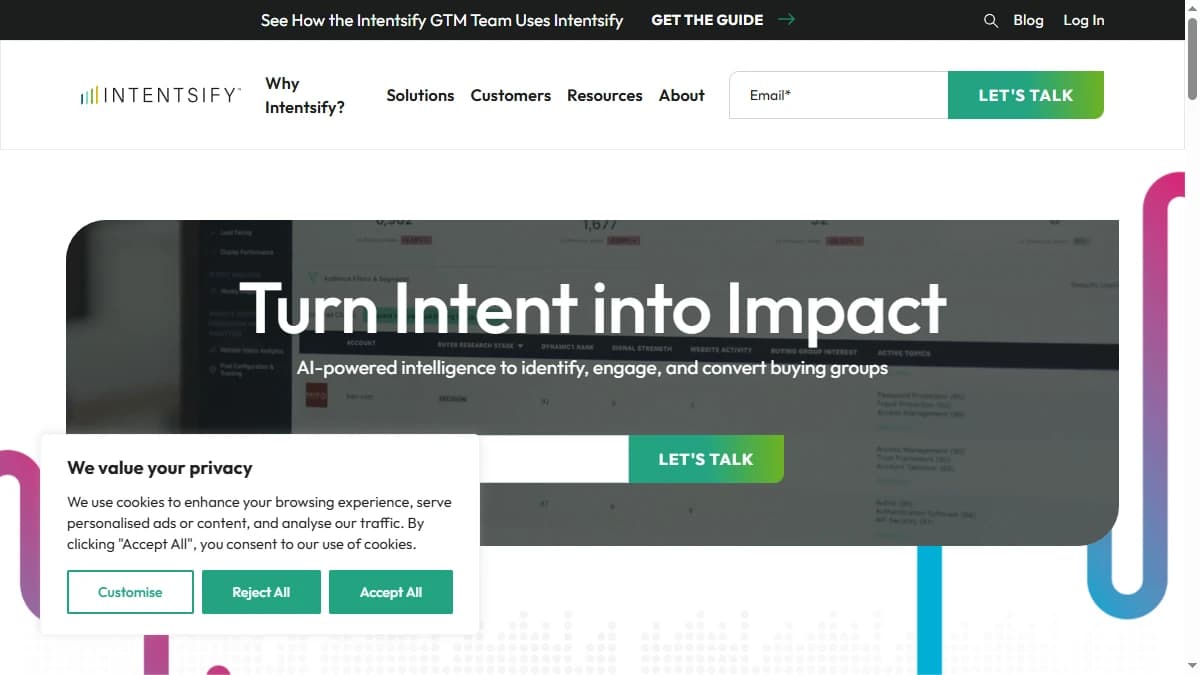
Intentsify — multi-source intent aggregation paired with managed activation programs
Intentsify is an intent activation platform best suited for demand-generation teams that want signals and campaign execution in the same contract, typically priced at $25,000 to $50,000 per year.
Its core argument against Bombora is source diversity. Intentsify blends multiple intent providers and its own collection rather than relying on a single co-op, then scores accounts on the combined picture.
The activation side is the real differentiator. Intentsify can run content syndication and display programs against the accounts its own models flag, which suits teams without in-house demand-gen capacity.
The tradeoffs are transparency and lock-in. Blended scoring makes it harder to audit why an account surfaced, and the services model is a poor fit for teams that just want a clean data feed — our Intentsify review digs into the pricing structure.
Pros
- Aggregates multiple intent sources, not one co-op
- Activation and content syndication bundled in
- Typically cheaper than 6sense or Demandbase
- Strong fit for lean demand-gen teams
- Account prioritisation tuned to your ICP
Cons
- Blended scoring is hard to audit
- Services-led model means slower iteration
- No published pricing and annual contracts only
- Thin contact-level data without add-ons
- Smaller ecosystem of native integrations
Best for: Demand-gen teams that want intent signals and campaign execution from one vendor.
Pricing: $25K–$50K/year, quote-based
Also Worth Knowing: Clay, TechTarget, Common Room
Three more tools come up constantly in Bombora evaluations. None is a like-for-like swap, but each wins a specific job.
- Clay is an activation layer, not a signal source. It is the best tool on this list for stitching intent, enrichment, and AI research into one workflow — but you still supply the intent feed, and credit costs climb fast at volume. Free tier available; most teams land between $349 and $800/mo. See our Clay review.
- TechTarget Priority Engine is the strongest signal on the market for IT, security, and infrastructure buyers, because it is first-party research on TechTarget properties with named contacts attached. It is narrow by design and priced from roughly $30,000 per year — full detail in our TechTarget review.
- Common Room captures signals Bombora structurally cannot see — community activity, product usage, and social engagement from real named people. It is the best fit for product-led and developer-first companies, starting around $1,500/mo. See our Common Room review.
Side-by-Side Comparison
The columns that matter are the last two. A signal you cannot attach a person to, and cannot send an email from, is a research project rather than a pipeline source.
| Tool | Signal Type | Starting Price | Contact Data | Built-in Outreach |
|---|---|---|---|---|
| Bombora (baseline) | Third-party content co-op (5,000+ sites) | $30K–$60K/yr | No | No |
| SyncGTM | Observable events — funding, hiring, job change, tech stack | $99/mo | Yes — 50+ providers, 76+ data points | Yes |
| G2 Buyer Intent | First-party review-site research | $20K–$30K/yr | Limited | No |
| 6sense | Predictive AI over third-party and first-party data | $60K–$300K/yr | Yes | Yes (ads + orchestration) |
| Demandbase | Own intent network with keyword granularity | $50K–$200K/yr | Yes | Yes (ads + orchestration) |
| ZoomInfo Intent | Publisher co-op intent mapped to contacts | $15K/yr + $5K–$10K intent add-on | Yes — 321M+ profiles | Yes (Engage add-on) |
| Intentsify | Multi-source intent aggregation and modelling | $25K–$50K/yr | Via activation services | Managed programs |
How to Choose the Right Bombora Alternative
Start from what you actually did with the Company Surge feed. Five decision points cover almost every case.
- You had signals but nobody acted on them. Pick SyncGTM. Signals, enrichment across 50+ providers, and outreach in one subscription from $99/mo — the shortest path from signal to sent email.
- You sell B2B software and live in a G2 category. Pick G2 Buyer Intent. First-party comparison signals beat inferred topic scores on conviction, and it costs less than Bombora.
- You need orchestration and paid media, not just data. Pick 6sense for predictive staging or Demandbase for keyword-level intent. Both assume enterprise budget and an ops owner.
- You already pay ZoomInfo. Add ZoomInfo Intent. It is rarely the best signal, but it is the least disruptive and the contacts are already there.
- You want intent plus someone to run the campaigns. Pick Intentsify. Multi-source scoring with managed activation, at roughly half the cost of an enterprise ABM suite.
One budgeting rule holds across all of them. Price the whole stack, not the feed — an intent contract with no contact data and no sending tool is a third of a system, and the missing two-thirds usually cost more than the part you just bought.
Final Verdict
Bombora is good at the job it was built for: telling you which accounts are researching your category. The problem in 2026 is that this is now the cheap half of the problem.
Knowing an account is in-market is worth nothing until you know who to email and can email them. That is the frame every option on this list should be judged against.
SyncGTM is the best overall Bombora alternative for that reason — buying signals, waterfall enrichment across 50+ providers, 76+ data points per lead, and outreach in one subscription from $99/mo, with a free tier to test the data before committing.
If you sell software, G2 Buyer Intent is the highest-conviction signal available and pairs well with any enrichment layer. If you need enterprise orchestration, 6sense and Demandbase remain the two serious options.
If you already pay ZoomInfo, its intent add-on is the pragmatic choice. If you want signals and campaign execution from one vendor, Intentsify is the value pick.
Pick the one that removes a step from your workflow — not the one with the biggest topic taxonomy.