

Xverify Review 2026: B2B Data Coverage, Pricing & SyncGTM Comparison

By Kushal Magar · June 13, 2026 · 12 min read
Key Takeaway
Xverify is a pay-as-you-go verification platform that validates email, phone, and postal addresses from $5/500 verifications ($0.01/email). It claims 98% accuracy and offers a combined API endpoint for all three data types in one call — a genuine differentiator for affiliate marketers and multi-channel outreach teams. It is slow on large batches (4–6 hours for 100K records), carries mixed accuracy reports on corporate B2B domains, and has no catch-all AI scoring or B2B contact enrichment. For B2B outbound teams that need to find contacts and verify them in one step, SyncGTM's waterfall enrichment across 50+ providers delivers verified contacts with better corporate coverage from $99/mo.
Xverify is a real-time verification platform that validates email addresses, phone numbers, and postal addresses on a pay-as-you-go basis. It was built for digital marketers and affiliate networks that need to catch bad data at the point of entry — not clean it up weeks later.
This review covers Xverify's pricing, accuracy, key features, and honest limitations — including how it compares against SyncGTM's waterfall enrichment approach for B2B outbound teams.
According to G2, Xverify has limited public reviews — a thin track record compared to NeverBounce (200+ reviews) and Emailable (277 reviews). Feedback that does exist is mixed: some users praise its ease of use and pricing, while others report high failure rates on corporate address validation and unresponsive support.
TL;DR
- What it is: Pay-as-you-go email, phone, and postal address verification platform with real-time and batch modes.
- Best for: Affiliate marketers and digital media buyers who need fraud protection and multi-channel data validation at point-of-form submission.
- Pricing: $5 for 500 verifications ($0.01/email), scaling to $0.001/email at 2.5M volume. No setup fees, no minimums. 100 free verifications on signup.
- Accuracy: 98% claimed across major email domains. Mixed independent reports — stronger on consumer domains, weaker on corporate B2B catch-all addresses.
- Key gap: No B2B contact finding, no catch-all AI scoring, slow batch processing (4–6 hours for 100K records), limited G2 review volume.
- SyncGTM vs Xverify: SyncGTM replaces Xverify for B2B outbound teams — waterfall enrichment across 50+ providers delivers verified contacts with deliverability built in, no separate cleaning step needed.

Xverify homepage — pay-as-you-go email, phone, and address verification
What Is Xverify?
Xverify is a verification platform that checks three types of contact data in real time: email addresses, phone numbers, and postal addresses. It targets digital marketers, affiliate networks, and lead generation companies that need to validate data at the moment it enters a form — stopping fraud, typos, and disposable addresses before they poison a database.
The platform uses what it calls SendShield Technology to run each email verification as a unique real-time transaction — no caching. It connects directly to the mail server to confirm the username exists at the domain, checks for spam complainers via community feedback loops, identifies disposable and temporary accounts, and auto-corrects common domain typos (e.g., "Yahooo.com" → "Yahoo.com"). IP blacklist monitoring across 200+ known blacklists flags high-risk addresses before they reach your CRM.
Xverify offers three integration methods: a JavaScript plugin for real-time form validation, a REST API for programmatic single-record and batch verification, and CSV batch upload via drag-and-drop or FTP. All three draw from the same pay-as-you-go credit pool.
The platform's most distinctive capability is its combined verification API — a single endpoint that validates email, phone, and postal address simultaneously. For affiliate marketers managing multi-channel lead capture forms, this eliminates the need to call three separate verification services. It is the feature that most clearly differentiates Xverify from pure email verifiers like Kickbox and MillionVerifier.
Xverify does not find contacts. It has no B2B database, no email finder, and no enrichment capability. Teams need existing contact data before Xverify can add value.
Xverify Pricing: Plans, Credits, What You Actually Pay
Xverify pricing is fully public and pay-as-you-go with no monthly commitments, no setup fees, and no minimum purchase. Email, phone, and postal address verification all use the same pricing tiers. Volume discounts apply automatically based on monthly usage.
| Verifications | Cost | Per Verification |
|---|---|---|
| 500 | $5 | $0.010 |
| 1,000 | $10 | $0.010 |
| 5,000 | $40 | $0.008 |
| 10,000 | $70 | $0.007 |
| 25,000 | $150 | $0.006 |
| 100,000 | $400 | $0.004 |
| 500,000 | $1,000 | $0.002 |
| 2,500,000 | $2,500 | $0.001 |
| 2.5M+ | Contact sales | Custom |
Xverify provides 100 free verifications on signup — enough to test accuracy before committing. There is no minimum purchase and no contract. Pricing for phone and postal address verification uses identical tiers to email.
Compared to competitors: NeverBounce charges $0.008/email at pay-as-you-go with no minimum, making it cost-equivalent to Xverify at the 5,000-credit tier. Emailable starts cheaper at $30/5,000 ($0.006/email) with non-expiring credits. At the 100K mark, Emailable ($400) matches Xverify ($400) on price but does not offer phone or address verification. The combined API endpoint is Xverify's pricing advantage — one payment covers three verification types simultaneously.
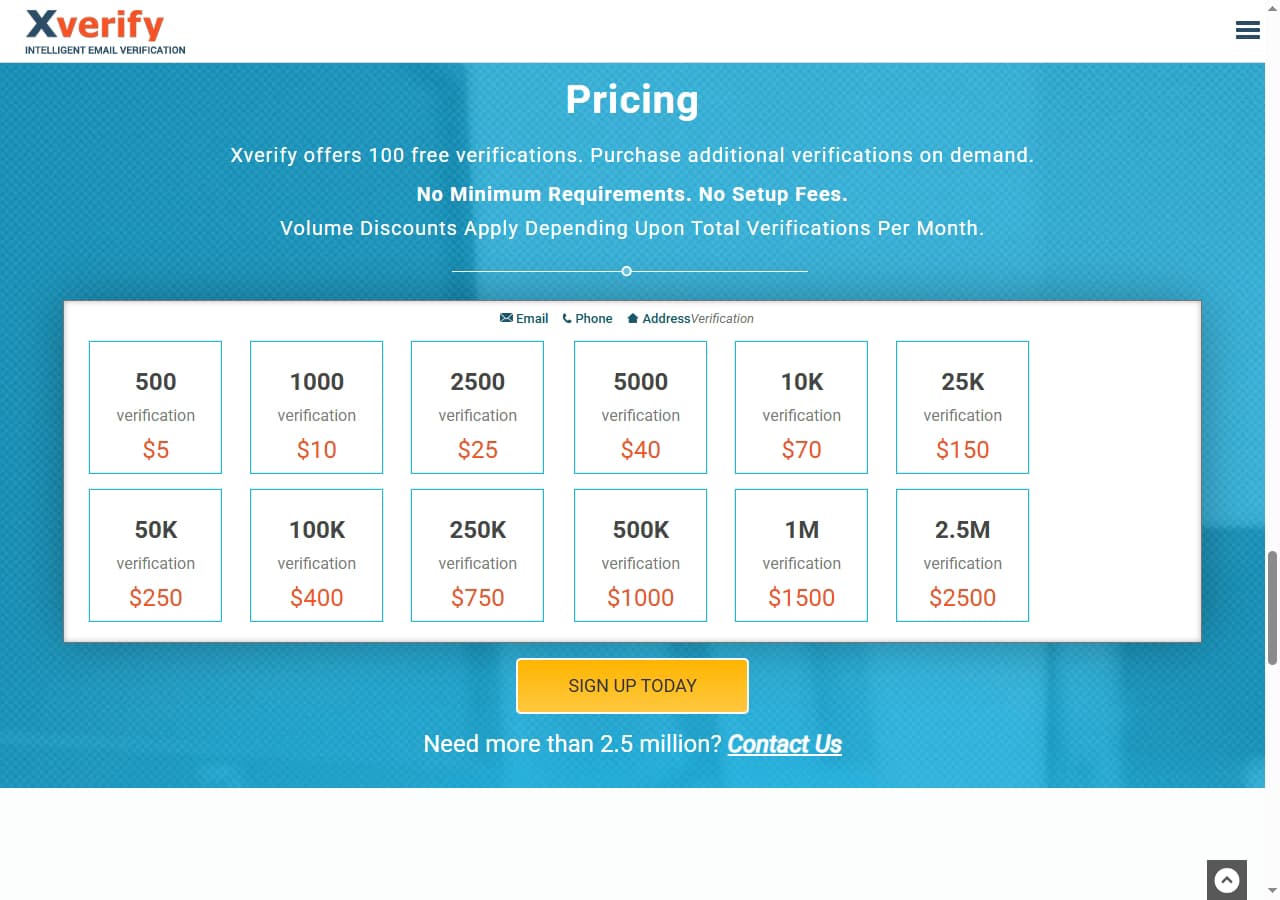
Xverify pricing page — no setup fees, no minimums, volume discounts from $0.01/verification
Xverify Key Features
Real-Time Email Verification with SendShield
Xverify's core email verification uses SendShield Technology to run a unique real-time transaction per address — no caching. It checks username registration at the domain via direct mail server connection, identifies spam complainers through community feedback loops, blocks disposable and temporary email accounts, and auto-corrects common domain typos. Results return in under one second for real-time API calls.
The platform monitors 200+ IP blacklists and flags addresses linked to known fraudulent activity — a layer beyond basic SMTP verification. Name verification checks for profanity and special characters in name fields, which affiliate networks use to catch obviously fake lead submissions.
Combined API Endpoint (Email + Phone + Address)
Xverify's most distinctive feature: a single API call that verifies email address, phone number, and postal address simultaneously. For lead generation companies managing multi-channel capture forms, this eliminates calling three separate verification APIs and reconciling three separate responses. The combined endpoint returns a unified validation verdict — valid/invalid/risky across all three fields — in one round trip.
This is not a feature most pure email verifiers offer. ZeroBounce, NeverBounce, and Emailable do not support phone or address verification. It is Xverify's clearest differentiation from the broader email verification market.
Fraud Protection for Affiliate Networks
Xverify was built around affiliate network use cases where fraudulent lead submissions directly affect revenue. It identifies linked fraudsters — catching when multiple fake leads share characteristics (IPs, email patterns, phone number ranges) that indicate coordinated abuse. Affiliate performance reports show data quality metrics per traffic source, helping network managers identify and suppress low-quality partners.
This fraud detection layer goes beyond what standard email verifiers provide. Teams running pay-per-lead affiliate programs where fraudulent submissions cost real money will find Xverify's protection more targeted than a generic email cleaner.
Batch Upload and FTP for Large Lists
Xverify supports CSV batch upload via drag-and-drop interface or FTP for large datasets. The platform processes files under 10,000 records in under 20 minutes. Files of 100,000 records take 4–6 hours. Files above that threshold are recommended for FTP submission. Processing times are slower than Emailable (30,000 emails/minute) and NeverBounce — a meaningful constraint for teams running same-day pre-campaign hygiene on large lists.
JavaScript Plugin for Form-Level Validation
Xverify provides a JavaScript integration that validates email addresses at form submission — blocking or warning on invalid addresses before the form posts. This is the integration most commonly used by affiliate landing pages and B2C lead capture forms. It prevents disposable addresses, typos, and fraudulent submissions from ever entering a database, as opposed to batch cleaning them out later.
The plugin is mobile-ready and integrates alongside the REST API for teams that need both real-time form validation and batch list processing from the same credit pool.
Xverify Pros: What It Does Well
- ✓Combined email + phone + address verification in one API call — the only major verifier in this tier that validates all three contact data types simultaneously. Eliminates multi-API complexity for teams running full-record validation at form submission.
- ✓No minimums, no setup fees, no contracts — pure pay-as-you-go with a $5 entry point. Teams with low or variable verification volumes pay exactly for what they use, with no forced monthly commitment.
- ✓Affiliate-grade fraud detection — spam complainer detection, linked fraudster identification, and per-traffic-source quality reporting go beyond basic email syntax checking. Built for use cases where fraudulent lead submissions have direct financial consequences.
- ✓Real-time sub-second response — API verification returns results in under one second per address. Suitable for embedding in signup flows and live lead routing workflows where latency matters.
- ✓Auto-correction for domain typos— catches "Yahooo.com", "Gmial.com", and similar common typos, offering the corrected address rather than simply rejecting it. Recovers leads that would otherwise be lost to manual entry errors.
- ✓200+ IP blacklist monitoring — flags addresses associated with known spam and fraud networks, beyond standard SMTP verification. Relevant for teams managing sender reputation across high-volume campaigns.
- ✓Competitive volume pricing — $0.001/email at 2.5M verifications/month is among the lowest in the market. Cost scales favorably for high-volume affiliate networks and media buyers.
Xverify Cons: Where It Falls Short
- ✗Mixed accuracy reports on corporate B2B addresses — one G2 reviewer reported a 34% failure rate on over 600 standard US corporate addresses. The claimed 98% accuracy likely applies to consumer domains (Gmail, Yahoo, Outlook) but may underperform on enterprise corporate email with catch-all configurations or aggressive greylisting. B2B outbound teams should test carefully before committing.
- ✗Slow batch processing on large lists— 100K records take 4–6 hours. Emailable processes 30,000 emails per minute. NeverBounce handles large batches in minutes. For teams running pre-campaign hygiene on large B2B lists with same-day deadlines, Xverify's speed is a practical constraint.
- ✗No catch-all AI scoring — enterprise B2B domains commonly use catch-all server configurations where the mail server accepts all inbound email regardless of whether the specific mailbox exists. Xverify flags these as catch-all but provides no AI-based scoring to recover actionable verdicts. ZeroBounce offers AI catch-all scoring that returns a confidence score — useful for B2B teams trying to maximize contact coverage without risking bounces.
- ✗Thin G2 review volume— limited public reviews on G2 and Capterra make social proof validation difficult. NeverBounce (200+ reviews), Emailable (277 reviews), and ZeroBounce (549 reviews) all have significantly more review volume. For teams using G2 data in vendor evaluation, Xverify's thin profile is a risk signal.
- ✗Customer support responsiveness reported as poor — multiple reviewers flag non-existent or slow support responses when issues arise. For teams relying on the platform for production-critical lead validation, this is a meaningful operational risk.
- ✗No B2B contact finding or enrichment — pure verification tool. No contact database, no email finder, no firmographic or technographic data. Every team using Xverify needs a separate upstream tool to build the list being verified.
- ✗Higher per-email cost at entry volumes than alternatives — at 5,000 verifications, Xverify charges $40 ($0.008/email). Emailable charges $30/5,000 ($0.006/email) with non-expiring credits. DeBounce charges $10/5,000 ($0.002/email). For teams with sub-25K monthly verification needs, alternatives are cheaper.
Xverify vs Alternatives: Comparison Table
Xverify competes with ZeroBounce, NeverBounce, Emailable, and Kickbox on email accuracy and pricing — and against SyncGTM when teams evaluate replacing their verification workflow entirely with waterfall enrichment. Here is how Xverify stacks up across the dimensions that matter for B2B and affiliate teams.
| Feature | Xverify | SyncGTM | ZeroBounce | NeverBounce |
|---|---|---|---|---|
| Starting Price | $5 for 500 verifications ($0.01/email) | $99/mo | $15/mo (2K credits) | $0.008/email (pay-as-you-go) |
| Pricing Transparency | Public pricing page, no setup fees | Public pricing page | Public pricing page | Public pricing page |
| Claimed Accuracy | 98% across major email domains | Waterfall cross-reference across 50+ providers | 99.6% claimed | 97–99% claimed |
| Catch-All Handling | Flagged as catch-all — no AI scoring | Waterfall retries alternate providers | AI catch-all scoring with confidence | Flagged as catch-all — no scoring |
| Phone Verification | Yes — same pay-as-you-go pricing | Via enrichment providers (direct dials) | No | No |
| Address Verification | Yes — postal address validation | No | No | No |
| Fraud Detection | Yes — spam complainers, disposable, IP blacklists | Via enrichment providers | Yes — AI spam trap scoring | No |
| B2B Contact Enrichment | None — verification only | Yes — email, phone, firmographics | Email append (US B2C only) | None — verification only |
| Buying Signals | None | Hiring, funding, tech changes, job changes | None | None |
| Native Outreach | None | Yes — built-in sequencing | None | None |
| Free Tier | 100 free verifications on signup | 200 enrichment credits/month | 100 free credits | 1,000 free verifications |
| Credit Expiry | No stated expiry | No expiry (subscription) | 12 months | No expiry |
| Batch Processing Speed | ~20 min for 50K records; 4–6 hrs for 100K | Real-time via API | High-speed bulk processing | High-speed bulk processing |
| G2 Rating | Limited reviews | N/A | 4.7/5 (549 reviews) | 4.4/5 (200+ reviews) |
SyncGTM vs Xverify: The Core Difference
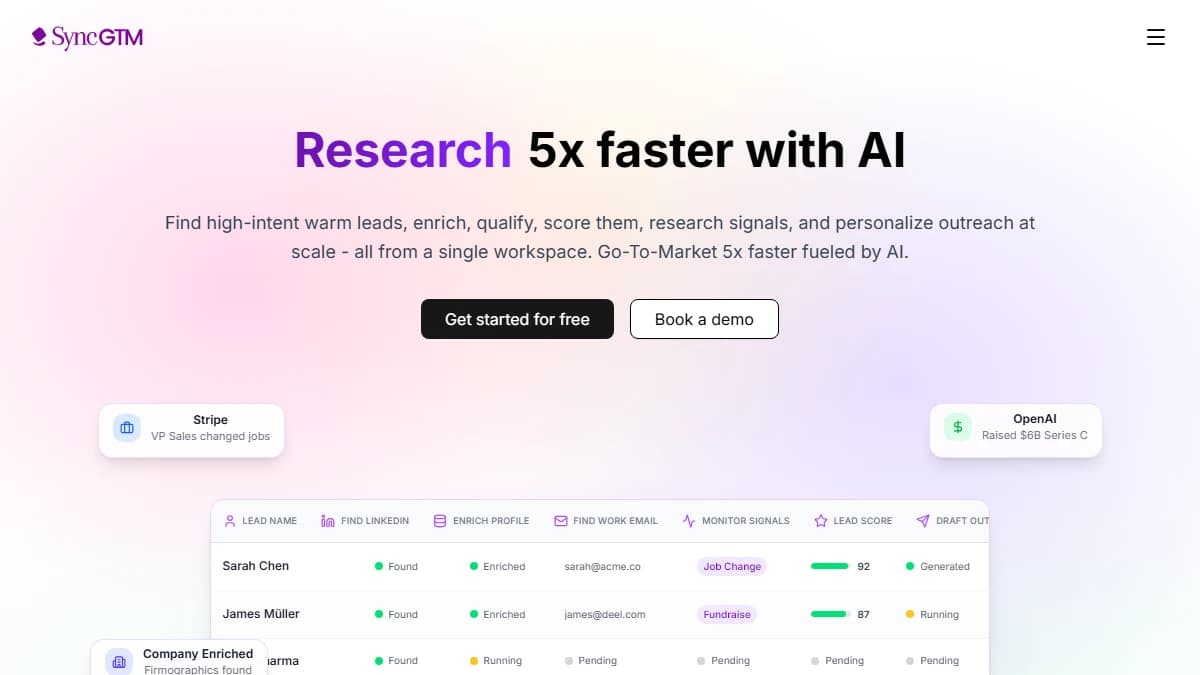
SyncGTM — waterfall enrichment across 50+ providers with verified contacts built in
SyncGTM is not an email verifier — it is a B2B prospecting platform built around waterfall enrichment. The comparison matters because both tools are used by teams that need verified contact data before outreach, but they solve the problem from opposite ends.
Xverify validates a list you already have. SyncGTM builds and verifies that list from scratch: verified email, direct dial, LinkedIn, and 76+ firmographic and technographic data points from a target account or company name. Verification is embedded in the enrichment output — cross-referenced across 50+ providers before delivery — making a separate Xverify validation step redundant for teams doing B2B prospecting end-to-end.
According to Gartner's B2B buying research, outbound teams that verify contact data at the point of enrichment — rather than cleaning post-collection — see 25–40% lower bounce rates and faster sequence completion. SyncGTM's waterfall approach applies this at scale: each provider in the waterfall cross-checks the previous result, meaning the final output carries significantly higher confidence than a single-source verification.
Where Xverify wins: affiliate and performance marketing teams that need fraud detection, phone validation, and postal address verification alongside email — in a single API call, with no monthly commitment. For those specific use cases, no email-only verifier matches it.
For teams doing B2B outbound prospecting that need to find contacts, verify them, enrich with firmographics, and sequence them — SyncGTM handles all four steps. See our BriteVerify review and DeBounce review for other verifier comparisons in this tier.
Who Should Use Xverify?
Xverify is well-suited for four specific scenarios:
- Affiliate networks and performance marketers needing fraud protection. Xverify was purpose-built for this use case. Spam complainer detection, linked fraudster identification, and per-traffic-source quality reports give affiliate managers tools that generic email verifiers do not provide. Teams paying per-lead where fraudulent submissions directly affect margins will get more targeted protection from Xverify than from a standard list cleaner.
- Teams that need to validate email, phone, and postal address simultaneously.No major competitor in this tier offers combined three-data-type verification in a single API call. For insurance lead forms, mortgage applications, and consumer offer pages where all three fields matter for contact quality, Xverify's combined endpoint eliminates integration complexity.
- Marketers with very low or irregular verification volumes. The $5 entry point with no minimum, no setup fee, and no contract means teams that verify 500 emails per month pay only $5. For small businesses or teams running occasional one-off campaigns, the pay-as-you-go model beats any subscription-based verifier.
- Developers embedding form-level email validation in consumer-facing products. The JavaScript plugin and sub-second API response support real-time validation at form submission. Teams building lead capture pages, SaaS signup flows, or CRM import pipelines can embed Xverify to block disposable addresses and typos before they enter the database.
Xverify is not the right choice for B2B outbound prospecting teams that need to find contacts before verifying them. It is not the right choice for enterprise sales teams processing 100K+ contact refreshes with same-day deadlines. And it is not the right choice for teams that need catch-all AI scoring to maximize coverage on corporate email domains.
For a broader comparison of email verification alternatives including SyncGTM, ZeroBounce, NeverBounce, and Emailable, see our Emailable review and NeverBounce review. For replacing the entire verification and enrichment workflow with waterfall data, see SyncGTM.