
By Kushal Magar · October 3, 2026 · 11 min read
ZoomInfo vs Lusha: B2B Contact Data Compared for 2026 Buyers
ZoomInfo vs Lusha looks like a data-quality fight, but the vendors' own phone accuracy claims sit one point apart: 87% for ZoomInfo, 86% for Lusha. Everything around the data differs. ZoomInfo sells intent, org charts, and 122M+ company records on a contract its own terms call "not cancellable"; Lusha sells one-click direct dials on published plans you can bill monthly.
ZoomInfo vs Lusha is the shortlist most sales leaders land on when they need verified emails and direct dials but aren't sure how much platform they need. ZoomInfo is built for enterprise go-to-market teams that want intent data, org charts, and account intelligence; Lusha is built for SMB reps who want a direct dial in one click.
ZoomInfo claims 500M+ professional profiles, 122M+ companies, and 135M+ direct dials, sold on quote-only contracts. Lusha claims 525M+ contacts and 117M+ direct dials, sold on published plans that bundle one to five seats.
Below, we compare accuracy claims, what each contract says about renewal and cancellation (we read both terms documents), signals, CRM workflow, and price per seat as of October 2026. For single-tool deep dives, see our ZoomInfo review and Lusha review; if Apollo.io is also on your list, see Apollo.io vs ZoomInfo and Apollo.io vs Lusha.
Quick Summary
ZoomInfo vs Lusha comes down to account depth and contract risk, not accuracy percentages. ZoomInfo claims 500M+ professional profiles, 122M+ companies, 135M+ direct dials, intent across 4,500+ topics, a 96% email deliverability rate, and 87% mobile number accuracy. It is quote-only: the entry package is widely reported at about $14,995 a year for 3 seats, Vendr's median contract is $33,500, and its license terms state the agreement is not cancellable. Lusha claims 525M+ contacts, 117M+ direct dials, 98% email accuracy, and 86% phone accuracy, and publishes prices of $37.45, $52.45, or $299.95 a month on annual billing for 1, 2, or 5 seats, plus a free plan. ZoomInfo fits enterprise teams that need org charts and intent; Lusha fits one to five reps who want fast direct dials. Test both on 200–300 of your own records.
TL;DR
- Short answer: ZoomInfo wins for enterprise teams that sell into large accounts and need intent data, org charts, and company depth. Lusha wins for SMB teams of one to five reps who want fast direct dials without a sales call or an annual commitment.
- Accuracy claims: ZoomInfo lists a 96% email deliverability rate and 87% mobile number accuracy; Lusha states 98% email and 86% phone accuracy. Both are vendor figures measured differently, so test both tools on 200–300 of your own records.
- Price per seat: Lusha Pro covers 2 seats for $629.10 a year (about $315 per seat), and Premium covers 5 for $3,599.10 (about $720 per seat). ZoomInfo is quote-only; its entry package is widely reported at ~$14,995 a year for 3 seats (about $5,000 per seat), and Vendr's median contract is $33,500.
- Contract terms: ZoomInfo's license terms call the agreement "not cancellable" and leave renewal to your order form, but add a 95% contact-accuracy guarantee. Lusha plans auto-renew at then-current pricing; cancel at least 14 days before renewal, and annual plans are owed in full.
- Signals and org data: ZoomInfo covers 4,500+ intent topics, website visitors, and hierarchy data, but intent starts above the entry Professional package. Lusha tracks 26 dated signals weekly, such as funding rounds and hiring surges.
- Pick ZoomInfo if you have a RevOps owner and budget for an annual contract. Pick Lusha if you want to start today on a card and grow to five seats before talking to sales.
What We Evaluated
- ZoomInfo vs Lusha accuracy: each vendor's email and phone claims, how they're defined, and how to test them
- Coverage depth: contacts, direct dials, company records, and org chart or hierarchy data
- Price per seat: published plan prices vs quote-only contracts, seats included, and what a direct dial costs in credits
- Contract terms from each vendor's own terms: renewal, cancellation notice, refunds, seat overages, and credit expiry
- Buying signals and intent data: what's included at the entry tier and what costs more
- Workflow fit: Chrome extension, CRM export, sequencing, dialing, and AI or MCP access
1. ZoomInfo — Enterprise coverage, org charts, and intent data on a negotiated annual contract
ZoomInfo — Enterprise coverage, org charts, and intent data on a negotiated annual contract
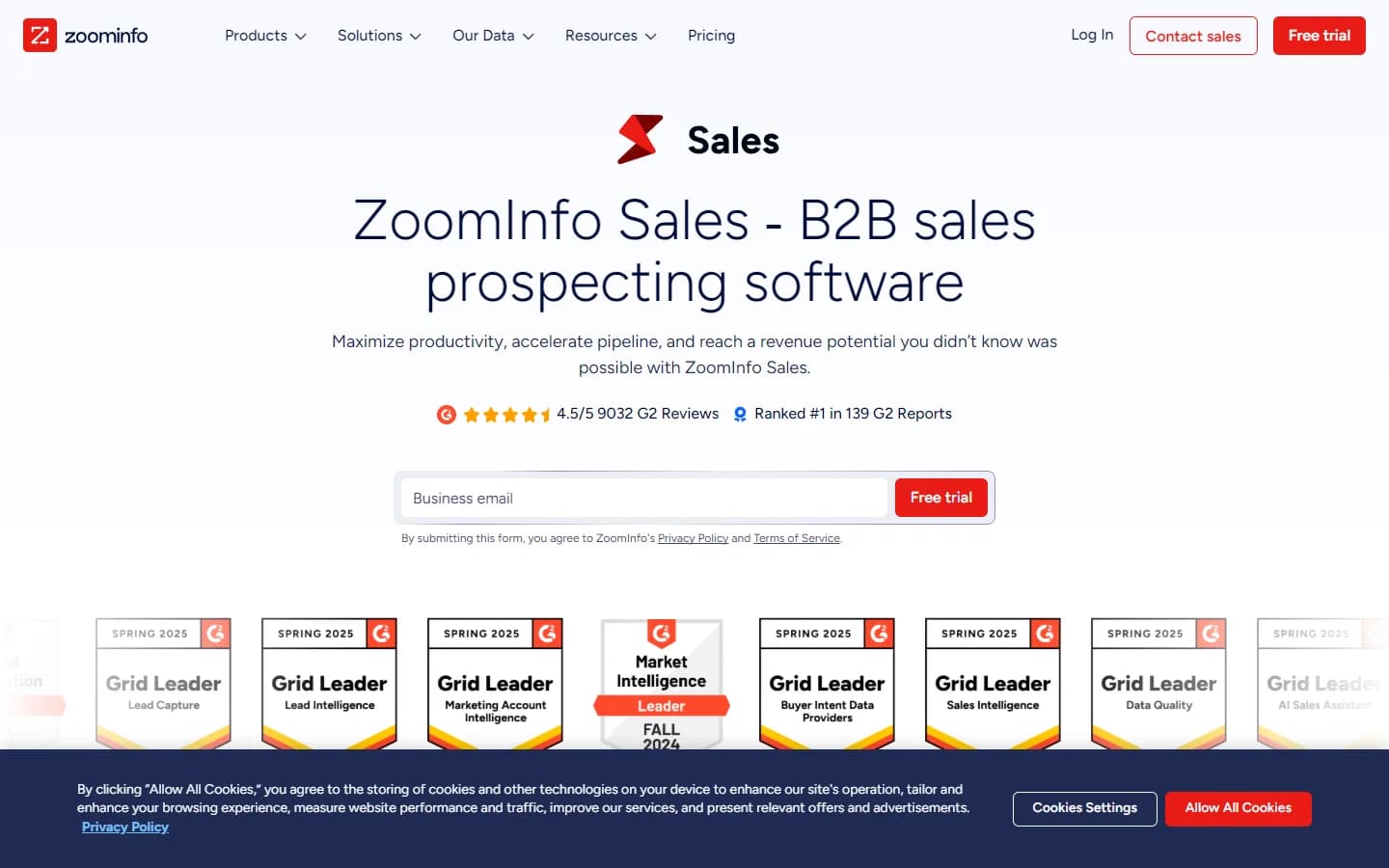
ZoomInfo is an enterprise go-to-market data platform that now calls itself a "GTM Intelligence Layer." Its data page lists 500M+ professional profiles, 122M+ company records, 300M+ verified business emails, 135M+ direct dials, and intent signals from 4,500+ topics.
The same page claims a 96% email deliverability rate and 87% mobile number accuracy, then repeats those figures as "contact hit rates" beside a 72% direct-dial rate. The stronger signal is contractual: ZoomInfo's license terms say that if more than 5% of contacts aren't employed by the listed company, ZoomInfo has 30 days to get back to 95% accuracy, or you can terminate with a prorated refund.
Depth is where ZoomInfo earns its price. Copilot Advanced adds hierarchy data, buyer intent, website visitors, Champion Tracking, and job posting changes, and ZoomInfo's pricing FAQ lists org charts and technographics among its richer data.
The entry Professional package covers profiles, mobile numbers, business emails, CRM integrations, and the Chrome extension, but not intent. Modules such as Engage, GTM Studio, Copilot, and Chorus are sold separately, and ZoomInfo lists 40+ native integrations, including Salesforce, HubSpot, and Microsoft Dynamics.
Pricing is quote-only. ZoomInfo's pricing page ties cost to licenses, features, and credits, which are spent each time you export a profile. The entry package is widely reported at ~$14,995 a year for 3 seats, and Vendr's buyer data puts the median contract at $33,500, with a range of $7,220 to $155,730.
Read the contract twice. The license terms state the agreement "is not cancellable," fees are due at signing, and users added beyond your seat count can be billed at the prevailing per-user rate through the end of the term. Renewal terms live in the order form; buyers commonly report 60–90 day non-renewal windows and 15–20% renewal increases.
You keep using data obtained during the term after it ends. A February 2026 amendment also grants ZoomInfo an irrevocable license to use data sent through its integrations to improve its products, a permission you can adjust inside the platform.
For seat math and negotiation tactics, see our ZoomInfo cost guide and ZoomInfo review, or compare options in the best ZoomInfo alternatives.
Pros
- +Deepest account layer by vendor count: 122M+ company records with hierarchy data and org charts
- +135M+ direct dials and 300M+ verified business emails, strongest on large North American accounts
- +Intent across 4,500+ topics plus website visitors, Champion Tracking, and job posting changes (from Copilot Advanced)
- +License terms include a 95% contact-accuracy guarantee and 99.9% uptime guarantee, each with a termination right
- +Built for enterprise security reviews: ISO 27001, ISO 27701, SOC 2 Type II, and TRUSTe GDPR and CCPA validations
Cons
- −No published pricing; the reported entry package is ~$14,995 a year for 3 seats, and Vendr's median contract is $33,500
- −License terms call the agreement "not cancellable," and renewal notice windows sit in the order form
- −Intent, website visitors, and Champion Tracking sit above the entry Professional package
- −Users added beyond your seat count can be billed at the prevailing per-user rate through the end of the term
- −Prepackaged integrations typically carry an install cost and a minimum bulk-credit purchase
Best for: Enterprise coverage, org charts, and intent data on a negotiated annual contract
Pricing: Quote-based. Sales packages: Professional, Copilot Advanced (adds intent and website visitors), and Copilot Enterprise. Widely reported entry: ~$14,995/year for 3 seats (Professional). Vendr median contract: $33,500/year (range $7,220–$155,730, February 2026). Free trial available.
2. Lusha — Fast direct dials for one to five reps on published plans with seats included
Lusha — Fast direct dials for one to five reps on published plans with seats included
Lusha is a B2B contact data platform built around speed: open a LinkedIn profile or company website, click the Chrome extension, and reveal a verified email or direct dial. By its own count it covers 525M+ contacts, 29M+ companies, and 117M+ direct dials.
Lusha states 98% email and 86% phone accuracy, both its own figures. The phone claim sits within a point of ZoomInfo's 87%, so neither number decides this matchup.
Prices are published on lusha.com/pricing (checked October 2026). Free is $0 for 1 seat and 40 credits a month; Starter, Pro, and Premium cost $37.45, $52.45, and $299.95 a month billed yearly for 1, 2, and 5 seats, with the equivalent of 400, 600, and 3,400 credits a month.
Credits cost 1 per email and 5 per phone number. That puts a direct dial at about $0.44 of plan value on annual Pro or Premium, and on monthly billing, unused Pro and Premium credits roll over up to twice the monthly cap.
Because seats come bundled, the per-seat math favors small teams: about $315 a year per seat on annual Pro and about $720 on annual Premium. The ceiling is five users; past that you move to the custom Scale plan, which adds SSO, a do-not-call list, and intent topics.
Lusha's terms and conditions (September 2026) are short but strict. Plans auto-renew at then-current pricing, promotional discounts can lapse at renewal, cancellation should be requested at least 14 days before the term ends, annual plans are owed in full, and payments are non-refundable.
Unused annual credits also expire at term end. Monthly billing caps your commitment at one month, the clearest contract difference from ZoomInfo.
Lusha has also grown beyond the extension. It tracks 26 buying signals weekly as dated events, such as funding, hiring surges, and promotions, and Engage sends email sequences from Gmail or Outlook. At EvoLusha 2026 on May 27, Lusha added plain-language search, daily AI recommendations, and signal-based outreach triggers.
CRM export is included on every plan, Free too, with native Salesforce and HubSpot apps plus monday CRM, Zoho, Pipedrive, and Bullhorn. Lusha also offers MCP access for Claude and ChatGPT and lists ISO 27001, SOC 2 Type II, GDPR, and CCPA credentials.
For plan-by-plan detail, see our Lusha review and the best Lusha alternatives, or our guide to LinkedIn phone number extensions.
Pros
- +Published pricing from $0, with month-to-month billing on Starter, Pro, and Premium
- +Seats bundled into plans: Pro covers 2 users for $629.10 a year, about $315 per seat
- +One-click Chrome extension reveals on LinkedIn, company websites, CRMs, and Gmail
- +117M+ direct dials and an 86% phone accuracy claim, at 5 credits per phone number
- +26 dated buying signals refreshed weekly, plus CRM export on every plan including Free
Cons
- −Hard seat ceilings of 1, 2, or 5 users before the custom Scale plan
- −Thinner company layer by vendor count: 29M+ companies against ZoomInfo's 122M+
- −Phone reveals cost 5x an email, about $0.44 of plan value per direct dial on annual Pro or Premium
- −Auto-renews at then-current pricing, annual plans must be paid in full, and payments are non-refundable
- −Engage is email-only, so phone-first teams still need a separate dialer
Best for: Fast direct dials for one to five reps on published plans with seats included
Pricing: Free (40 credits/mo, 1 seat). Starter $37.45/mo (1 seat), Pro $52.45/mo (2 seats), and Premium $299.95/mo (5 seats) billed yearly, or $49.90, $69.90, and $399.90 monthly; Scale custom. 1 credit per email, 5 per phone. As of October 2026.
Comparison Table
| Tool | Best For | Free Tier | Starting Price | Standout Feature |
|---|---|---|---|---|
| ZoomInfo | Enterprise coverage, org charts, and intent data on a negotiated annual contract | Yes (ZoomInfo Lite, 10 credits/month) | ~$14,995/year for 3 seats (Professional, reported) | 122M+ company records, 4,500+ intent topics, and a contractual 95% accuracy guarantee |
| Lusha | Fast direct dials for one to five reps on published plans with seats included | Yes (40 credits/mo, 1 seat) | $37.45/month (Starter, annual, 1 seat) | 117M+ direct dials behind a one-click Chrome extension, with seats bundled into each plan |
How to Choose
- ZoomInfo if you need enterprise coverage, org charts, and intent data on a negotiated annual contract
- Lusha if you need fast direct dials for one to five reps on published plans with seats included
Final Verdict
Pick ZoomInfo if you sell into large accounts where the buying group matters as much as the phone number. Its 122M+ company records, hierarchy data, and 4,500+ intent topics are the deepest account layer in this comparison. Budget for the real number: intent starts at Copilot Advanced, Vendr's median contract is $33,500 a year, and the agreement is non-cancellable. Negotiate (Vendr buyers average about 22% off), get the renewal clause in writing in the order form, and invoke the 95% accuracy guarantee if data quality slips.
Pick Lusha if you're one to five reps who live on LinkedIn and want a direct dial in one click, starting today on a card. Five Premium seats cost $3,599.10 a year, about a quarter of ZoomInfo's reported three-seat entry package, and monthly billing lets you leave after a month. Set a reminder 14 days before renewal, plan for a separate dialer, and expect custom Scale pricing past five users.
The deciding question isn't accuracy, since the vendors' phone claims sit a point apart. It's how much account intelligence you need around each contact and how much contract risk you can carry. Run the same 200–300 ICP records through Lusha's free plan and a ZoomInfo trial, compare connect and bounce rates per dollar, then sign.
Whichever you choose, SyncGTM can strengthen the enrichment behind it, filling missed direct dials and emails with verified data and firmographics from 50+ providers.