

By Kushal Magar · October 2, 2026 · 11 min read
Apollo.io vs Lusha: Contact Data and Direct Dials Ranked 2026
Apollo.io vs Lusha used to be an easy split: Apollo for database size and sequences, Lusha for the Chrome extension and phone numbers. In 2026 both claim 98% email accuracy, Lusha claims the bigger contact count, and Apollo's pooled credits change what a mobile number costs. The real differences are phone pricing, seat packaging, and where the data goes after the reveal.
Apollo.io vs Lusha is one of the most common shortlists for SDR teams that need verified emails and mobile numbers without an enterprise contract. Both publish prices, both have free plans, and both reveal contacts from a Chrome extension, so the choice comes down to how you prospect and how much you dial.
Apollo.io is an AI GTM system: a 240M+ contact database with waterfall enrichment, buying signals, sequences, and a dialer, priced per seat. Lusha is a contact data platform built around one-click reveals, with 117M+ direct dials by its own count, priced per plan with a fixed number of seats included.
Below, we compare accuracy claims (and how to test them), the cost of a mobile number, credit limits, seats, signals, and CRM exports, with prices checked on both pricing pages in October 2026. For single-tool deep dives, see our Apollo.io review and Lusha review.
Quick Summary
Apollo.io vs Lusha comes down to phone volume, team size, and whether you want outreach in the same tool. Apollo.io is an AI GTM system with 240M+ contacts, 30M+ companies, 98% reported email accuracy, waterfall enrichment, and sequences sent from your own connected mailbox. As of October 2026 it costs $49, $79, or $119 per user per month on annual billing (Basic, Professional, Organization), with 30,000 to 72,000 pooled credits per seat per year at 1 credit per email and 8 per phone number. Lusha claims 525M+ contacts, 117M+ direct dials, 98% email accuracy, and 86% phone accuracy, charges 5 credits per phone number, and bundles seats into plans: $37.45 a month for 1 seat, $52.45 for 2, or $299.95 for 5 on annual billing. Lusha costs less for one or two reps; Apollo gives more credits per dollar plus sequencing and dialing. Neither accuracy figure is independently audited, so test both on 200–300 of your own records before committing.
TL;DR
- Short answer: Apollo.io wins for teams of three or more reps who want data, sequences, and a dialer in one tool, and for anyone revealing mobile numbers at volume. Lusha wins for one or two reps who prospect from LinkedIn, want direct dials fast, and already run outreach somewhere else.
- Accuracy claims: Apollo reports 98% email accuracy across 240M+ contacts and 30M+ companies. Lusha states 98% email and 86% phone accuracy across 525M+ contacts and 29M+ companies. All of these are vendor figures, so test both on 200–300 of your own records.
- Cost per mobile number: Lusha charges 5 credits per phone number and Apollo charges 8. Apollo's plans include far more credits, though: about $0.16 of plan value per number on any paid annual plan, against about $0.44 on Lusha Pro or Premium (annual).
- Seats: Apollo charges per seat ($49 Basic, $79 Professional, $119 Organization with a 3-seat minimum, all annual). Lusha prices per plan: Starter covers 1 seat, Pro 2 seats ($52.45/month annual), and Premium 5 seats ($299.95/month annual). Teams above five users move to Lusha's custom Scale plan.
- Outreach and CRM: Apollo sends multi-channel sequences from your own mailbox and adds a US dialer on paid plans. Lusha Engage sends email-only sequences from Gmail or Outlook, and every Lusha plan includes CRM export.
- Signals: Apollo covers intent, job changes, and website visitors. Lusha tracks 26 dated signals weekly, including funding, hiring surges, leadership changes, and promotions, plus intent topics.
What We Evaluated
- Apollo.io vs Lusha accuracy: each vendor's email and phone accuracy claim, and how to check it on your own records
- Direct dials and mobile numbers: credits per phone reveal and the effective cost per number on each annual plan
- Credit limits: monthly vs annual allotments, rollover rules, and what happens to unused credits
- Seat packaging: per-seat pricing vs plans with seats included, and the annual cost at 1, 2, and 5 reps
- CRM exports and integrations: native CRM apps, bulk limits, and API and MCP access
- Workflow after the reveal: Chrome extension, sequences, dialer, and buying signals
1. Apollo.io — High-volume email and mobile reveals plus sequences and a dialer in one per-seat tool
Apollo.io — High-volume email and mobile reveals plus sequences and a dialer in one per-seat tool
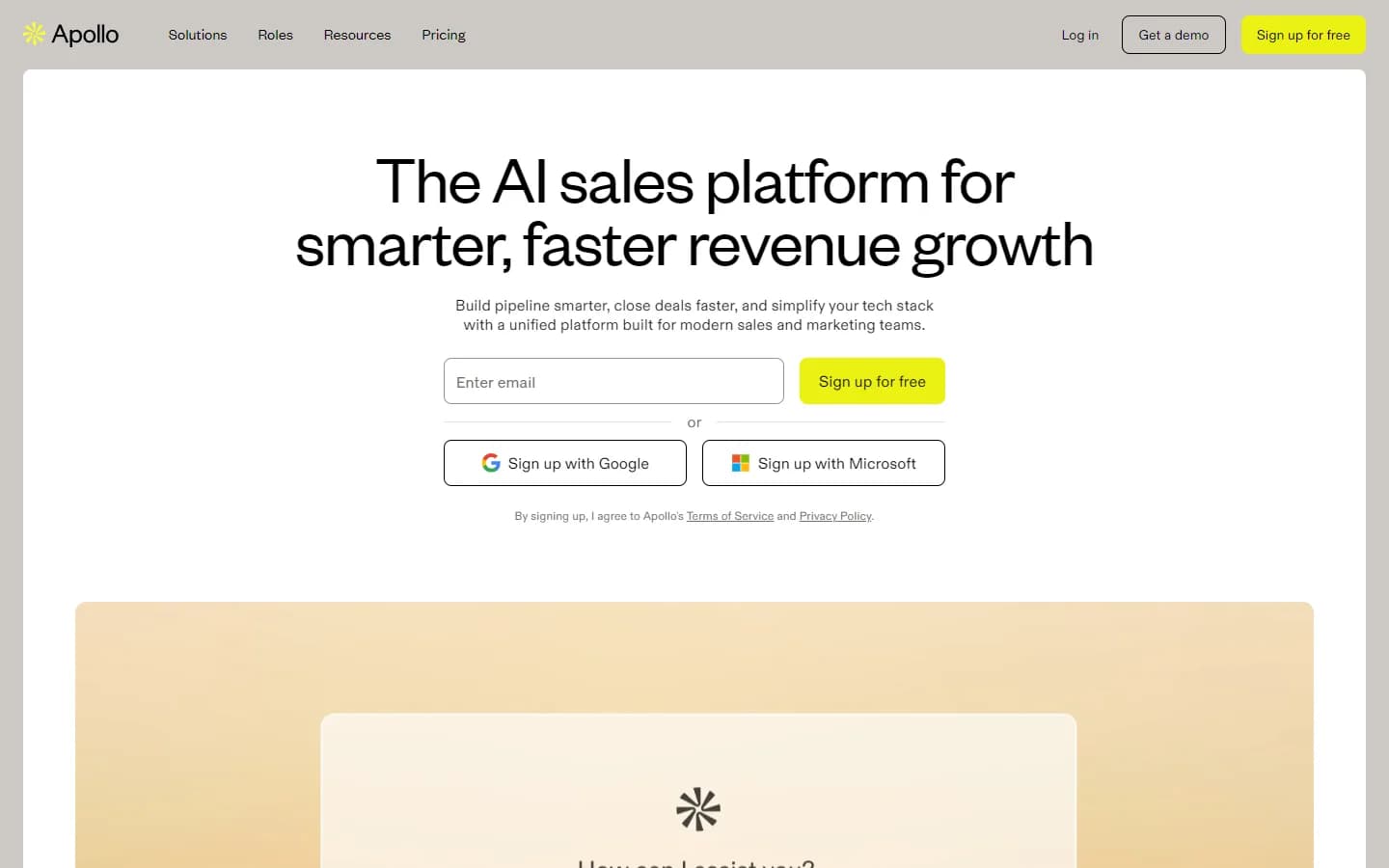
Apollo.io is an AI GTM system for teams that want prospecting data and outreach in one product. By Apollo's count it covers 240M+ contacts and 30M+ companies, and it reports 98% email accuracy. When its own database misses, waterfall enrichment cascades through 20+ data partners to fill missing emails and phone numbers.
Phone numbers are where the Apollo.io vs Lusha math splits. Apollo now runs one pooled credit balance: its pricing page lists 1 credit per email and 8 credits per phone number. On annual billing, Basic includes 30,000 credits per seat per year, Professional 48,000, and Organization 72,000, granted upfront and shared across the team. That works out to about $0.16 of plan value per phone number on every paid plan.
Credits don't roll over. Unused credits expire each billing cycle, add-on credits renew until you remove them, and admins can set per-user caps on the shared pool.
Most of Apollo's value shows up after the reveal. Sequences mix email, calls, and LinkedIn tasks and send from your own connected mailbox, with domain warming, inbox rotation, and reputation monitoring built in. Paid plans add a US dialer (credits apply), and buying signals cover intent, job changes, and website visitors.
For CRM exports, Basic includes HubSpot and Salesforce sync plus automated CRM and job change enrichment, and Professional adds custom field mapping and deal sync. Apollo lists 200+ integrations, is embedded in Salesforce and Slack, and offers Apollo MCP, the Apollo CLI, and an API. Bulk actions cap at 1,000 selected records on Basic, 2,500 on Professional, and 10,000 on Organization.
Prices are published at apollo.io/pricing (checked October 2026): Basic, Professional, and Organization run $49, $79, and $119 per user per month on annual billing, and Organization requires 3 seats. Every seat on an account must be on the same plan, so you can't mix Basic and Professional users.
Coverage is strongest in North America, and G2 reviewers report weaker job-title and phone data in Europe, APAC, and LATAM. For the full breakdown, see our Apollo.io review and Apollo.io vs ZoomInfo, or compare options in the best Apollo alternatives.
Pros
- +Far more credits per dollar: 30,000 to 72,000 per seat per year on paid plans, about $0.16 of plan value per phone number
- +Database, waterfall enrichment across 20+ data partners, sequences, and a US dialer in one product
- +Sequences send from your own connected mailbox, with domain warming, inbox rotation, and reputation monitoring
- +Buying signals (intent, job changes, website visitors) live in the same profiles reps sequence from
- +200+ integrations, embedded in Salesforce and Slack, plus Apollo MCP, CLI, and API for agent workflows
Cons
- −Per-seat pricing, and every seat on an account must be on the same plan
- −Phone numbers cost 8 credits each, and unused credits expire at the end of each billing cycle
- −Free plan is thin for real outbound: 900 credits per seat per year, 2 active sequences, and Gmail-only sending
- −Coverage and accuracy vary outside North America, per G2 reviewers
- −Steep learning curve between basic use and workflows, waterfall configuration, and API or MCP automation
Best for: High-volume email and mobile reveals plus sequences and a dialer in one per-seat tool
Pricing: Free (900 credits/seat/year). Basic $49, Professional $79, and Organization $119 per user/month billed annually (Organization: annual-only, 3-seat minimum); Basic and Professional are $65 and $99 monthly; Custom via sales. 1 credit per email, 8 per phone. As of October 2026.
2. Lusha — Fast LinkedIn-to-direct-dial lookups for one to five reps on a plan with seats included
Lusha — Fast LinkedIn-to-direct-dial lookups for one to five reps on a plan with seats included
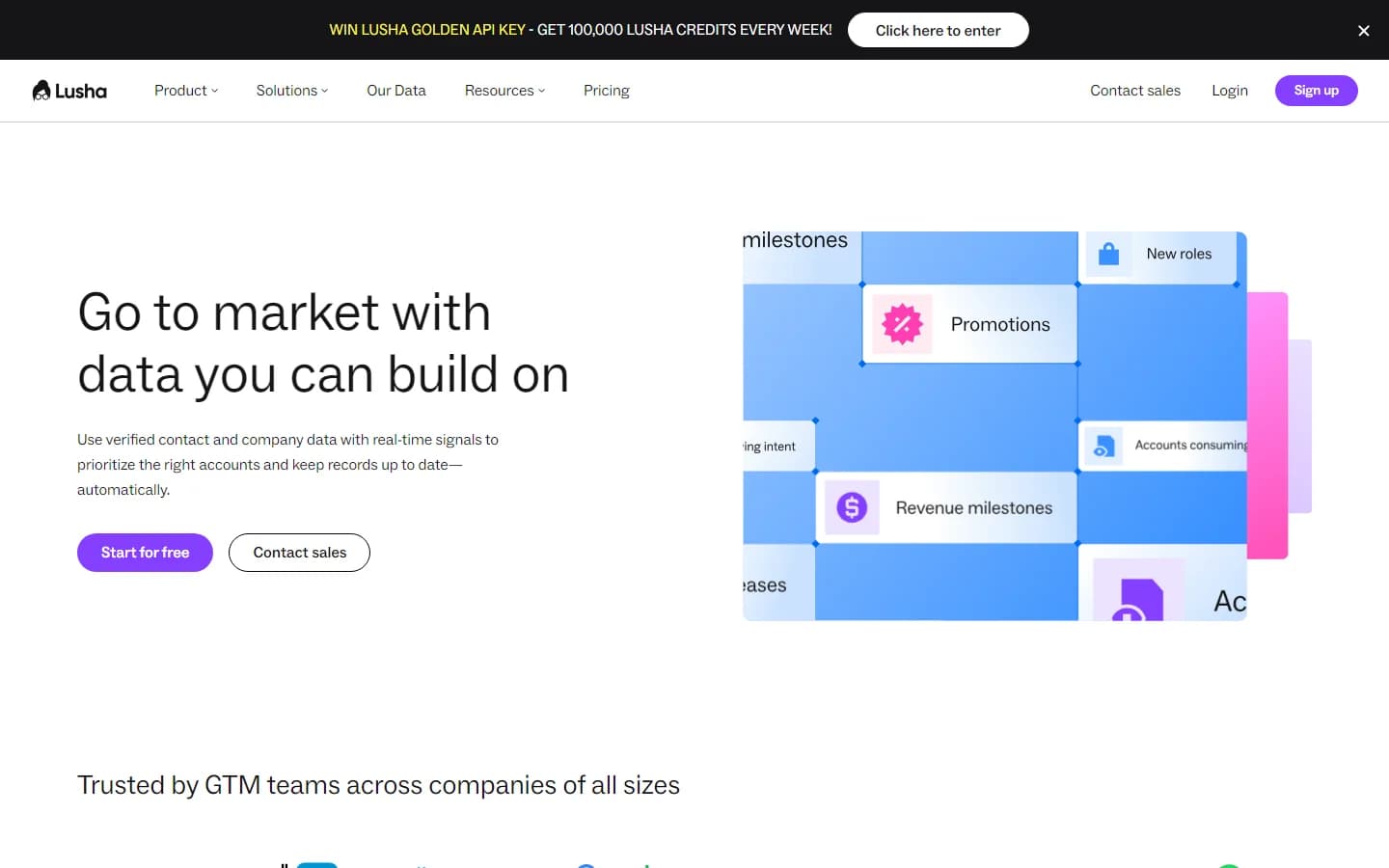
Lusha is a B2B contact data platform built for speed: open a LinkedIn profile or company website, click the Chrome extension, and reveal a verified email or direct dial. It now describes itself as "the B2B data and intelligence layer for GTM teams and AI agents" and claims 525M+ verified contacts, 29M+ companies, 165M+ emails, and 117M+ direct dials.
Lusha states platform figures of 98% email accuracy and 86% phone accuracy across its full database. That phone claim is why phone-first teams shortlist it, so test it on your own territory first.
Credits are simple: 1 per verified email, 5 per phone number. Starter, Pro, and Premium include 400, 600, and 3,400 credits a month; monthly Pro and Premium credits roll over up to twice the cap, while annual plans grant the year upfront and reset at year end. At annual prices, a phone number costs about $0.44 of plan value on Pro or Premium.
Lusha prices per plan, not per seat. Starter includes 1 seat, Pro includes 2, and Premium includes 5 with team management and credit allocation. Teams larger than five users go to the custom Scale plan, which adds SSO, a do-not-call list, 25 intent topics, and lower per-credit pricing.
Lusha has also grown beyond the extension. Engage sends email sequences from your Gmail or Outlook account (up to 1,000 emails a day), and 26 buying signals refresh weekly as dated events: funding, hiring surges, leadership changes, headcount shifts, job changes, and promotions. At EvoLusha 2026 on May 27, Lusha added plain-language search, daily AI recommendations of up to 10,000 contacts and companies, and signal-based outreach triggers.
CRM export is included on every plan, Free too, with native Salesforce and HubSpot apps plus monday CRM, Zoho, Pipedrive, and Bullhorn. The API is strictly rate-limited on Free and Starter and opens up on Pro with webhooks, and MCP access for Claude and ChatGPT is listed on all plans. Lusha also lists ISO 27001, 27701, and 42001, SOC 2 Type II, GDPR, and CCPA credentials.
Plan prices are published on lusha.com/pricing (checked October 2026). For plan-by-plan detail, see our Lusha review and the best Lusha alternatives, or our guide to LinkedIn phone number extensions.
Pros
- +One-click Chrome extension reveals on LinkedIn, company websites, CRMs, and Gmail
- +Clearest direct-dial focus of the two: 117M+ direct dials and an 86% phone accuracy claim
- +Seats included in the plan price: Pro covers 2 users for $52.45/month on annual billing
- +Monthly Pro and Premium credits roll over up to twice the monthly cap
- +26 dated buying signals refreshed weekly, including funding rounds and hiring surges
Cons
- −Phone numbers cost 5x an email reveal, about $0.44 of plan value per number on annual Pro or Premium
- −Hard seat ceilings of 1, 2, or 5 users before the custom Scale plan
- −Engage is email-only, so phone-first teams still need a separate dialer
- −Annual credits reset at the end of the cycle, and SSO is reserved for Scale
- −G2 reviewers report stale titles for recent job changers, which wastes 5-credit phone reveals
Best for: Fast LinkedIn-to-direct-dial lookups for one to five reps on a plan with seats included
Pricing: Free (40 credits/mo, 1 seat). Starter $37.45/mo (1 seat), Pro $52.45/mo (2 seats), and Premium $299.95/mo (5 seats) billed yearly, or $49.90, $69.90, and $399.90 monthly; Scale custom. 1 credit per email, 5 per phone. As of October 2026.
Comparison Table
| Tool | Best For | Free Tier | Starting Price | Standout Feature |
|---|---|---|---|---|
| Apollo.io | High-volume email and mobile reveals plus sequences and a dialer in one per-seat tool | Yes (900 credits/seat/year, 2 active sequences) | $49/user/month (Basic, annual) | Pooled credits at about $0.16 of plan value per phone number, plus sequences from your own mailbox |
| Lusha | Fast LinkedIn-to-direct-dial lookups for one to five reps on a plan with seats included | Yes (40 credits/mo, 1 seat) | $37.45/month (Starter, annual, 1 seat) | 86% phone accuracy claim and 117M+ direct dials behind a one-click Chrome extension |
How to Choose
- Apollo.io if you need high-volume email and mobile reveals plus sequences and a dialer in one per-seat tool
- Lusha if you need fast LinkedIn-to-direct-dial lookups for one to five reps on a plan with seats included
Final Verdict
Pick Apollo.io if you have three or more reps, reveal mobile numbers at volume, or want prospecting and outreach in one tool. Five reps on Basic cost $2,940 a year on annual billing, less than Lusha Premium's $3,599.10 for five seats, and Apollo's pooled 150,000 credits dwarf Lusha Premium's 40,800. That price also buys sequences from your own mailbox, waterfall enrichment, and a US dialer.
Pick Lusha if you're one or two reps who live on LinkedIn, want a direct dial in one click, and already have a sequencer and dialer. Lusha Pro covers two users for $629.10 a year, the lowest absolute cost in this comparison, and Lusha's 86% phone accuracy claim and dated signals such as funding rounds and hiring surges suit phone-first, event-driven prospecting. Just watch the five-seat ceiling before custom Scale pricing.
The deciding question isn't accuracy, since both vendors claim 98% on email. It's how many phone numbers each rep reveals and whether you want the reveal and the outreach in one place. Test 200–300 of your own records and compare usable records per credit before you commit to annual credits that won't roll over.
Whichever you choose, SyncGTM can strengthen the enrichment behind it, filling missed emails and mobile numbers with verified data and firmographics from 50+ providers.