
By Kushal Magar · October 2, 2026 · 12 min read
Apollo.io vs Clay: Database or Enrichment Workflow in 2026?
Apollo.io vs Clay looks like a head-to-head, but the two tools start from opposite ends. Apollo sells you the data and the outreach in one login: search a 240M+ contact database, reveal an email, and drop the person into a sequence. Clay sells you a workbench: a spreadsheet where every column can call a different data provider, an AI research agent, or an API. The cleanest way to choose is to look at what each one meters. Apollo prices people. Clay prices work.
The Apollo.io vs Clay question usually shows up when a team outgrows its first prospecting setup. Reps want more verified contacts, ops wants cleaner CRM data, and someone asks whether the fix is a bigger database or a smarter enrichment workflow. Apollo.io is the database answer; Clay is the workflow answer.
Both products moved in 2026. Apollo now positions itself as an AI GTM system, with waterfall enrichment across 20+ data partners and an MCP server that puts its data inside ChatGPT and Claude. Clay rebuilt its pricing around data credits plus actions in March (here's what changed), added unlimited people and company search in June, and made its native email Sequencer generally available on September 1.
So the old framing (Apollo for data, Clay for enrichment, no overlap) is out of date. Below, we compare data depth, learning curve, and credit burn using pricing checked on both vendors' sites in October 2026. For each tool on its own, see our Apollo.io review and Clay review.
Quick Summary
Apollo.io vs Clay is a choice between a contact database and an enrichment workflow builder. Apollo.io is an AI GTM system anchored by 240M+ contacts and 30M+ companies with 98% email accuracy (Apollo's figures), plus sequences sent from your own mailbox, a dialer, buying signals, and 200+ integrations. As of October 2026 it costs $0, $49, $79, or $119 per seat per month on annual billing, plus a Custom plan, with 30,000, 48,000, or 72,000 credits per seat per year on paid plans; an email costs 1 credit and a phone number 8. Clay is a spreadsheet-style platform that chains 150+ data providers, AI research, and your CRM into custom workflows. It costs $0, $167, or $446 per month on annual billing with unlimited seats, metered by data credits (from $0.05 each) and actions (under $0.01 each). Apollo is faster to learn and cheaper per contact; Clay finds more of what one database misses but needs real build time.
TL;DR
- Short answer: Apollo.io is a contact database with outreach built in; Clay is a spreadsheet-style enrichment builder that buys data from 150+ providers. Apollo wins on speed to the first sequence. Clay wins on coverage and workflow control.
- Data depth: Apollo searches its own 240M+ contacts (98% email accuracy, by Apollo's count) and waterfalls through 20+ partners. Clay chains providers, AI web research, and your CRM in the order you set, and charges nothing for empty lookups.
- Learning curve: Apollo is useful in the first session. Clay takes real build time, which is why it runs its own university with courses and cohorts.
- Pricing (as of October 2026, annual billing): Apollo costs $0, $49, $79, or $119 per seat per month (Organization has a 3-seat minimum), plus a Custom plan. Clay costs $0, $167, or $446 per month with unlimited seats, plus custom Enterprise.
- Credit burn: an Apollo email costs 1 credit and a phone number 8, roughly $0.02 and $0.16 on Basic annual. Clay estimates 6–20 data credits per fully enriched record, and data credits start at $0.05 each.
- Pick Apollo if reps need to find, email, and call prospects from one tool. Pick Clay if a GTM engineer or ops lead will build enrichment workflows that feed your CRM and sequencer.
What We Evaluated
- Apollo.io vs Clay data depth: proprietary database size and accuracy claims vs multi-provider waterfall coverage, and what each charges when a lookup misses
- Pricing model: per-seat plans with pooled credits (Apollo) vs workspace plans with unlimited seats and two usage meters (Clay), verified on each vendor's pricing page in October 2026
- Credit burn per contact: what an email, a phone number, and a fully enriched record actually cost on each platform
- Learning curve: time to the first useful list and first sequence, and how much the advanced features depend on a GTM engineer or ops lead
- Outreach: Apollo's multi-channel sequences and dialer vs Clay's email-only Sequencer (generally available September 1, 2026) and sequencing integrations
- Signals and integrations: buying intent, job changes, web intent, CRM sync, and AI access through MCP servers and APIs
1. Apollo.io — A contact database with sequences and a dialer built in
Apollo.io — A contact database with sequences and a dialer built in
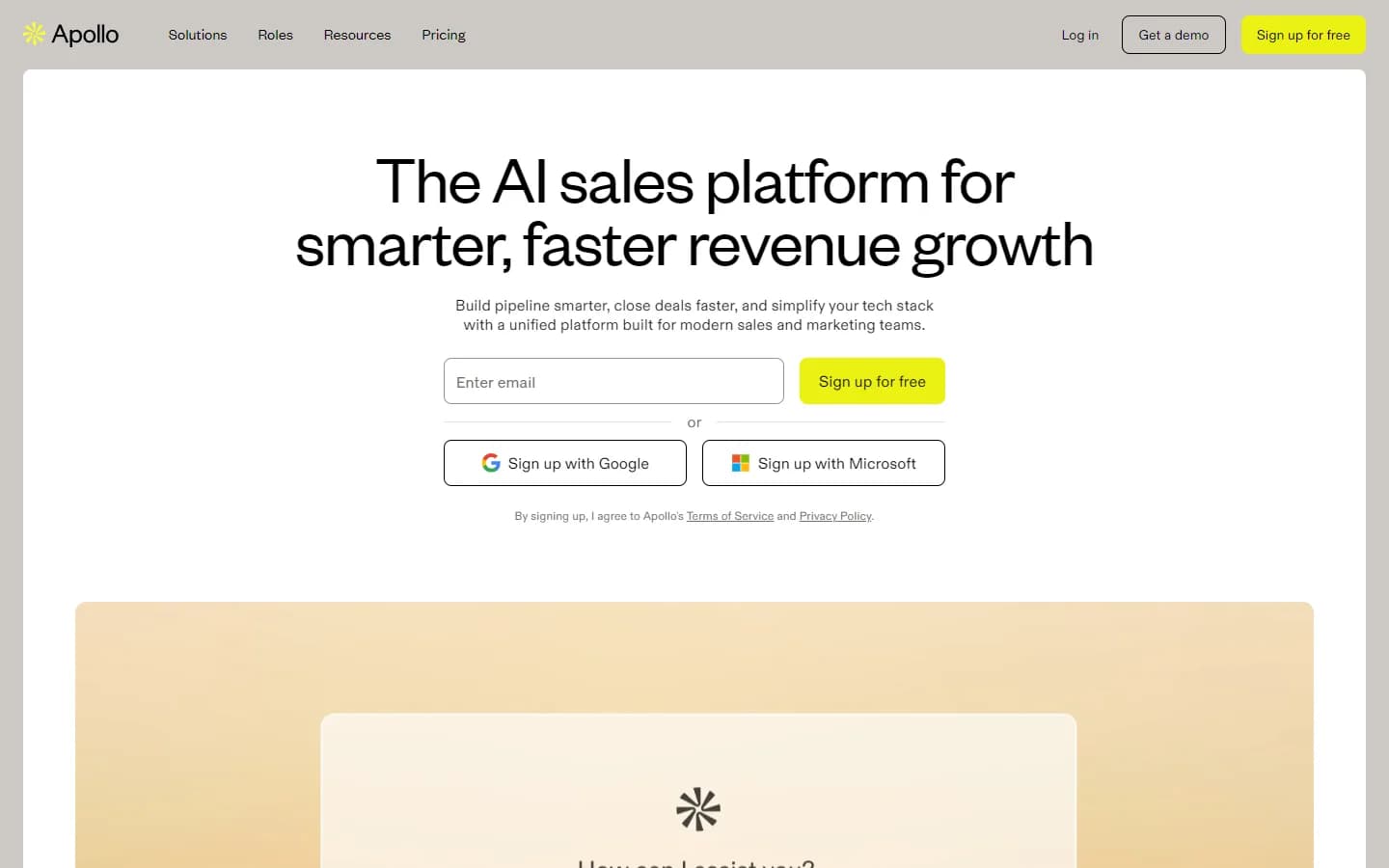
Apollo.io is an AI GTM system built around its own data network: 240M+ contacts and 30M+ companies with 98% email accuracy, by Apollo's count, searchable with 65+ filters. You reveal an email or phone number, add the contact to a sequence, and the emails go out from your own connected Gmail or Microsoft mailbox, backed by domain warming, inbox rotation, and reputation monitoring.
Its data depth is better than the old "single database" knock suggests. Apollo checks its own records first, then waterfalls through 20+ data partners for missing emails and phone numbers. On top sit buying signals (intent, job changes, and website visitors), a dialer, and 200+ integrations, including HubSpot and Salesforce, while Apollo MCP, the Apollo CLI, and the API bring the same data into AI assistants and scripts.
Pricing as of October 2026, per apollo.io/pricing: Free, Basic ($49 per seat per month annual, $65 monthly), Professional ($79 / $99), Organization ($119, annual only, 3-seat minimum), and Custom (contact sales, for SSO, advanced security, and custom volumes). Basic and Professional include 30,000 or 48,000 credits per seat per year, pooled across the team; an email costs 1 credit, a phone number 8, and unused credits expire each cycle. Apollo holds a 4.7/5 rating across more than 9,000 G2 reviews.
Pros
- +One login for search, enrichment, sequences, dialer, and CRM sync, so reps can go from filter to first email in a single session
- +240M+ contacts and 30M+ companies with 98% email accuracy (Apollo's figures), plus waterfall enrichment across 20+ data partners
- +Low unit cost for data it already holds: an email is 1 credit, about $0.02 on Basic annual
- +Credits are pooled across the team and granted upfront, so heavy and light users balance out
- +Free plan, 14-day trials on paid plans, and Apollo MCP included on every plan
Cons
- −Per-seat pricing: five reps on Professional cost $4,740 a year on annual billing, and every seat must be on the same plan
- −Phone numbers cost 8 credits each, so mobile-heavy workflows drain the pool quickly
- −Unused credits, including purchased add-ons, expire at the end of each billing cycle
- −Coverage varies outside North America, according to G2 reviewers, and custom data points beyond Apollo's fields aren't its strength
- −Signals cover intent, job changes, and website visitors; funding rounds and tech-stack changes need another source
Best for: A contact database with sequences and a dialer built in
Pricing: Free ($0, 75 credits per seat per month); Basic $49, Professional $79, and Organization $119 (annual only, 3-seat minimum) per seat per month billed annually ($65 and $99 monthly for Basic and Professional), with 30,000 / 48,000 / 72,000 credits per seat per year; Custom plan via sales for SSO, advanced security, and custom volumes. Email = 1 credit, phone number = 8 credits. Verified on apollo.io/pricing, October 2026.
2. Clay — Custom enrichment workflows across many data providers
Clay — Custom enrichment workflows across many data providers
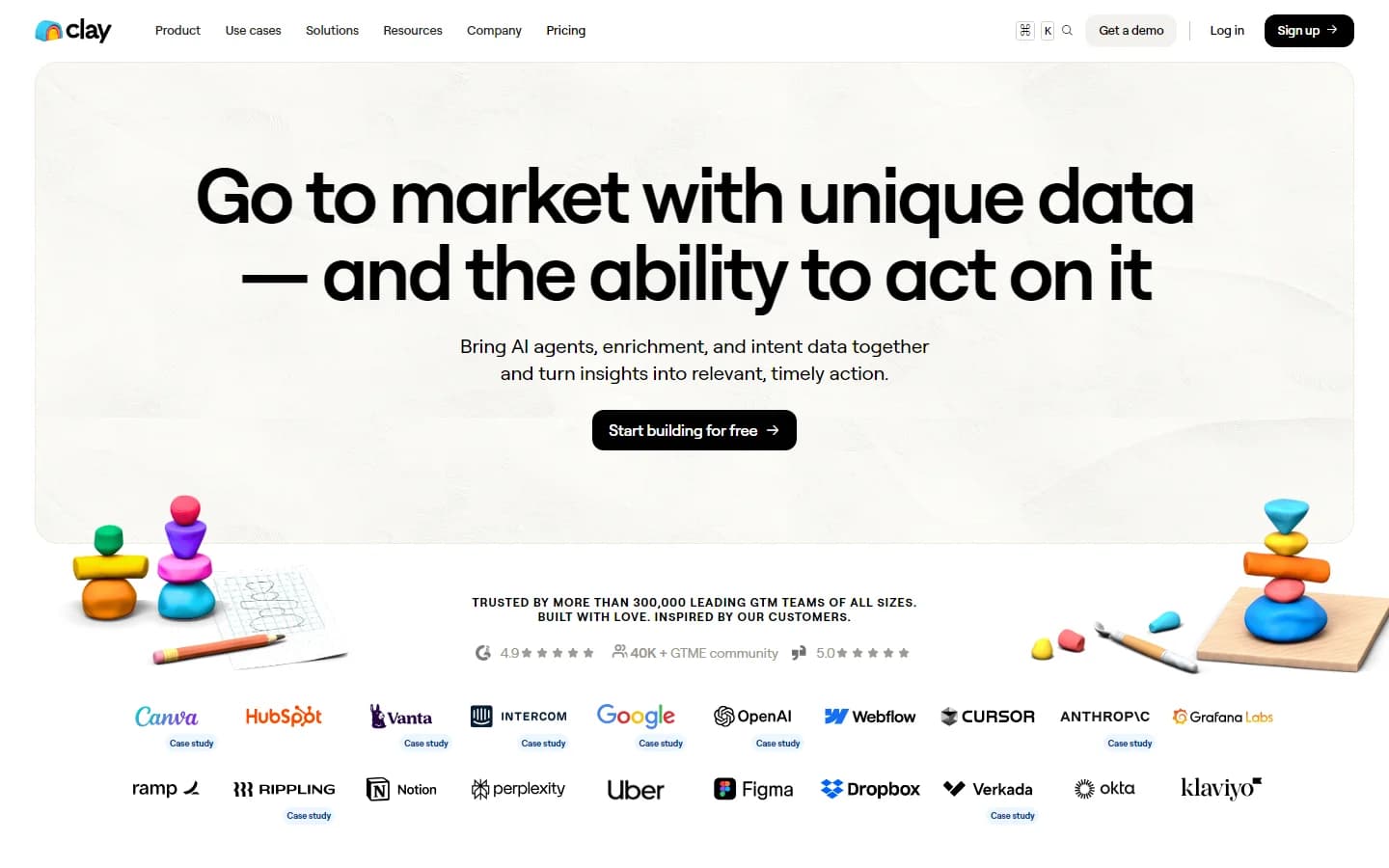
Clay is a spreadsheet-style GTM data platform: every row is a company or a person, and every column can call a data provider, an AI model, or an API. Instead of one database, it gives you a marketplace of 150+ data providers, waterfalls that try them in the order you set, and Claygent, an AI agent that researches custom data points on the web. Clay says it serves more than 17,000 customers, and it closed a $115M Series D at a $7.1B valuation on September 9, 2026.
This year closed two old gaps. Audiences (June 23) added unlimited people and company search on paid plans, and the native Clay Sequencer became generally available on September 1. The Sequencer is email-only and capped at four steps per campaign. Building tables well is a skill of its own, and a big part of what GTM engineering teams do.
Pricing as of October 2026, per clay.com/pricing: Free, Launch ($167 per month annual, $185 monthly; 2,500 data credits and 15,000 actions), Growth ($446 / $495; 6,000 data credits and 40,000 actions, plus CRM auto-sync, HTTP API, and webhooks), and custom Enterprise, all with unlimited seats. Data credits pay for the data, from $0.05 each; actions meter the platform work, under $0.01 each, one per enrichment.
Pros
- +Coverage from 150+ data providers in configurable waterfalls, plus AI web research for data points no database sells
- +Unlimited seats on every plan, so cost tracks usage rather than headcount
- +No data credits or actions charged when an enrichment returns nothing
- +Bring your own API keys to skip data credits entirely and pay only for actions
- +Unused data credits roll over on Launch and Growth (up to one month's credits on monthly plans, 15% of annual credits on annual plans)
Cons
- −Steep learning curve: waterfalls, formulas, and Claygent prompts take real build time, usually owned by a GTM engineer or ops lead
- −Two meters to watch, data credits and actions, and actions reset every billing cycle
- −A fully enriched record typically costs 6–20 data credits, by Clay's own estimate
- −CRM auto-sync, HTTP API, and webhooks start at Growth ($446 per month on annual billing)
- −The native Sequencer is email-only with up to four steps, and there is no built-in dialer
Best for: Custom enrichment workflows across many data providers
Pricing: Free ($0, 100 data credits + 500 actions per month); Launch $167 per month billed annually or $185 monthly (2,500 data credits + 15,000 actions); Growth $446 per month billed annually or $495 monthly (6,000 data credits + 40,000 actions); Enterprise custom (100,000+ data credits, 200,000+ actions). Unlimited seats on every plan; top-ups cost a 30% premium. Verified on clay.com/pricing, October 2026.
Comparison Table
| Tool | Best For | Free Tier | Starting Price | Standout Feature |
|---|---|---|---|---|
| Apollo.io | A contact database with sequences and a dialer built in | Yes (75 credits per seat per month, 2 sequences, Gmail only) | $49/seat/month (Basic, annual) | Search, reveal, and sequence in one tool, with pooled credits at about $0.02 per email |
| Clay | Custom enrichment workflows across many data providers | Yes (100 data credits + 500 actions per month, 200 rows per table) | $167/month (Launch, annual, unlimited seats) | Waterfall enrichment across 150+ providers plus AI research, built like a spreadsheet |
How to Choose
- Apollo.io if you need a contact database with sequences and a dialer built in
- Clay if you need custom enrichment workflows across many data providers
Final Verdict
Pick Apollo.io if your reps need to find people, reveal contact data, and start outreach from one tool this week. It is the faster tool to learn, its unit cost is the lower of the two for data it already holds (about $0.02 per email on Basic annual), and sequences, a dialer, and buying signals come with the same seat. The tradeoff is per-seat pricing and credits that expire every cycle, so model cost at next year's headcount, not today's.
Pick Clay if someone on the team (a GTM engineer, a RevOps lead, or a technical founder) will own the build, and your edge comes from data a single database doesn't have: niche roles, international contacts, custom research fields, or signal-triggered workflows. Unlimited seats, rollover data credits, and no-charge misses make it efficient once tuned. Budget for 6–20 data credits per fully enriched record and a learning curve measured in weeks, not hours.
For a 3-to-10 rep outbound team without an ops owner, start with Apollo. For a team with a CRM full of target accounts and someone who enjoys building, Clay will find more and bend to your process, and plenty of those teams keep Apollo running anyway as one provider inside a Clay waterfall.
Whichever you choose, SyncGTM can strengthen the enrichment behind it with verified emails, phone numbers, and firmographics from 50+ providers.