
By Kushal Magar · October 3, 2026 · 11 min read
Apollo vs HubSpot: Prospecting Tool or CRM? Compared for 2026
Apollo and HubSpot rarely fight over the same job. Apollo is where reps find people and start conversations; HubSpot is where those conversations become deals, forecasts, and customer records. The overlap is growing from both sides, with Apollo managing deals and HubSpot running a prospecting agent. So the real question is which job each one should own in your stack.
Apollo.io vs HubSpot is the comparison most sales teams hit when outbound starts to matter. One is a prospecting platform that has picked up CRM features; the other is a CRM that has picked up prospecting features.
That's why many teams don't choose at all. Apollo's native HubSpot integration syncs contacts, accounts, and deals both ways, and Apollo is one of the data providers HubSpot's own Prospecting Agent can pull contacts from.
Below, we compare data, outreach, pipeline, and October 2026 pricing, explain what the integration syncs, and give a clear split for teams that run both. For each tool on its own, see our Apollo.io review and HubSpot review.
Quick Summary
Apollo vs HubSpot is less a head-to-head than a division of labor. Apollo.io is an AI GTM system with 240M+ contacts, 98% email accuracy by its own measure, buying signals, and sequences sent from your own mailbox, at $49, $79, or $119 per seat per month billed annually as of October 2026. HubSpot Sales Hub is a CRM-first sales layer at $7 (discounted from $20), $90, or from $150 per seat per month, with $1,500 and $3,500 onboarding fees on the top two tiers; sequences and forecasting start at Professional. Apollo's native integration syncs contacts, accounts, and deals both ways. For five reps, Apollo Basic costs $2,940 a year and HubSpot Professional $6,900 in year one.
TL;DR
- Short answer: Apollo is a prospecting and outbound platform; HubSpot is a CRM. Apollo wins at finding net-new contacts and running sequences; HubSpot wins at pipeline, forecasting, and everything after the reply.
- Data: Apollo includes 240M+ contacts and 30M+ companies with 98% email accuracy (Apollo's claim). HubSpot enriches records you already have and sources net-new contacts through connected providers.
- Outreach: Apollo sequences come with every plan and send from your own mailbox. HubSpot sequences start at Sales Hub Professional.
- Pricing (October 2026, billed annually): Apollo costs $49, $79, or $119 per seat per month. HubSpot Sales Hub costs $7 (discounted from $20), $90, or from $150, plus one-time onboarding of $1,500 on Professional and $3,500 on Enterprise.
- Integration: From Apollo's Basic plan, contacts, accounts, and deals sync both ways, and Apollo activity lands in HubSpot.
- Pick Apollo for outbound-first teams without a CRM process. Pick HubSpot if pipeline is mostly inbound. Run both when outbound feeds a pipeline marketing and success also touch.
What We Evaluated
- Apollo vs HubSpot core job: prospecting and outbound versus a CRM of record for pipeline and the customer lifecycle
- Contact data: Apollo's 240M+ database versus HubSpot's enrichment and Prospecting Agent providers
- Outreach: which plan unlocks sequences, which mailbox sends them, and daily send limits
- Pipeline and reporting: deal management, forecasting, and custom reports
- AI agents and buying signals, including HubSpot's pay-per-result Prospecting Agent
- Integration and total cost as of October 2026, including seat-plus-onboarding math for five reps
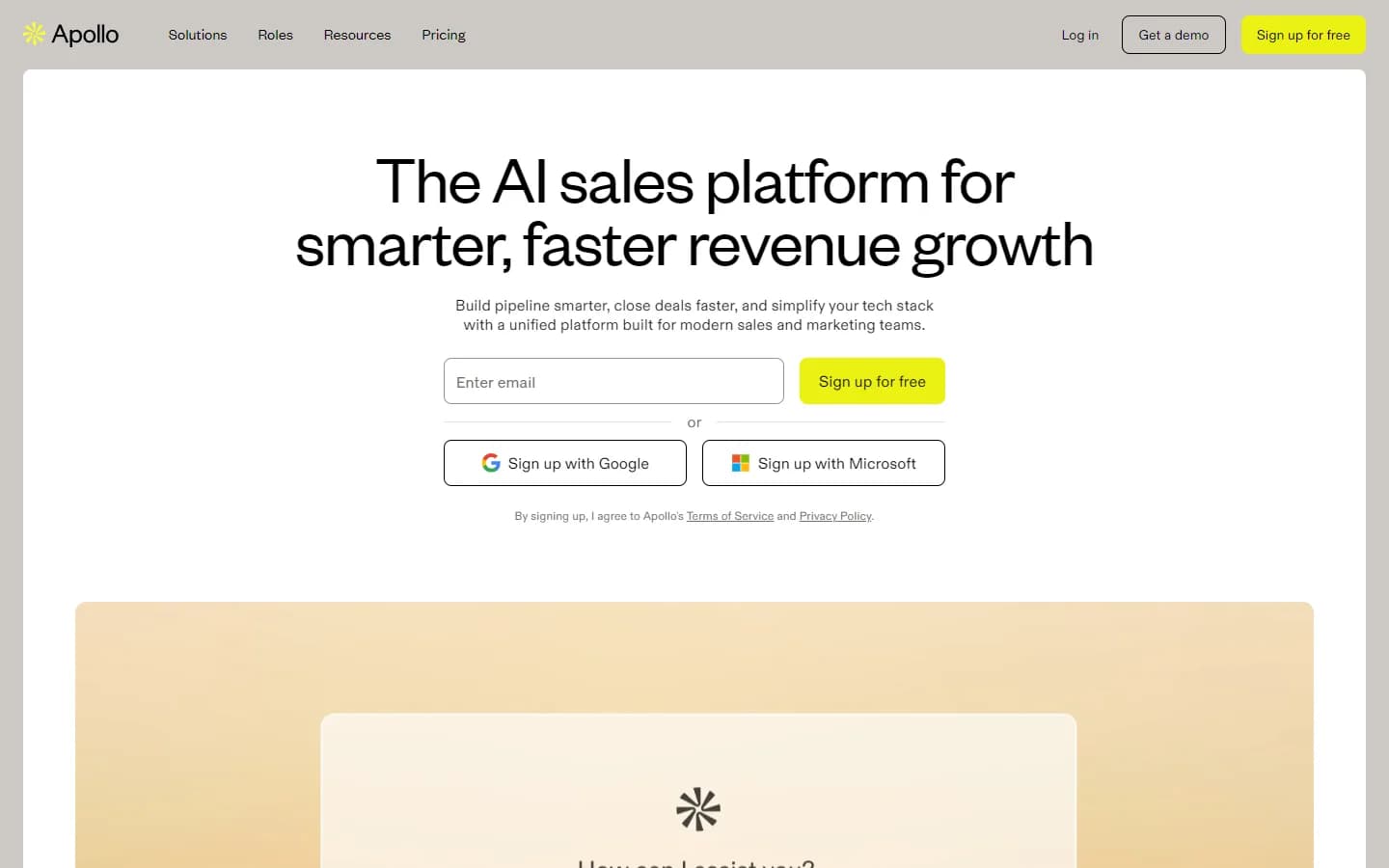
1. Apollo.io — A contact database, buying signals, and outbound sequences in one per-seat platform
Apollo.io — A contact database, buying signals, and outbound sequences in one per-seat platform
Apollo.io is an AI GTM system built for outbound: find the right people, enrich them, and reach them. It is anchored by 240M+ contacts and 30M+ companies, with 98% email accuracy by Apollo's own measure.
Reps search by title, seniority, industry, and company size, then spend credits to reveal details: 1 credit per email and 8 per phone number. When Apollo's own record is missing an email or phone, waterfall enrichment checks 20+ data partners to fill the gap.
Buying signals cover intent, job changes, and website visitors. Sequences mix email, calls, and LinkedIn tasks and send from your own connected mailbox, with a deliverability suite and email warmup on paid plans.
Apollo isn't purely top-of-funnel anymore. It also covers meeting scheduling, call recording, pre-meeting AI insights, and, from the Basic plan, lead and deal management, which is where the overlap with HubSpot begins.
Apollo offers 200+ integrations, including a native HubSpot integration, plus Apollo MCP, the Apollo CLI, and an API for AI assistants and scripts.
Pricing is per seat, and all seats share one plan. Apollo's pricing page grants 30,000 credits per seat a year on Basic, 48,000 on Professional, and 72,000 on Organization; credits are pooled, granted upfront, and don't roll over.
Watch-outs: user reviews cited in our Apollo.io review report weaker data outside North America, and every rep pays the full seat price. If Apollo isn't the fit, see our Apollo alternatives and Apollo.io vs ZoomInfo.
Pros
- +240M+ contacts and 30M+ companies with 98% email accuracy (Apollo's claim)
- +Sequences on every plan, sent from your own mailbox, with a deliverability suite and warmup on paid plans
- +Buying signals for intent, job changes, and website visitors
- +Native HubSpot sync for contacts, accounts, deals, and activities from the Basic plan
- +Apollo MCP, CLI, and API for AI assistants and automation
Cons
- −Pipeline, forecasting, and reporting are lighter than a dedicated CRM's
- −No service or support tooling, so post-sale teams still need another system
- −Free and Basic cap sending at 250 emails a day
- −Credits don't roll over, and per-seat pricing adds up as the team grows
- −Data quality varies outside North America, according to user reviews
Best for: A contact database, buying signals, and outbound sequences in one per-seat platform
Pricing: Free (900 credits per seat per year, 2 sequences); Basic $49/seat/month billed annually or $65 monthly; Professional $79 annually or $99 monthly; Organization $119/seat/month, annual only, 3-seat minimum; custom plans via sales. Credits are pooled and don't roll over. As of October 2026, apollo.io/pricing.
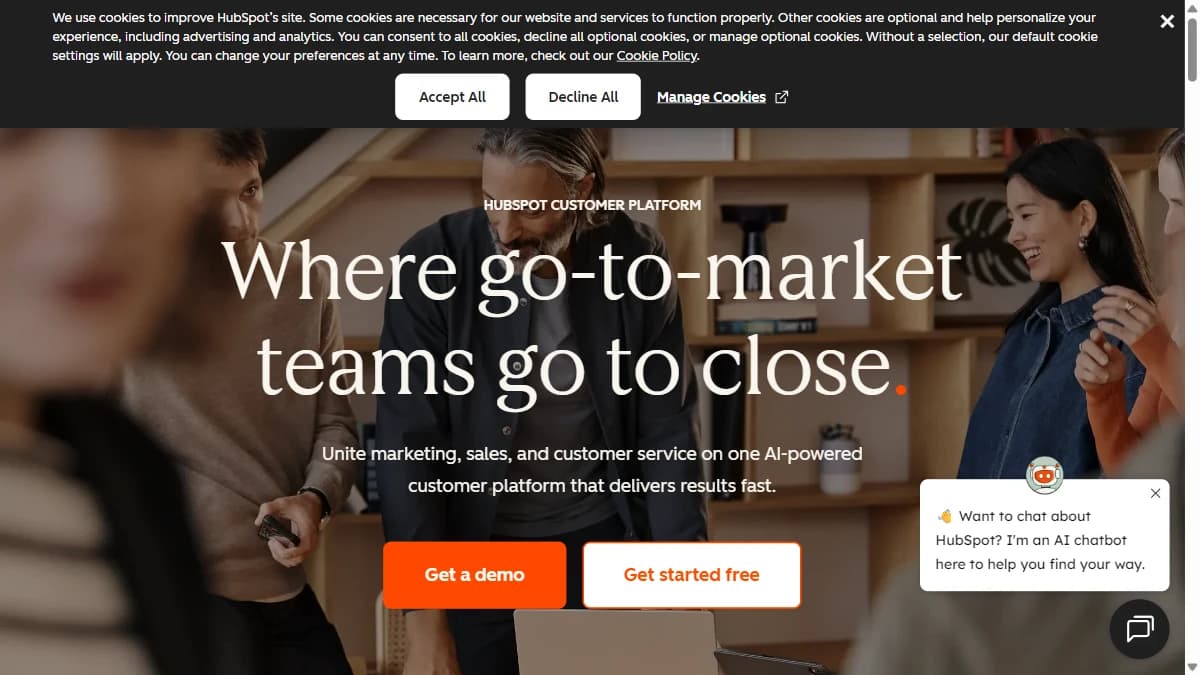
2. HubSpot — A CRM of record for pipeline, forecasting, reporting, and the full customer lifecycle
HubSpot — A CRM of record for pipeline, forecasting, reporting, and the full customer lifecycle
HubSpot is a customer platform built on its Smart CRM, with Sales Hub as the sales layer. It owns everything after first contact: contact and company records, pipelines, forecasting, reporting, and handoffs to marketing and service.
Per HubSpot's Sales Hub pricing page, Starter includes the Prospecting Agent, calling (500 minutes), task queues, intent signals, and 500 HubSpot Credits a month; sequences, forecasting, conversation intelligence, and up to 100 custom reports start at Professional, which includes 3,000 credits.
Sequences send up to 500 emails per user per day on Professional and 1,000 on Enterprise, and LinkedIn steps need a Sales Navigator subscription.
HubSpot's own prospecting features
HubSpot has been closing the prospecting gap. Its Prospecting Agent watches for signals like funding rounds, leadership changes, and site visits, sources buying committees, and drafts outreach in each rep's voice; reps can review every draft or switch it to fully autonomous mode.
It is priced per result: $1 for each lead it recommends outreach for, paid from HubSpot Credits, on Starter and above. For net-new contacts it relies on connected data providers, and HubSpot lists ZoomInfo, Apollo, Surfe, and Seamless.
Clearbit is now part of HubSpot, and native data enrichment fills details like job title, industry, and company size without spending HubSpot Credits. It matches on a name and work email or a company domain, so it improves existing records rather than finding new people.
Expect that gap to keep narrowing. On June 30, 2026, Warmly announced an agreement to be acquired by HubSpot; it identifies individual website visitors, the same ground Apollo's website visitor signals cover.
For more on HubSpot as a CRM, see HubSpot vs Salesforce and HubSpot vs Zoho CRM. Weighing a dedicated engagement tool instead? Read Salesloft vs HubSpot.
Apollo vs HubSpot head-to-head: where they overlap and where they don't
| Dimension | Apollo.io | HubSpot Sales Hub |
|---|---|---|
| Core job | Find prospects and run outbound | CRM of record: pipeline, forecasting, lifecycle |
| Contact data | 240M+ contacts, 30M+ companies; 98% email accuracy (Apollo's claim) | Enriches existing records; Prospecting Agent sources net-new contacts from connected providers |
| Sequences | Every plan (2 on Free, unlimited from Basic); 250 sends/day on Free and Basic, uncapped from Professional | Professional and up; 500 sends/user/day (1,000 on Enterprise) |
| Buying signals | Intent, job changes, website visitors | Intent signals from Starter; agent watches funding, leadership changes, site visits |
| Pipeline and reporting | Lead and deal management from Basic; analytics from Professional | Deal pipelines; forecasting and custom reports from Professional |
| AI agents | AI Assistant on every plan; agents from Professional | Prospecting Agent ($1 per recommended lead) and Agent Builder from Starter |
| Pricing (annual) | $49–$119 per seat per month | $7 (discounted) to $150+ per seat per month, plus onboarding on Professional and Enterprise |
| Free plan | 900 credits per seat per year, 2 sequences | Free CRM tools for up to 2 users |
Data. Apollo is the contact source. HubSpot enriches records you already hold, so outbound to new accounts usually means connecting a provider, often Apollo itself.
Outreach. Both run sequences, but Apollo includes them on every plan and uncaps daily sends from Professional. HubSpot gates them behind its $90 tier, where they suit follow-up on contacts that workflows already track.
Pipeline. This is HubSpot's home ground. Professional's forecasting, conversation intelligence, 300 workflows, and 100 custom reports go well beyond Apollo's deal management.
How the Apollo and HubSpot integration works
Apollo offers two HubSpot connections. HubSpot CRM syncs contacts, accounts, and deals both ways and pushes emails, calls, meetings, tasks, and notes from Apollo to the matching HubSpot record.
A second option, HubSpot Data Enrichment, only enriches existing records. In the CRM version, Apollo pulls HubSpot records on a schedule so reps skip existing contacts, and push rules send records back by deal stage, email verification status, or custom fields.
Field and stage mapping set where values land and whether Apollo overwrites or only fills empty fields. Paid plans get six hours to finish mapping before sync starts; dedupe HubSpot first, since Apollo mirrors its duplicates.
Apollo's pricing page lists CRM integrations from Basic, with Professional positioned for advanced CRM integrations; Free only includes CRM enrichment for 100 records a month. The link also runs the other way: connect Apollo, and HubSpot's Prospecting Agent can pull Apollo contacts into its research.
What a 5-rep team pays (October 2026, annual billing)
Apollo Basic for five reps costs $245 a month, or $2,940 a year. HubSpot Sales Hub Professional for five costs $450 a month, or $5,400 a year, plus the $1,500 onboarding fee, for $6,900 in year one.
Running both on those tiers comes to $9,840 in year one. A leaner split pairs Apollo Basic with HubSpot Starter, since Apollo already handles sequences: $2,940 plus $420 at Starter's discounted $7 rate, or $1,200 at the undiscounted $20.
That lean split stops working once you need forecasting or custom reports, which start at Professional.
Pros
- +Full CRM of record: deal pipelines, forecasting, custom reports, and 2,000+ marketplace apps
- +Marketing, sales, and service on one platform, so handoffs keep their history
- +Prospecting Agent from Starter, priced at $1 per recommended lead
- +Native data enrichment that doesn't consume HubSpot Credits
- +Free CRM tools for up to 2 users
Cons
- −Sequences, forecasting, and custom reports start at Professional ($90/seat/month billed annually)
- −Required one-time onboarding fees: $1,500 on Professional and $3,500 on Enterprise
- −Net-new contact sourcing relies on connected data providers such as ZoomInfo or Apollo
- −Starter's $7 annual seat price is shown discounted from $20, so confirm your renewal rate
- −Sequences cap at 500 emails per user per day on Professional
Best for: A CRM of record for pipeline, forecasting, reporting, and the full customer lifecycle
Pricing: Free (up to 2 users); Starter $7/seat/month billed annually (shown discounted from $20); Professional $90/seat/month billed annually (shown discounted from $100) plus $1,500 one-time onboarding; Enterprise from $150/seat/month plus $3,500 onboarding. Monthly HubSpot Credits: 500 (Starter), 3,000 (Professional), 5,000 (Enterprise). As of October 2026, hubspot.com/pricing/sales.
Comparison Table
| Tool | Best For | Free Tier | Starting Price | Standout Feature |
|---|---|---|---|---|
| Apollo.io | A contact database, buying signals, and outbound sequences in one per-seat platform | Yes (900 credits per seat per year, 2 sequences) | $49/seat/month (Basic, annual) | 240M+ contacts, buying signals, and sequences from your own mailbox in one seat |
| HubSpot | A CRM of record for pipeline, forecasting, reporting, and the full customer lifecycle | Yes (free CRM tools for up to 2 users) | $7/seat/month (Starter, annual, discounted from $20) | One customer record across marketing, sales, and service, plus a pay-per-result Prospecting Agent |
How to Choose
- Apollo.io if you need a contact database, buying signals, and outbound sequences in one per-seat platform
- HubSpot if you need a CRM of record for pipeline, forecasting, reporting, and the full customer lifecycle
Final Verdict
Pick Apollo if outbound is your main source of pipeline and you don't need a full CRM yet. One $49 seat buys 240M+ contacts, buying signals, unlimited sequences from your own mailbox, and basic deal management; move to Professional once reps need more than 250 sends a day.
Pick HubSpot if most pipeline comes from inbound, or if marketing, sales, and service need one shared record. Professional at $90 per seat plus $1,500 onboarding buys forecasting, sequences, and custom reports, and the Prospecting Agent adds outbound help at $1 per recommended lead, though net-new accounts still call for a connected data provider.
Run both when outbound feeds a pipeline other teams touch: Apollo owns list building, enrichment, and sequences to new contacts, while HubSpot owns engaged contacts, deals, forecasting, and reporting. A small team can pair Apollo Basic with HubSpot Starter until it needs Professional's forecasting, with push rules that send only verified or engaged contacts to HubSpot.
Whichever stack you land on, SyncGTM can strengthen the enrichment behind it with verified emails, phone numbers, and firmographics from 50+ providers.