

By Kushal Magar · October 3, 2026 · 11 min read
Apollo.io vs Seamless.ai: Real-Time Search vs Database 2026
Apollo.io vs Seamless.ai is really a question about when your contact data gets checked. Apollo stores 240M+ contacts and fills the gaps from 20+ data partners; Seamless says it researches and verifies each contact at the moment you search. Neither model guarantees a clean list, and neither vendor's accuracy claim is independently audited. The gap you can actually measure is commercial: Apollo publishes per-seat prices with a monthly option, while every Seamless subscription is an annual contract that auto-renews unless you cancel 60 days out.
Apollo.io vs Seamless.ai is one of the most common shortlists for teams buying their first contact-data tool. Both find work emails and phone numbers for B2B buyers, both layer signals and outreach on top, and both now pitch themselves as AI sales platforms.
Apollo.io is an AI GTM system built on a stored database: 240M+ contacts and 30M+ companies, waterfall enrichment across 20+ data partners, and sequences that send from your own mailbox, all on a public price list. Seamless.ai, which rebranded to just "Seamless" in February 2026, calls itself "a real-time search engine, not a database" and sells quote-based annual contracts.
The architecture gap is smaller than the marketing suggests. Seamless still advertises 1.8B+ verified business emails and 414M+ phone numbers, so in practice it runs a large index that it re-researches and verifies when you search. Apollo keeps its database current with waterfall enrichment, job-change tracking, and validation inside its sequences.
Below, we compare data sourcing, accuracy claims, bounce handling, outreach, pricing, and contract terms. For single-tool deep dives, see our Apollo.io review and Seamless.ai review.
Quick Summary
Apollo.io vs Seamless.ai is a choice between a stored contact database and search-time contact research, but the bigger practical differences are pricing transparency and contract terms. Apollo.io is an AI GTM system with 240M+ contacts, 98% reported email accuracy, waterfall enrichment across 20+ data partners, buying signals, and sequences that send from your own mailbox, priced from $49 per seat per month billed annually (as of October 2026). Seamless.ai, now branded Seamless, says it researches and verifies emails and direct dials at lookup time, publishes no accuracy percentage, and quotes every paid plan; free accounts get 50 credits. Its Terms of Use make every subscription annual, with cancellation required in-platform at least 60 days before renewal, versus Apollo's 30-day notice window. Apollo fits teams that want data and outreach in one self-serve tool; Seamless fits lookup-heavy teams that negotiate pooled credits and manage the renewal date closely.
TL;DR
- Short answer: Apollo.io wins for most SMB and mid-market teams: published prices, a monthly billing option, and data, signals, sequences, and a dialer in one product. Seamless.ai fits teams whose reps look up specific people at known accounts all day, want pooled credits across many users, and can accept an annual contract.
- Data model: Apollo serves contacts from a stored 240M+ contact database, then cascades through 20+ data partners when an email or phone is missing. Seamless says each search researches the public web and runs a 10-step AI verification on emails and direct dials at lookup time.
- Accuracy: Apollo reports 98% email accuracy. Seamless publishes no accuracy percentage; it automatically returns credits for emails its own check flags as invalid. Neither claim is independently audited, so pull the same 200–300 records from your ICP in both tools and compare bounces.
- Pricing (as of October 2026): Apollo runs $49–$119 per seat per month billed annually, or $65 (Basic) and $99 (Professional) billed monthly, so 10 reps on Professional cost $9,480 a year. Seamless publishes no paid prices; after 50 free credits, its pricing page is a quote form.
- Contract terms: Apollo subscriptions auto-renew for the same term unless you give notice 30 days before it ends. Every Seamless subscription is annual, even when billed monthly, and renews for another 12 months unless you cancel in-platform at least 60 days before renewal.
What We Evaluated
- Apollo.io vs Seamless.ai data model: a stored, continuously enriched database vs search-time research and verification
- Each vendor's own accuracy claim, and what happens to your credits and sender reputation when an email bounces
- Buying signals: intent, job changes, and website visitors, and how each tool turns them into outreach
- Built-in execution: sequences, daily sending limits, dialer, AI agents, and API access
- Pricing transparency and true annual cost at 10 seats, as of October 2026
- Contract terms: commitment length, auto-renewal, and cancellation notice windows
1. Apollo.io — A stored contact database, buying signals, and sequences in one tool at published per-seat prices
Apollo.io — A stored contact database, buying signals, and sequences in one tool at published per-seat prices
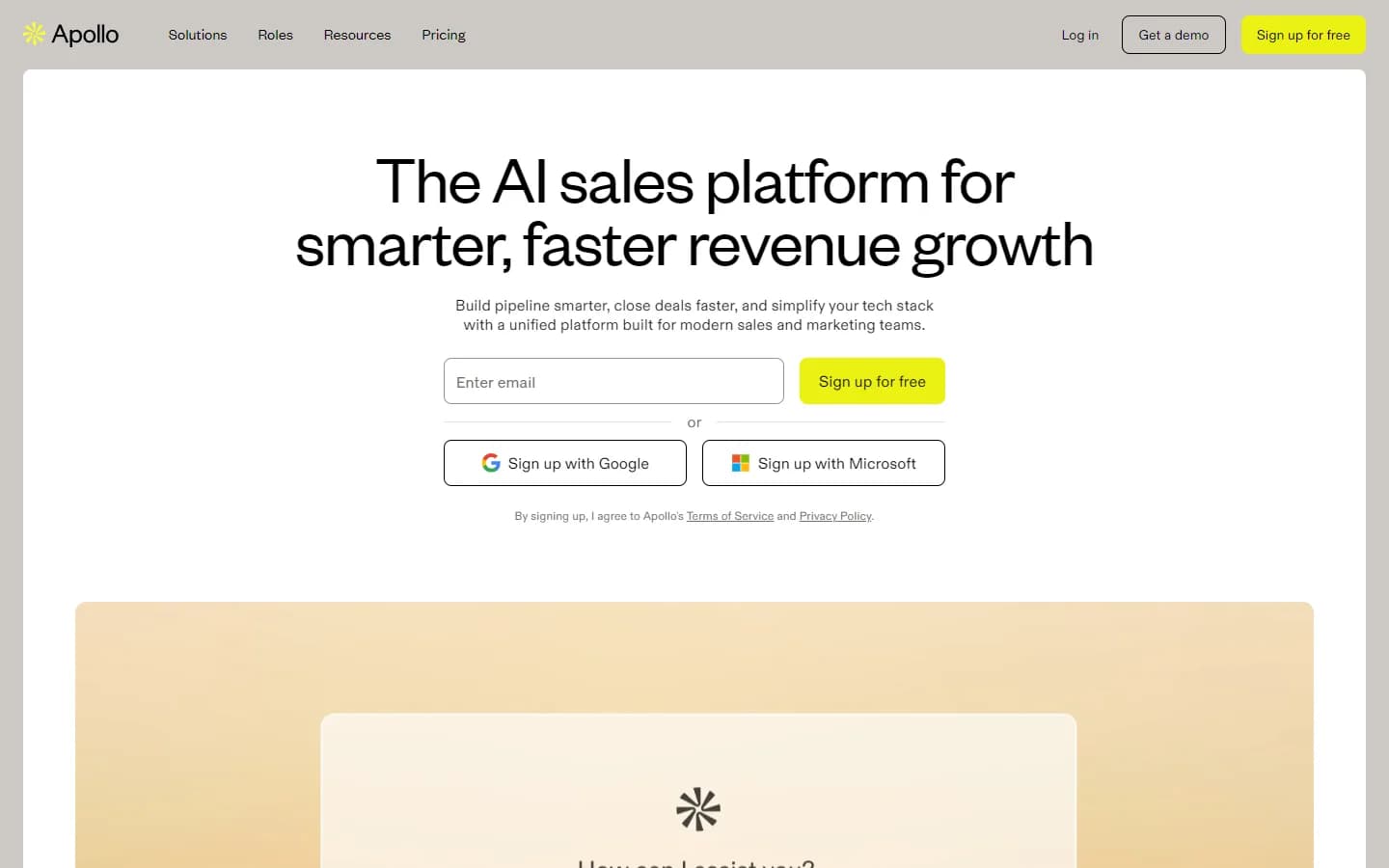
Apollo.io is an AI GTM system built on a stored database of 240M+ contacts and 30M+ companies, with 98% email accuracy by Apollo's own measure. When its own record is missing an email or phone number, waterfall enrichment cascades through 20+ data partners to fill it.
The database model makes Apollo fast: reps filter with 65+ search filters and spend credits only on records they reveal. As of October 2026, an email costs 1 credit and a phone number 8.
Freshness comes from layering rather than search-time crawling. Apollo enriches existing records through a CSV upload or CRM connection, flags contacts who changed jobs, and builds email and phone validation into its sequences. If you're new to the cascade approach, our guide to waterfall enrichment explains why it lifts coverage.
Buying signals cover intent, job changes, and website visitors, though visitor identification requires Apollo's tracking script on your site. Teams that want funding-round or tech-stack triggers usually add a dedicated intent data tool alongside it.
Execution is bundled. Sequences mix email, calls, and LinkedIn tasks with A/B testing and send from your own connected mailbox, with domain warming, inbox rotation, and reputation monitoring; Free and Basic cap daily sends at 250 emails, while Professional and Organization are unlimited.
It also lists 200+ integrations, is embedded in Salesforce and Slack, and exposes Apollo MCP (on every plan), the Apollo CLI, and an API with 70+ REST endpoints.
Pricing is published at apollo.io/pricing (as of October 2026): Free; Basic at $49 per seat per month billed annually or $65 monthly; Professional at $79 annually or $99 monthly; and Organization at $119, annual only with a 3-seat minimum. Annual seats include 30,000, 48,000, and 72,000 credits per seat per year respectively, Basic and Professional come with a 14-day trial, and custom plans go through sales.
Per Apollo's Terms of Service (updated August 10, 2026), subscriptions auto-renew for a term equal to the one expiring unless you give notice at least 30 days before it ends. Fees within a term are non-refundable.
Ramp's spend data shows Apollo used by 39% of businesses buying sales data tools as of October 2026. G2 reviewers report weaker job-title and phone data outside North America, so test a regional sample first; see also Apollo.io vs ZoomInfo and the best Apollo alternatives.
Pros
- +Published per-seat pricing with a monthly option ($65 Basic, $99 Professional) and a 14-day trial on both
- +Stored 240M+ contact database with 65+ filters, plus waterfall enrichment across 20+ data partners for missing emails and phones
- +Sequences, dialer, and buying signals in one tool, sending from your own connected mailbox with deliverability tools built in
- +200+ integrations, embedded in Salesforce and Slack, plus Apollo MCP, CLI, and API for agent workflows
- +30-day non-renewal notice window, handled through account settings or support
Cons
- −Per-seat pricing scales with headcount; Organization is annual only with a 3-seat minimum
- −Free and Basic plans cap daily email sends at 250
- −Coverage and accuracy vary outside North America, per G2 reviewers
- −No native funding-round or tech-stack-change triggers in its signal set
- −Steep learning curve between basic search and workflows, waterfall setup, and API or MCP automation
Best for: A stored contact database, buying signals, and sequences in one tool at published per-seat prices
Pricing: Free plan (900 credits/seat/year). Basic $49, Professional $79, and Organization $119 per seat/month billed annually (Organization: annual only, 3-seat minimum); Basic $65 and Professional $99 per seat/month billed monthly. Custom plans via sales. As of October 2026, apollo.io/pricing.
2. Seamless.ai — Search-time contact lookups and pooled credits across many users, on an annual contract
Seamless.ai — Search-time contact lookups and pooled credits across many users, on an annual contract
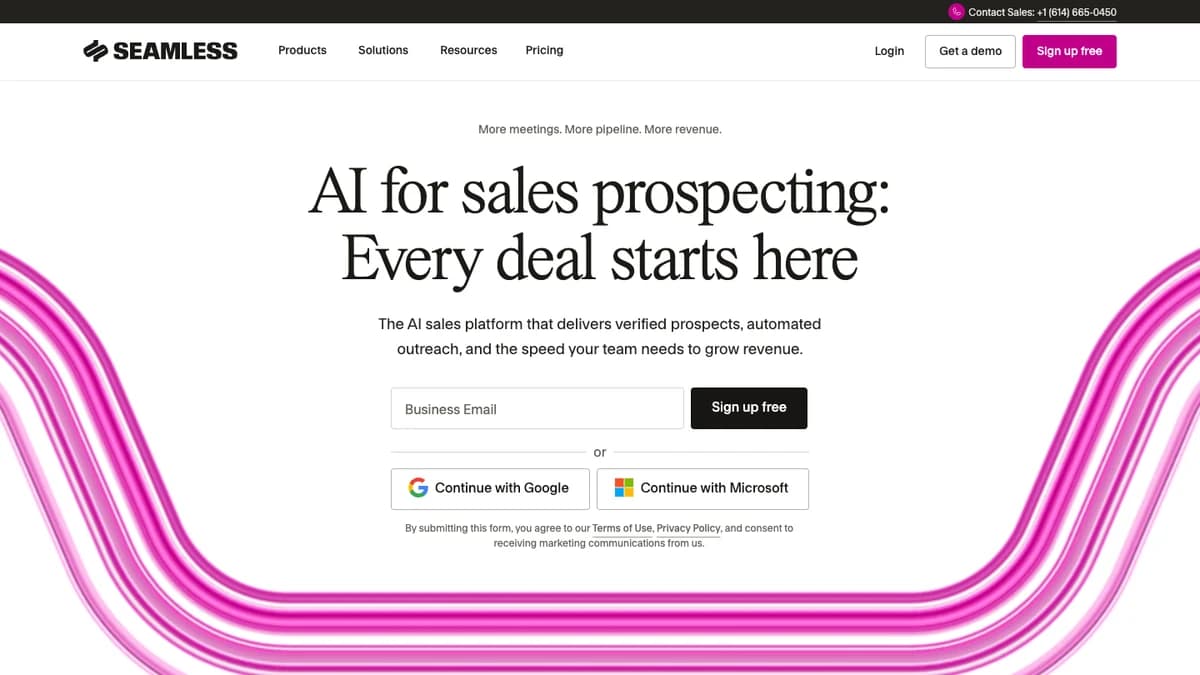
Seamless.ai, rebranded as Seamless in February 2026, is an AI sales platform built around search-time contact research. Its own FAQ calls it "a real-time search engine, not a database": each search scours the public web, and a 10-step AI engine researches and verifies emails and direct dials at that moment.
It still publishes database-scale numbers on its homepage: 1.8B+ verified business emails and 414M+ phone numbers. Read that as a large index re-checked when you pull a record.
Seamless publishes no accuracy percentage. Instead, its Credit Back Protection program automatically returns credits for emails its own verification flags as invalid at lookup time.
The fine print matters. Soft bounces, role-based addresses like sales@, emails that pass verification and fail later, and phone numbers aren't covered, and Seamless can change or end the program at any time. Credit-back limits what bad data costs you in credits, not the sender-reputation damage of a hard bounce on an address it marked valid.
The platform now goes past lookups. The Data Engine adds Buyer Intent, Job Changes, and CRM Enrich; the Connect hub covers emailing, calling, and social selling; and AI agents handle outbound, inbound, and ops work.
In May 2026 Seamless made its API available on every plan, free included, and in June 2026 it began powering contact sourcing inside HubSpot's Breeze Prospecting Agent. It also offers MCP, a Chrome extension, and says it connects with 6,000+ tools.
Pricing is quote-only as of October 2026: seamless.ai/pricing redirects to an inquiry form that asks how many contacts you need a month, from up to 1,000 to 25,000+. The page promises volume discounts, unlimited-user options, no setup fees, and up to 50% in discounts or credits matching the remaining value of a competitor contract you're leaving.
Free accounts get 50 credits, and Bulk Credits pool usage across search, enrichment, AI, and the API, with optional per-user limits. Even Vendr's purchase database shows no sample pricing for Seamless.
The contract is where buyers get caught. Seamless's Terms of Use say every subscription is annual, even on monthly billing, all sales are final, and you must cancel inside the platform at least 60 days before renewal or the contract renews for another 12 months. Seamless can also change subscription fees effective on notice.
That clause shapes its reputation: a 1.2/5 TrustScore on Trustpilot across 310 reviews, 83% one-star, with renewals and cancellation the recurring themes (Trustpilot notes the company hasn't invited reviews recently, so they may not be representative). Users on Capterra rate it 4.5/5, though some flag credits draining fast and numbers reaching main lines instead of direct dials.
For more, see our Seamless.ai review and Seamless.ai alternatives.
Pros
- +Search-time research with a 10-step verification on emails and direct dials, per Seamless
- +Automatic credit-back on emails its verification flags as invalid
- +Fast lookups by name, company, or title, including from LinkedIn through the Chrome extension
- +Bulk Credits pool usage across search, enrichment, AI Assistant, Autopilot, and API, with unlimited-user pricing on offer
- +API on every plan (free included) and native contact sourcing inside HubSpot's Breeze Prospecting Agent
Cons
- −No published paid pricing; every paid plan starts with a sales conversation
- −Every subscription is annual, with a 60-day in-platform cancellation window before auto-renewal
- −No published accuracy figure, and credit-back excludes phones, soft bounces, and emails that fail after verification
- −1.2/5 TrustScore on Trustpilot, with renewals and cancellation the dominant complaints
- −Credits can drain fast during bulk list-building, per Capterra reviewers
Best for: Search-time contact lookups and pooled credits across many users, on an annual contract
Pricing: Quote-based as of October 2026: free plan with 50 credits; paid plans priced by contacts per month, users, and modules through a sales inquiry. All subscriptions are annual (billed monthly or annually) and auto-renew unless cancelled in-platform 60+ days before renewal.
Comparison Table
| Tool | Best For | Free Tier | Starting Price | Standout Feature |
|---|---|---|---|---|
| Apollo.io | A stored contact database, buying signals, and sequences in one tool at published per-seat prices | Yes (900 credits/seat/year, 2 sequences) | $49/seat/month (Basic, annual) | 240M+ contacts, waterfall enrichment, and sequences from your own mailbox in one self-serve tool |
| Seamless.ai | Search-time contact lookups and pooled credits across many users, on an annual contract | Yes (50 credits) | Quote-based (no published paid prices) | Search-time verification with automatic credit-back on invalid emails |
How to Choose
- Apollo.io if you need a stored contact database, buying signals, and sequences in one tool at published per-seat prices
- Seamless.ai if you need search-time contact lookups and pooled credits across many users, on an annual contract
Final Verdict
Pick Apollo.io if you want data and outreach in one tool on terms you can read before you buy. Ten reps on Professional cost $9,480 a year billed annually, or $11,880 on monthly billing, and that covers sequences from your own mailbox, a dialer, waterfall enrichment, and intent, job-change, and website-visitor signals. If you sell outside North America, validate a regional sample before scaling.
Pick Seamless.ai if your reps mostly research named people at named accounts, from LinkedIn through the Chrome extension or inside HubSpot's Prospecting Agent, and you'd rather buy a pooled credit balance across many users than per-seat licenses. Go in with eyes open: get every price and the renewal terms on the order form, ask for a shorter notice window, and set a reminder 75 days before renewal. Renewal and cancellation complaints drive much of its 1.2/5 Trustpilot score.
The deciding question isn't real-time vs database, because both tools blend the two and neither accuracy claim is audited. It's what happens after the lookup and how you want to buy: published prices and bundled outreach (Apollo), or negotiated pooled credits for lookup-heavy work (Seamless). Either way, run a 200–300 record bake-off and measure bounces before you commit.
Whichever you choose, SyncGTM can strengthen the enrichment behind it with verified emails, phone numbers, and firmographics from 50+ providers.