

Apollo vs Outreach: Prospecting vs Sales Engagement 2026

By Kushal Magar · October 22, 2026 · 11 min read
Key Takeaway
Apollo and Outreach overlap on sequences but solve different problems. Apollo is a prospecting platform: about 240M contacts, sequences, a dialer, and a free plan, with paid seats reported at $49–$79/user/mo on annual billing. Outreach is an enterprise sales engagement and revenue platform: governed sequences, conversation intelligence, deal management, and forecasting, sold by quote (Vendr median contract $45,600/yr) with no contact data. Pick Apollo to fill pipeline; pick Outreach to run a large team's process.
Apollo vs Outreach looks like a sequencer fight, but it is really prospecting vs sales engagement. Apollo sells you the list and the tools to work it; Outreach sells the operating system a big sales team runs on.
Most pages ranking for this keyword come from a third vendor pitching itself at the end. This one uses each vendor’s own homepage and pricing page, checked October 2026, and labels every third-party price as third-party.
TL;DR
| Dimension | Apollo | Outreach | Winner |
|---|---|---|---|
| Core job | Find and contact prospects | Run and govern a sales team's process | Depends on your motion |
| Contact data | ~240M contacts, 30M companies built in | None; bring your own | Apollo |
| Entry price | Free plan; Basic $49/user/mo (annual)* | Quote only; est. $100–$160/user/mo* | Apollo |
| Sequences | Email, calls, LinkedIn tasks | Multichannel with governance and testing | Outreach for large teams |
| Forecasting | No dedicated module | Projections, rollups, scenarios (Amplify Pro) | Outreach |
| Deal management | Deals and pipeline basics | Deal inspection with AI risk flags | Outreach |
| Admin effort | Self-serve, same-day setup | Needs a RevOps or sales ops owner | Apollo |
| AI | AI assistant, research, writing, MCP | Agents for research, deals, revenue, MCP | Tie; different jobs |
*Third-party figures. Neither vendor displayed per-seat prices on its pricing page when we checked in October 2026.
Apollo vs Outreach: Data vs Execution
Apollo answers “who should we contact?” Outreach answers “how does a 100-rep team contact them consistently, and what will we close this quarter?”
That split drives everything else. Apollo bundles a B2B database with sequences, so a two-person team can prospect on day one. Outreach has no contact data, so it assumes you already pay for a data source and a CRM.
This comparison is for sales leaders, founders, and RevOps owners choosing a primary outbound platform. It covers data, cadences, forecasting, admin effort, and pricing.
If you are weighing Apollo against a lighter sequencer instead, see our lemlist vs Apollo comparison.
Apollo Deep Dive
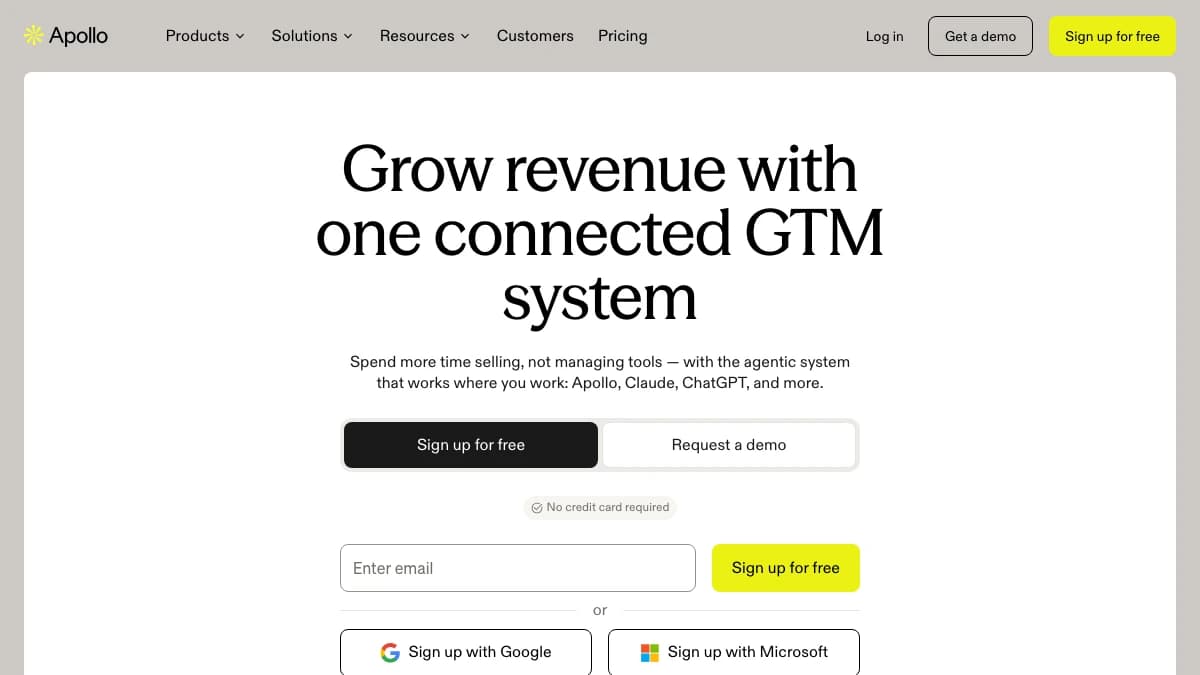
Apollo — B2B contact data, sequences, and dialing in one workspace
Apollo.io is a prospecting platform best suited for SMB and mid-market teams, combining a contact database with sequences from a free plan up. Its homepage cites about 240M contacts, 30M companies, and 600,000+ customer companies (vendor figures).
In 2026 Apollo pitches itself as “one connected GTM system.” The workspace covers search, enrichment, waterfall enrichment, sequences, a parallel dialer, deliverability tools, meetings, deals, and AI assistants, plus an MCP server for Claude and ChatGPT.
Sequences mix email, calls, LinkedIn tasks, and custom tasks. LinkedIn steps are tasks a rep completes by hand, not automated actions.
The trade-off is depth. Apollo has deals and pipeline views, but no dedicated forecasting module, and its governance controls are lighter than an enterprise engagement platform. For a full breakdown, read our Apollo.io review.
Pros
- ✓ Contact data and sequences in one seat, so no second vendor to start
- ✓ Free plan with no time limit; paid seats reported from $49/user/mo annual
- ✓ Self-serve setup: connect a mailbox and launch the same day
- ✓ Built-in dialer, parallel dialer, and call recording on higher tiers
- ✓ Native waterfall enrichment and an MCP server for AI assistants
Cons
- ✗ No dedicated forecasting, territory, or deal-inspection suite
- ✗ Credits expire each cycle, and phone reveals cost more credits than emails
- ✗ Data accuracy is a recurring complaint in user reviews
- ✗ LinkedIn steps are manual tasks, not automation
- ✗ Pricing figures are hidden on Apollo's page at time of writing
Apollo Pricing (per user)
| Plan | Monthly billing | Annual billing | What it adds |
|---|---|---|---|
| Free | $0 | $0 | Limited credits; for evaluation |
| Basic | $59/user/mo | $49/user/mo | Email sequencing, core integrations |
| Professional | $99/user/mo | $79/user/mo | Higher credit limits, AI features, call recording |
| Custom (formerly Organization) | Via sales | Via sales | Custom volumes, SSO, advanced security |
Apollo's pricing page listed plan names and features but no dollar figures when fetched in October 2026. Prices above are from third-party pricing trackers (e.g. Zeliq, Docket) and may change. Credits are pooled per team and expire each billing cycle, per Apollo's page.
Outreach Deep Dive
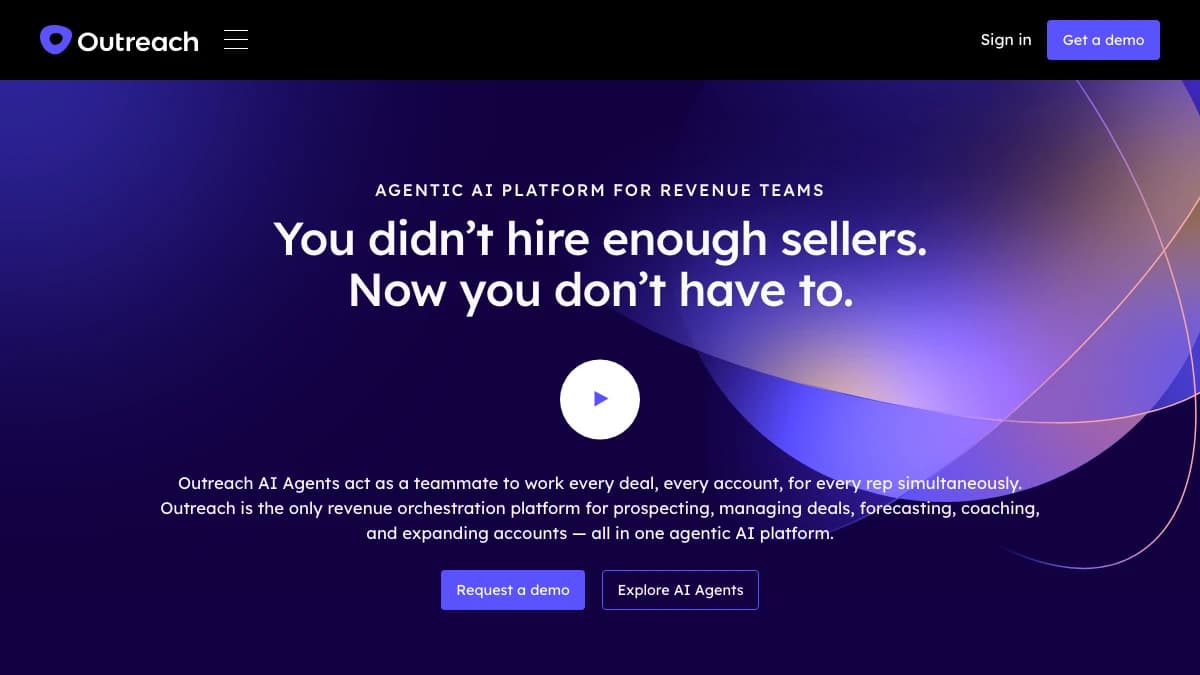
Outreach — sales engagement, deals, and forecasting for revenue teams
Outreach is an enterprise sales engagement and revenue platform best suited for teams with RevOps support, offering governed sequences, deal management, and forecasting by custom quote. It moved from outreach.io to outreach.ai and now calls itself an “agentic AI platform for revenue teams.”
The product spans prospecting, deal management, forecasting, coaching, and account expansion. AI agents handle research, meeting prep, deal risk, and renewals, and Outreach also offers an MCP server.
What it does not include is contact data. Outreach expects records to arrive from your CRM and a data provider, then governs how reps work them.
Pricing is quote-only across four Amplify packages, billed per user plus AI credits. Forecasting is listed only in the top Pro package. More detail lives in our Outreach review.
Pros
- ✓ Built for scale: team-wide sequence governance, testing, and permissions
- ✓ Forecasting with projections, scenario planning, and rollups (Amplify Pro)
- ✓ Deal management with AI risk flagging and conversation intelligence
- ✓ Deep Salesforce and HubSpot integrations for CRM-centric orgs
- ✓ AI agents across research, deals, and renewals
Cons
- ✗ No contact database; you pay a separate data provider
- ✗ No public pricing; Vendr median contract is $45,600/yr
- ✗ Sales-led rollout that needs an admin to own it
- ✗ Forecasting and territory management only in the top package
- ✗ Overkill for teams under roughly 10 reps
Outreach Packages
| Package | AI credits | Public price | What it adds |
|---|---|---|---|
| Amplify Essentials | 10,000 | Not listed | AI agents, engagement, conversation intelligence, deal and pipeline management |
| Amplify Core | 25,000 | Not listed | Adds sequencing, reporting, call insights, revenue and personalization agents |
| Amplify Plus | 50,000 | Not listed | Adds advanced agents |
| Amplify Pro | 100,000 | Not listed | Adds forecasting, territory management, managed services |
Package names, AI credits, and features from outreach.ai/pricing (October 2026). Per user pricing, no platform fee, support included. Add-ons: Data Sharing, Connectors, Additional Instances, Listener Licenses. Aggregators such as CostBench estimate $100–$160/user/mo.
Apollo vs Outreach: Head-to-Head
Here is every dimension that changes the buying decision, side by side. Vendor claims are labeled as such.
| Feature | Apollo | Outreach |
|---|---|---|
| Best for | SMB and mid-market teams that need data plus outreach in one seat | Mid-market and enterprise teams with RevOps support and a separate data source |
| Positioning (2026) | "One connected GTM system" for prospecting, outreach, and dialing | "Agentic AI platform for revenue teams" across prospecting, deals, and forecasting |
| Free option | Free plan with no time limit | None; demo and quote |
| Pricing model | Per user, with credits for emails, phones, and exports | Per user plus AI credits by package; no platform fee |
| Published prices | Hidden on Apollo's page at time of writing; third parties list $49–$79/user/mo annual | Not published; Vendr median contract $45,600/yr |
| Contact database | ~240M contacts, 30M companies (vendor figure) | None |
| Enrichment | Native enrichment plus waterfall enrichment | Via integrations and a Data Sharing add-on |
| Sequences | Email, dialer, LinkedIn tasks, custom tasks | Multichannel sequences, A/B testing, team governance |
| Dialer | Built-in dialer and parallel dialer | Built-in dialer |
| Conversation intelligence | Call recording and insights | Call insights and AI topic analysis |
| Forecasting | No dedicated forecasting module | Projection, scenario planner, rollups, trends (Amplify Pro) |
| Deal management | Deals, tasks, pipeline views | Deal management with AI risk flagging |
| CRM | Built-in CRM objects plus Salesforce and HubSpot sync | Deep Salesforce, HubSpot, and Dynamics integrations |
| Setup | Self-serve | Sales-led rollout with admin ownership |
5 Key Differences Between Apollo and Outreach
1. Data: built in vs bring your own
Apollo includes contact and company data in every plan, paid for with credits. Outreach includes none.
That makes the real Outreach cost “Outreach plus a data vendor.” Many Outreach shops use Apollo, ZoomInfo, or a waterfall enrichment tool to fill that gap.
2. Cadences: speed vs governance
Both run multistep sequences with email, calls, and tasks. Apollo optimizes for a rep building and launching a sequence alone.
Outreach optimizes for managers. Shared sequences, testing, and permissions keep 200 reps on the same playbook, which matters more as headcount grows.
3. Forecasting and deals
This is Outreach’s clearest win. Its Pro package lists projections, a scenario planner, rollups, and trends, and every package includes deal management with AI risk flags.
Apollo tracks deals and pipeline, but does not market a forecasting module. Teams on Apollo usually forecast in Salesforce, HubSpot, or a dedicated tool.
4. Admin effort
Apollo is self-serve: sign up, connect Gmail or Outlook, and send. A founder can run it without help.
Outreach is sold and implemented with sales, CRM mapping, and permission design. Plan for a RevOps or sales ops owner, and weeks before the rollout is fully live.
5. Pricing transparency
Apollo has a free plan and widely reported seat prices of $49 to $79 per user per month on annual billing. Outreach publishes no prices at all.
Per Vendr’s buyer data, the median Outreach contract is $45,600 per year across 919 purchases, with a range of roughly $8,700 to $215,000.
Apollo vs Outreach Pricing Math: 3 Team Sizes
Sticker prices hide the real gap: Outreach needs a data source, and Apollo needs credits. These estimates use third-party seat prices and a $130/user/mo Outreach midpoint.
| Scenario | Apollo | Outreach | Better value |
|---|---|---|---|
| 3-rep startup, no data source yet | Basic: 3 × $49 = $147/mo, data included | Seats est. 3 × $100 = $300/mo + data provider | Apollo |
| 15-rep mid-market team | Professional: 15 × $79 = $1,185/mo | Est. 15 × $130 = $1,950/mo + data provider | Apollo on cost; Outreach on governance |
| 80-rep enterprise org with forecasting | Custom quote; no native forecasting | Est. 80 × $130 = $10,400/mo + data; forecasting in Pro | Outreach, if forecasting replaces another tool |
Estimates only. Outreach quotes vary with seats, package, term, and negotiation; Apollo totals exclude add-on credits.
For small teams, Apollo wins on cost before features enter the conversation. At enterprise scale, Outreach can pay for itself if its forecasting and deal tooling replace a separate platform. See our Outreach alternatives if neither price point fits.
Which One Should You Pick?
Choose Apollo if:
- You have fewer than about 20 reps and no separate data vendor.
- You want to start free and self-serve, without a sales cycle.
- Your bottleneck is finding contacts, not managing rep behavior.
- Forecasting already lives in your CRM.
Choose Outreach if:
- You run 50+ quota-carrying reps across multiple teams.
- Leadership needs governed sequences, forecasting, and deal inspection in one platform.
- You already pay for a data provider and run Salesforce or HubSpot.
- You have RevOps capacity to own the rollout.
Still deciding whether Apollo is the right data layer? Our Apollo alternatives roundup and Salesloft review cover the other common picks.
Final Verdict
Pick Apollo if your problem is pipeline volume. A built-in database, sequences, a dialer, and a free plan make it the fastest path from zero to booked meetings for startups and mid-market teams.
Pick Outreach if your problem is running a large sales org. Governed cadences, deal inspection, and forecasting justify the quote-only price once headcount and process complexity outgrow a prospecting tool.
Many enterprises run both: Apollo for data, Outreach for execution. That works, but only if records arrive verified, since bounces hurt every sequence downstream.
Whichever you choose, SyncGTM can strengthen the enrichment behind it with verified emails, phone numbers, and firmographics from 50+ providers.