

Lemlist vs Apollo: Cold Outreach Platforms Compared 2026

By Kushal Magar · October 21, 2026 · 12 min read
Key Takeaway
Lemlist and Apollo both run cold outreach sequences, but they start from opposite ends. lemlist starts from the message: automated LinkedIn steps, calls, SMS, conditional branching, and creative personalization, with lemwarm on every plan, from $69/mo. Apollo starts from the data: 240M contacts and 30M companies, sequences, a dialer, and a free plan, with paid seats from $49/user/mo on annual billing. Pick lemlist for reply quality, Apollo for list building in one seat.
Lemlist vs Apollo is really a question of where your outbound breaks. lemlist fixes the message with multichannel, personalized sequences; Apollo fixes the list with a big B2B database and sequences attached.
Most pages ranking for this keyword are written by lemlist or by a third sequencing vendor. This one uses each vendor’s pricing page and help docs, checked October 2026, and labels vendor claims as claims.
TL;DR
Pick lemlist if you already know who to contact and replies depend on LinkedIn touches, calls, and personalization beyond a first-name variable. Pick Apollo if you need to find the contacts too and want data, sequences, and a dialer in one seat.
Apollo is cheaper for a solo seller who needs leads. lemlist is cheaper for an email-only team, because its Email plan covers unlimited users at one flat price.
| Dimension | lemlist | Apollo | Edge |
|---|---|---|---|
| Core strength | Personalized multichannel sequences | B2B database plus sequences | Depends on your motion |
| Entry price | $69/mo Email ($55 annual) | Free plan; Basic $49/user/mo (annual) | Apollo |
| Pricing model | Email: flat by volume; Multichannel: per user | Per user, with pooled credits | lemlist for email-only teams |
| Contact database | 650M+ contacts (claimed); finder credits extra | 240M contacts, 30M companies; credits included | Apollo |
| LinkedIn steps | Automated: visits, invites, messages, voice notes | Manual tasks for reps | lemlist |
| Calls and SMS | Dialer and SMS on Multichannel | Dialer; call recording on higher tiers | Tie on calls; lemlist on SMS |
| Warmup | lemwarm on every plan | Deliverability Suite with warmup status | lemlist |
| Sequence logic | Conditional branches across channels | Mostly linear steps | lemlist |
| CRM and pipeline | Integrations only | Built-in deals, tasks, and CRM sync | Apollo |
| G2 rating | 4.6/5 | 4.7/5 | Apollo, narrowly |
Pricing from lemlist.com/pricing and apollo.io/pricing, checked October 2026. Apollo per-user prices are annual billing; monthly billing costs more. G2 ratings as cited on lemlist’s own comparison page at time of writing.
Lemlist vs Apollo: Outreach vs Data
Both tools send multi-step cold outreach, include a contact database, and add AI writing help. They overlap more every year, but their cores are still different products.
lemlist is a sales engagement tool that added data. Apollo is a sales intelligence database that added engagement.
That origin shapes everything below. lemlist goes deeper on channels, sequence logic, and deliverability; Apollo goes deeper on search filters, credits, and pipeline tracking.
Lemlist Deep Dive
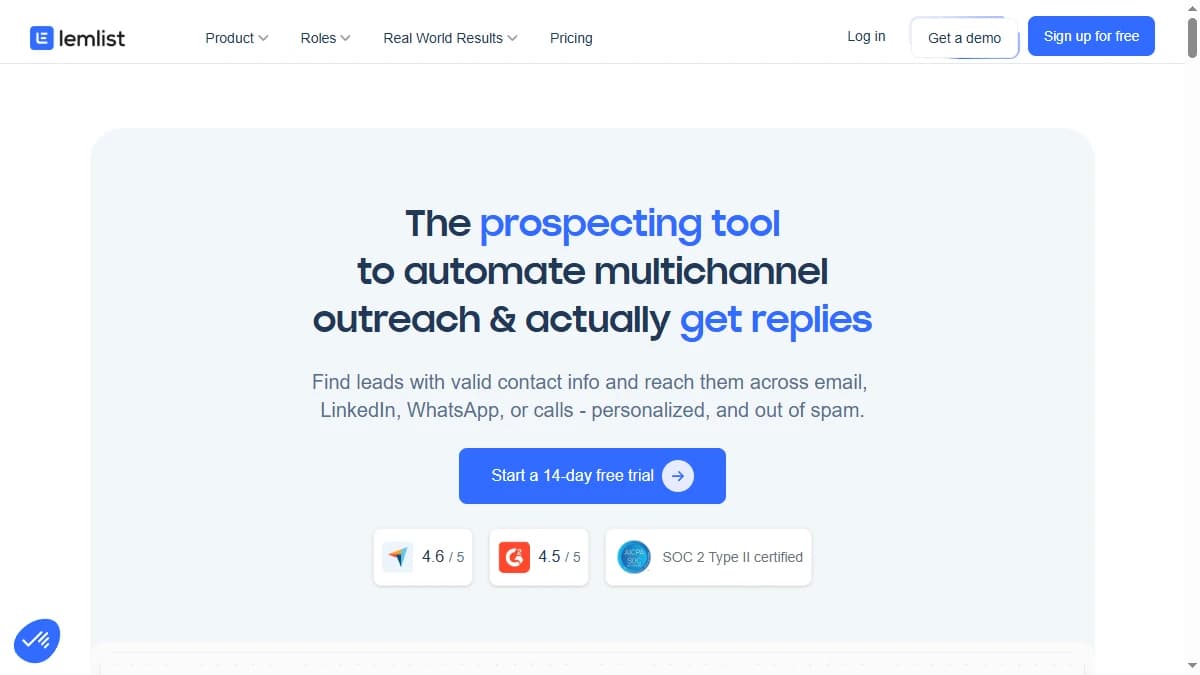
lemlist — personalized sequences across email, LinkedIn, calls, and SMS
lemlist is a multichannel outreach platform best suited for teams that win on personalization, with plans from $69/mo. Its sequence builder chains email, LinkedIn actions, calls, and SMS, and branches on opens, clicks, replies, and accepted invites.
Personalization is the brand. lemlist offers images with the prospect’s name or logo, personalized video thumbnails, custom landing pages, and AI-written lines, plus lemAgent for AI-assisted campaign building.
Deliverability is included, not upsold. lemwarm warmup and the Deliverability Hub come with every plan, and the Email plan covers unlimited users and senders up to 50,000 emails a month.
Data is the weaker half. lemlist claims 650M+ B2B contacts, but email and phone finding run on an add-on: $20/mo for 2,000 credits, about 400 emails or 100 phone numbers.
Full breakdown in our lemlist review.
Pros
- ✓ Automated LinkedIn steps: visits, invites, messages, voice notes
- ✓ Calls, SMS, and a built-in dialer on Multichannel
- ✓ Conditional sequences that branch across channels
- ✓ Creative personalization: images, video thumbnails, landing pages
- ✓ lemwarm and Deliverability Hub on every plan
- ✓ Email plan covers unlimited users for one flat price
Cons
- ✗ Multichannel is $109 per user per month and grows with headcount
- ✗ Email and phone finding cost extra credits
- ✗ No free plan, only a trial
- ✗ Email plan's public tier caps at 50,000 emails a month
- ✗ No built-in CRM or deal pipeline
Best for: SDR teams, agencies, and founders who work a defined account list and need every touch to feel personal.
Pricing
| Plan | Monthly | Annual | Volume | Senders |
|---|---|---|---|---|
| $69/mo | $55/mo | Up to 50,000 emails/mo | Unlimited users and senders | |
| Multichannel | $109/user/mo | $87/user/mo | Unlimited emails and messages | 5 senders per user |
| Enterprise | Custom | Custom | Unlimited | 5+ senders per user, SSO/SAML |
lemwarm included on all plans. Add-ons: lead enrichment $20/mo (2,000 credits), buying intent signals $29/mo (100 signals), WhatsApp automation. Source: lemlist.com/pricing, October 2026.
Apollo Deep Dive
Apollo — B2B database, sequences, dialer, and CRM sync in one seat
Apollo is a sales intelligence and engagement platform best suited for teams that need to find prospects and sequence them in one place, with a free plan and paid seats from $49/user/mo (annual). Its pricing page lists 240M contacts and 30M companies.
The workflow starts in search. You filter by title, industry, headcount, technology, and intent, reveal emails and phones with credits, then drop contacts into a sequence.
Sequences mix automatic emails, manual emails, calls, LinkedIn tasks, and custom tasks. LinkedIn steps are tasks a rep completes by hand, and branching logic is lighter than lemlist’s.
Credits are pooled across the team, reset each billing cycle, and do not roll over. On deliverability, Apollo’s Deliverability Suite scores each mailbox, shows warmup status, and flags setup gaps.
The common complaint is data accuracy. Even lemlist’s comparison page, citing third-party reviews, names it the most consistent Apollo criticism. More detail in our Apollo.io review.
Pros
- ✓ 240M contacts and 30M companies with deep search filters
- ✓ Free plan with no time limit
- ✓ Data, sequences, dialer, and pipeline in one seat
- ✓ Credits included on every paid plan
- ✓ Built-in CRM objects plus Salesforce and HubSpot sync
- ✓ 4.7/5 G2 rating
Cons
- ✗ LinkedIn steps are manual tasks, not automation
- ✗ Mostly linear sequences with limited branching
- ✗ Per-user pricing, and credits expire each cycle
- ✗ Data accuracy is a frequent complaint in reviews
- ✗ No personalized images, video, or landing pages
Best for: founders and SDR teams that build lists from scratch every week and want one tool from search to send.
Pricing
| Plan | Monthly | Annual | Credits | Notes |
|---|---|---|---|---|
| Free | $0 | $0 | Limited credits | Gmail-only campaigns |
| Basic | Higher than annual | $49/user/mo | Data credits per user | Email sequencing, core integrations |
| Professional | Higher than annual | $79/user/mo | Higher credit limits | AI features, call recording |
| Organization | Higher than annual | $119/user/mo | Highest credit limits | 3-user minimum; advanced reports |
Annual per-user prices as published by Apollo and repeated on lemlist's comparison page; monthly billing runs roughly 20% higher. Custom tier adds SSO and custom volumes. Source: apollo.io/pricing, October 2026.
Lemlist vs Apollo: Head-to-Head
Here is every feature that changes the buying decision, side by side. lemlist prices are monthly unless noted; Apollo prices are annual per user.
| Feature | lemlist | Apollo |
|---|---|---|
| Best for | Teams where personalization and multichannel touches drive replies | Teams that need prospect data and sequencing in one seat |
| Free option | 14-day trial with Multichannel features and 200 credits | Free plan with no time limit; campaigns from Gmail only |
| Entry plan | Email $69/mo ($55 annual): up to 50,000 emails/mo, unlimited users and senders | Basic $49/user/mo (annual): sequences, data credits, core integrations |
| Mid plan | Multichannel $109/user/mo ($87 annual): 5 senders per user, unlimited emails and messages | Professional $79/user/mo (annual): higher credit limits, AI features, call recording |
| Top plan | Enterprise: custom, SSO/SAML, dedicated manager | Organization $119/user/mo (annual, 3-user minimum); Custom tier via sales |
| Credits | Add-on: $20/mo for 2,000 (about 400 emails or 100 phones) | Pooled per team, reset each cycle, no rollover |
| Channels | Email, LinkedIn, calls, SMS; WhatsApp add-on | Email, calls, LinkedIn tasks, custom tasks |
| Personalization | Variables, AI writing, personalized images, video thumbnails, landing pages | Variables, AI-written emails, snippets |
| Deliverability | lemwarm and Deliverability Hub on every plan | Deliverability Suite: mailbox scores, warmup status, sending limits |
| Intent data | Buying intent signals add-on ($29/mo, 100 signals) | Buying intent and job-change filters in the database |
| CRM | Integrations with Salesforce, HubSpot, Pipedrive | Built-in CRM objects plus Salesforce and HubSpot sync |
| AI agents | lemAgent and AI agents | AI research, writing, and workflow assistants |
| G2 rating | 4.6/5 | 4.7/5 |
5 Key Differences
1. Data quality and coverage
Apollo wins on data workflow. Search, filters, intent, and credit reveals sit at the center of the product, and every paid seat includes credits.
lemlist claims a bigger headline number (650M+ vs 240M), but finding emails and phones costs add-on credits. Neither vendor publishes independent accuracy rates.
Single-source databases miss contacts in some regions and industries. Teams that care about bounce rates often run a waterfall email finder before any list hits a sequence.
2. Deliverability
lemlist treats deliverability as a core feature. lemwarm and the Deliverability Hub ship on every plan, and the Email plan includes unlimited senders for inbox rotation.
Apollo has caught up on visibility. Its Deliverability Suite scores mailboxes, shows warmup status, and lets you set sending limits per inbox.
Neither tool fixes a bad list. Google’s email sender guidelines ask bulk senders to keep spam rates below 0.10% and never reach 0.30%. Our cold email warmup tools roundup covers the rest.
3. Channels and LinkedIn
This is lemlist’s clearest win. Multichannel automates LinkedIn visits, invites, messages, and voice notes, and adds SMS, a dialer, and a WhatsApp add-on.
Apollo covers email and calls well, but LinkedIn steps are reminders for reps to act. Fine for low volume, slow for a team running hundreds of touches a day.
Any LinkedIn automation runs from reps’ own accounts, so daily limits still apply. Our automated LinkedIn prospecting guide covers safe volumes.
4. Personalization and sequence logic
lemlist sequences branch. A step can wait for an accepted invite before messaging, or switch to a call when an email goes unanswered.
Apollo sequences are mostly linear, with AI-written emails and snippets for personalization. See our guide to cold email response rates for what actually moves replies.
5. Pricing model
lemlist’s Email plan is flat: $69/mo for unlimited users up to 50,000 emails. Multichannel switches to $109 per user.
Apollo is per user on every paid plan, from $49 to $119 on annual billing, with credits bundled in. You pay for seats, but you also get data you would otherwise buy separately.
Pricing Math: 4 Real Scenarios
Sticker prices hide how each tool scales. Here is the monthly cost of the same job on each, using annual billing for both.
| Scenario | lemlist | Apollo | Cheaper |
|---|---|---|---|
| Solo founder who needs leads and email | Email $55 + enrichment $16 = $71 | Basic: $49 | Apollo by $22 |
| 3 reps, email only, list already built | Email: $55 (unlimited users) | Basic: 3 × $49 = $147 | lemlist by $92 |
| 5 reps, email + LinkedIn touches | Multichannel: 5 × $87 = $435 (LinkedIn automated) | Professional: 5 × $79 = $395 (LinkedIn manual) | Apollo by $40, if reps do LinkedIn by hand |
| 10 reps, full stack with dialer and data | Multichannel: 10 × $87 = $870 + data credits | Organization: 10 × $119 = $1,190 | lemlist on software; Apollo on bundled data |
Annual billing: lemlist Email $55/mo, Multichannel $87/user/mo, enrichment add-on $16/mo; Apollo Basic $49, Professional $79, Organization $119 per user per month. Apollo credit overages and lemlist extra credits are not included.
Which One Should You Pick?
Start with where your list comes from. Then decide how many channels each sequence needs.
- Choose lemlist if you already have target accounts, LinkedIn and calls are part of every sequence, or personalization depth is what lifts your reply rate.
- Choose Apollo if you build new lists every week, want data and sequencing under one login, or need a free plan to start.
- Use both if you source in Apollo and run personalized multichannel follow-up in lemlist, syncing contacts through CSV or an automation tool.
Still weighing other options? Compare the field in our lemlist alternatives and Apollo alternatives guides, or see lemlist vs Instantly and Apollo vs Instantly.
Final Verdict
Pick lemlist if your problem is reply rate. Automated LinkedIn steps, branching sequences, creative personalization, and warmup on every plan make it the stronger outreach engine.
Pick Apollo if your problem is pipeline volume. A 240M-contact database, bundled credits, a dialer, and a free plan make it the faster way to go from zero to a working list.
Either way, verify emails before upload. Bounces burn the domains you warmed, and no sequencer can undo that.
Whichever you choose, SyncGTM can strengthen the enrichment behind it with verified emails, phone numbers, and firmographics from 50+ providers.