

7 Best B2B Directories for Finding and Listing Leads in 2026

By Kushal Magar · November 7, 2026 · 14 min read
Key Takeaway
B2B directories do two jobs: they show you which companies to target, and they put your company in front of buyers. G2 and Crunchbase are the strongest for sourcing, Clutch and Capterra for getting listed, and Kompass and Thomasnet for industrial niches. None of them hands you verified contacts, so pair the directory with an enrichment step.
B2B directories are still one of the cheapest ways to find target accounts and get found by buyers. The catch is that most teams use them for only one of those two jobs.
This guide ranks seven B2B directories on both: how useful each is for sourcing leads, and what it costs to get your own company listed. It also shows how to turn a directory page into enriched contacts with SyncGTM, so the list you build actually reaches a decision-maker.
TL;DR
- G2: best overall B2B directory for software companies, both to list on and to mine for accounts.
- Crunchbase: best for sourcing funded startups by round, investor, and headcount (Pro from $49/mo on annual billing).
- Clutch: best place for agencies and service firms to get listed, with 350K+ providers and free profiles.
- Capterra: best for SMB software that wants pay-per-click visibility on top of a free listing.
- Kompass: best for global industrial prospecting, with 57M+ companies across 70+ countries.
- Thomasnet: best for selling to or sourcing North American manufacturers.
- Product Hunt: best for finding newly launched SaaS products and their founders.
- SyncGTM is not a directory. It is the layer that pulls directory listings and turns them into verified contacts.
What Are B2B Directories?
B2B directories are online databases that list businesses by industry, service, location, or product category so other businesses can find, compare, and contact them. They range from review marketplaces like G2 and Clutch to firmographic databases like Crunchbase and Kompass.
They matter because buyers do most of their homework alone. Gartner research found B2B buyers spend only 17% of the purchase journey meeting potential suppliers, and about 27% researching independently online.
Directories sit right inside that independent research. If you are not listed, you are not on the shortlist.
The same structured data makes them useful for outbound. A filtered directory page is a pre-segmented account list, which is why directories show up in most lead list building workflows.
How We Ranked These Directories
Most roundups of the best B2B directories pick one lens: either "where to list your agency" or "where to find leads." We scored each directory on both, because the same platform often wins one and loses the other.
- Lead sourcing value: how well you can filter companies, and how much firmographic or intent data each listing carries.
- Listing value: buyer traffic, review credibility, and whether a free profile is enough to show up.
- Cost: price to access data and price to get meaningful visibility, from vendor pricing pages where published.
- Contact depth: whether the directory gives you people and contact details, or only company names.
- Niche fit: software, services, startups, or industrial. A directory that dominates one niche beats a generic one.
Prices and figures were checked in November 2026. Where a vendor does not publish pricing, we say so instead of guessing.
Turn Directory Listings Into Contacts With SyncGTM
SyncGTM is a GTM data platform that pulls leads from 33+ sources, including G2 and Product Hunt scrapers, and enriches each company with decision-makers, verified work emails, and phone numbers. It is not a directory you list on; it is how you make directory data reachable.
Every directory on this list stops at the company. You get a name, a website, maybe a category and a headcount band, but rarely the person who signs the contract.
SyncGTM closes that gap in one table:
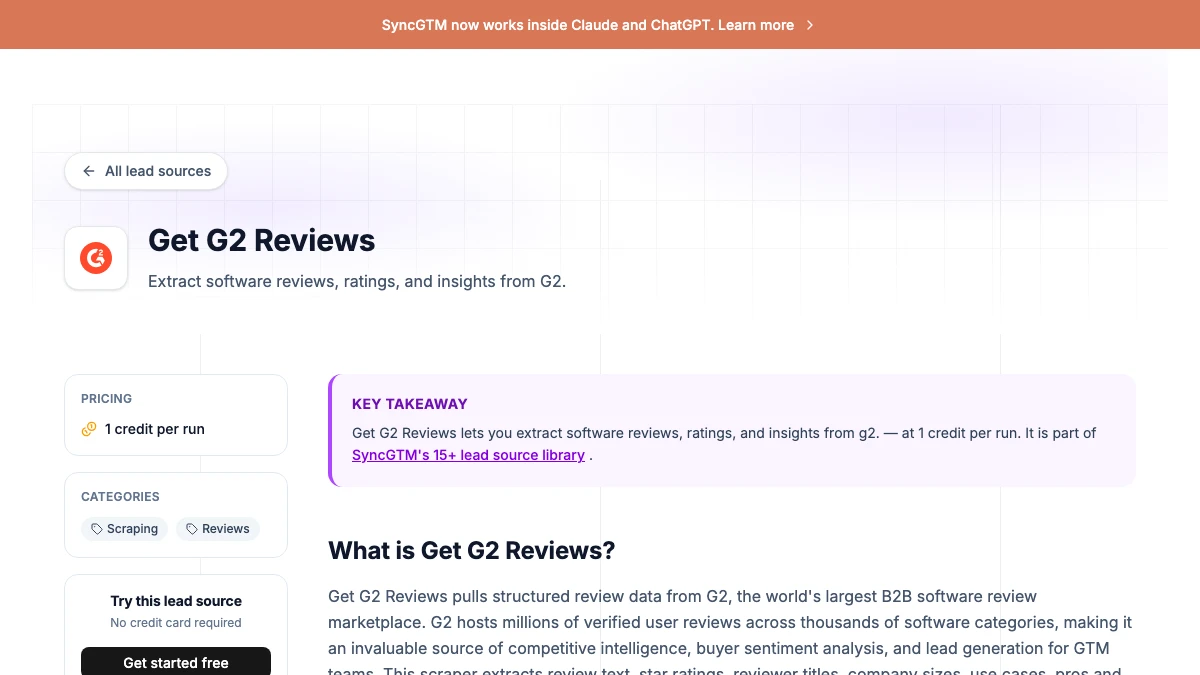
- Pull listings. Get G2 Reviews extracts reviewer job titles, company sizes, and industries for any G2 product page. Pull Product Hunt Listings returns products, launch dates, and maker profiles. Both cost 1 credit per run.
- Cover other directories. For Clutch, Kompass, or Thomasnet category pages, the AI web scraper extracts company names and websites into rows, or you import a directory CSV export.
- Resolve and enrich the company. Company domain lookup and organization enrichment add domain, headcount, industry, and location.
- Find the buyers. Find people within a company filters by title and seniority, then work email lookup runs a waterfall across 40+ data providers and email verification checks every address before you send.
- Push to your stack. Send the finished list to HubSpot, Salesforce, Pipedrive, Attio, or Close, or to your sequencer.
Pros
- Works on top of every directory in this list instead of replacing it
- Native G2 and Product Hunt lead sources, plus AI scraping for any other directory page
- Waterfall enrichment across 40+ providers finds more contacts than a single database
- Free plan with 50 credits per month, no credit card
Cons
- Not a place to list your own company; you still need the directories for inbound visibility
- Scraped directory pages vary in structure, so expect some cleanup on niche sites
For finding leads: The fastest way to turn any directory below into people you can actually email or call.
For getting listed: Not applicable. Use it alongside the directories you list on.
Best for: Sales and RevOps teams who build account lists from directories and need contacts behind them.
Pricing: Free plan with 50 credits per month; paid plans from $49/mo (Solo, 1,000 credits). See SyncGTM pricing.
1. G2
G2 is the largest B2B software review marketplace, best suited for software companies that want buyer visibility and for sellers who target companies by the tools they use. A basic seller profile is free; paid marketing plans and Buyer Intent data are quote-based.
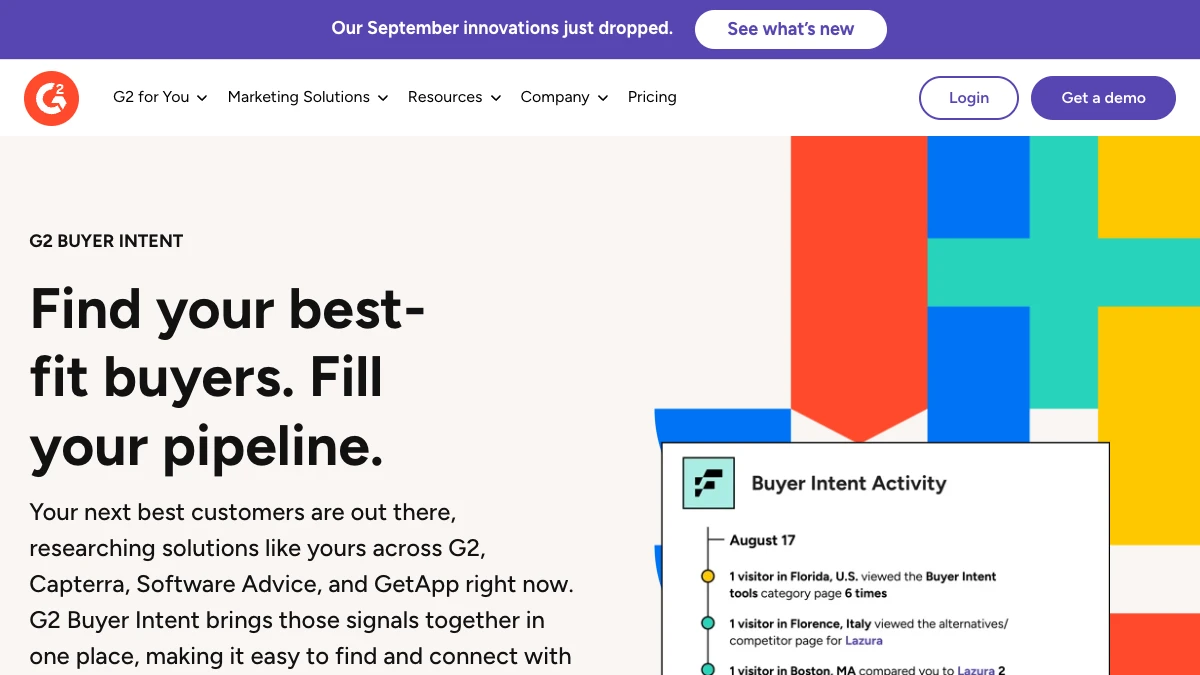
G2 got bigger in 2026. It acquired Capterra, Software Advice, and GetApp from Gartner, a deal that closed in February 2026, and G2 says the combined network holds close to 6 million reviews and reaches 200M+ software buyers a year.
For sourcing, the gold is in review metadata. Each review shows the reviewer's job title, company size, and industry, so a competitor's review page becomes a list of segments already paying for a tool like yours.
For listing, G2 carries the most weight with mid-market and enterprise software buyers. Badges like "Leader" and "High Performer" are earned from review volume and satisfaction, not bought.
Pros
- Biggest software review audience, now spanning four review sites
- Review metadata (title, company size, industry) doubles as competitor-displacement targeting
- Free profile is enough to start collecting reviews
- Buyer Intent shows which companies research your category or competitors
Cons
- Reviewer names and companies are often anonymized, so you target segments, not named people
- Buyer Intent is enterprise-priced; our G2 Buyer Intent review puts it in the tens of thousands per year
- Only covers software; useless for services or industrial sellers
For finding leads: Strong for software sellers: mine competitor reviews for segments and use intent for account timing.
For getting listed: Essential for any B2B software company. Start with the free profile and a review campaign.
Best for: SaaS companies, both as a listing channel and an account-sourcing input.
Pricing: Free profile. Paid plans and G2 Buyer Intent are quote-based.
2. Crunchbase
Crunchbase is a private-company database best suited for sourcing startups and scale-ups by funding stage, investor, and headcount, with Pro access from $49/mo on annual billing. Companies can create and edit their own profile for free.
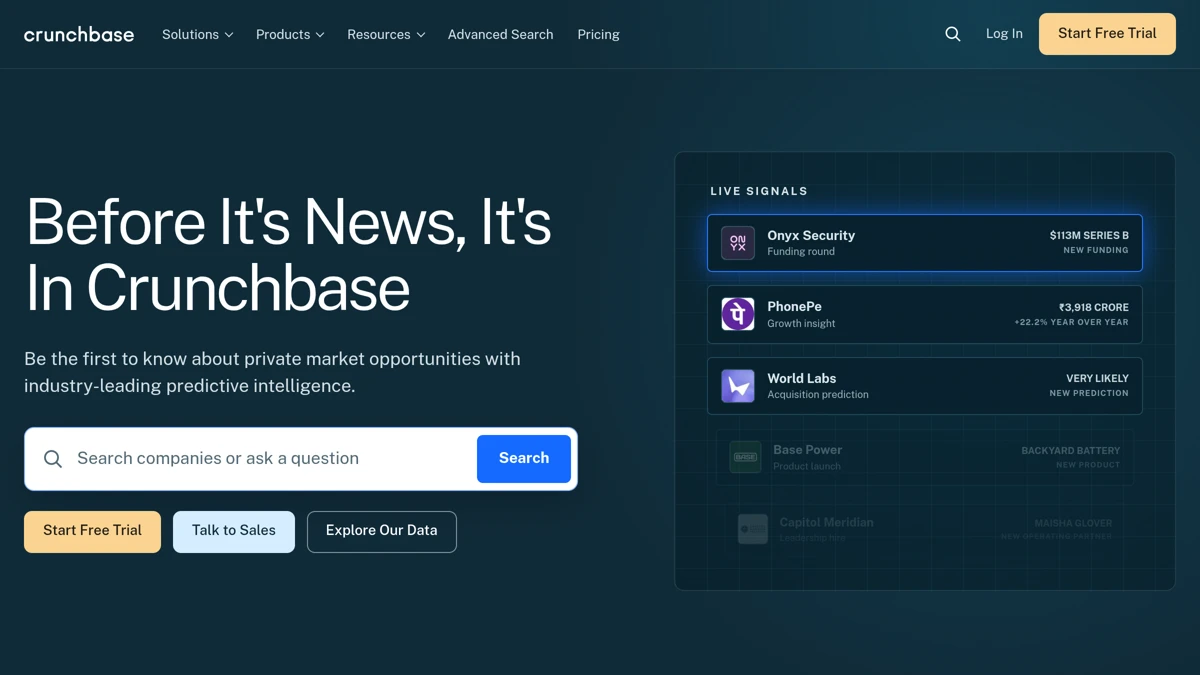
Crunchbase is the directory most outbound teams already use without calling it one. Filter by "Series A in the last 90 days, 50-200 employees, US" and you have a timely account list.
Funding is a strong trigger because new money means new hires and new budgets. That is the same logic behind recently-funded signals in outbound playbooks.
Pros
- Best funding, investor, and acquisition data of any directory here
- Advanced search filters on stage, date, location, headcount, and industry
- Free self-managed company profile helps investors and partners find you
Cons
- Thin on traditional, bootstrapped, and non-tech businesses
- Exports are capped by plan (third-party sources cite about 2,000 rows/month on Pro)
- Contact data is limited, so you still need email and phone enrichment
For finding leads: Excellent for venture-backed targets and trigger-based outbound.
For getting listed: Worth claiming for credibility with investors and partners, but it is not a buyer marketplace.
Best for: Teams selling to startups and scale-ups.
Pricing: Free tier with limited search. Pro at $49/mo billed annually or $99 month-to-month; Business from $199/mo billed annually.
Full breakdown in our Crunchbase review.
3. Clutch
Clutch is a B2B services marketplace best suited for agencies, dev shops, and consultancies that want verified reviews and inbound project requests, with free basic listings. It lists 350K+ providers.
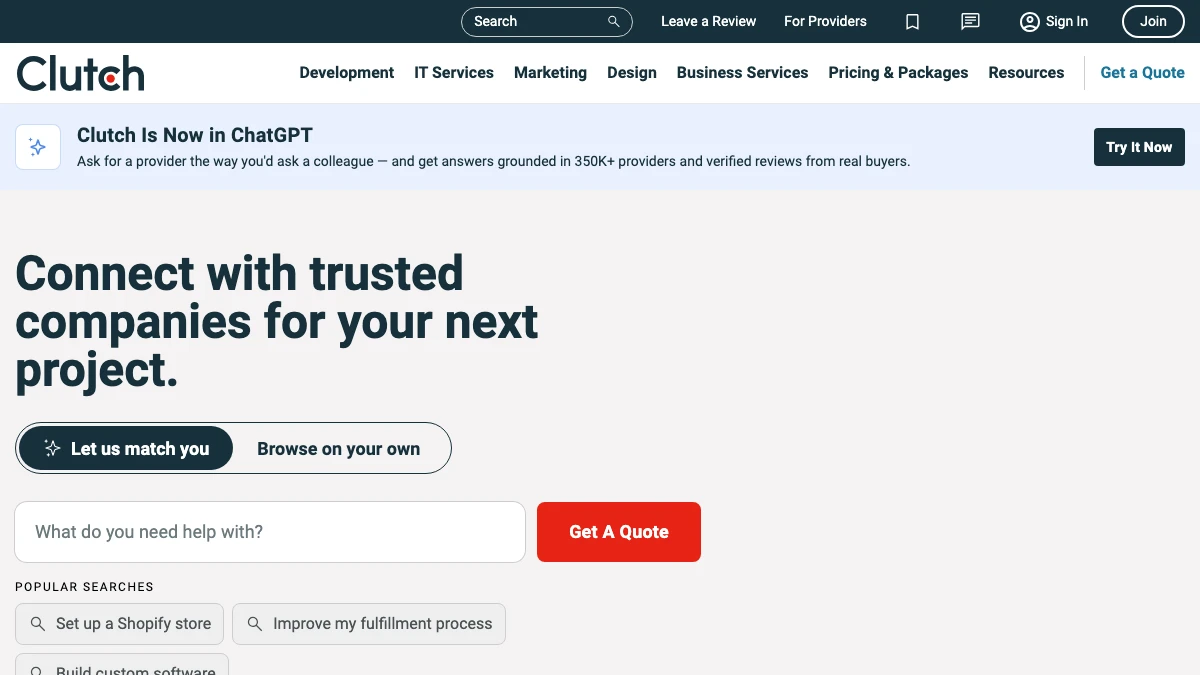
Clutch's edge is review credibility. Reviews go through a human-led verification process that confirms the reviewer's identity, which buyers trust more than self-reported testimonials.
Rankings inside each category weigh reviews, portfolio, and market presence. Sponsored placements sit on top for firms that want to buy visibility.
For sourcing, Clutch is a ready-made map of agencies by service, location, team size, and minimum project size. That is useful if agencies are your buyers, and much less so otherwise.
Pros
- Free listing with verified, identity-checked reviews
- Large buyer audience actively looking to hire service firms
- Granular filters (service, location, team size, hourly rate) for agency prospecting
Cons
- Crowded categories make organic visibility slow without reviews or sponsorship
- Only covers service providers, not product companies
- No contact data beyond the firm's own profile
For finding leads: Strong only if you sell to agencies and service firms.
For getting listed: The first directory any B2B agency should complete.
Best for: Agencies, consultancies, and IT services firms.
Pricing: Free basic listing. Sponsored placement pricing is set per category and not published.
4. Capterra
Capterra is a software review directory best suited for small-business software vendors, combining a free listing with pay-per-click placement in category pages. It is now part of G2's review network.
Capterra announced 2 million verified reviews back in January 2023, and its audience skews toward small businesses comparing tools. That makes it a better fit than G2 for affordable, self-serve products.
The pay-per-click model is the key difference. You bid per category and pay per visitor sent to your site, which gives a predictable cost per click rather than a flat annual fee.
Pros
- Free listing across Capterra, and through the same network, Software Advice and GetApp
- Pay-per-click pricing means you only pay for traffic you receive
- Strong SMB buyer audience for affordable software
Cons
- Paid placements dominate top category spots, so organic listings sink
- Bid prices are not published; competitive categories get expensive
- Low sourcing value: vendor lists without buyer data
For finding leads: Limited. Use category pages to map competitors, not to find buyers.
For getting listed: High value for SMB software, especially with a PPC budget.
Best for: Software vendors selling to small and mid-sized businesses.
Pricing: Free basic listing. Pay-per-click bids vary by category; third-party sources report minimums around $2 per click.
5. Kompass
Kompass is a global B2B company directory best suited for industrial, manufacturing, and trade prospecting outside the US, covering 57M+ companies across 70+ countries. Its EasyBusiness data product uses credit-based exports with a 7-day free trial.
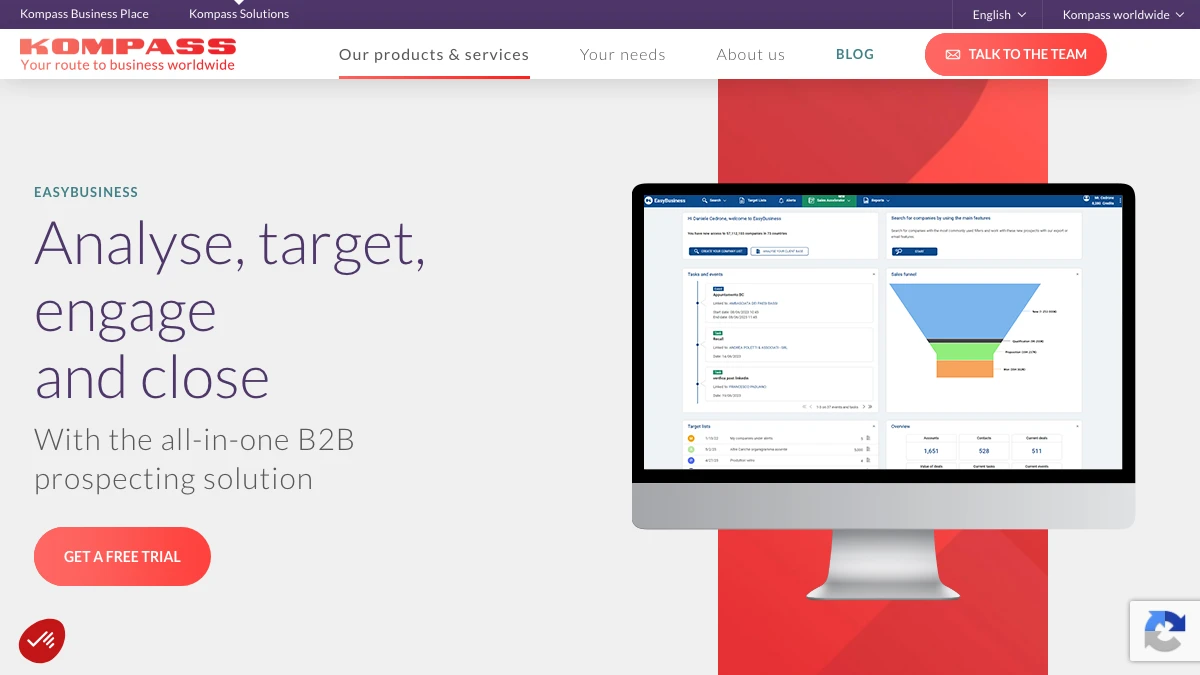
Kompass is the most data-heavy directory on this list. It lists 85M+ executives and 25M+ company and executive emails, searchable with 60+ filters including its own product and activity classification.
That classification is why industrial sellers like it. You can target "manufacturers of hydraulic valves in Germany" instead of a vague industry code, similar to an SIC code search but more granular.
Pros
- Best global coverage here, strong in Europe and Asia
- Detailed product and activity classification for industrial niches
- Includes executive names and some emails, unlike most directories
Cons
- Credit-based downloads add up fast on large lists
- Interface and data feel dated next to modern prospecting tools
- Thin on software and startup companies
For finding leads: Strong for global industrial and trade targets.
For getting listed: A free basic company listing helps international buyers find you; paid boosts add visibility.
Best for: Manufacturers, distributors, and exporters selling across borders.
Pricing: Free basic listing and 7-day EasyBusiness trial. Data access is credit-based and quoted by region.
6. Thomasnet
Thomasnet is a North American industrial sourcing directory best suited for manufacturers and suppliers that sell to procurement teams and engineers, listing 500K+ suppliers across 80,000+ categories. Suppliers can claim a company profile, with paid advertising for more reach.
Buyers on Thomasnet arrive with a spec in hand. They search for a capability, a certification, or a material, which makes it one of the highest-intent listing channels in industrial B2B.
For sourcing, the category structure lets you pull every supplier of a given capability in a region. It is company-level only, so plan an enrichment step to reach plant managers and buyers.
Pros
- High-intent industrial buyers searching by capability and certification
- Very granular categories for niche supplier lists
- Free company profile to get started
Cons
- North America only
- Strict bot protection makes bulk exports difficult
- No people or contact data on listings
For finding leads: Good for building supplier and manufacturer account lists in the US and Canada.
For getting listed: Essential for North American manufacturers.
Best for: Industrial suppliers and teams selling into manufacturing.
Pricing: Free profile. Advertising programs are quote-based.
7. Product Hunt
Product Hunt is a launch platform for new software best suited for finding just-launched SaaS products and the founders behind them, and launching your own product costs nothing. It is a daily leaderboard more than a classic directory.
The lead sourcing value is timing. A company that launched this week is hiring, buying tools, and open to partnerships, and its maker profiles name the founders directly.
As a listing channel, results swing hard by rank. Third-party launch data puts an average launch at a few hundred visitors, while top-three products of the day can see thousands.
Pros
- Free to launch, with a tech-savvy early-adopter audience
- Maker profiles name founders, which most directories never do
- Fresh, time-stamped data that works as a launch trigger
Cons
- Traffic is a one-day spike, not steady inbound
- Skews toward consumer and prosumer tools, less enterprise B2B
- No emails or phone numbers on maker profiles
For finding leads: Great for founder-led outreach to newly launched SaaS companies.
For getting listed: Worth one well-prepared launch for awareness and backlinks, not a lasting pipeline source.
Best for: Selling to early-stage SaaS founders; launching developer and productivity tools.
Pricing: Free to launch and browse.
B2B Directories Compared
Here is how the seven B2B directories stack up side by side on sourcing value, listing cost, and contact data.
| Directory | Best for | Lead sourcing value | Listing cost | Contact data | Coverage |
|---|---|---|---|---|---|
| G2 | Software vendors and buyers | High (reviewer firmographics, intent) | Free profile; paid plans and Buyer Intent quote-based | No (reviewer title, company size, industry only) | Global software |
| Crunchbase | Funded startups and scale-ups | High (funding, headcount, investors) | Free profile | Limited (some contacts on paid plans) | Global private companies |
| Clutch | Agencies and IT service firms | Medium (agency lists by service and location) | Free listing; sponsorships paid | No | 350K+ service providers |
| Capterra | SMB software | Medium (category vendor lists) | Free listing; pay-per-click placement | No | Global software |
| Kompass | Global industrial and B2B trade | High (57M+ companies, 60+ filters) | Free basic listing; data access credit-based | Yes (exec names and emails on paid data) | 70+ countries |
| Thomasnet | North American manufacturers | Medium (supplier lists by category) | Free profile claim; advertising paid | No (company-level only) | 500K+ North American suppliers |
| Product Hunt | New SaaS launches and founders | Medium (maker profiles, launch dates) | Free launch | No (maker names and profiles only) | Global tech products |
Contact data refers to what the directory itself shows. Any of these lists can be enriched with decision-maker emails and phones in SyncGTM.
How to Choose a B2B Directory
Pick by your buyer and your goal, not by directory size.
- You sell software: list on G2 and Capterra first. Then mine competitor reviews on G2 for target segments.
- You run an agency or service firm: complete your Clutch profile and run a review campaign before paying for sponsorship.
- You sell to startups: source from Crunchbase and Product Hunt, and use funding and launch dates as outreach triggers.
- You sell to or are a manufacturer: use Thomasnet for North America and Kompass for everywhere else.
- You need contacts, not companies: treat every directory as an account source and add an enrichment step. Our guides on building a target account list and lookalike company search cover the next steps.
One rule applies everywhere: check each directory's terms before bulk scraping, and verify every email before outreach to protect your sender reputation.
Final Verdict
G2 is the best B2B directory overall for software companies, because it wins on both listing and sourcing. Crunchbase is the best pure sourcing directory for startup targets.
Clutch is the must-list for agencies, and Capterra adds pay-per-click reach for SMB software. Kompass and Thomasnet own industrial niches, and Product Hunt is the best feed of brand-new SaaS companies.
Whichever directories you use, the list is only half the job. SyncGTM pulls listings from G2, Product Hunt, and any directory page, then finds and verifies the people behind each company so your list turns into pipeline.
Last reviewed November 2026. Directory pricing and coverage figures come from each vendor's own pages or cited third-party sources and change often; confirm current terms with the vendor before buying.