

By Kushal Magar · September 30, 2026 · 12 min read
HubSpot vs Mailchimp: Marketing Platform Compared for 2026
HubSpot vs Mailchimp gets searched by two very different people who land on the same page: someone outgrowing broadcast email and someone trying to justify a CRM-sized budget for what feels like a newsletter tool. That's because Mailchimp and HubSpot aren't actually competing for the same job. Mailchimp is an email marketing and e-commerce marketing platform built for fast, good-looking campaigns. HubSpot is a B2B lifecycle marketing suite where every send, form, and workflow reads and writes CRM data. The right answer depends less on features and more on which job you're hiring the tool to do.
Most 'HubSpot vs Mailchimp' comparisons treat this like a straight feature-for-feature fight — same category, same buyer, just pick the winner. It isn't that clean. Mailchimp started as, and still primarily is, an email marketing platform with strong e-commerce and B2C leanings: templates, deliverability, Shopify integration, abandoned-cart flows, product recommendation blocks. HubSpot Marketing Hub is one hub inside a CRM platform, where lead scoring, lifecycle stages, and attribution reporting all run off the same contact record sales is working.
That difference is the actual decision, and most published comparisons bury it under a feature checklist instead of naming it upfront. If you're sending a newsletter or a promo campaign to a list, HubSpot's CRM machinery is overhead you don't need. If you're segmenting by deal stage, lead score, or sales-owned properties — and marketing needs to hand qualified leads to sales without a CSV in between — Mailchimp's marketing CRM is a shallow approximation of what HubSpot already does natively.
Both vendors tier pricing by contact volume, so a dollar figure without its contact tier is close to meaningless — a mistake several existing comparisons make by quoting a headline price with no bracket attached. Below, every figure is verified against each vendor's own pricing page as of September 2026, with the contact tier it applies to. For how HubSpot stacks up against a full CRM competitor rather than an email tool, see our HubSpot review.
Quick Summary
HubSpot vs Mailchimp is a mismatched comparison dressed up as a fair one: Mailchimp is an email marketing and e-commerce marketing platform, HubSpot Marketing Hub is one module of a B2B lifecycle marketing suite built on a CRM. As of September 2026, Mailchimp's Essentials and Standard plans are priced at $13/mo and $20/mo respectively at the 0–500 contact bracket (a promotional rate for the first 12 months, confirmed on mailchimp.com/pricing/), with Premium at $350/mo at the same bracket and unlimited contacts available at higher tiers. HubSpot Marketing Hub starts at $7/mo per seat for Starter (1,000 marketing contacts included, a reduced promotional rate off a $20/mo/seat list price), jumps to $800/mo for Professional (3 core seats, 2,000 marketing contacts, plus a $3,000 one-time onboarding fee), and $3,600/mo for Enterprise (5 core seats, 10,000 marketing contacts, plus a $7,000 onboarding fee) — all confirmed on hubspot.com/pricing/marketing. The two vendors also meter contacts differently: Mailchimp's tiers are built around total contacts in a bracket, while HubSpot separates 'marketing contacts' (the ones you actually email or advertise to, which drive the bill) from 'non-marketing contacts' (stored free up to 15 million, unable to receive campaigns) — meaning a CRM full of inactive or sales-only contacts doesn't inflate the HubSpot marketing bill the way a bloated list inflates Mailchimp's. Feature depth follows the same split as the pricing: Mailchimp's automation is built for straightforward flows — welcome series, abandoned cart, post-purchase — with best-in-class templates and deliverability tooling, but its 'CRM' is a shallow contact-property layer, not a real system of record. HubSpot's automation reads and writes actual CRM properties: lifecycle stage, lead score, deal association, and sales activity all feed workflow logic, and marketing-to-sales handoff happens inside the same record instead of an export. Neither is a flat winner. The honest line is a threshold: if you're sending broadcast or promotional email to a list without segmenting off CRM data, Mailchimp gets you there faster and cheaper. If growth depends on scoring and routing leads through a pipeline sales actually works, HubSpot's CRM-native approach is doing a job Mailchimp's marketing CRM can't fully replicate. SyncGTM doesn't compete with either — it's the enrichment layer underneath, running a 76+ data-point waterfall across 50+ providers so contact and firmographic data feeding either platform's segmentation is accurate instead of stale.
TL;DR
- Short answer: These solve different problems. Mailchimp is the faster, cheaper path to a good-looking email campaign, strong for e-commerce and B2C sends. HubSpot is heavier to set up but ties marketing to a real CRM — lifecycle stages, lead scoring, and attribution that reads sales data, not just email opens.
- Verified pricing (September 2026, USD): Mailchimp's Essentials and Standard plans run $13/mo and $20/mo at the 0–500 contact tier (promotional rate, first 12 months); Premium is $350/mo at that same tier with unlimited contacts on higher plans. HubSpot Marketing Hub Starter runs from $7/mo per seat (1,000 marketing contacts included); Professional starts at $800/mo for 3 core seats plus a $3,000 one-time onboarding fee (2,000 marketing contacts included); Enterprise starts at $3,600/mo for 5 core seats plus a $7,000 onboarding fee (10,000 marketing contacts included).
- Contact tiers matter more than the sticker price. Mailchimp bills against a contact-count bracket that includes everyone on the list, not just people who open email — check your actual list size against Mailchimp's tier table before comparing headline prices. HubSpot separately meters 'marketing contacts' (billed) against 'non-marketing contacts' (stored free, can't receive campaigns) — a CRM full of non-marketing contacts doesn't inflate the marketing bill the way a bloated Mailchimp list does.
- Pick Mailchimp if you're sending broadcast or e-commerce email to a list and don't need that list segmented by CRM properties, deal stage, or sales activity.
- Pick HubSpot Marketing Hub if segmentation and nurture need to run off real CRM data — lead score, lifecycle stage, deal ownership — and marketing needs a clean handoff to sales without exporting a list.
- SyncGTM isn't a third marketing platform in this comparison — it's the enrichment and signal layer that feeds either one with 76+ verified data points per lead, so whichever tool you pick starts from accurate contact and firmographic data instead of a stale list.
What We Evaluated
- Verified pricing at every published tier, with the exact contact bracket or marketing-contact count each price applies to
- Whether segmentation and automation run off real CRM properties (lifecycle stage, deal data) or contact-level email metadata only
- Depth of e-commerce and B2C features (Shopify integration, abandoned-cart, product recommendations) vs. B2B lifecycle features (lead scoring, attribution reporting)
- How each vendor meters and bills contacts — total list size vs. marketing-contact vs. non-marketing-contact
- Setup and onboarding overhead, including any one-time onboarding fees disclosed on the vendor's own pricing page
- Template quality, deliverability tooling, and time-to-first-campaign for teams that just need to send email
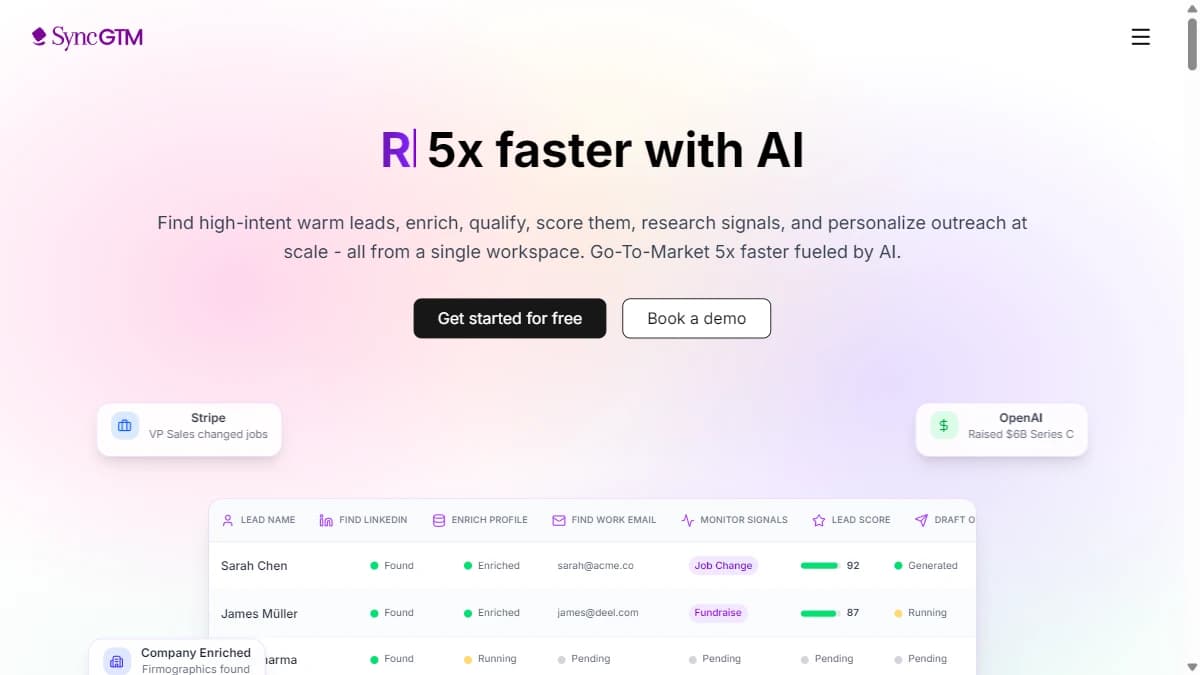
1. SyncGTM — Teams on either HubSpot or Mailchimp who need contact and firmographic data to stay accurate as their list or CRM grows
SyncGTM — Teams on either HubSpot or Mailchimp who need contact and firmographic data to stay accurate as their list or CRM grows
Quick context before the head-to-head: SyncGTM isn't a third marketing platform competing with HubSpot or Mailchimp here — it's the enrichment layer that makes segmentation in either one actually work.
A real-time waterfall across 50+ data providers adds 76+ data points per lead — verified email, firmographics, job-change and growth signals — so the contact and company properties HubSpot's lifecycle stages or Mailchimp's tags are built on stay current instead of decaying. 2-way sync keeps enriched data flowing back into whichever CRM sits behind your marketing tool.
See pricing for current plans, or read our B2B marketing and sales alignment guide for how clean handoff data changes lifecycle marketing. Now, the actual HubSpot-vs-Mailchimp comparison.
Pros
- +Feeds either HubSpot or Mailchimp with verified, enriched contact and firmographic data — works underneath both platforms in this comparison
- +76+ data points per lead from a 50+ provider waterfall, refreshed at lookup rather than a static one-time append
- +2-way CRM sync keeps enrichment current in HubSpot without manual re-import
- +Not a competing marketing platform — no migration required to add it on top of an existing HubSpot or Mailchimp setup
Cons
- −Not an email sending or marketing automation platform itself — HubSpot or Mailchimp is still required to build and send campaigns
- −Value depends on actually using enriched segmentation, not just having cleaner contact data sitting in a list
Best for: Teams on either HubSpot or Mailchimp who need contact and firmographic data to stay accurate as their list or CRM grows
Pricing: Starts at $99/mo. Free tier available.
2. HubSpot Marketing Hub — B2B teams that need segmentation, lead scoring, and nurture to run off real CRM data and hand qualified leads to sales inside the same record
HubSpot Marketing Hub — B2B teams that need segmentation, lead scoring, and nurture to run off real CRM data and hand qualified leads to sales inside the same record
HubSpot Marketing Hub is the marketing module of HubSpot's CRM platform, priced in three tiers as of September 2026: Starter (from $7/mo per seat, a reduced promotional rate off a $20/mo/seat list price, with 1,000 marketing contacts included), Professional ($800/mo for 3 core seats and 2,000 marketing contacts, plus a one-time $3,000 onboarding fee), and Enterprise ($3,600/mo for 5 core seats and 10,000 marketing contacts, plus a one-time $7,000 onboarding fee). All figures confirmed on hubspot.com/pricing/marketing.
The jump from Starter to Professional is where HubSpot separates from Mailchimp functionally, not just on price — Professional unlocks lifecycle-stage automation, lead scoring, and attribution reporting that reads real CRM properties rather than email-list metadata. That's also where the $3,000 onboarding fee and the CRM learning curve show up.
HubSpot meters 'marketing contacts' (billed, actively emailed or advertised to) separately from 'non-marketing contacts' (stored free up to 15 million, can't receive campaigns) — a distinction that matters for any team whose CRM holds far more contacts than it actively markets to.
Pros
- +Segmentation and automation run off real CRM properties — lifecycle stage, lead score, deal association — not just email engagement
- +Marketing-to-sales handoff happens inside the same contact record, no list export required
- +Non-marketing contacts are stored free (up to 15 million), so a large CRM doesn't automatically inflate the marketing bill
- +Attribution reporting ties campaigns to closed revenue, not just opens and clicks
Cons
- −Professional and Enterprise carry one-time onboarding fees ($3,000 and $7,000) on top of the monthly bundle price
- −Starter's promotional $7/mo/seat rate reverts toward a $20/mo/seat list price — confirm current terms before budgeting long-term
- −Meaningfully heavier setup than Mailchimp for teams that only need to send broadcast email
- −Professional's $800/mo jump from Starter is a real cliff for teams not yet ready to use CRM-native automation
Best for: B2B teams that need segmentation, lead scoring, and nurture to run off real CRM data and hand qualified leads to sales inside the same record
Pricing: $7/mo/seat (Starter, 1,000 marketing contacts) to $3,600/mo (Enterprise, 10,000 marketing contacts) plus onboarding fees on Professional and Enterprise. Verified on hubspot.com/pricing/marketing, September 2026.
3. Mailchimp — Teams sending broadcast, promotional, or e-commerce email to a list without CRM-driven segmentation
Mailchimp — Teams sending broadcast, promotional, or e-commerce email to a list without CRM-driven segmentation
Mailchimp is priced by contact-count bracket across four tiers as of September 2026: Free (up to 250 contacts), Essentials ($13/mo at the 0–500 contact tier, a promotional rate for the first 12 months), Standard ($20/mo at the same tier, also promotional), and Premium ($350/mo at the 0–500 tier, with unlimited contacts available at the top of the range). All figures confirmed on mailchimp.com/pricing/; the regular non-promotional rate after 12 months isn't disclosed as a static figure on the pricing page, so confirm current terms before budgeting past year one.
Where Mailchimp earns the comparison is speed and polish: strong pre-built templates, deliverability tooling, and e-commerce-specific features — Shopify integration, abandoned-cart flows, product recommendation blocks — that HubSpot doesn't match without add-ons. For teams sending broadcast or promotional email without CRM-driven segmentation, that's the whole job done well.
Mailchimp's own 'CRM' layer is built around contact properties and campaign/purchase history, not deal stages or sales activity — closer to smart list segmentation than a system of record. Pricing brackets scale with total contacts in the list, so list growth (not just active email engagement) drives the bill up.
Pros
- +Fastest path to a polished, on-brand campaign — strong templates and deliverability tooling out of the box
- +Purpose-built e-commerce features (Shopify integration, abandoned-cart, product recommendations) that HubSpot doesn't match natively
- +No onboarding fee and a shallower learning curve than HubSpot for teams that just need to send email
- +Free tier available up to 250 contacts, useful for testing before committing to a paid bracket
Cons
- −Pricing brackets are built around total contact count in the list, so list growth alone drives cost up regardless of engagement
- −Regular (non-promotional) pricing after the first 12 months isn't disclosed as a static figure on the pricing page
- −'CRM' features are contact-property and purchase-history based, not deal-stage or sales-activity based — a shallow substitute for a real CRM
- −No native lead-scoring-to-sales-pipeline handoff the way HubSpot's CRM-native workflows provide
Best for: Teams sending broadcast, promotional, or e-commerce email to a list without CRM-driven segmentation
Pricing: $13–$350/mo at the 0–500 contact tier across Essentials, Standard, and Premium (Essentials/Standard rates are promotional for 12 months); Free tier up to 250 contacts. Verified on mailchimp.com/pricing/, September 2026.
Comparison Table
| Tool | Best For | Free Tier | Starting Price | Standout Feature |
|---|---|---|---|---|
| SyncGTM | Teams on either HubSpot or Mailchimp who need contact and firmographic data to stay accurate as their list or CRM grows | Yes | $99/mo | Works underneath both platforms in this comparison, so the enrichment layer doesn't change if the marketing-platform decision does |
| HubSpot Marketing Hub | B2B teams that need segmentation, lead scoring, and nurture to run off real CRM data and hand qualified leads to sales inside the same record | Yes (limited free tools; Starter is the first paid marketing tier) | $7/mo/seat (Starter, promotional) | The only one of the two where marketing automation reads and writes actual CRM data instead of contact-level email metadata |
| Mailchimp | Teams sending broadcast, promotional, or e-commerce email to a list without CRM-driven segmentation | Yes (up to 250 contacts) | $13/mo (Essentials, 0–500 contacts, promotional) | Fastest, most polished path to a sent campaign, with e-commerce features HubSpot doesn't natively match |
How to Choose
- SyncGTM if you need teams on either hubspot or mailchimp who need contact and firmographic data to stay accurate as their list or crm grows
- HubSpot Marketing Hub if you need b2b teams that need segmentation, lead scoring, and nurture to run off real crm data and hand qualified leads to sales inside the same record
- Mailchimp if you need teams sending broadcast, promotional, or e-commerce email to a list without crm-driven segmentation